

[Above: This booklet is from the 'National Socialistische Kriegsopferversorgung' (The National Socialist War Victim's Care), or NSKOV for short. This was a social welfare organization established in 1934 to help seriously wounded veterans and frontline fighters from World War I. This was issued in October 1937.]

[Above: Close-up.]

[Above: Pages within.]

[Above: Pages within.]

[Above: Pages within.]

[Above: Zinc NSKOV tinnie from 1937.]

[Above: Bronze NSKOV tinnie from June 24, 1934.]

[Above: Steel NSKOV tinnie from Herne (North Rhine-Westphalia,) in 1933.]

[Above: NSKOV tinnie.]


[Above: This is a 'Reichsarbeitsdienst' (Reich Labor Service) checklist of clothing issued. Wait, so this guy was issued three armbands and one pair of underwear?! Hehe...]

[Above: Close-up.]

[Above: Checklist reverse.]

[Above: Wehrmacht Soldbuch, this was issued just a few days before the invasion of Poland, on August 27, 1939, to a Pioneer Gefreiter (born December 31, 1913). He was promoted to Obergefreiter on June 1, 1941 (less than a month after the invasion of the Soviet Union on June 22, 1941). In May and June 1941 he was wounded and sent to field hospitals, being discharged about a month later. He was awarded the Iron Cross 2nd Class on June 26, 1940 (About one month from the invasion of France on May 10, 1940). Click to see inside.]

[Above: Pages within.]

[Above: This is a volunteer certificate from Munich dated July 25, 1937 for entry into the Reich Labor Service (Reichsarbeitsdienst). This paper was for a farmer's son named Josef Bramböck (born May 17, 1918, making him around 19 years old) from Osterwarngau (Bavaria).]

[Above: Close-up. Wow, this is one of the most beautifully stamped eagles I've ever seen.]

[Above: Reverse.]

[Above: This is interesting and I've never seen this before. It from a National Socialist organization in Schleswig-Holstein. I wonder why they didn't just use the NSDAP? It says:
'UP-EWIG-UNGEDEELT
Schleswig - Holsteiner - Bund
Zweite Reichstagung in Flensburg
am 29. und 30. Mai 1937
ist berechtigt, an der nicht öffentlichen Geschäftssikung am Sonnabend,
dem 29. Mai 1937, um 16 Uhr im "Blauen Saal des Deutschen
Hauses" teilzunehmen.'
(Forever Undivided
Schleswig-Holsteiner - Bund
Second Reichstag in Flensburg
on May 29 and 30, 1937
is entitled to participate in the closed session on Saturday,
May 29, 1937, at 4 p.m. in the "Blue Hall of the German
House.").
'UP-EWIG-UNGEDEELT' (Forever Undivided) is a Low German phrase referring to the historical motto of Schleswig-Holstein.]

[Above: Close-up.]

[Above: Here is another card from the organization above, and from the same man. His name is Traugott Hinz. This is a strange sounding name to me, it means 'faith in god'. I'm not sure how common it is, or was, but I've never came across it before.]

[Above: Reverse. This is a place for dues stamps from the years 1935-1937.]

[Above: Another booklet from Traugott from the same organization.]

[Above: Inside, with dues stamps from 1938-1941. Note that each year cost five marks. According to the cover of the booklet, which says 'Mindest Jahresbeitrag', this is the 'Minimum annual contribution'.]

[Above: Close-up.]

[Above: Another dues booklet.]

[Above: This uses the old 1938-1941 booklet, but adds new years for 1942-1945. It's strange that for 1944 they just put the strip of stamp down the side instead of in its place...]

[Above: Postwar dues booklet.]

[Above: Inside showing dues stamps for 1947. It would appear there was no 1946.]

[Above: And yet another dues card from Traugott.]

[Above: Reverse. This begins at 1949, but the card above could have been used, instead 1949 is blank. Maybe he lost the above card and later found it? You'll also note they phased out dues stamps.]

[Above: These stamps were stuck in the membership cards above, but they don't have anything to do with them. Edeka is a German supermarket company.]

[Above: Again this was with the membership cards above. It is a German trading stamp (Rabattmarke) from a grocery buying group known as VIVO. This was a promotional retail stamp used as a customer loyalty reward in West Germany.
Let's see what else AI can tell us about these stamps...
'VIVO was founded in West Germany in 1953 as a voluntary association of independent grocers and wholesalers. It expanded into one of the earliest major international grocery purchasing groups across Europe.
During the mid-20th century, trading stamps were incredibly popular in German supermarkets. When customers shopped at a VIVO grocery store,
they were given these paper stamps based on how much money they spent (in this case, one stamp for every 1 Deutsche Mark purchase).
The shoppers would collect these stamps and paste them into a booklet. Once the booklet was full, it could be turned back into the grocery store to be redeemed for cash discounts or special merchandise premiums,
much like modern digital cash-back or grocery store loyalty reward programs tod']

[Above: Another VIVO stamp.]

[Above: Meet Anna Marie Frenzl. This is a oddly plain Third Reich I.D., it also has a very low number - 72. This is from February 21, 1945, from Sudetenland.]

[Above: Inside.]

[Above: Close-up.]

[Above: This is a booklet dealing with work book information, also belonging to Anna Frenzl (above). It is from the NSDAP Gau Sudetenland. Reverse/front.]

[Above: Page two and three.]

[Above: Page four and five.]

[Above: This booklet, also belonging to Anna Frenzl, is for 'Claims to Benefits from Sickness, Disability, and Old Age Insurance'.]

[Above: Reverse.]
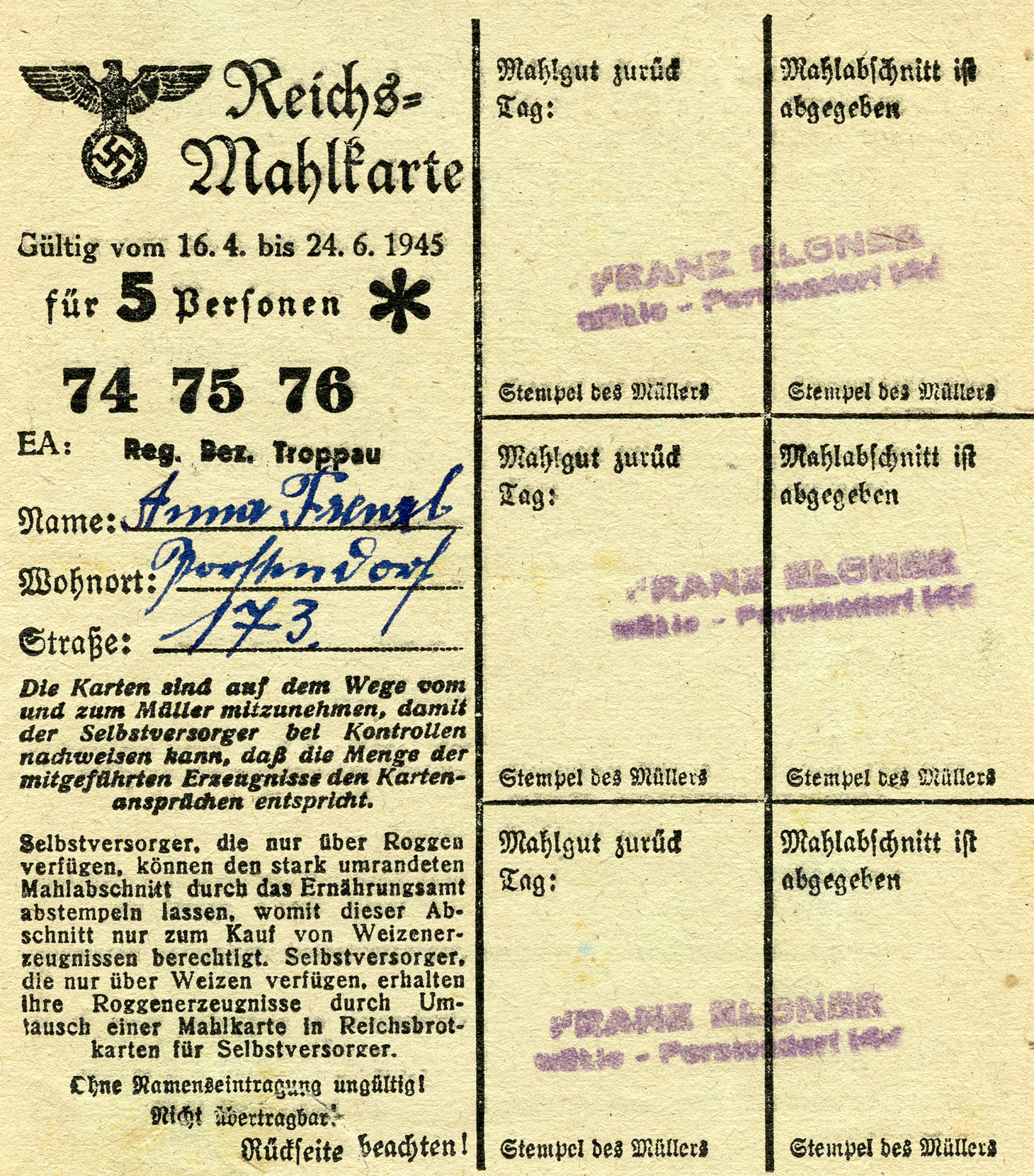
[Above: Also belonging to Anna Frenzl, this is a ration meal card.]
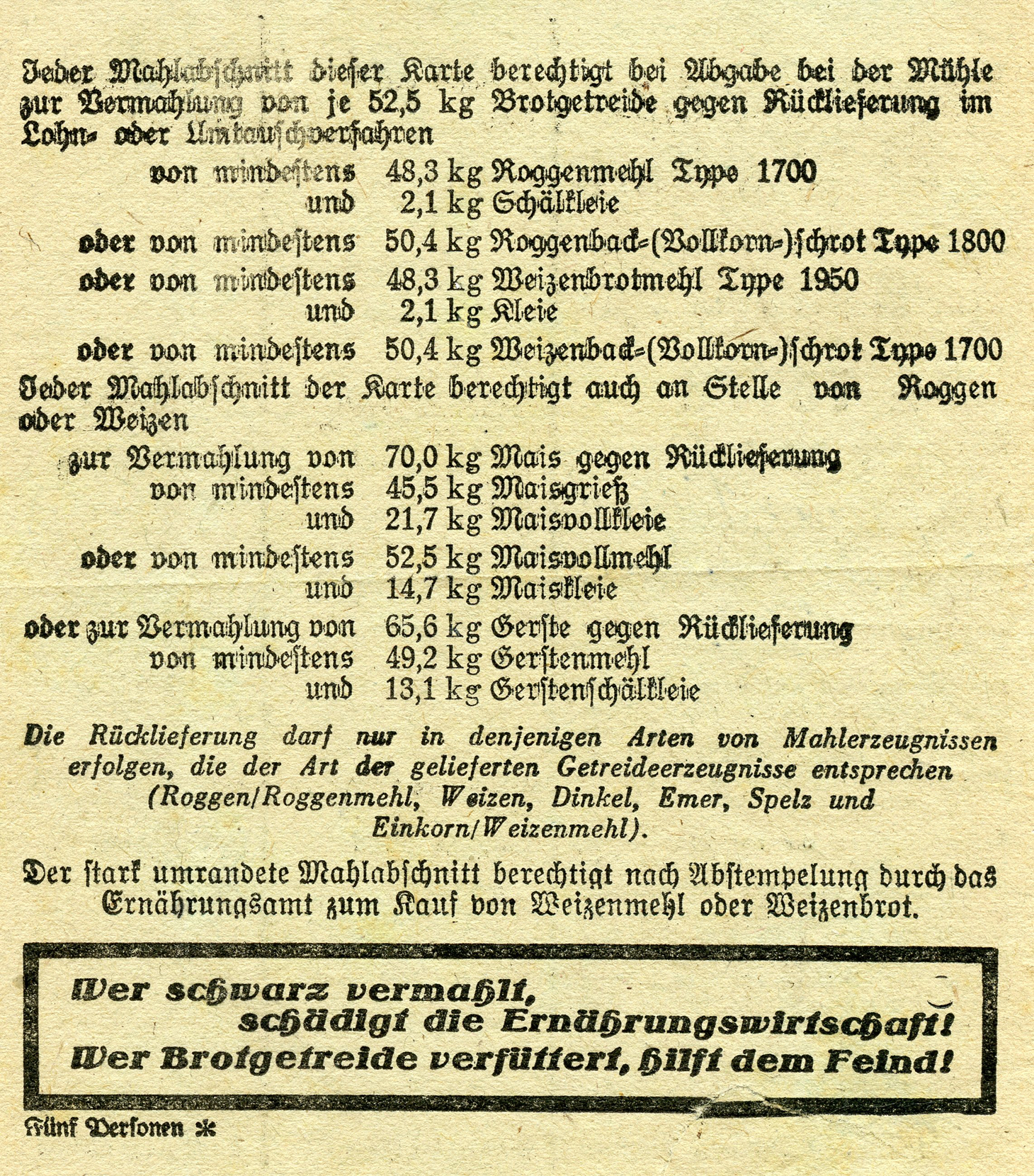
[Above: Reverse.]
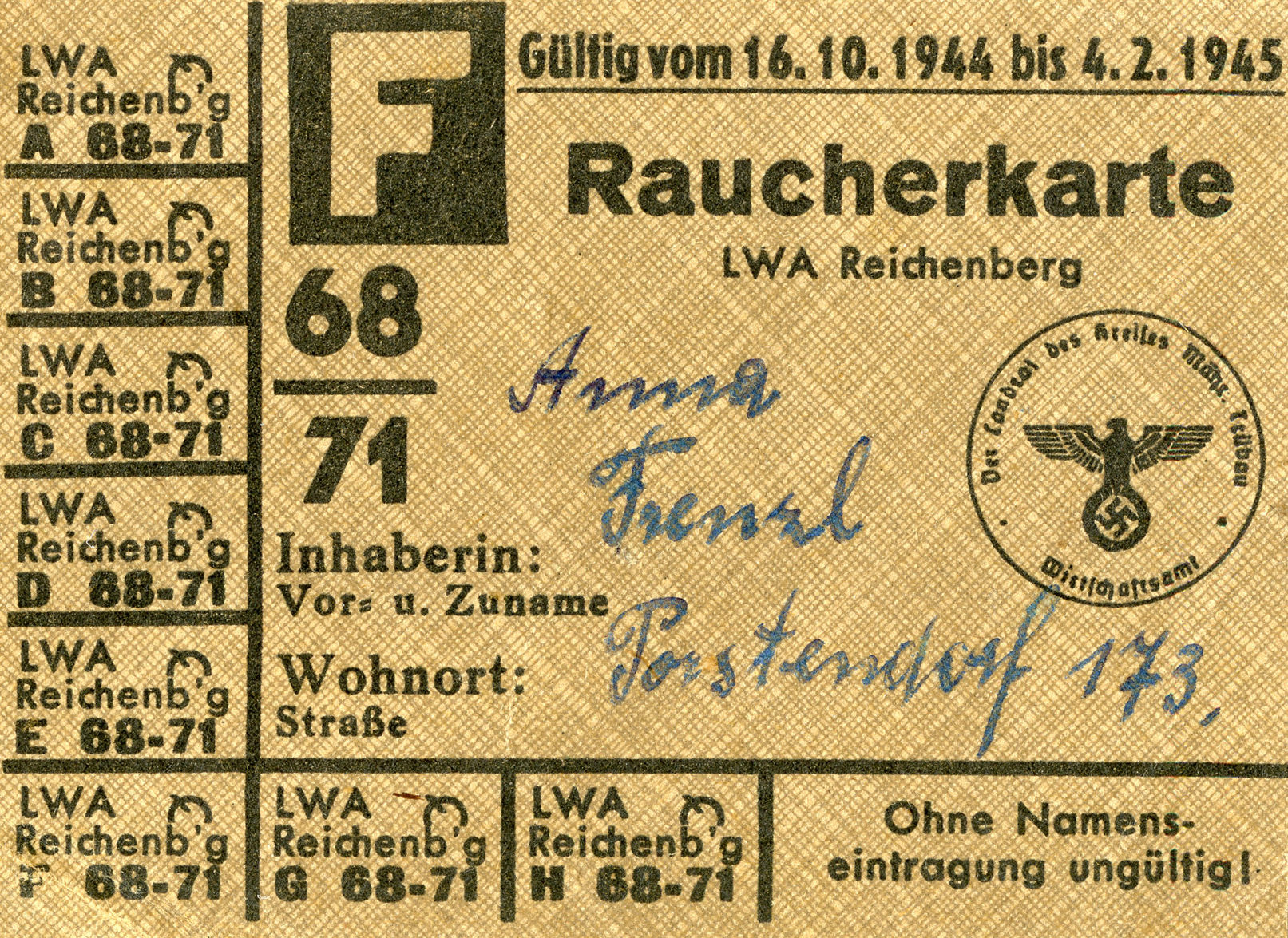
[Above: Another ration card, also belonging to Anna Frenzl. This was for smoking tobacco.]

[Above: Also with Anna's paper, this is from the postwar occupation and was somehow used to 'promote housing contruction.' Hmm...]

[Above: Why this was with her papers only she knew. But for over 80 years it has remained with them. The previous owners kept it with her papers, and I will as well. It's funny how that works. That 'Mocturtle soup' sounds awful. But looking at the recipe for this it is nothing like you'd imagine. Among the ingredients is gingersnap cookies... AI helped me to find some very interesting information on this hotel:
'However, this specific hotel holds a fascinating and highly significant place in media history.
The Hidden History of Hotel Tielemann:
While it spent decades operating as a standard resort hotel in the famous spa town of Bad Nauheim, its most famous chapter began right after Germany's surrender in 1945:
The Birthplace of Modern German Press:
In the summer of 1945, the U.S. Army psychological warfare division confiscated the vacant Hotel Tielemann at Auguste-Viktoria-Straße 1.
The DANA Agency:
On June 29, 1945, a small 13-man team of American and German journalists set up typewriters in the attic of Hotel Tielemann to launch the DANA (Deutsche Allgemeine Nachrichtenagentur).
The Legacy:
DANA later became DENA, and eventually merged with other regional news agencies to become the dpa (Deutsche Presse-Agentur), which remains Germany's largest and primary press agency today.
The hotel building itself was eventually torn down, and the site where it once stood was repurposed for apartment housing.']
Okay. Wow. This is truly CRAZY. Germany's largest and primary press agency today began from a U.S. Army psychological warfare division!? And AI dares to call this 'the first free' news agency in Germany after the war?! This is insane information. Do Germans know this about this newspaper? This is INSANE!!!
[Above: Reverse.]
[Above: An identification card from February 21, 1945, so very late in the war, also from Sudetenland. This also belonged to Anna Frenzl, as you can see.]
[Above: Check out the detail on this eagle, they usually don't draw in the chest feathers.]
[Above: When you open these up you see an identical page as the cover, not sure why they did this.]
[Above: Close-up. We might as well look at this eage close-up too, we wouldn't want it to feel bad.]
[Above: This expires on February 20, 1950, but the war would be over in just a few months. Over eighty years later Germany is still occupied.]
[Above: Close-up.]
This was the very first free, independent, non-Nazi news agency established in West Germany after the war.
As the staff rapidly expanded to hundreds of people, the operations grew too large for Hotel Tielemann, and the military moved the journalists into the nearby, larger Hotel Bristol.