[Below: This P.O.W. letter was sent from Stalag XVII B. It was postmarked on January 11, 1943 from Dolovo, Serbia. Click to enlarge.]

[Below: Close-up. Click to enlarge.]

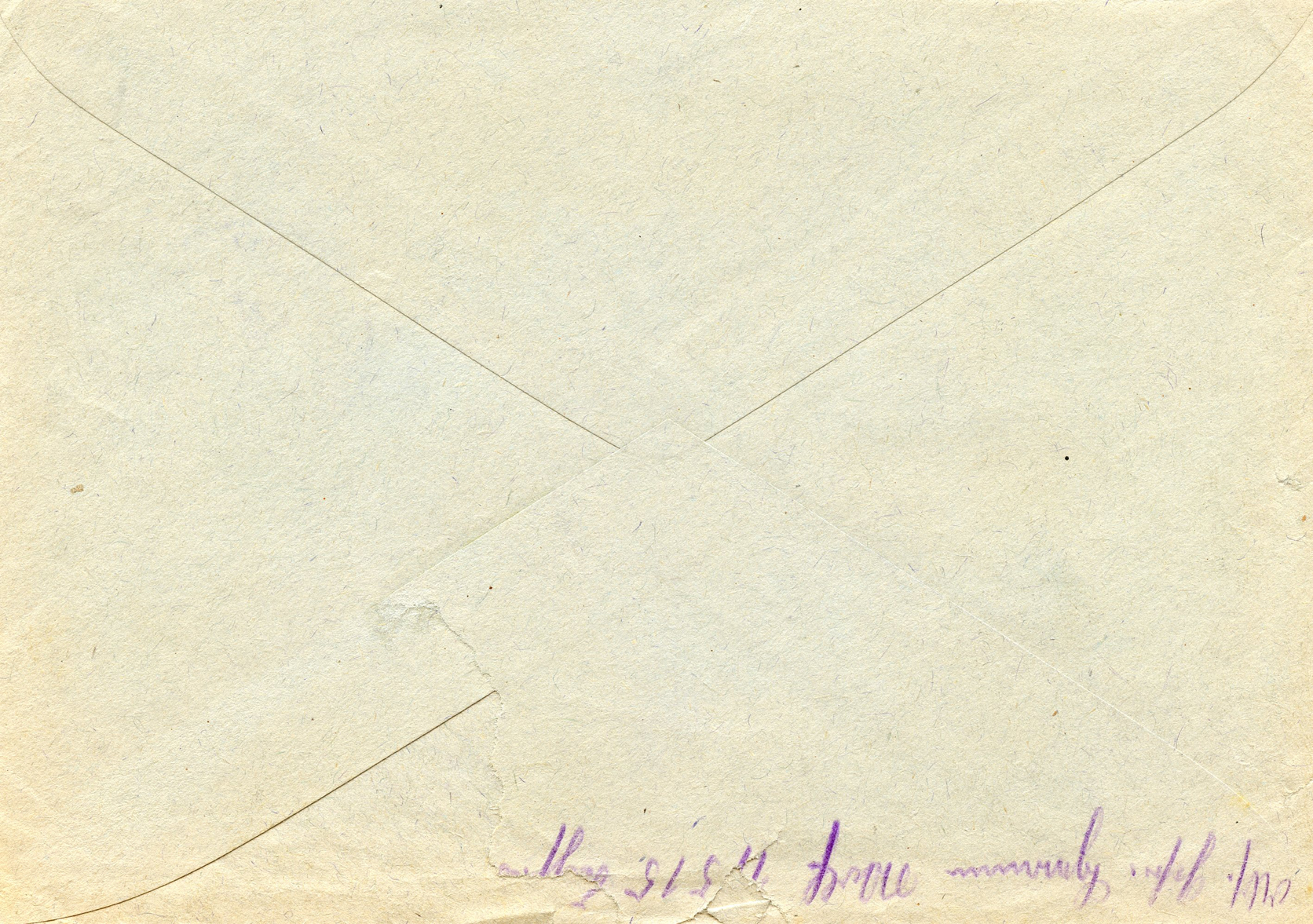
[Below: Reverse. Click to enlarge.]


[Below: This P.O.W. letter was sent from Oflag XIII B (an Oflag is a camp for officers, Oflag being short from Offizierlager). It was postmarked on January 22, 1943 from Smederevska Palanka, Serbia. Click to enlarge.]

[Below: Close-up. Click to enlarge.]

[Below: Reverse. Click to enlarge.]

[Below: This P.O.W. letter was also sent from Oflag XIII B. It was postmarked on July 5, 1943 from Smederevska Palanka, Serbia. Click to enlarge.]

[Below: Close-up. Click to enlarge.]

[Below: Reverse. Click to enlarge.]

[Below: This P.O.W. letter was also sent from Oflag XIII B. It was postmarked on September 24, 1943 from Smederevska Palanka, Serbia. Click to enlarge.]

[Below: Close-up. Click to enlarge.]

[Below: Reverse. Click to enlarge.]

[Below: This P.O.W. letter was also sent from Oflag XIII B. It was postmarked on March 13, 1944 from Smederevska Palanka, Serbia. Click to enlarge.]

[Below: Close-up. Click to enlarge.]

[Below: Reverse. Click to enlarge.]

[Below: This P.O.W. letter was also sent from Oflag XIII B. It is marked December 26, 1943 from Smederevska Palanka, Serbia. Click to enlarge.]

[Below: Close-up. Click to enlarge.]

[Below: Reverse. Click to enlarge.]

[Below: This P.O.W. letter was also sent from Oflag XIII B. It was postmarked on June 3, 1942 from Smederevska Palanka, Serbia. Click to enlarge.]

[Below: Close-up. Click to enlarge.]

[Below: Reverse. Click to enlarge.]

[Below: This P.O.W. letter was also sent from Oflag XIII B. It is marked on February 29, 1944 (leap year!) from Smederevska Palanka, Serbia. Click to enlarge.]

[Below: Close-up. Click to enlarge.]

[Below: Reverse. Click to enlarge.]

[Below: This P.O.W. letter was also sent from Oflag XIII B. It is marked on April 5, 1944 from Smederevska Palanka, Serbia. Click to enlarge.]

[Below: Close-up. Click to enlarge.]

[Below: Reverse. Click to enlarge.]

[Below: This P.O.W. letter was sent from Stalag VI C. It is postmarked on July 9, 1942 from Germany and written by a Croatian. Click to enlarge.]

[Below: Reverse. Click to enlarge.]

[Below: This P.O.W. letter was sent frmom Stalag VIII C. It was postmarked on September 29, 1942 from Zemun, Serbia. Click to enlarge.]

[Below: Close-up. Click to enlarge.]

[Below: Reverse. Click to enlarge.]

[Below: This P.O.W. letter was sent frmom Stalag II. A. It was postmarked on October 30, 1943 and sent to Antwerp, Belgium. Click to enlarge.]

[Below: Reverse. Click to enlarge.]

[Below: This is from a P.O.W. camp near the town of Biberach on the Riss (the name of the local river to distinguish it from other Biberachs in Germany!), in south-eastern Baden-Württemberg. This was canceled on September 22, 1944 and was sent to England. A little research shows that this was likely (or previously) called Oflag V-B, a prisoner-of-war camp for Allied officers, but it is written to have been in operation from 1940 until 1942, so it was supposedly closed by 1944. I'm guessing it was either reopened or was never closed. Regardless, they simply refer to it here as 'Biberach/Riss Internment Camp'. Click to enlarge.]

[Below: Reverse. Click to enlarge.]

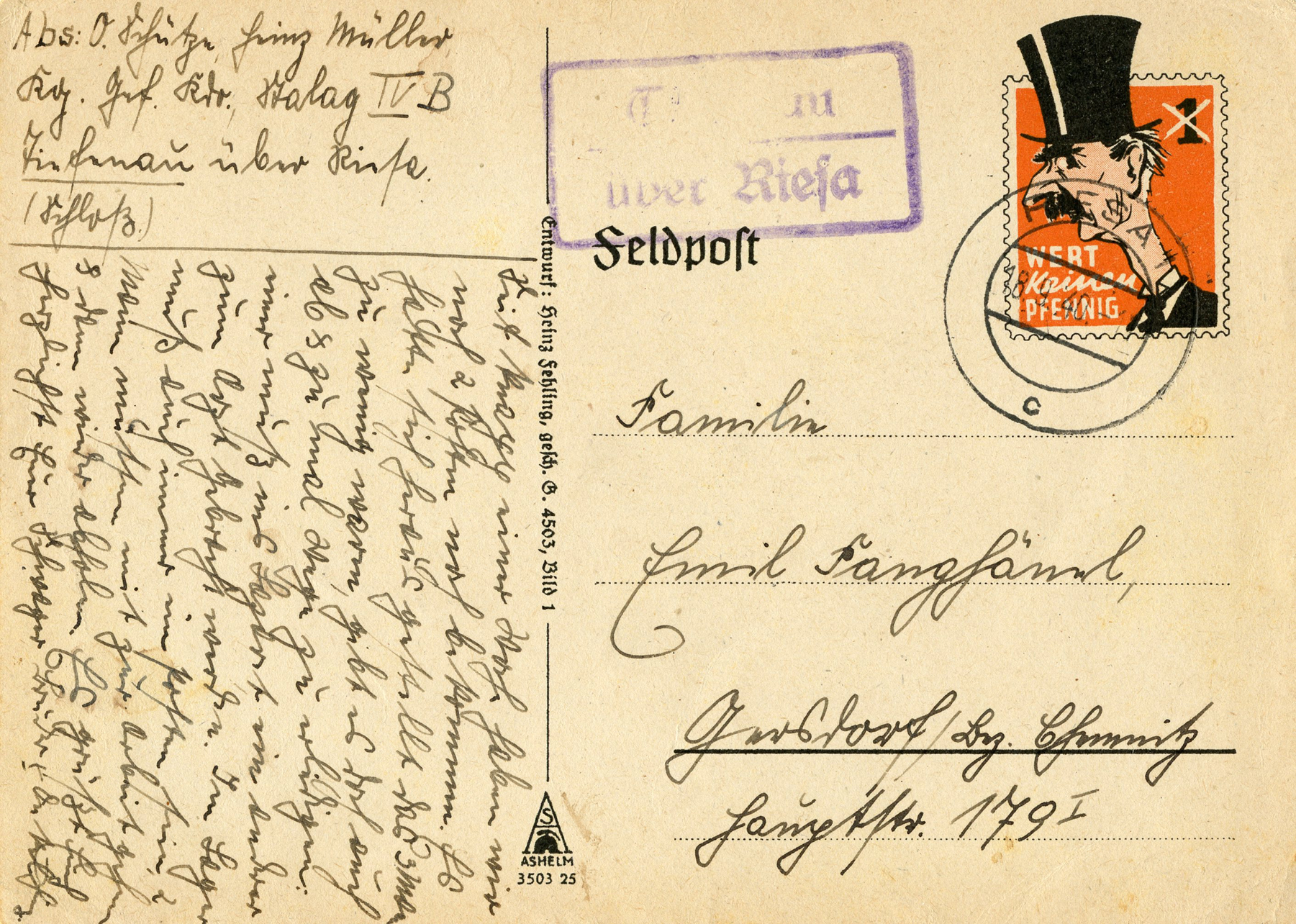
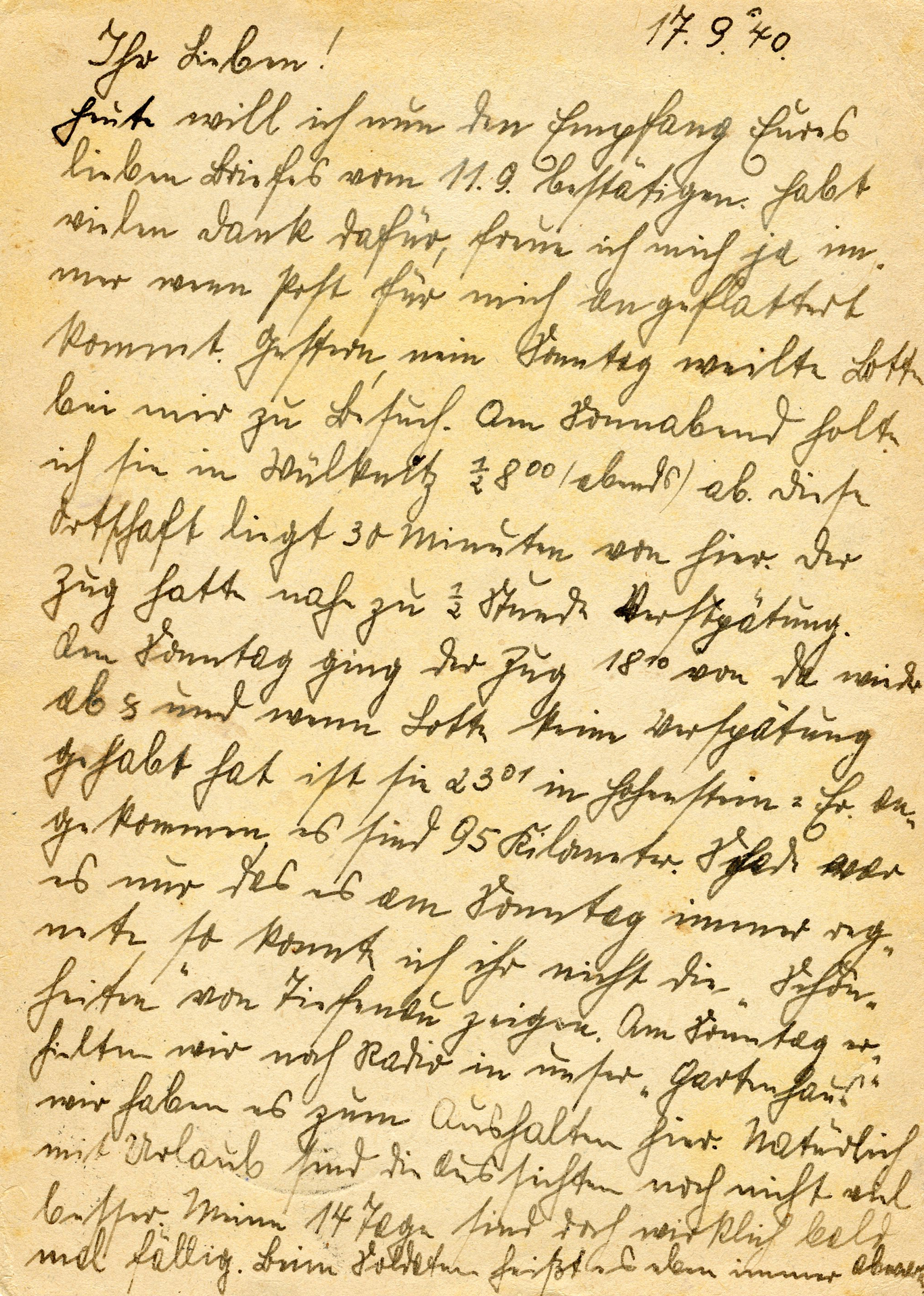
[Below: It is much rarer and more expensive to find one of these postcards actually used through the mails, better yet as a Feldpost. This was sent from Stalag IV-B, which was 'one of the largest German prisoner-of-war (POW) camps operated during World War II. Opened in September 1939, the camp was located near the town of Mühlberg in the Prussian Province of Saxony (now Brandenburg), approximately 30 miles north of Dresden. Over the course of the war, more than 300,000 prisoners from over 40 nations passed through its gates.' It was postmarked September 17, 1940.]
[Below: Postcard reverse.]
[Below: This envelope, postmarked on February 11, 1941, is from 'Base Principale Aeronautique de Bizerte-Carouba' (Bizerte-Carouba Main Aeronautical Base) and was sent to the Swiss Red Cross. Karouba Naval Aeronautics Base was a French naval aeronautics facility located in Bizerte, Tunisia. It was used during World War II by the United States during the North African Campaign and was designated as Bizerte Airfield, hosting B-17 Flying Fortress heavy bombers. Click to enlarge.]

[Below: This camp-made postcard is from Oflag VII B. The Germans must have made this to trick people into thinking they let the inmates make it. At least, that's what they'll tell us. Click to enlarge.]

[Below: Reverse. Click to enlarge.]

[Below: This was sent from the Swiss Red Cross on December 17, 1941 to Madrid, Spain, with Spanish censor tape. Click to enlarge.]

[Below: Reverse. Click to enlarge.]

[Below: This is from French Algeria and was sent to the Swiss Red Cross. It was postmarked on February 4, 1943 and has Allied censor tape. Note that Marshal Philippe Pétain is on the postage stamp. Click to enlarge.]

[Below: Close-up. Click to enlarge.]

[Below: Reverse. Click to enlarge.]

[Below: A rare diagonal bisect (stamp cut in half) from April 25, 1943. This is usually done when the post office is low on stamps and is widely collected. It features Marshal Philippe Pétain on the postage stamp. Click to enlarge.]

[Below: Close-up. Click to enlarge.]

[Below: Reverse. Click to enlarge.]

[Below: Since we're on the subject of French bisects, here is another rare bisect from January 6, 1942. It features Marshal Philippe Pétain on the postage stamp. Click to enlarge.]

[Below: Close-up. Click to enlarge.]

[Below: This was postmarked on February 12, 1944 and sent to the Swiss Red Cross. It features Marshal Philippe Pétain on the postage stamp. On the reverse is German censor tape. Click to enlarge.]

[Below: Reverse. Click to enlarge.]

[Below: This was sent from Switzerland to New York, postmarked on January 30, 1940. Click to enlarge.]

[Below: Reverse. Click to enlarge.]

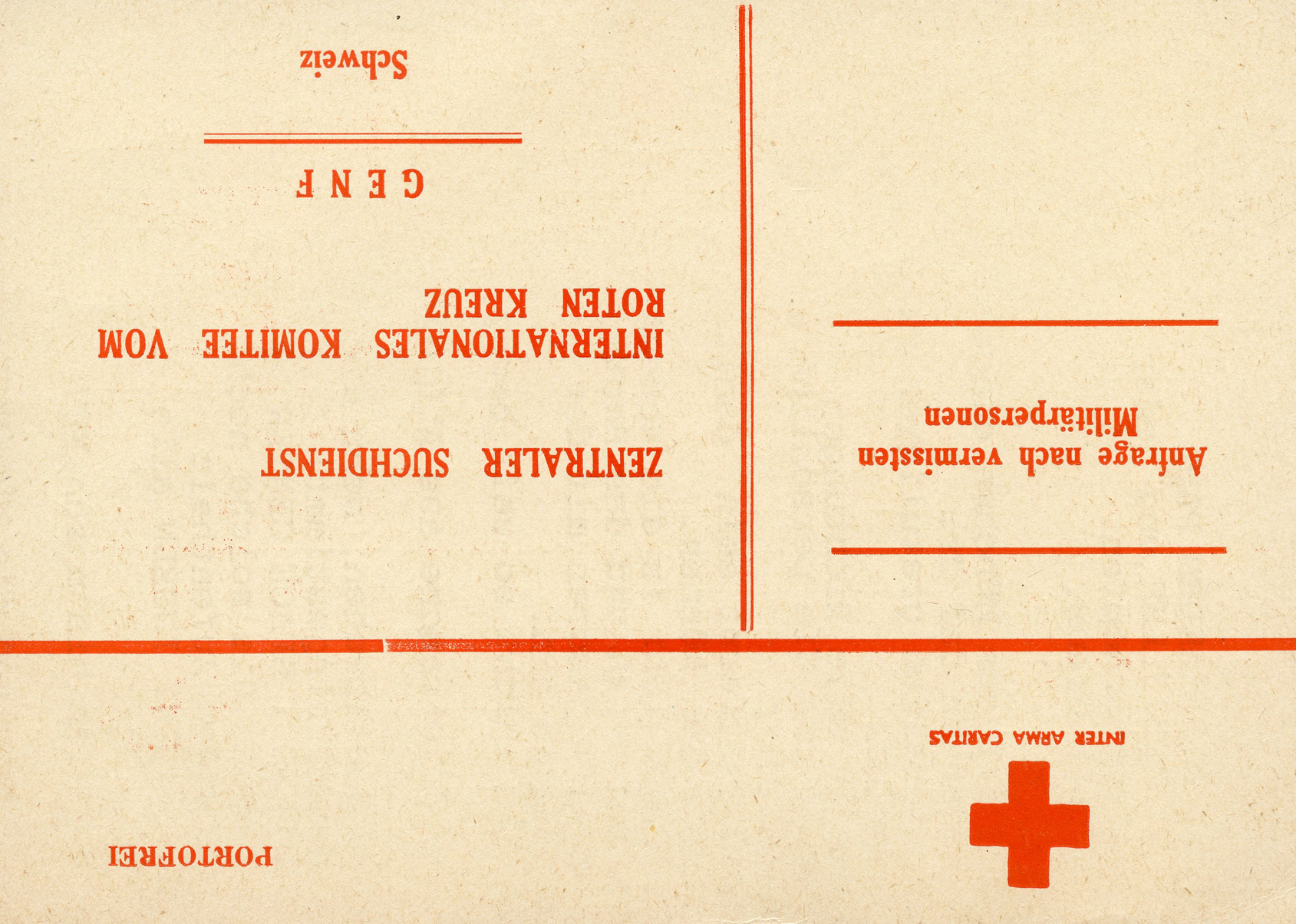
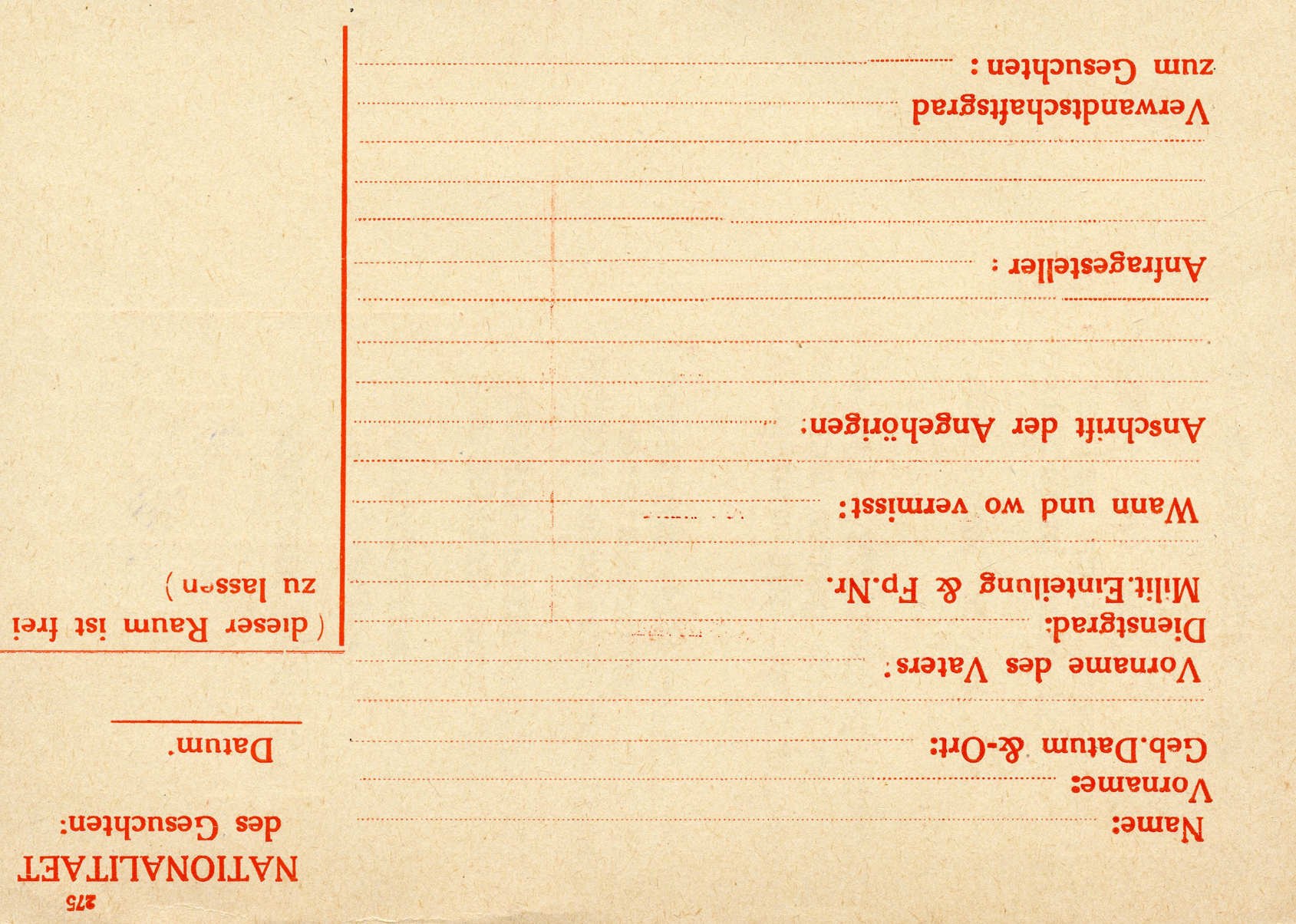
[Below: This is a tracing request postcard issued by the International Committee of the Red Cross, based in Geneva, Switzerland. During and after the war, millions of families were separated. The International Red Cross operated a massive tracing system known as the Central Tracing Agency to help locate missing soldiers and civilians, register prisoners of war (POWs), and restore family contact. This specific postcard says 'Anfrage nach vermissten Militärpersonen' (Inquiry for missing military personnel). On the top right-hand corner it says 'Inter Arma Caritas' The official Latin motto of the International Red Cross, which translates to 'Amidst Arms, Charity' (or 'Charity in War').]
[Below: Reverse.]
[Below: This was sent from a German P.O.W. from the Afrika Korps imprisoned in a British camp in Egypt. It is dated July 30, 1943. Click to enlarge.]

[Below: Reverse. Click to enlarge.]

[Below: This was sent from a Scottish P.O.W. interned in Italy and sent to New York. It's been censored by Italy and the USA. Click to enlarge.]

[Below: Reverse. Click to enlarge.]

[Below: This was sent from Oflag VII A on March 26, 1944 from a Polish P.O.W. Click to enlarge.]

[Below: Reverse. Click to enlarge.]

[Below: This postcard was canceled in the Pinneberg P.O.W. camp on August 11, 1947. This was an old Wehrmacht P.O.W. camp which the Allies turned into a P.O.W. camp/displaced person camp. The box stamp in the lower left hand corner says 'Fliegerhorst Uetersen' (Uetersen Air Base), Uetersen is also a town. Click to enlarge.]

[Below: Close-up.]

[Below: Reverse. Click to enlarge.]

[Below: '220 HQ CCG BAOR 6' refers to the Headquarters of the 220th unit of the Control Commission for Germany (CCG), which was part of the British Army of the Rhine (BAOR). Click to enlarge.]

[Below: Close-up.]

[Below: This is from a P.O.W. camp in Yugoslavia, postmarked on May 27, 1948. Click to enlarge.]

[Below: This is from a P.O.W. camp in Yugoslavia. May 27, 1948. Click to enlarge.]

[Below: Reverse. Imagine trying to read this?! Click to enlarge.]

[Below: This is sent from France and sent to the Red Cross, censored and postmarked in May 1945. Click to enlarge.]

[Below: Reverse. Click to enlarge.]

[Below: Another one from France and sent to the Red Cross, censored and postmarked in 1945. Click to enlarge.]

[Below: Reverse. Click to enlarge.]

[Below: Another one from France and sent to the Red Cross, but this one is sent to the Red Cross President, from the government of France, sometime after the war. The reverse is blank. Click to enlarge.]

[Below: This was sent from a German Afrika Korps P.O.W. in a British camp in Egypt. It is dated December 6, 1946. Click to enlarge.]

[Below: Reverse. Click to enlarge.]

[Below: This was written on January 2, 1949. Click to enlarge.]

[Below: Reverse. Click to enlarge.]

[Below: This was written on April 17, 1949. Click to enlarge.]

[Below: Reverse. Click to enlarge.]

[Below: This was written on June 27, 1946. Click to enlarge.]

[Below: Reverse. Click to enlarge.]

[Below: This was written on August 2, 1946. Click to enlarge.]

[Below: Reverse. Click to enlarge.]

[Below: This is from a Hungarian P.O.W. in Russia. It was written on October 27, 1949. Click to enlarge.]

[Below: Reverse. Click to enlarge.]

[Below: This is from a Hungarian P.O.W. in Russia. This is a double postcard for the addressee to send back. It was written on January 26, 1948. Click to enlarge.]

[Below: Reverse. Click to enlarge.]

[Below: This was sent to the Civilian Internment Camp Moosburg, canceled on June 11, 1946. This Allied forced work camp was formally the massive Stalag VII-A POW camp. In 1946, the camp was operated by the American Army as a Civilian concentration camp for German officials and suspected 'collaborators' for 'denazification'. Also of note is the purple '10b' mark, this is a rare camp censor stamp. Click to enlarge.]

[Below: Reverse. Click to enlarge.]

[Below: This was sent to Civilian Internment Camp Moosburg, canceled in Munich on September 9, 1947. Click to enlarge.]

[Below: Moosburg censorship stamp. Click to enlarge.]

[Below: Reverse. Click to enlarge.]

[Below: This was sent from the Civilian Internment Camp Moosburg, canceled in the town of Moosburg on March 17, 1947 (with fancy cancel). Click to enlarge.]

[Below: Moosburg censorship stamp. Click to enlarge.]

[Below: Reverse. Click to enlarge.]

[Below: This postcard was sent from the Civilian Internment Camp Moosburg, canceled on February 14, 1947 and sent to another Allied forced work camp in Regensburg. Click to enlarge.]

[Below: Moosburg censorship stamp. Click to enlarge.]

[Below: Reverse. Click to enlarge.]

[Below: This was sent registered to the Civilian Internment Enclosure 91 in Darmstadt, canceled on October 29, 1946. This was an American Army controlled camp used to detain civilian internees 'suspected of supporting the Nazi regime'. Oh how criminal of those Germans supporting their democratically voted in government. Click to enlarge.]

[Below: Civilian Internment Enclosure 91 in Darmstadt camp censor. Click to enlarge.]

[Below: Reverse. Click to enlarge.]

[Below: This was sent to 'Flüchtlings-Suchestelle im Landratsamt Wunsiedel' (Refugee Search at the Wunsiedel District Office) from 'Münich-Allach Flüchtlingslager 2' (Munich-Allach Refugee Camp 2). This was sent after the war, during Allied occupation and is interesting because Allach was a company (manufactured in Dachau) that made fine ceramics supervised and operated by the SS. The ceramics are extremely prized today. After the war the Munich-Allach Refugee Camp (or Displaced Persons Camp) was turned into a temporary housing facility established at the site of the former Munich-Allach Concentration Camp. Click to enlarge.]

[Below: Reverse. Click to enlarge.]

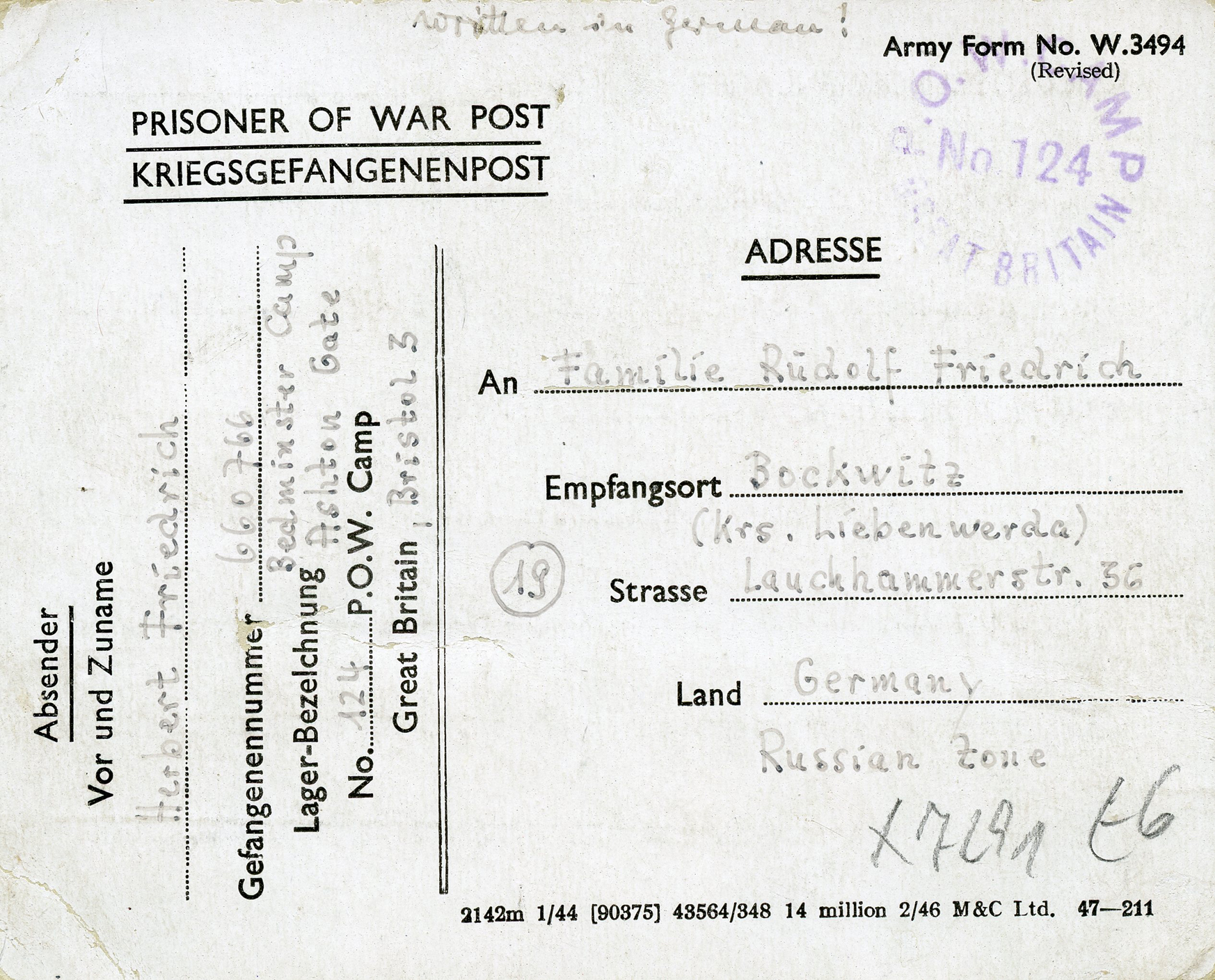
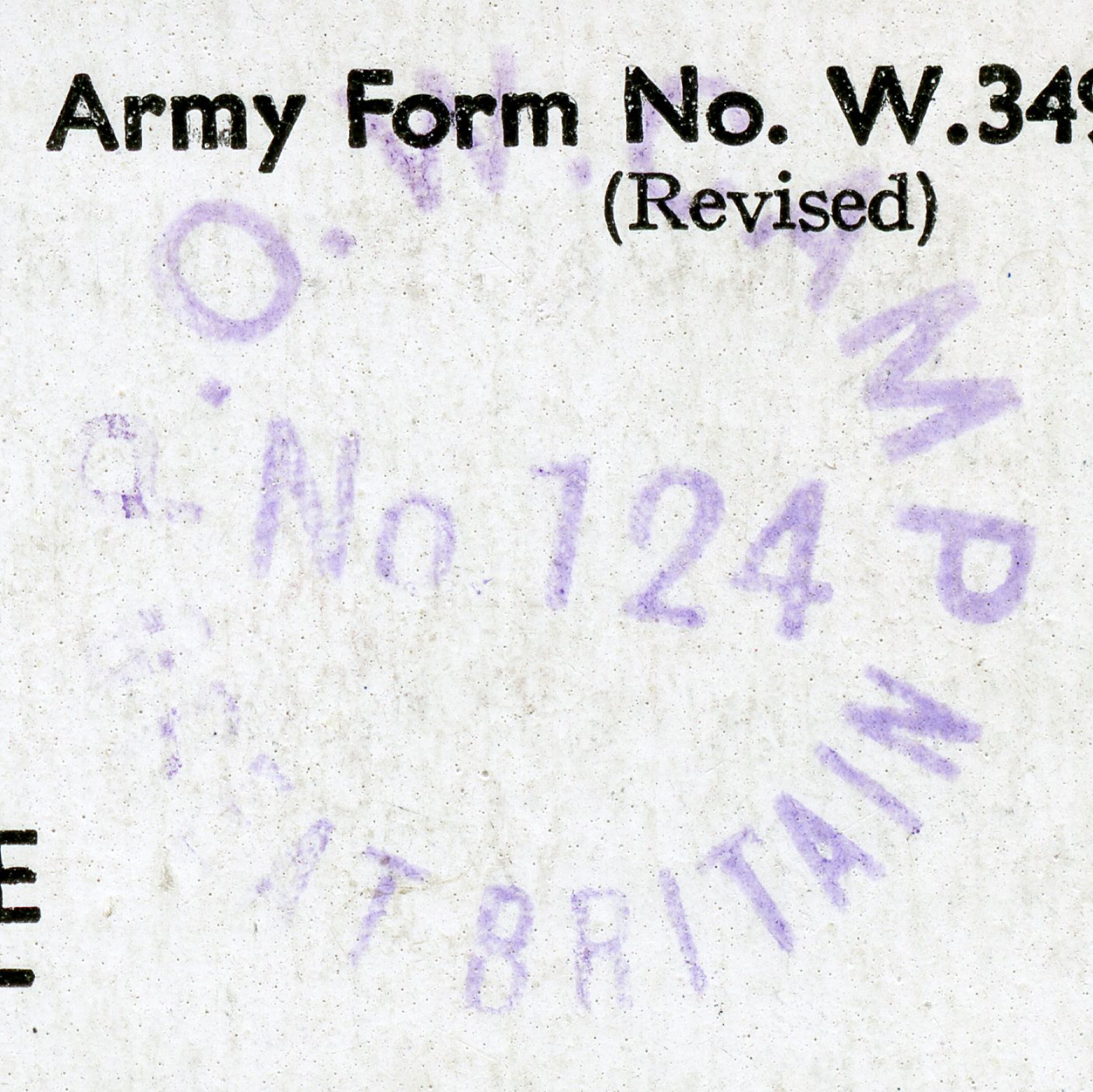
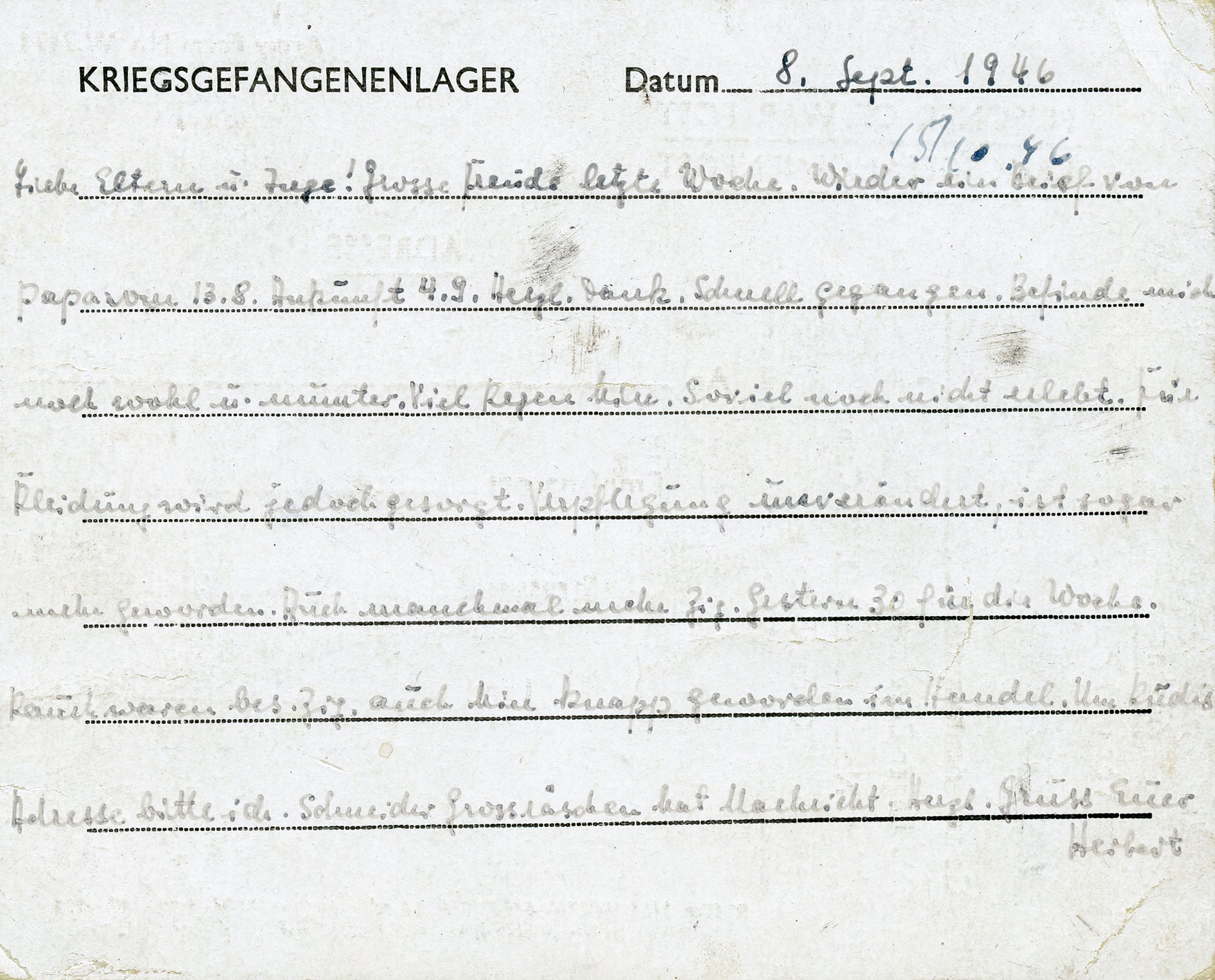
[Below: This was sent from a German POW in Britain (Bedminster Camp - Ashton Gate), dated September 8, 1946. Click to enlarge.]
[Below: Close-up. Click to enlarge.]
[Below: Reverse. Click to enlarge.]
[Below: This was sent to the Swiss Red Cross from Hamburg and canceled on August 31, 1946. Note the envelope is a pre-printed National Socialist Germany variety which someone has colored out the banned swastika. Click to enlarge.]

[Below: Close-up. Click to enlarge.]

[Below: Reverse. Click to enlarge.]

[Below: International Red Cross letter folded for the mail, February 1960. Click to enlarge.]
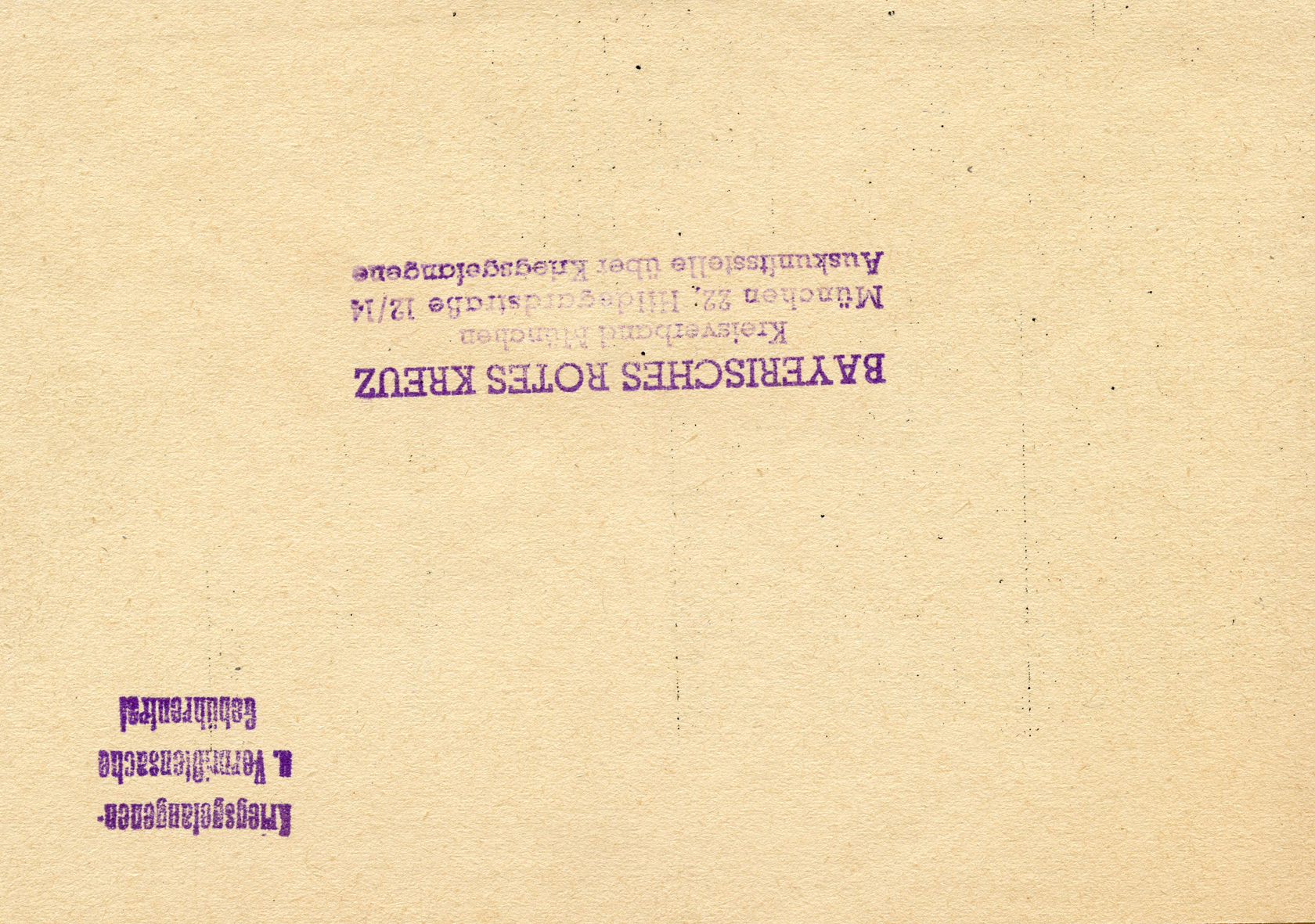
[Below: Reverse. Click to enlarge.]

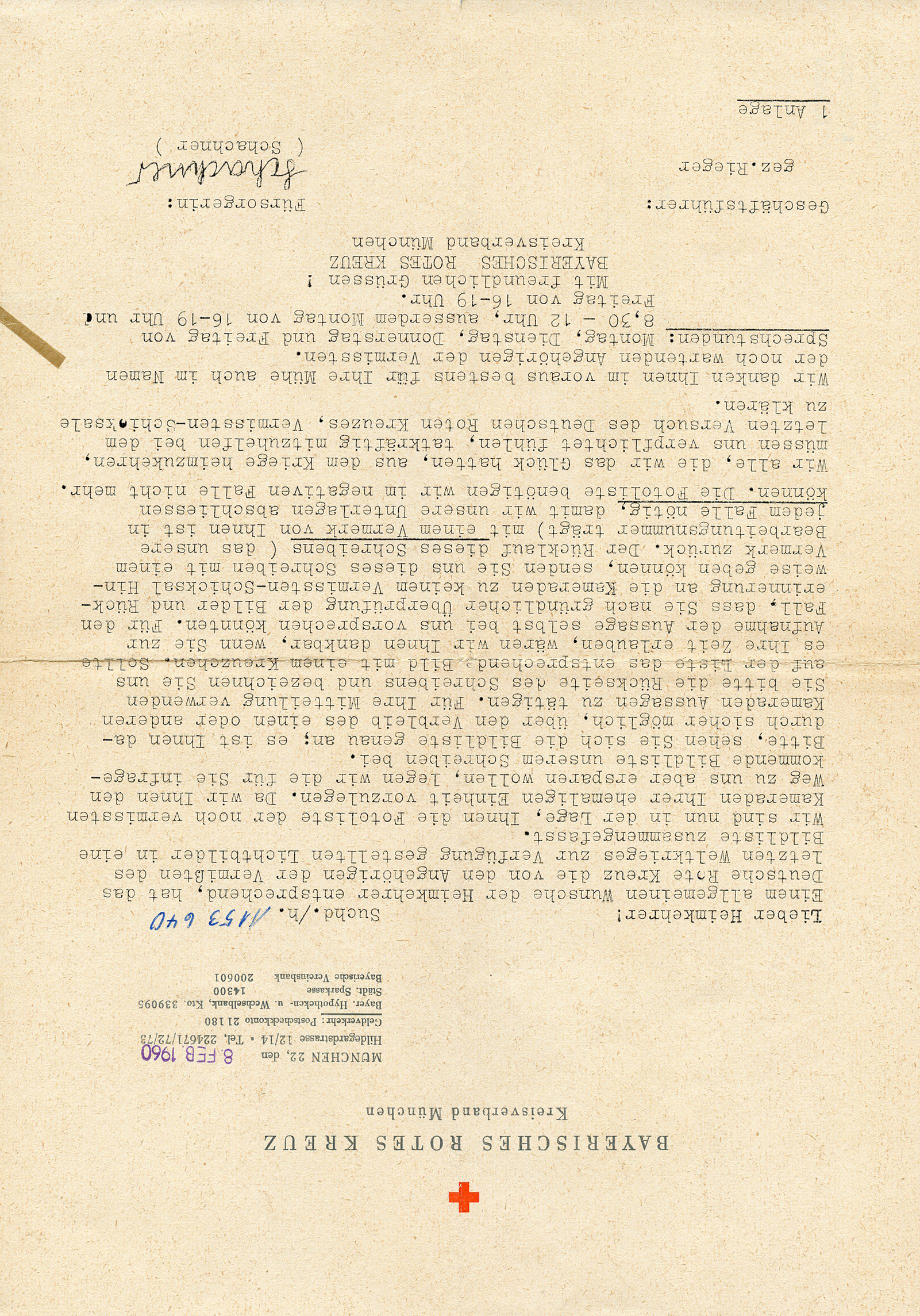
[Below: Letter unfolded. This is a formal letter from the Bavarian Red Cross, dated February 8, 1960, addressed to a returning World War II soldier ('Heimkehrer' referring to those who had been kept in captivity). The letter asks for assistance in identifying or providing information about missing comrades using an attached list of photographs. It says:
'Dear Returning Soldier!
In accordance with a general wish of returning soldiers, the German Red Cross has compiled a photo list from the photographs provided by the relatives of those missing from the last World War.
We are now in a position to present you with the photo list of the still-missing comrades from your former unit. Since we want to save you the trip to our office, we are enclosing the relevant photo list with this letter.
Please look closely at the photo list; it may enable you to provide statements regarding the whereabouts or fate of one or more of your comrades. To send your response, please use the reverse side of this letter and indicate the corresponding picture on the list with a small cross. Should your time permit, we would be grateful if you could visit us in person to record the statement itself.
In the event that, after a thorough review of the pictures and recollection of your comrades, you cannot give any clues regarding a missing person's fate, please return this letter to us with a note to that effect. Returning this letter (which bears our processing number) with a note from you is necessary in any case so that we can close our records. In this negative case, you do not need to send back the photo list.
All of us who were fortunate enough to return home from the war must feel obligated to actively assist in this last attempt by the German Red Cross to clarify the fates of the missing.
We thank you very much in advance for your effort, also on behalf of the still-waiting relatives of the missing.'
Click to enlarge.]
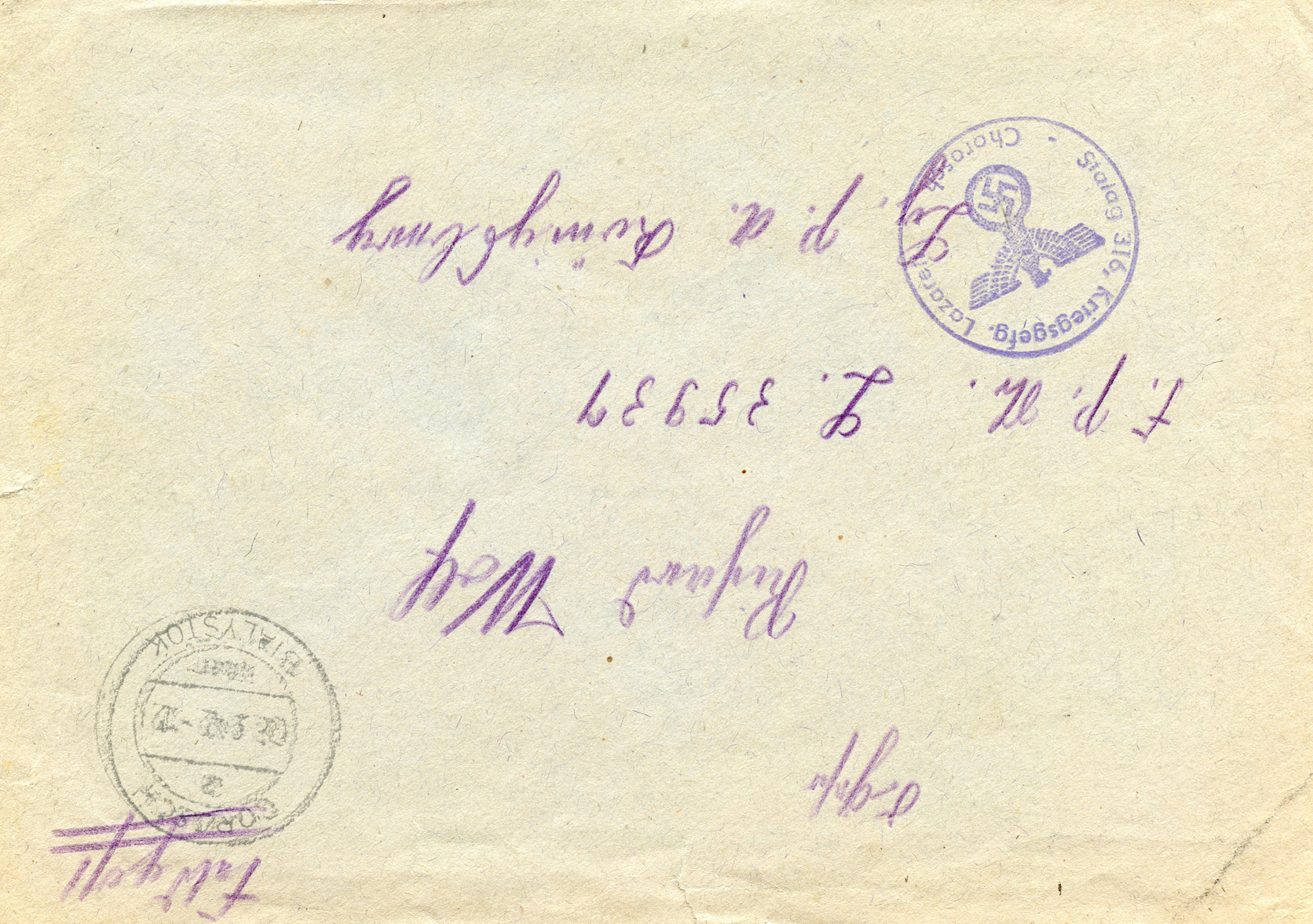
[Below: The envelope is addressed to Richard Wolf, with a Feldpost number of 'L.35937'. The prefix 'L' denotes a unit belonging to the Luftwaffe.
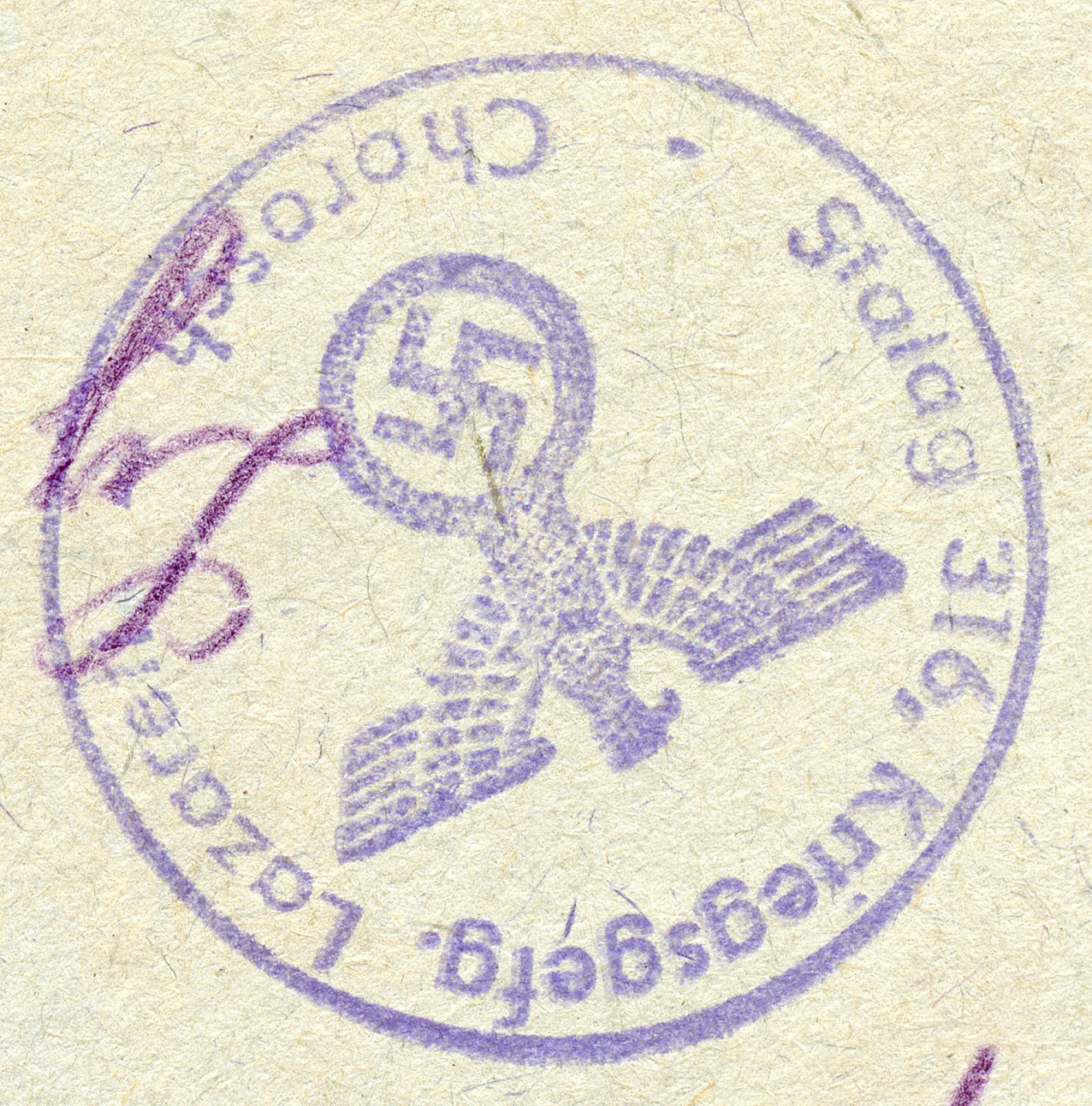
The blue ink stamp on the bottom left is a military cachet from a Prisoner of War/Military Hospital facility. It says 'Stalag 316, Kriegsgefg. Lazarett Choroszcz'. Stalag 316 was a German main camp for prisoners of war that operated in the region of Bialystok. A 'Kriegsgefangenen-Lazarett' is a military field hospital specifically designated for treating prisoners of war or wounded personnel within that camp's jurisdiction.
Choroszcz is a town located just west of the city of Bialystok (an important regional transit hub for German forces operating on the Eastern Front) in northeastern Poland. Click to enlarge.]
[Below: Close-up. Click to enlarge.]
[Below: Reverse. Click to enlarge.]