One this page we'll place items of Fascist era Italy and Germany.
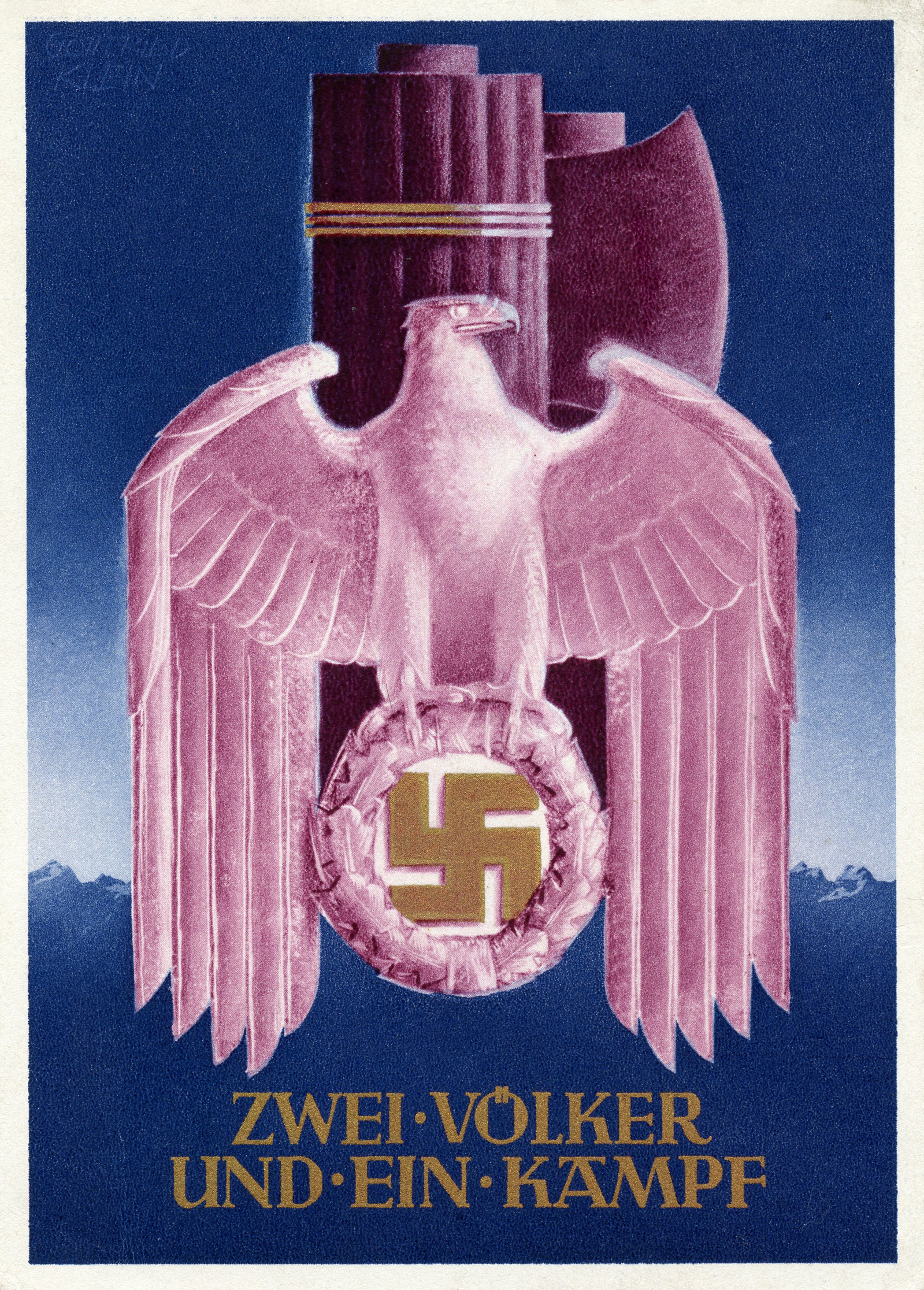
[Below: A truly beautiful postcard. It says: 'Zwei Völker und Ein Kampf' (Two Peoples and One Struggle).]
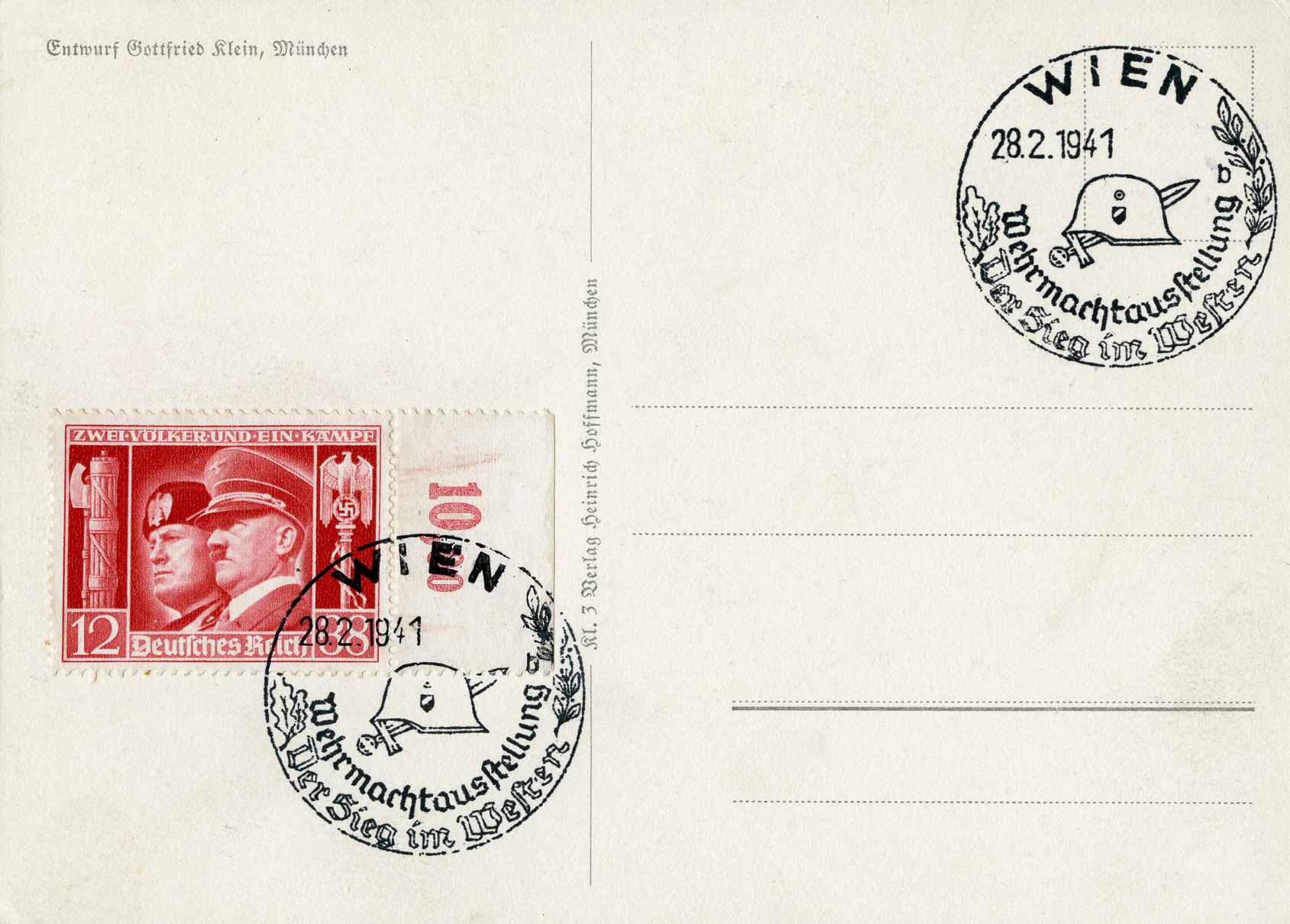
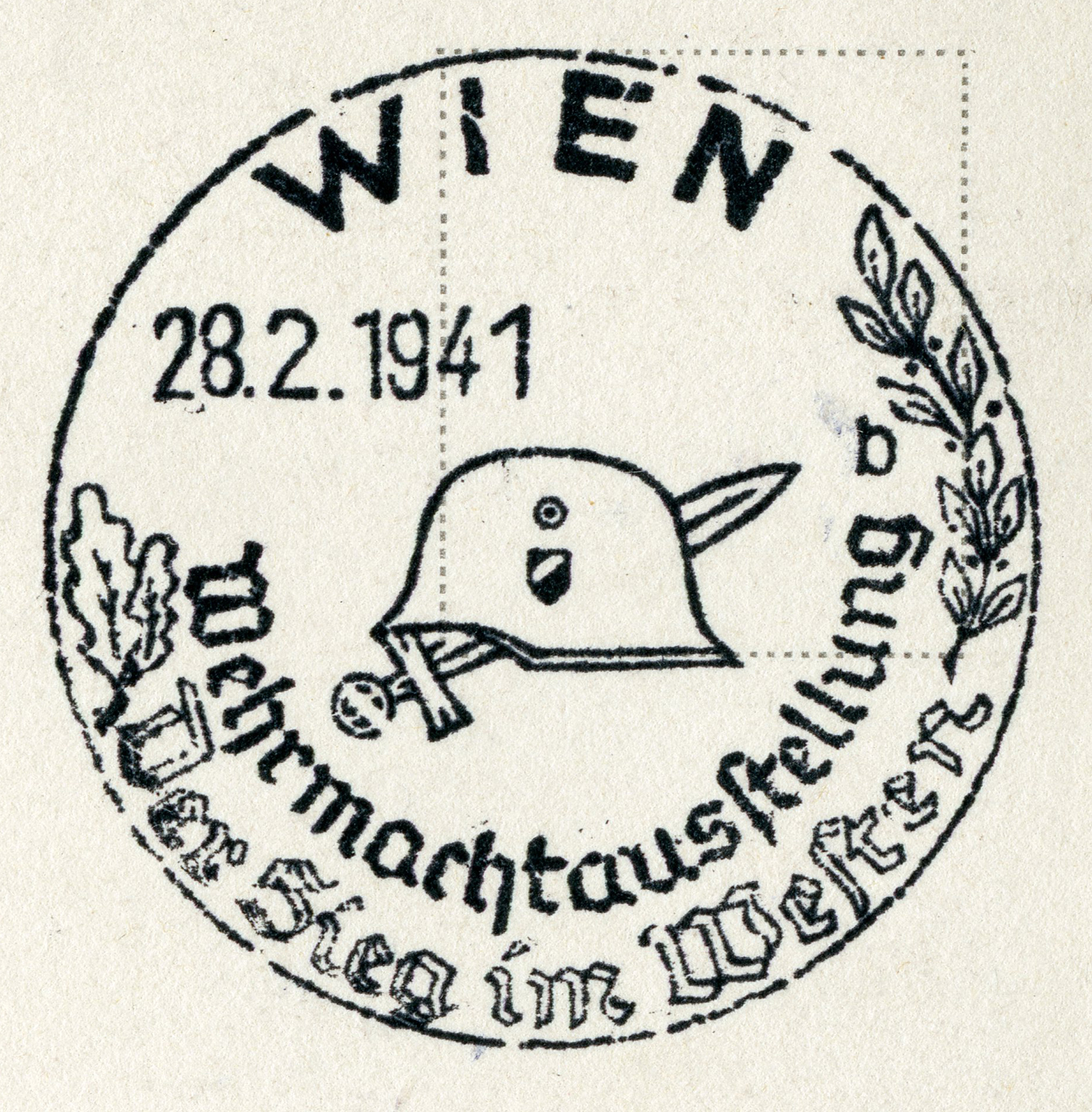
[Below: Reverse. This was postmarked in Vienna on February 28, 1941. It says: 'Wehrmacht ausstellung - Der Sieg im Westen' (Wehrmacht Exhibition - Victory in the West).]
[Below: Close-up.]

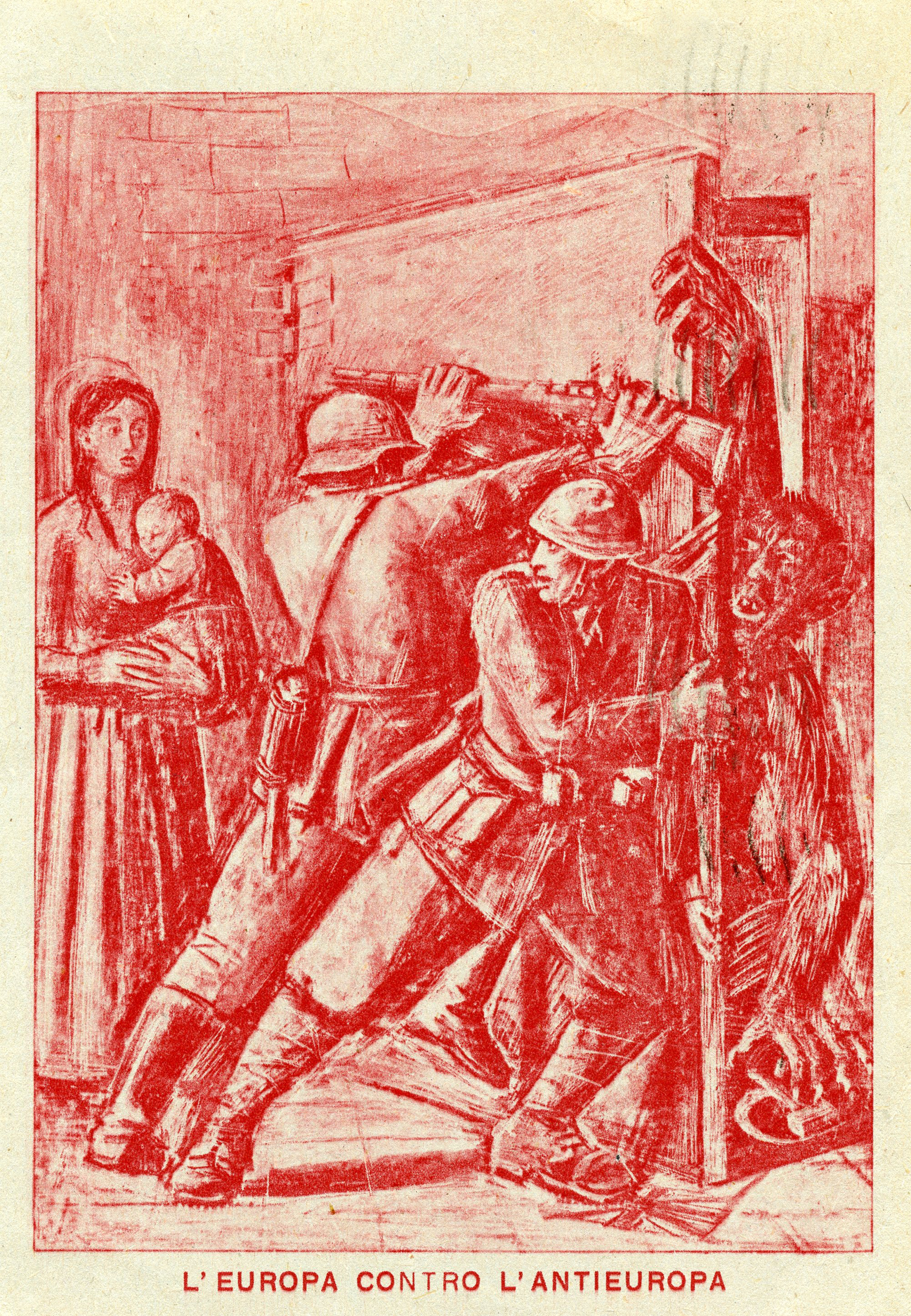
[Below: This postcard is so incredibly cool. It shows a German and Italian soldier protecting a women and child, holding back the monster of communism. It says: 'L'Europa Contro L'antiEuropa' (Europe Against Anti-Europe).]
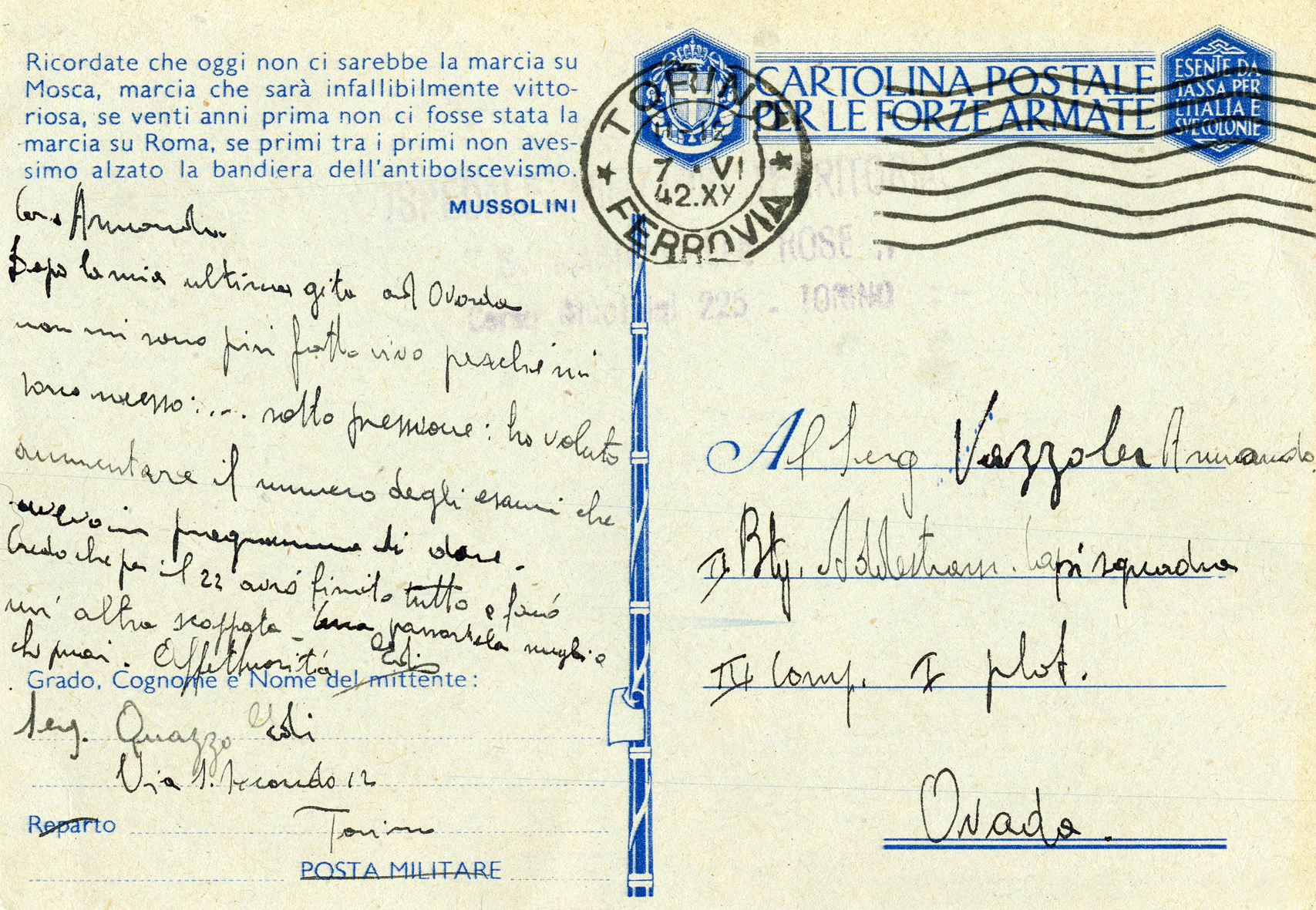
[Below: Reverse. This is a Feldpost postcard, it is postmarked on June 7, 1942. Note the quote in the upper left hand by Mussolini.]
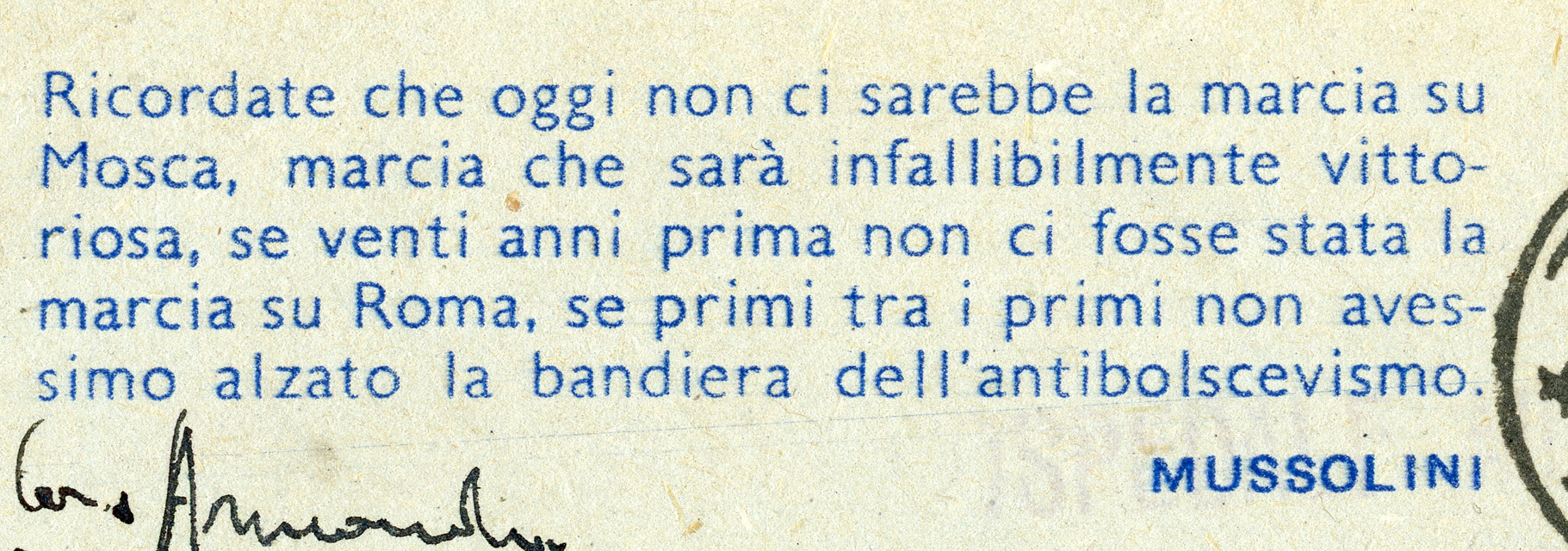
[Below: This Mussolini quote says:
'Remember that today there would not be the March on Moscow,
a march that will be infallibly victorious, if twenty years earlier there had not been the March on Rome,
if we had not been the first among the first to raise the banner of anti-Bolshevism.']
[Below: This has a special cancel for Adolf Hitler's visit to Italy to meet Mussonlini.]
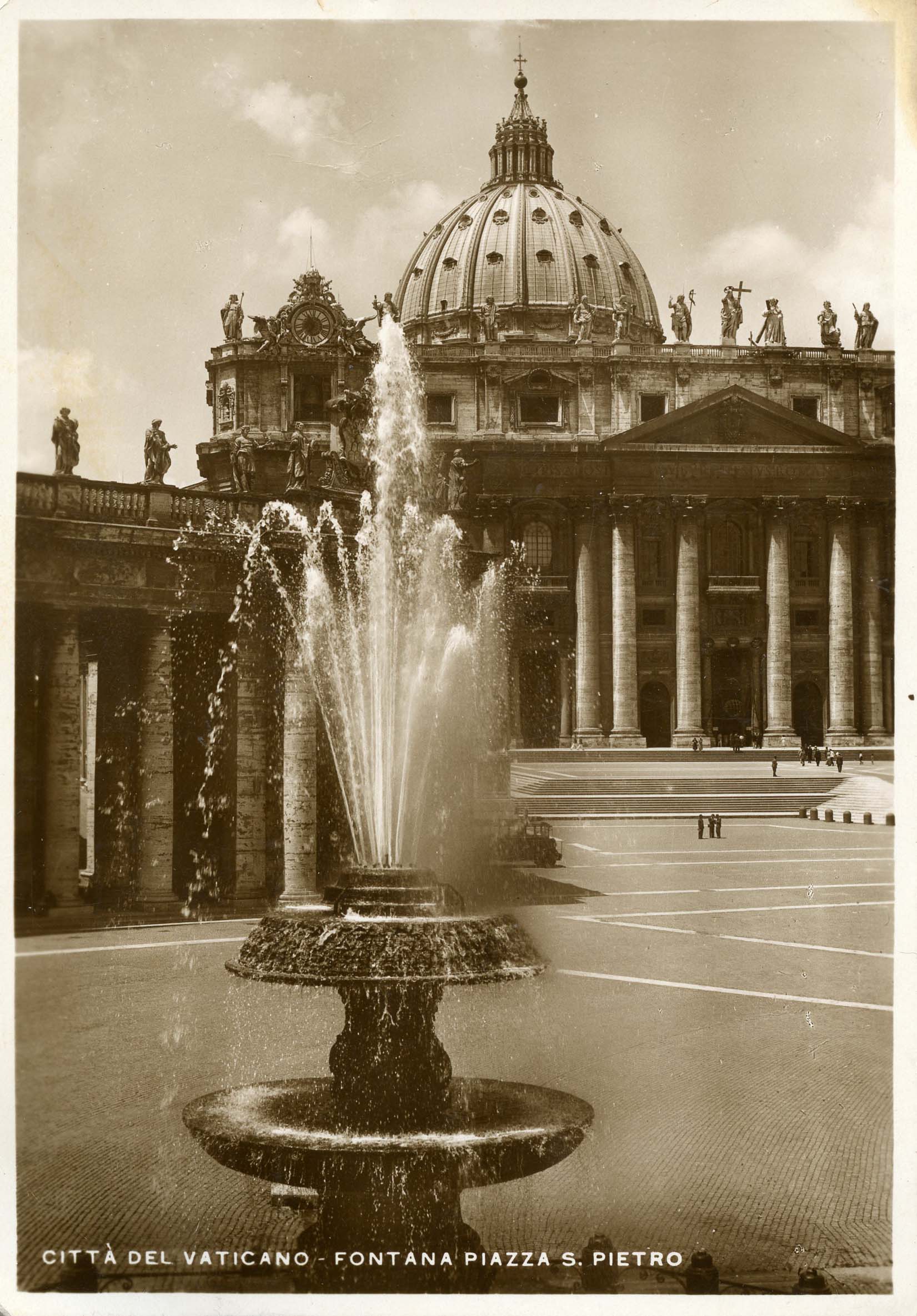
[Below: Reverse.]
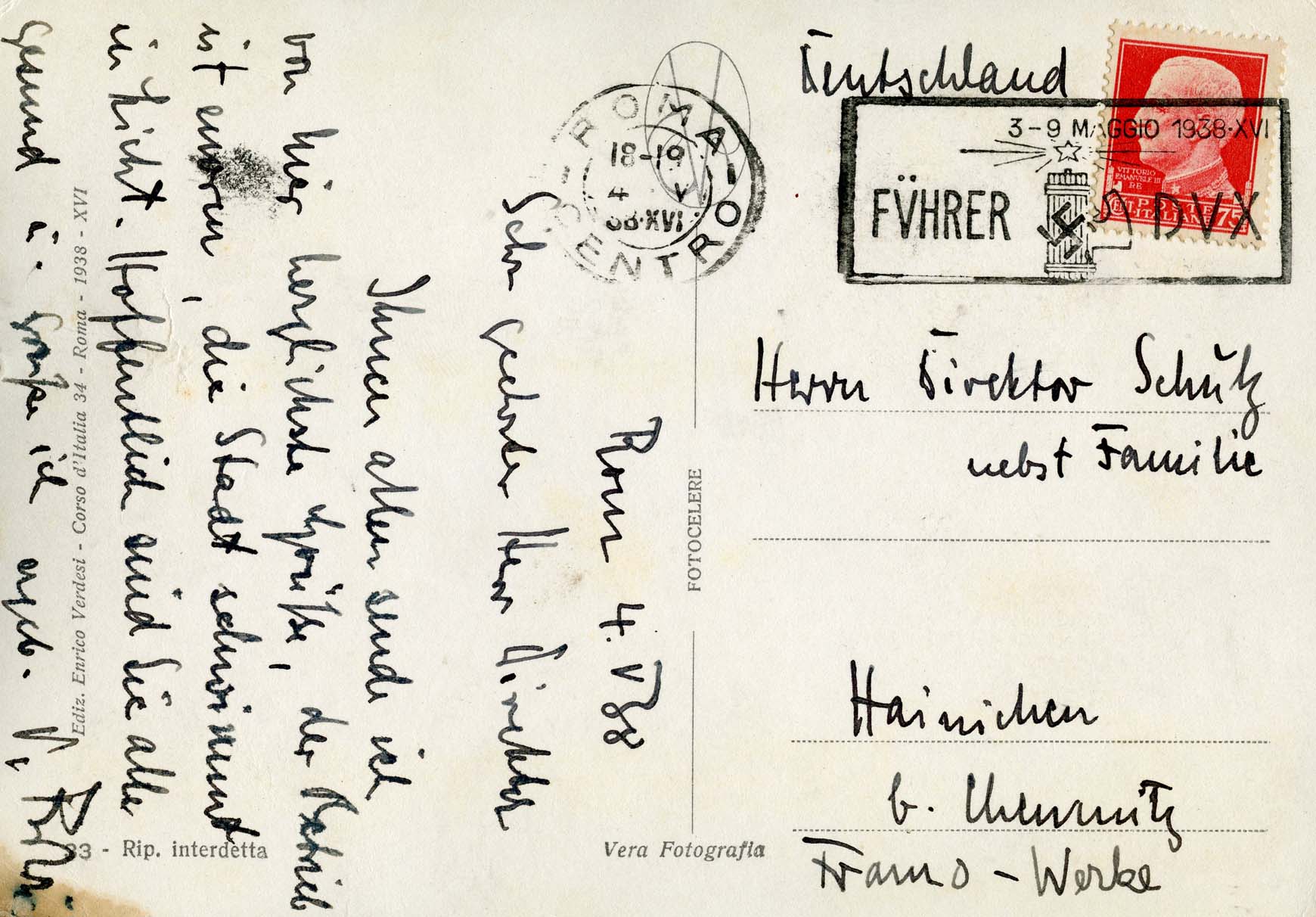
[Below: Close-up.]
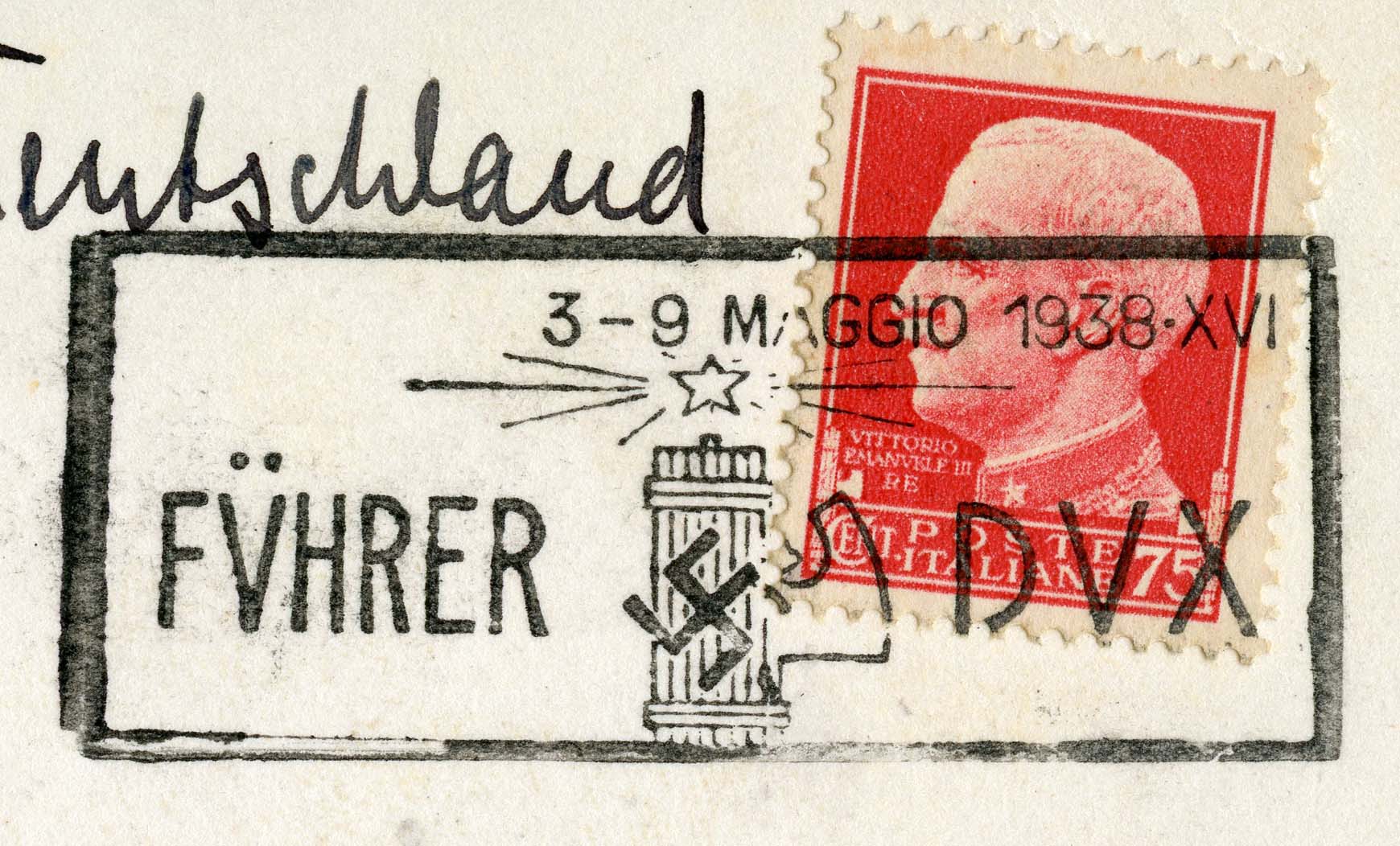
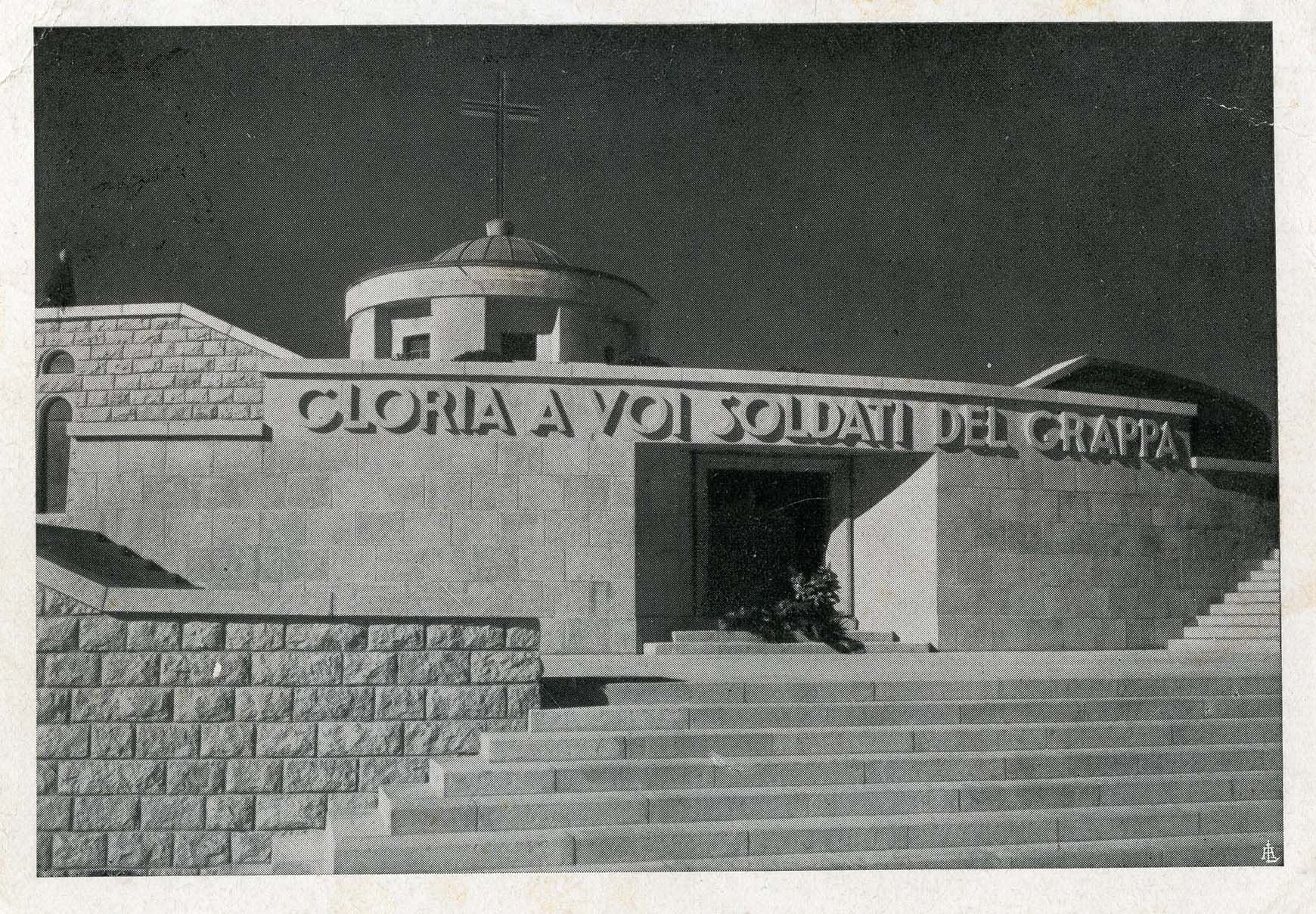
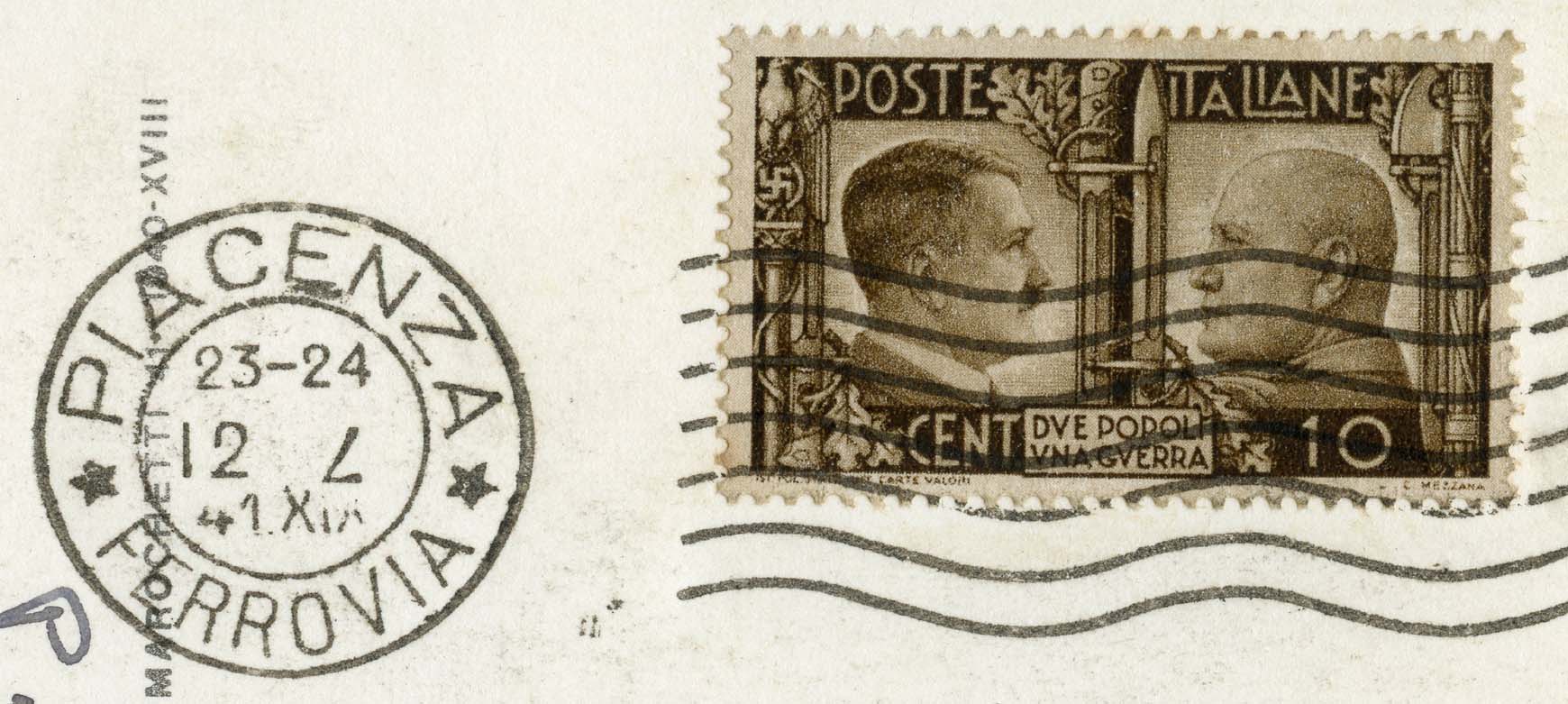
[Below: This says: 'Gloria A Voi Soldati Del Grappa' (Glory to You, Soldiers of the Grappa). This is a WWI memorial at the summit of Mount Grappa, built between 1932-35. It holds the remains of 22,910 fallen soldiers. Front/reverse.]
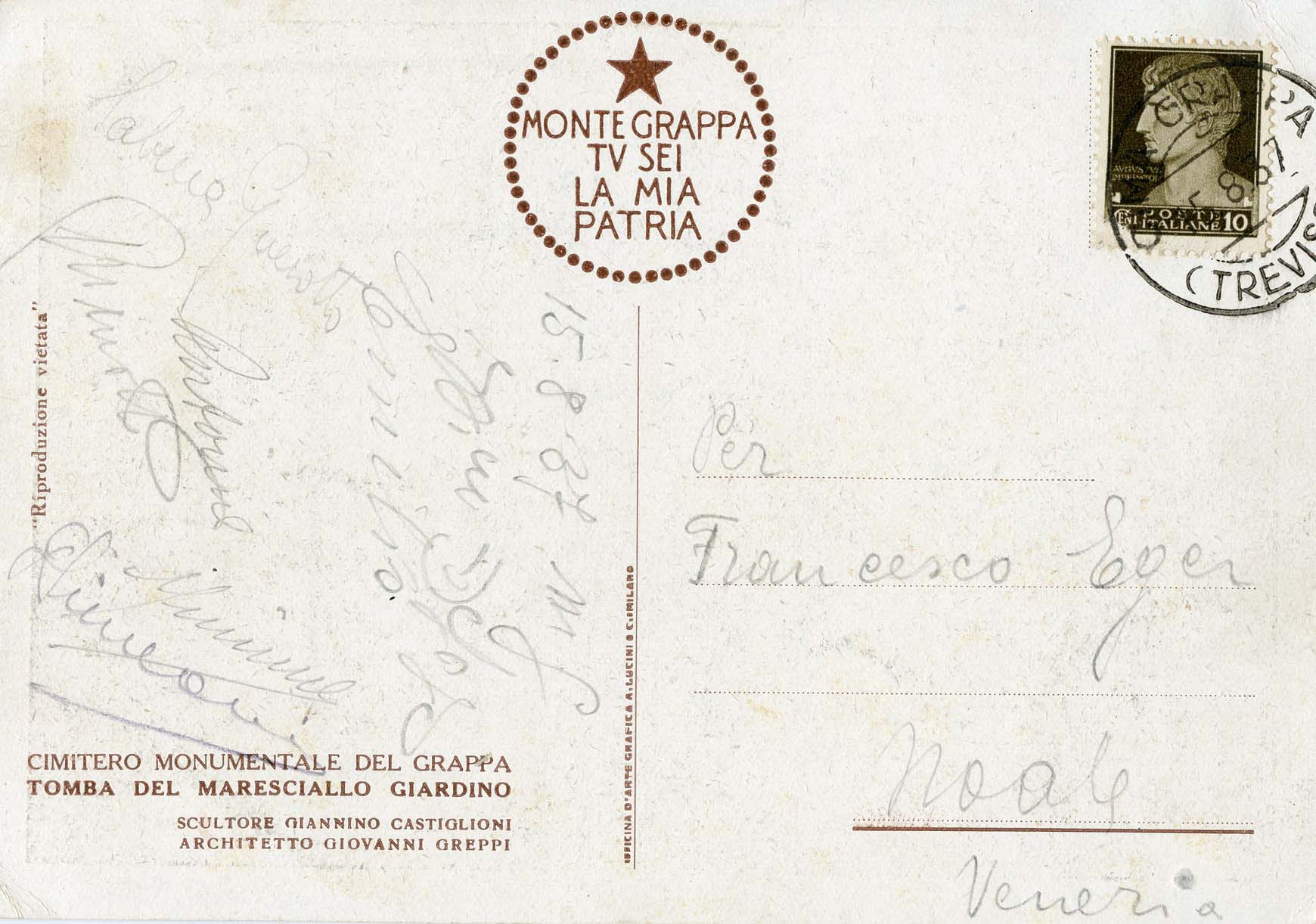
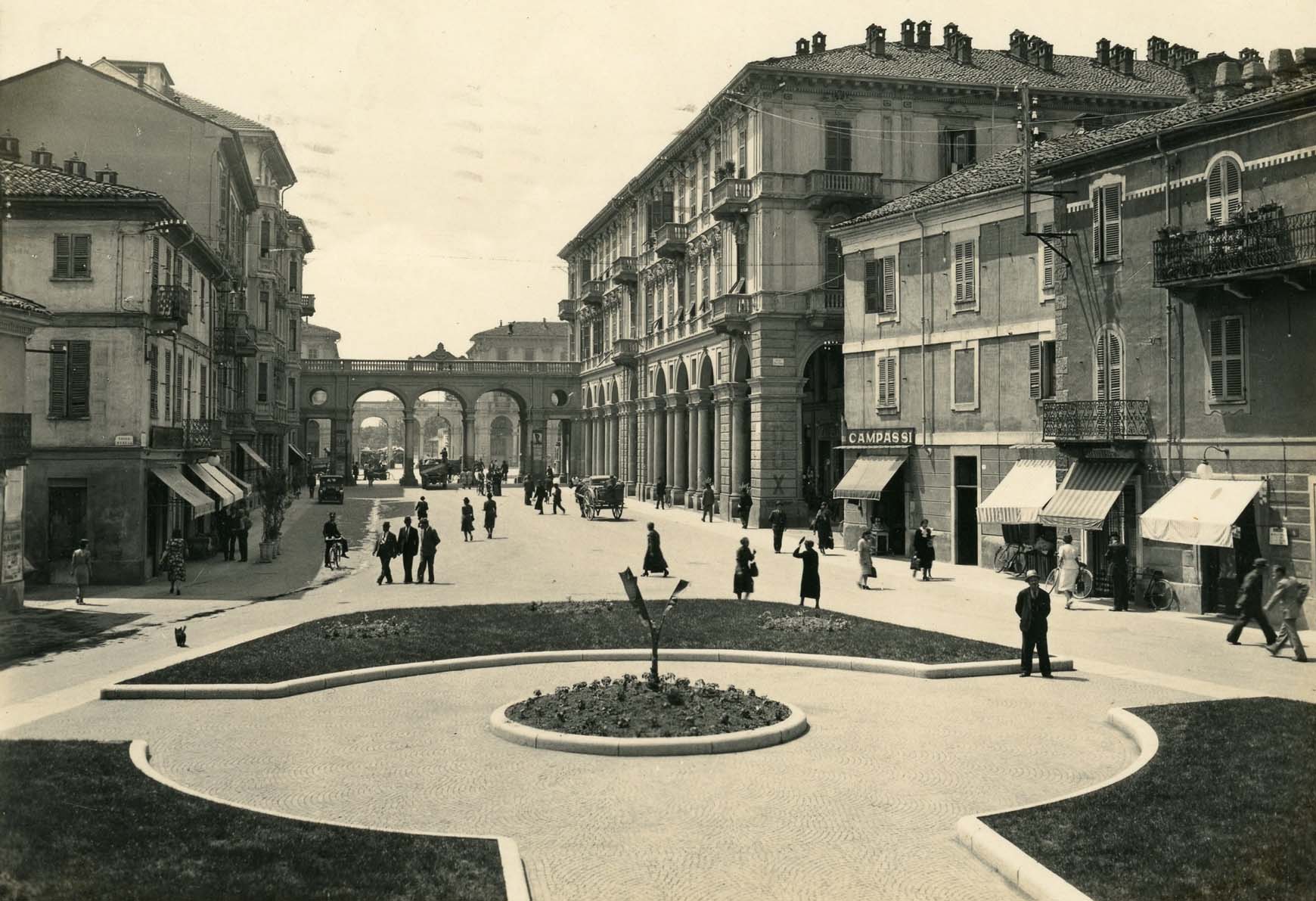
[Below: This says: 'Piacenza - Monuments al Pontiere italians' (Piacenza – Monument to the Italian Pontiere). Piacenza is an ancient city in Italy. Pontiere is a bridge builder or military engineer.]
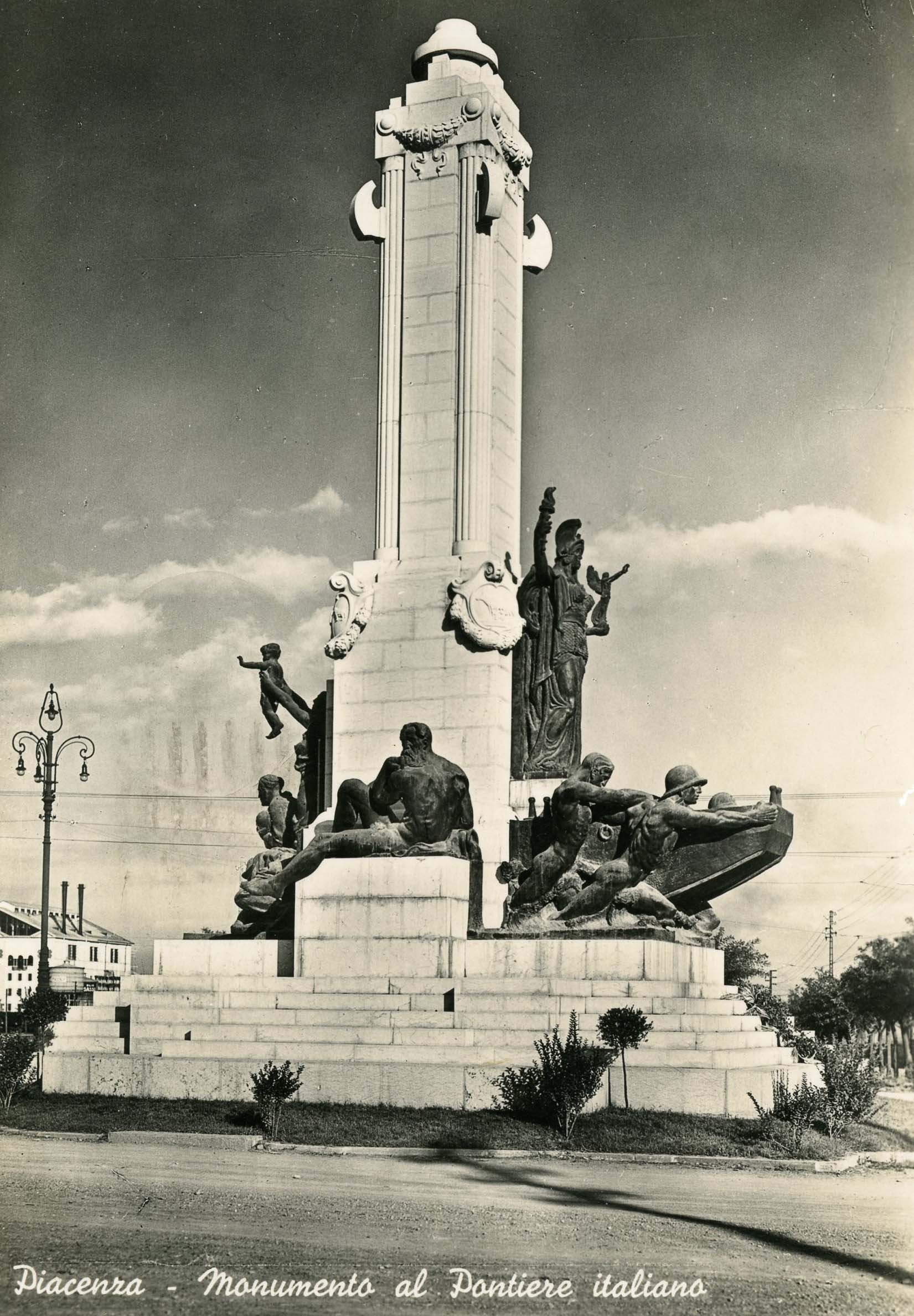
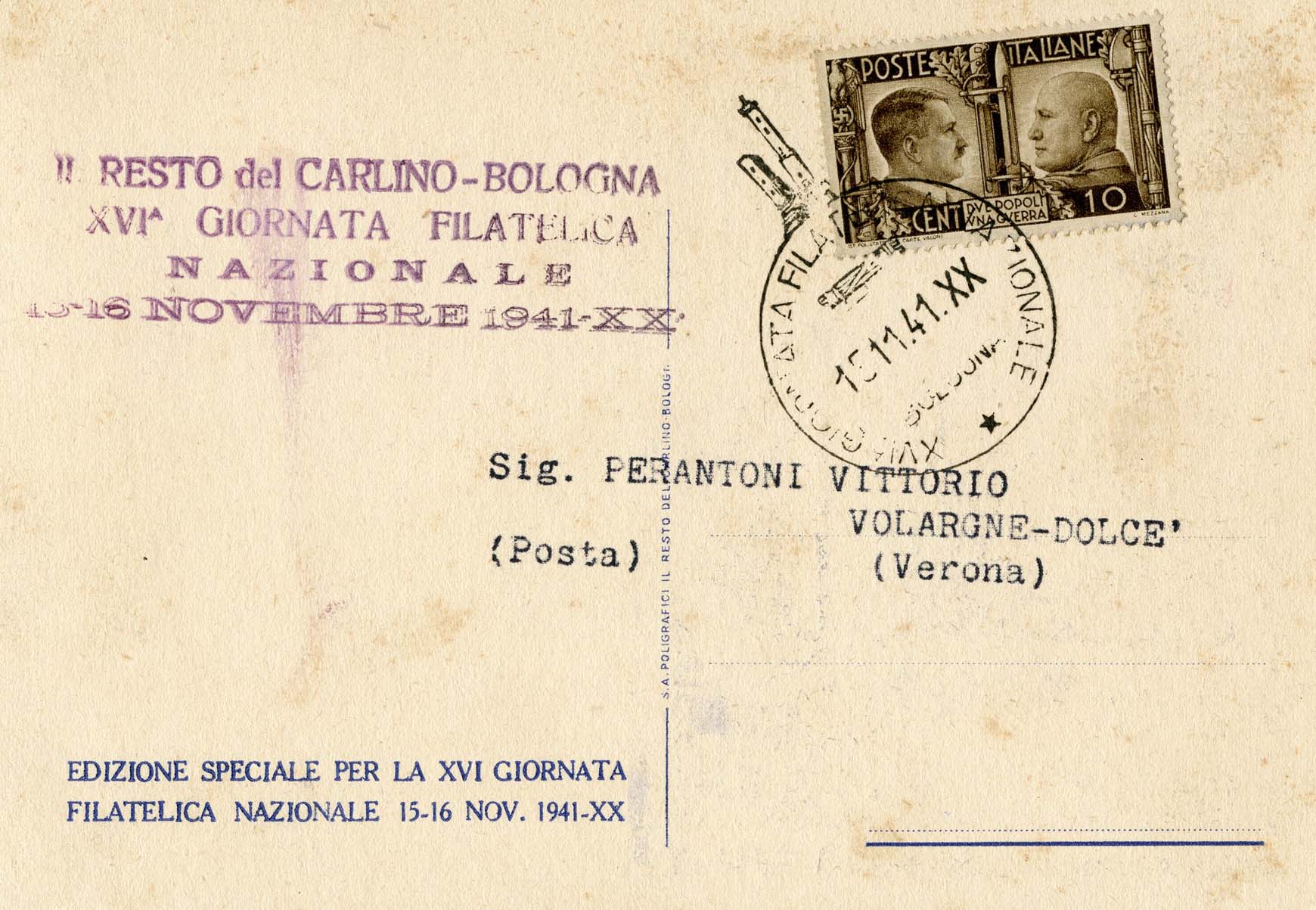
[Below: Reverse. This was sent from an Infantry Sargeant to Victor Peratoni, 1941.]
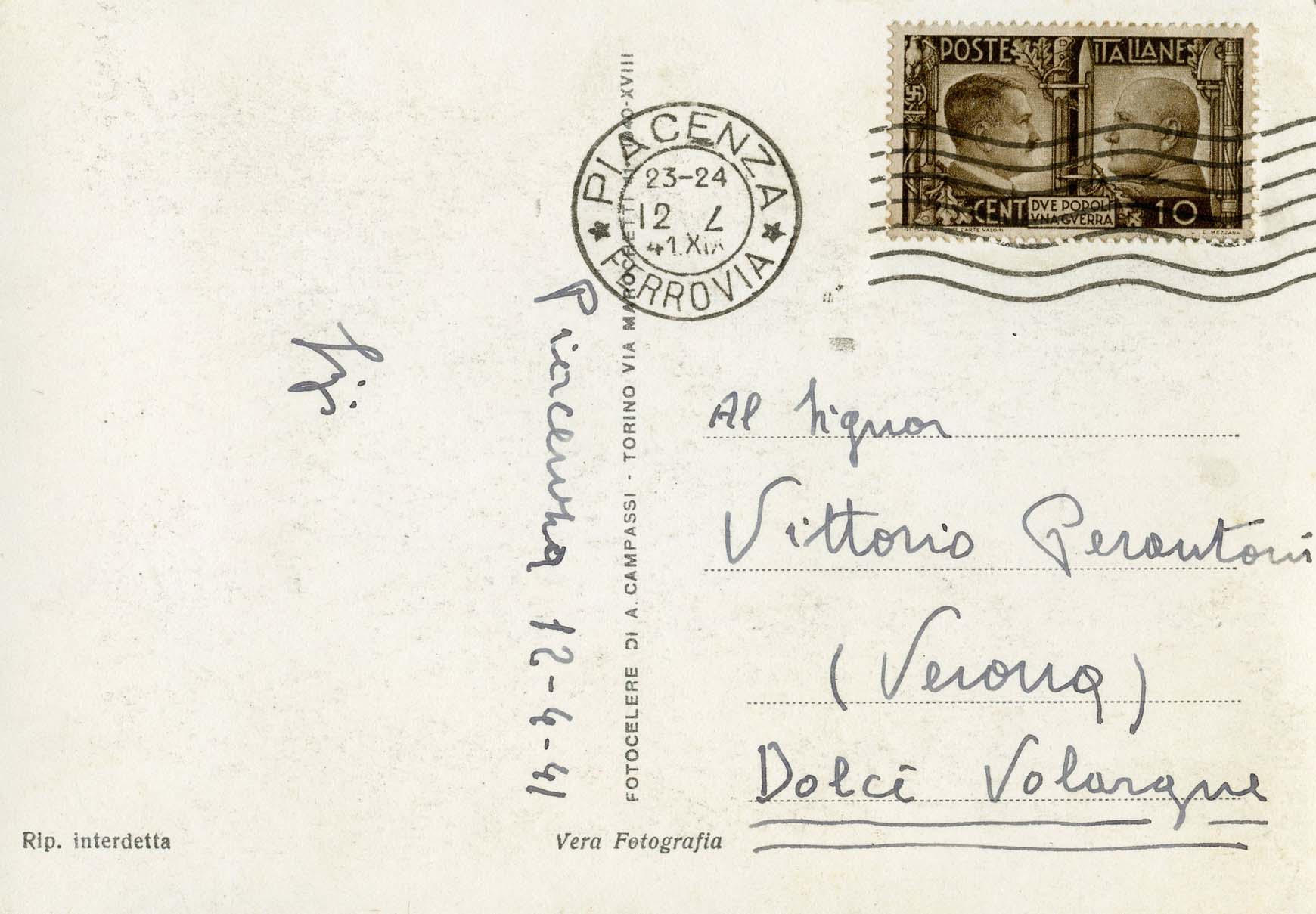
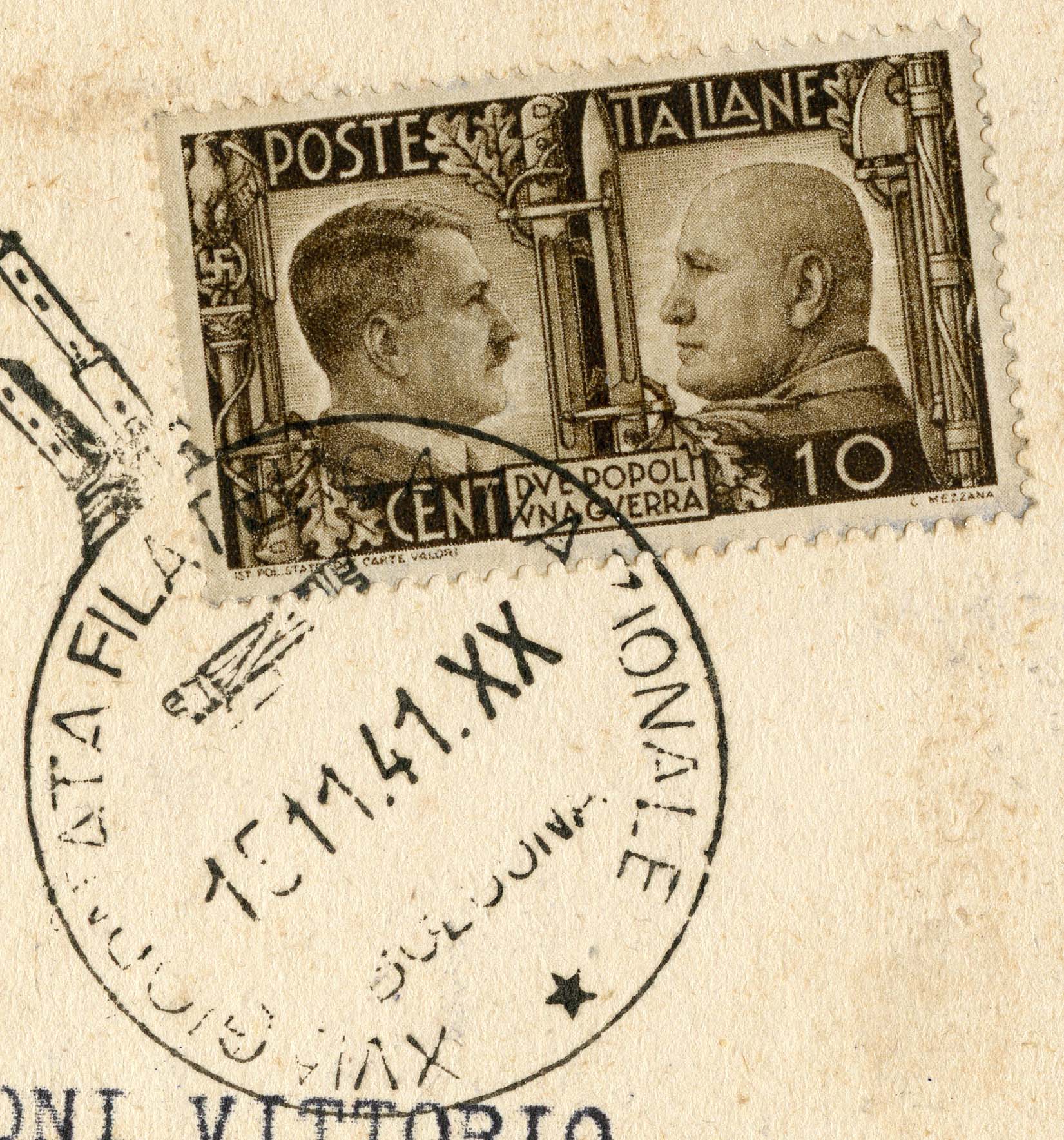
[Below: Close-up. One of my favorite Italian stamps 'Two People - One War']
[Below: ...]
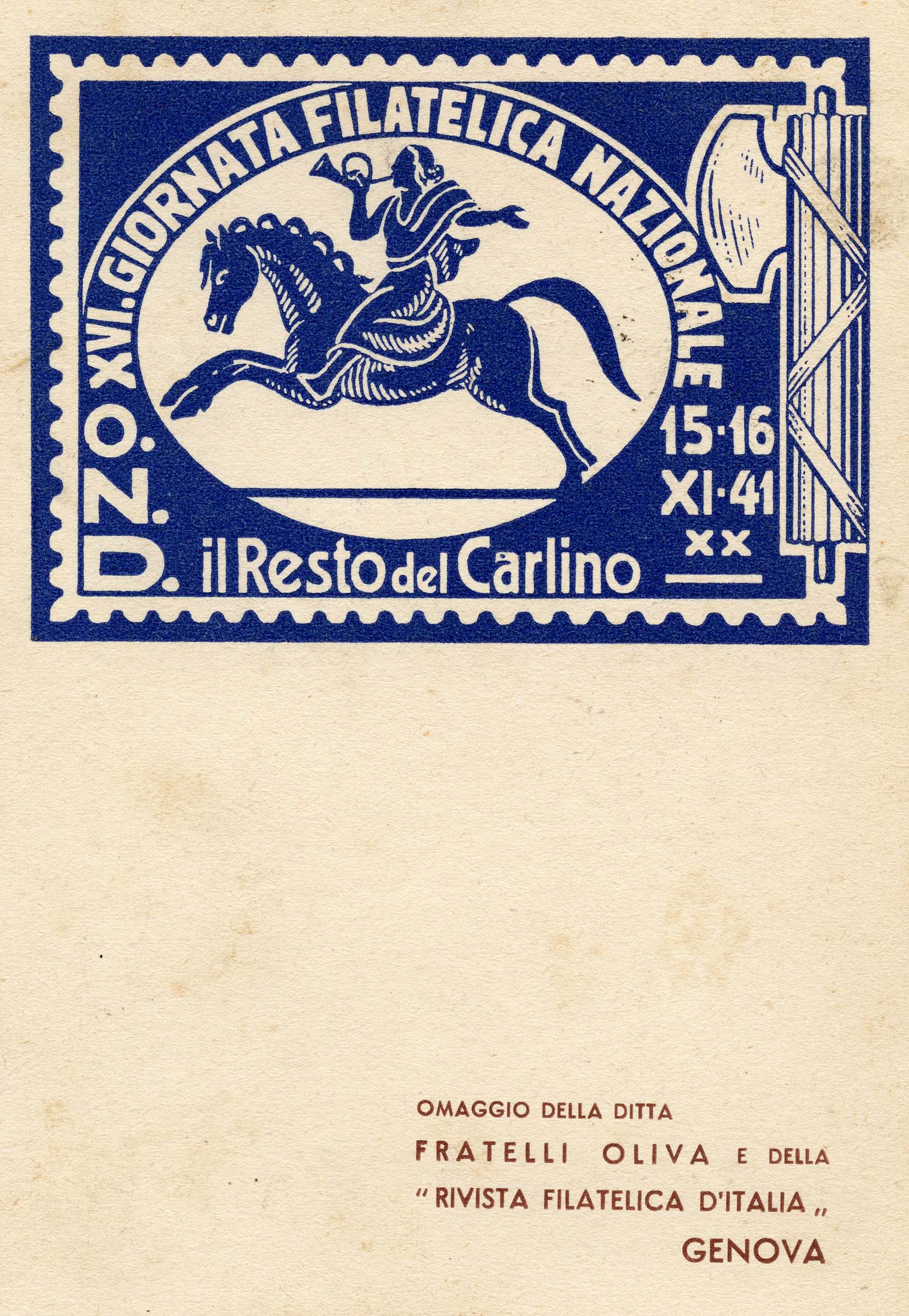
[Below: Reverse.]
[Below: Close-up.]
[Below: Front/reverse.]
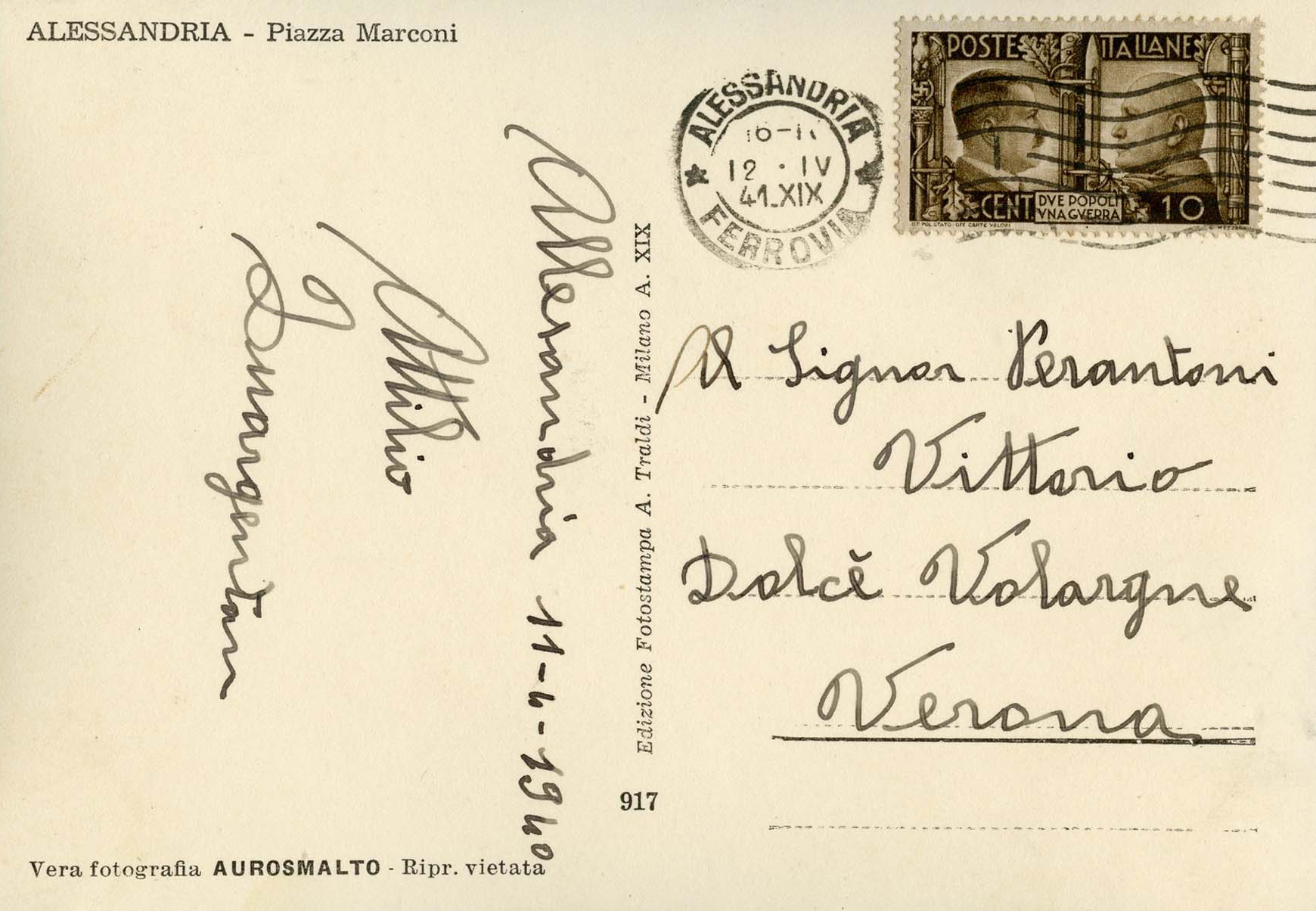
[Below: Close-up.]
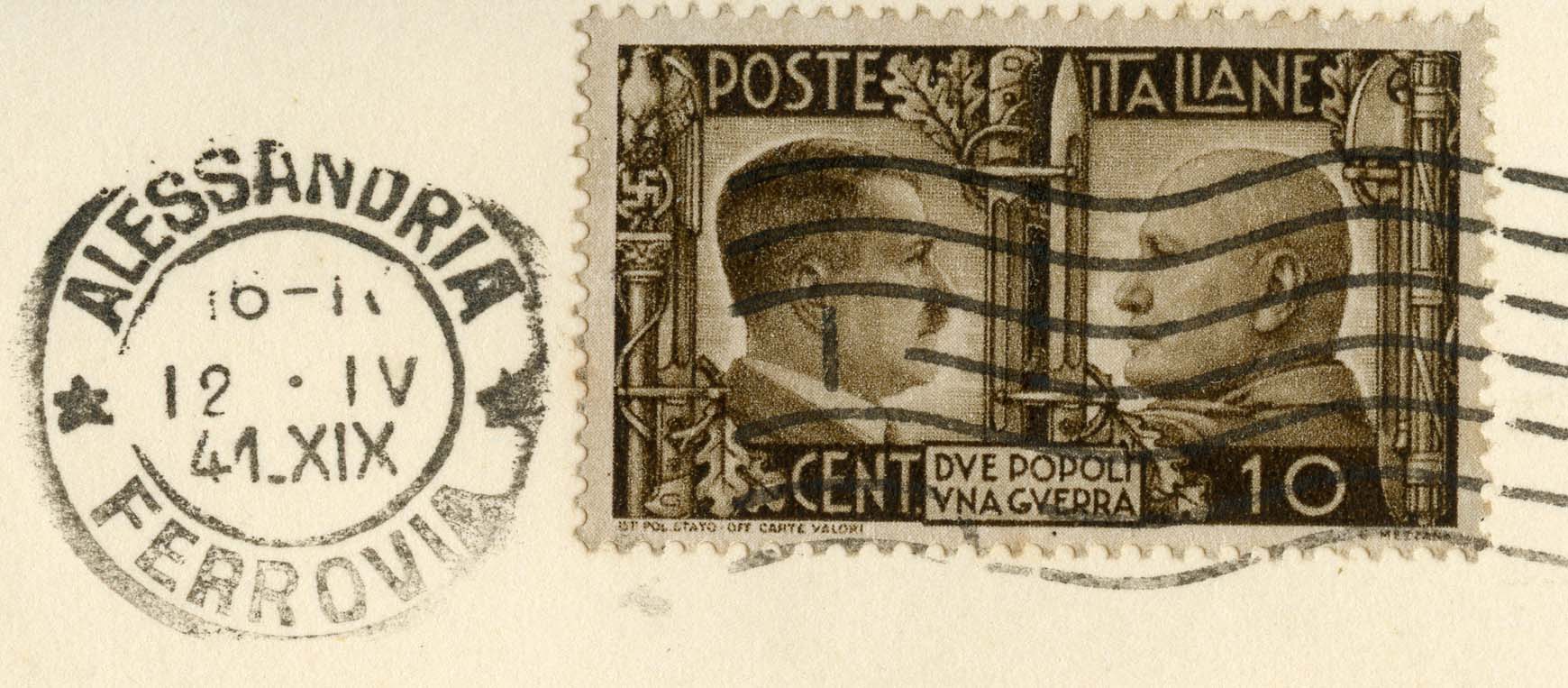
[Below: Front/reverse.]
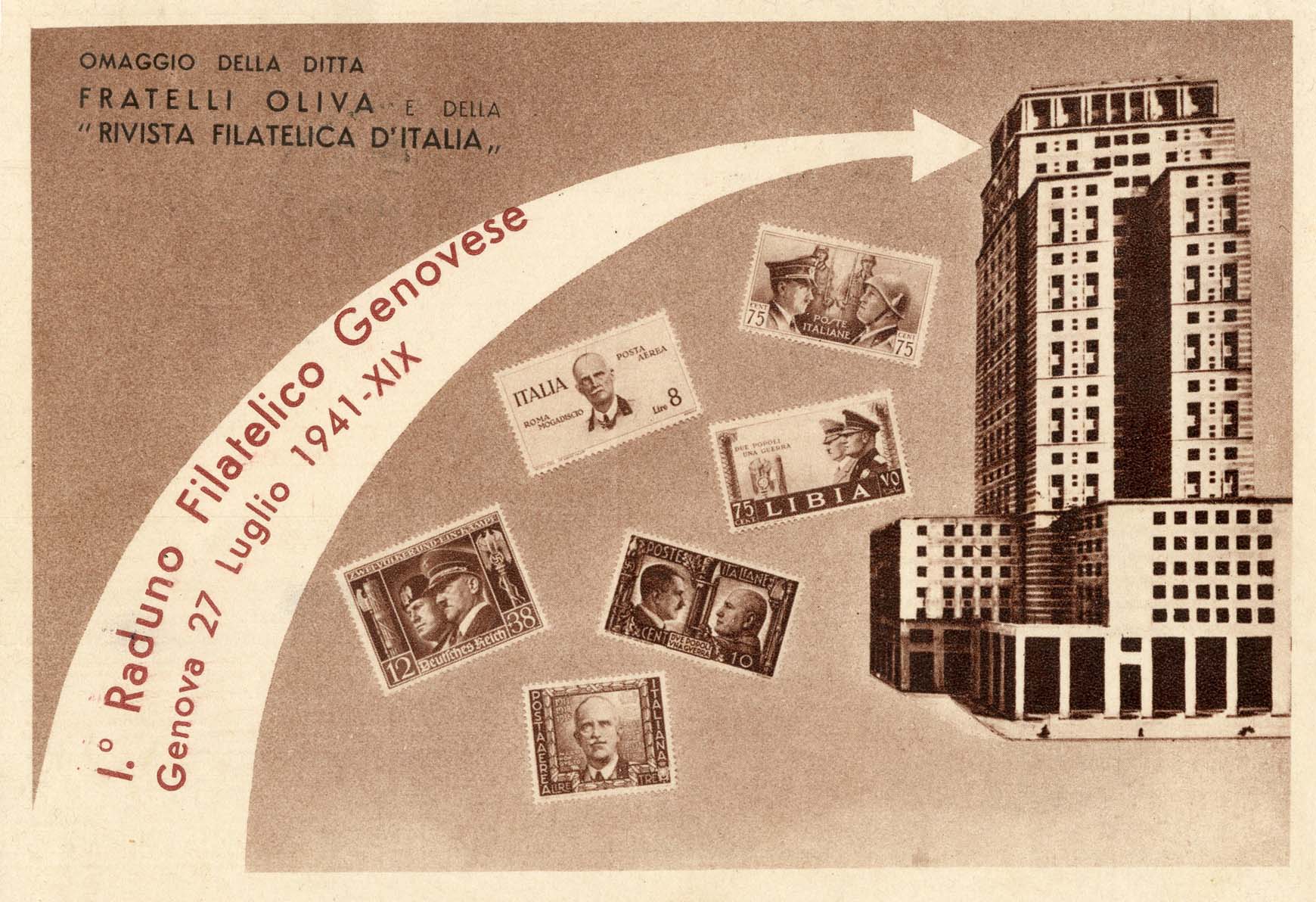
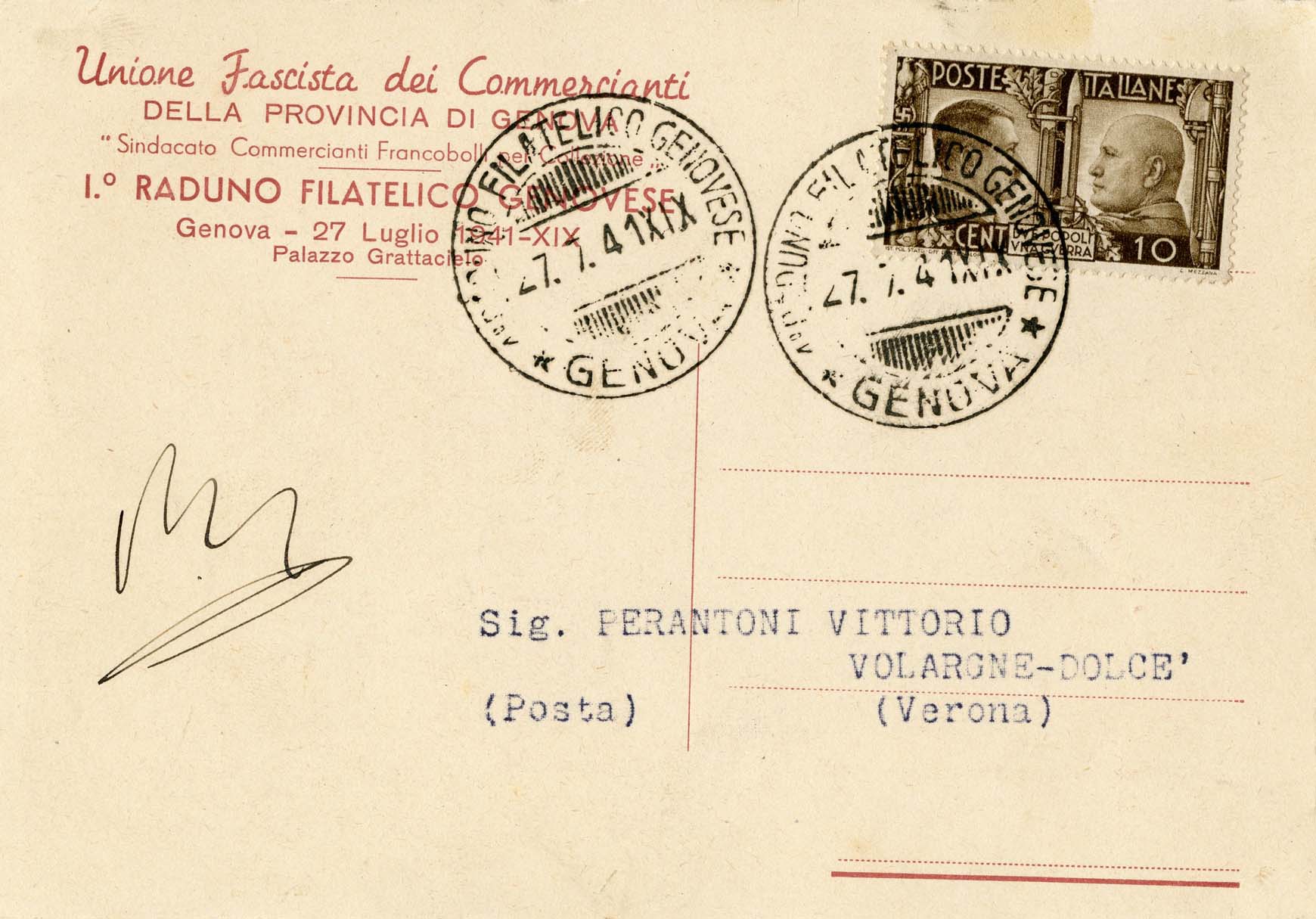
[Below: Close-up.]
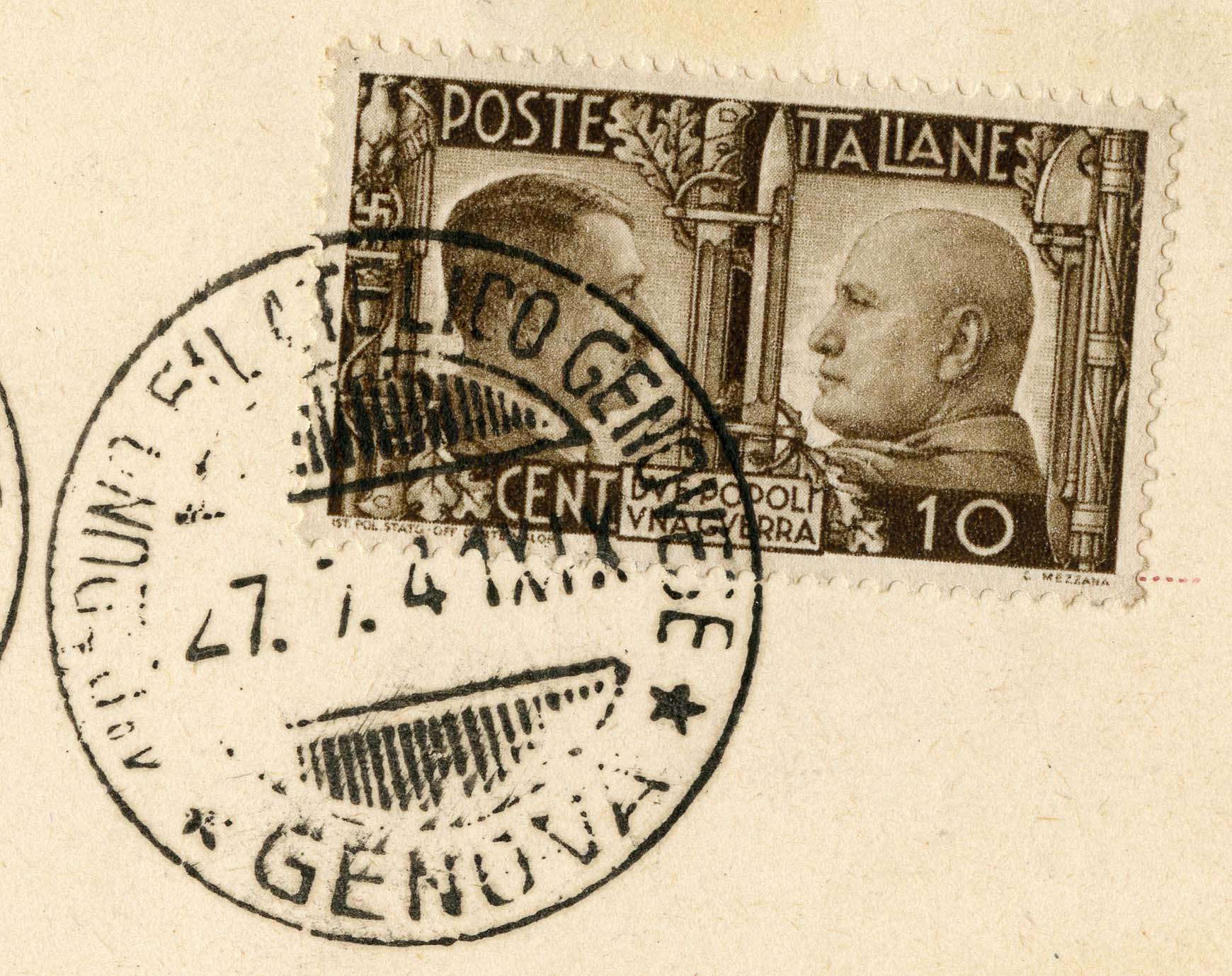
[Below: Front/reverse.]
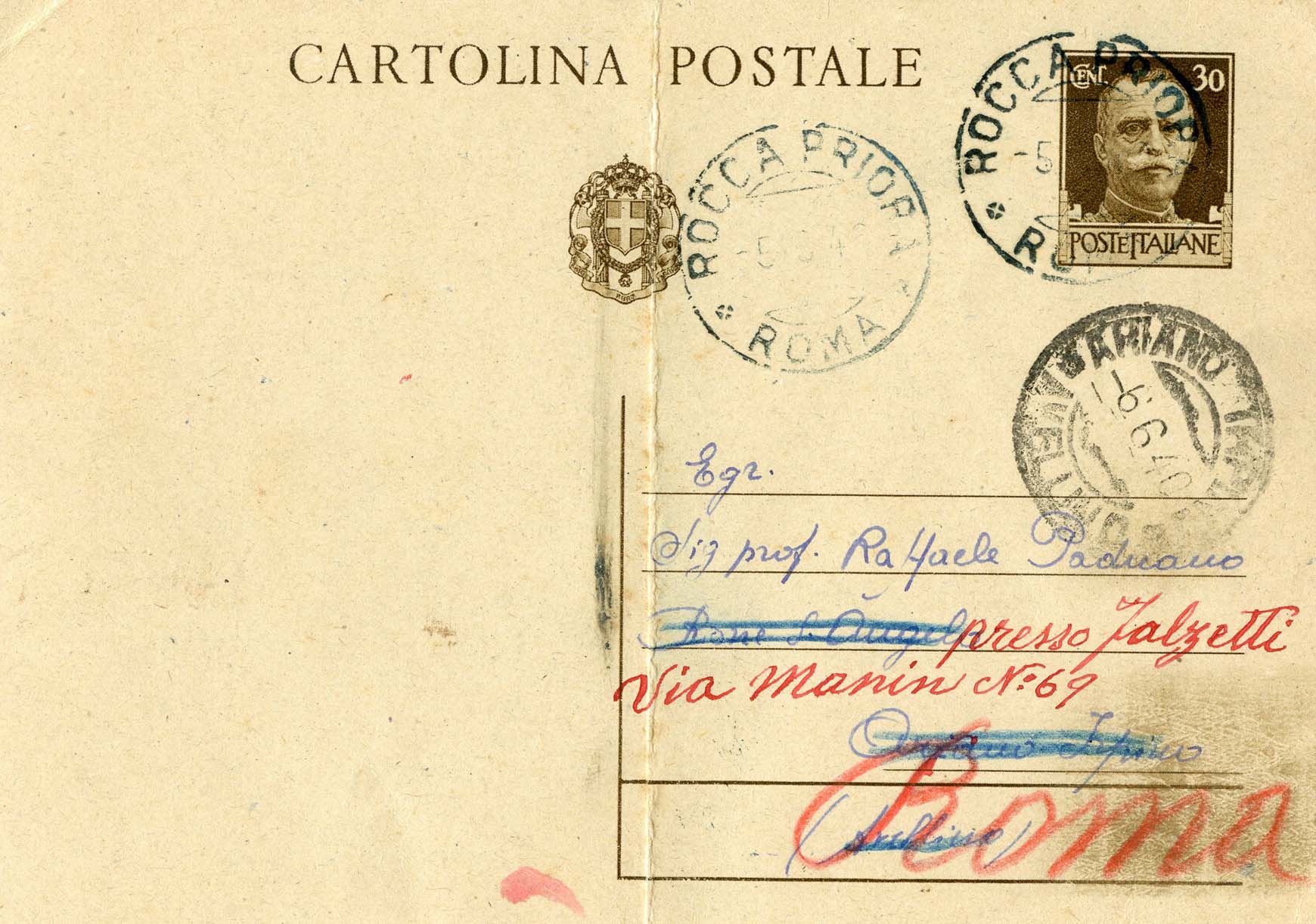
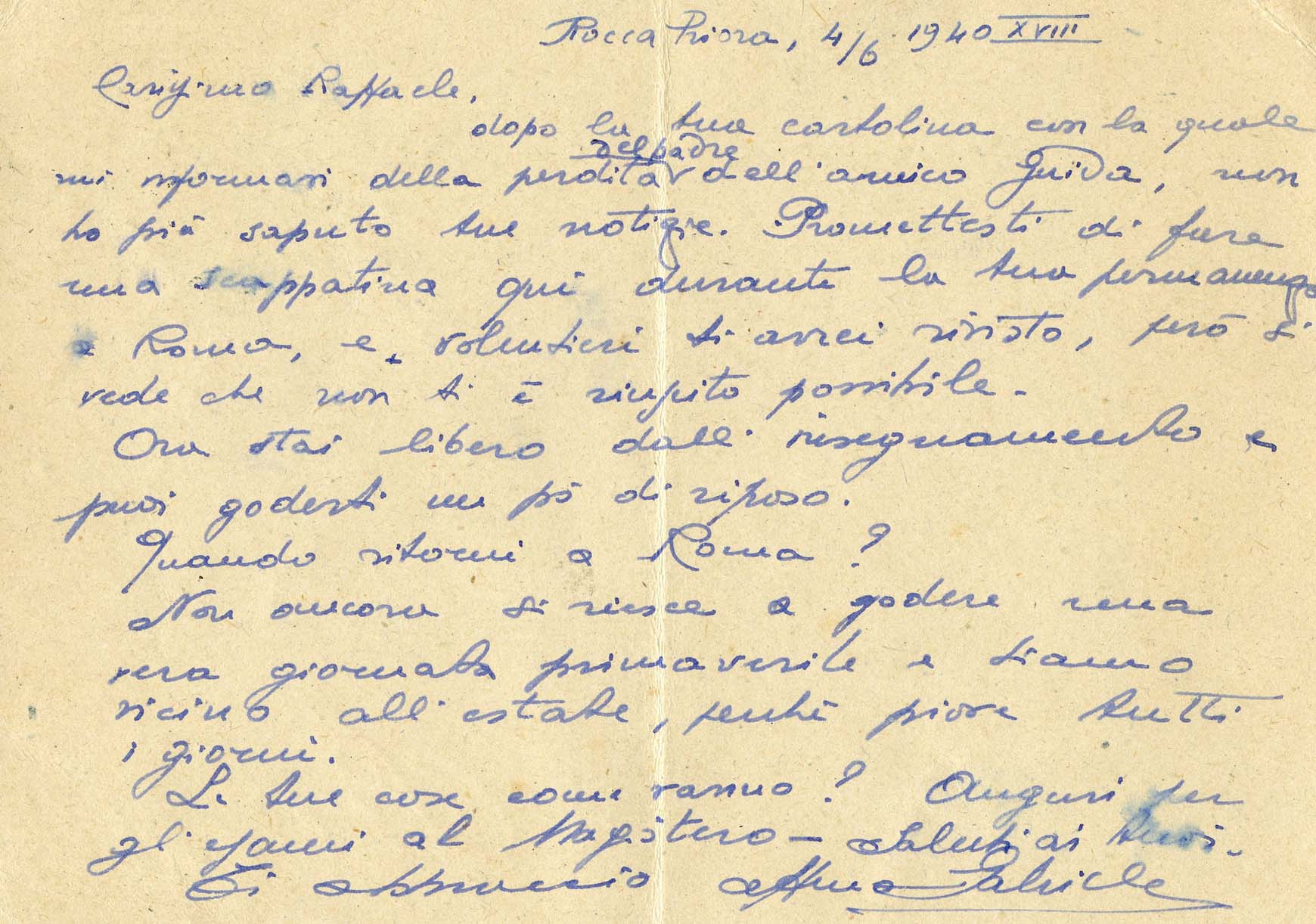
[Below: 'Vinceremo' (We Will Win). After the war they actually went so far as to cross out this slogan while still using stocks of this postcard. Front/reverse]
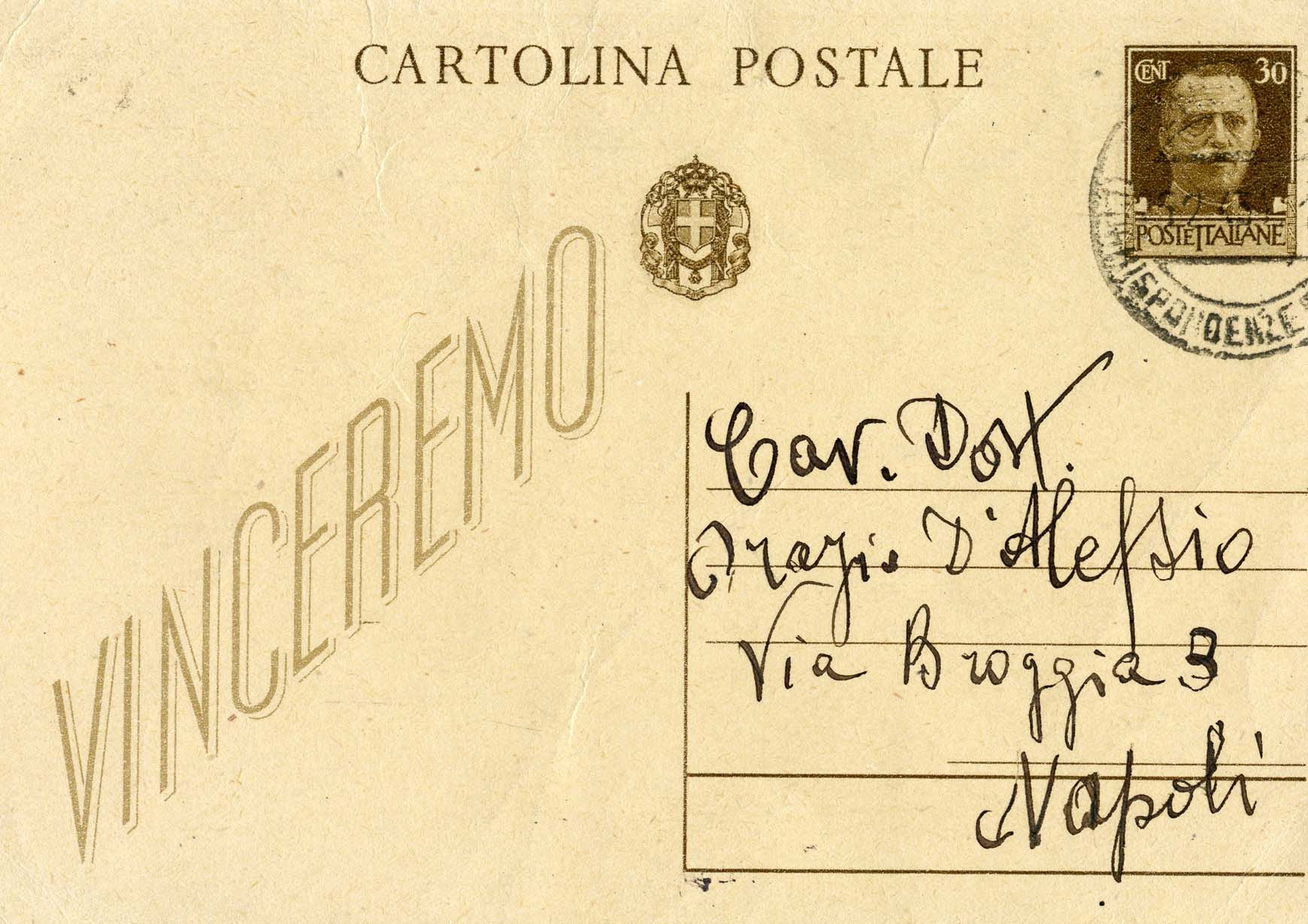
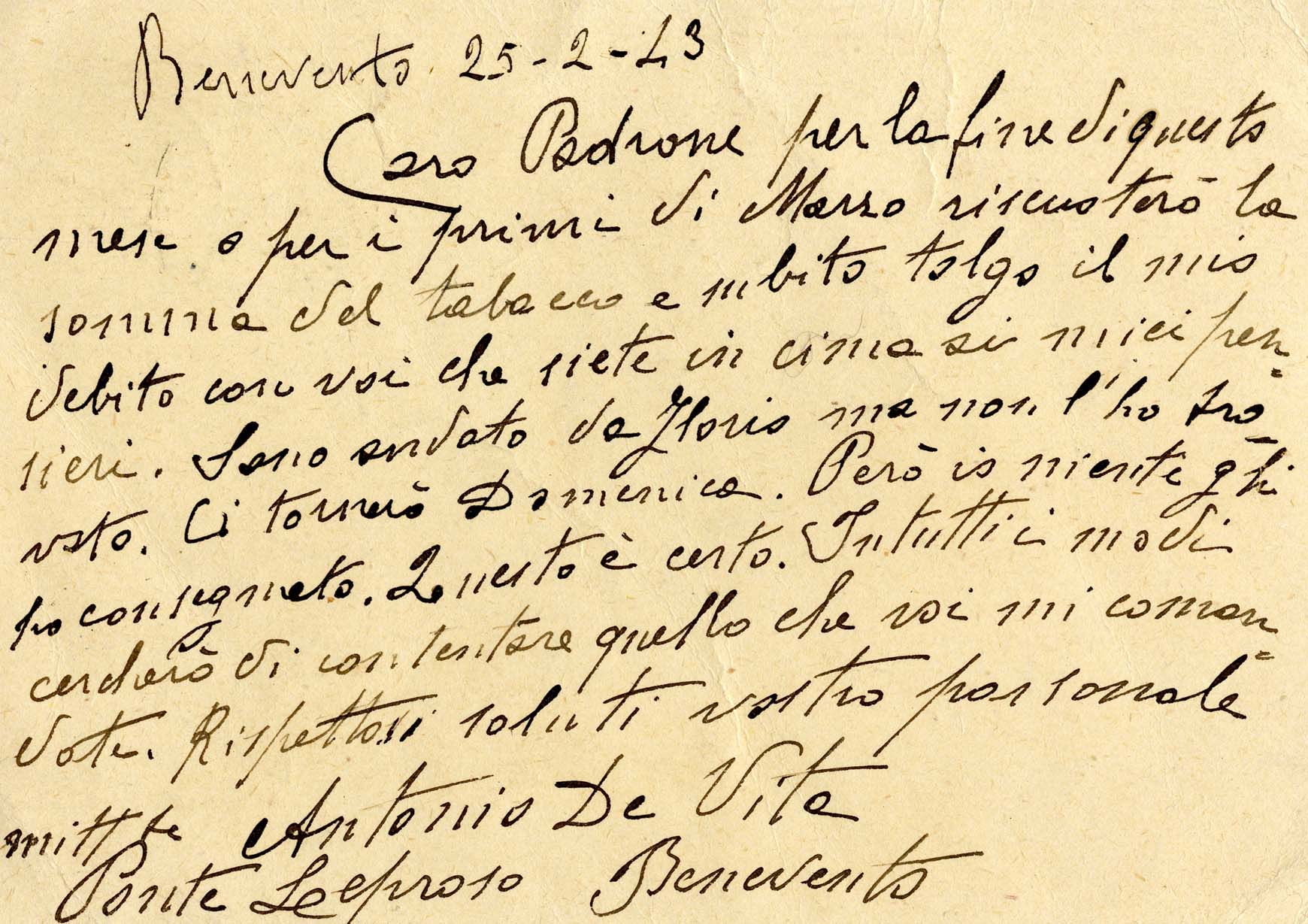
[Below: 'Vinceremo' (We Will Win). Front/reverse.]
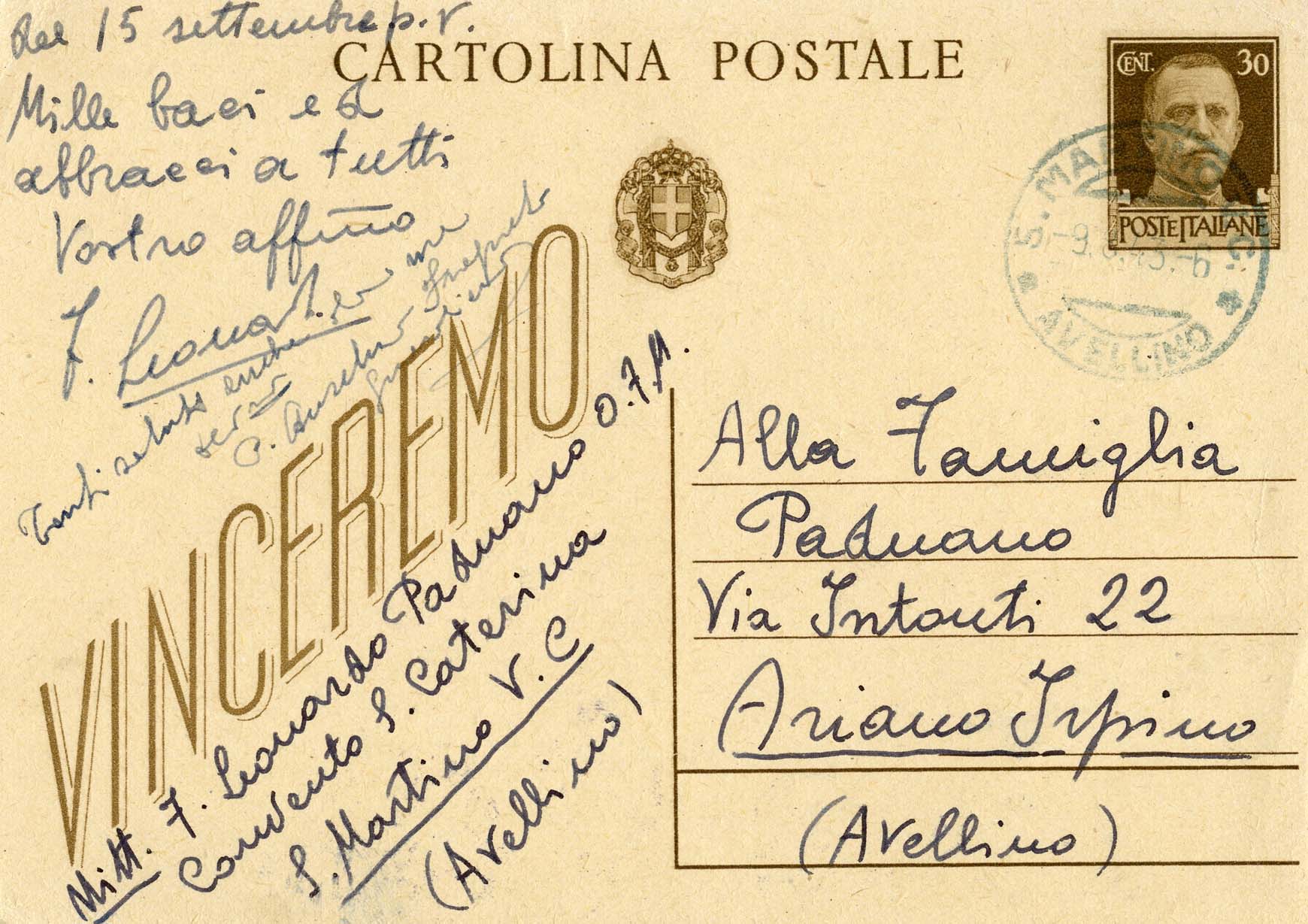
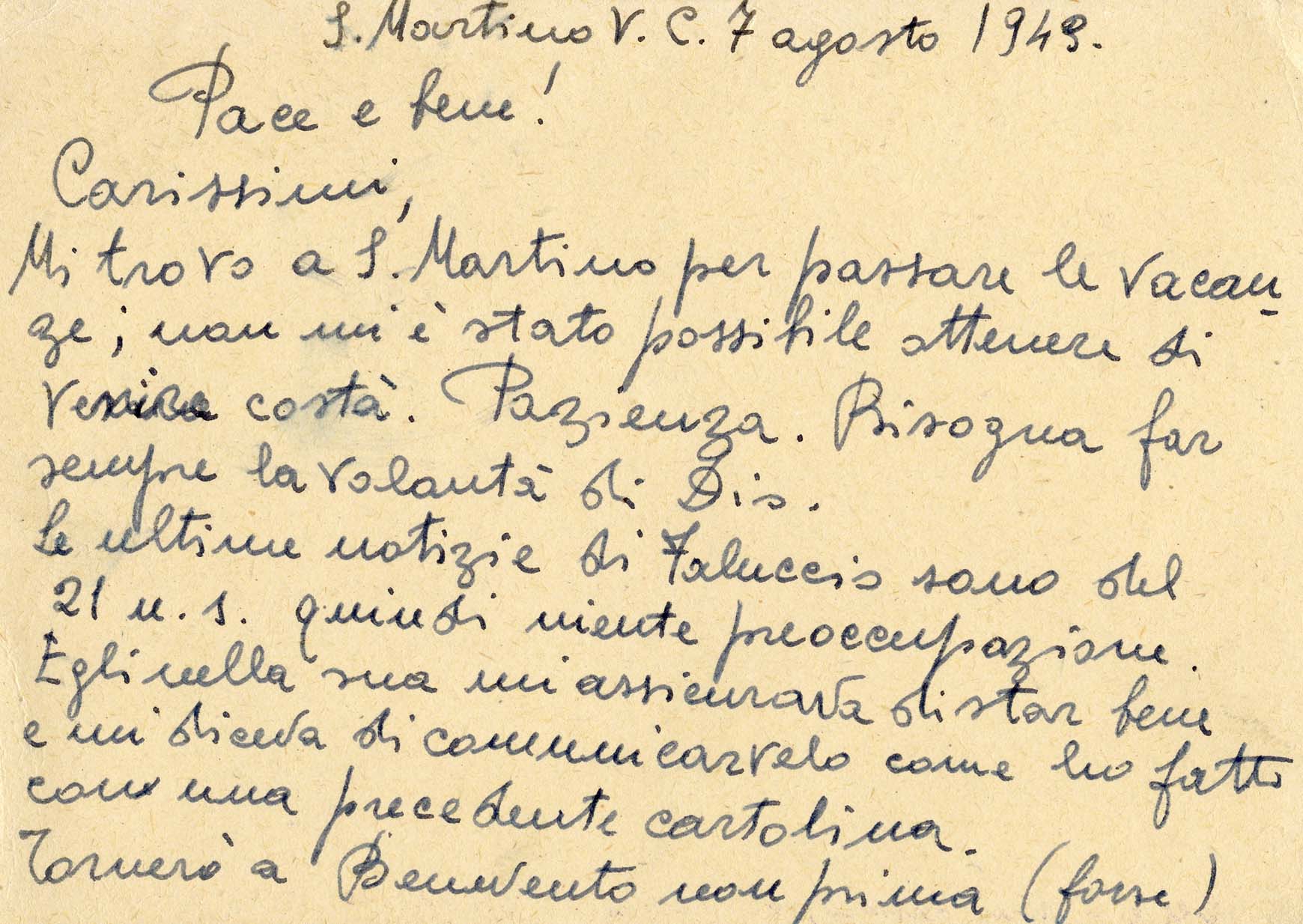
[Below: 'Vinceremo' (We Will Win). This has a censor mark. Front/reverse.]
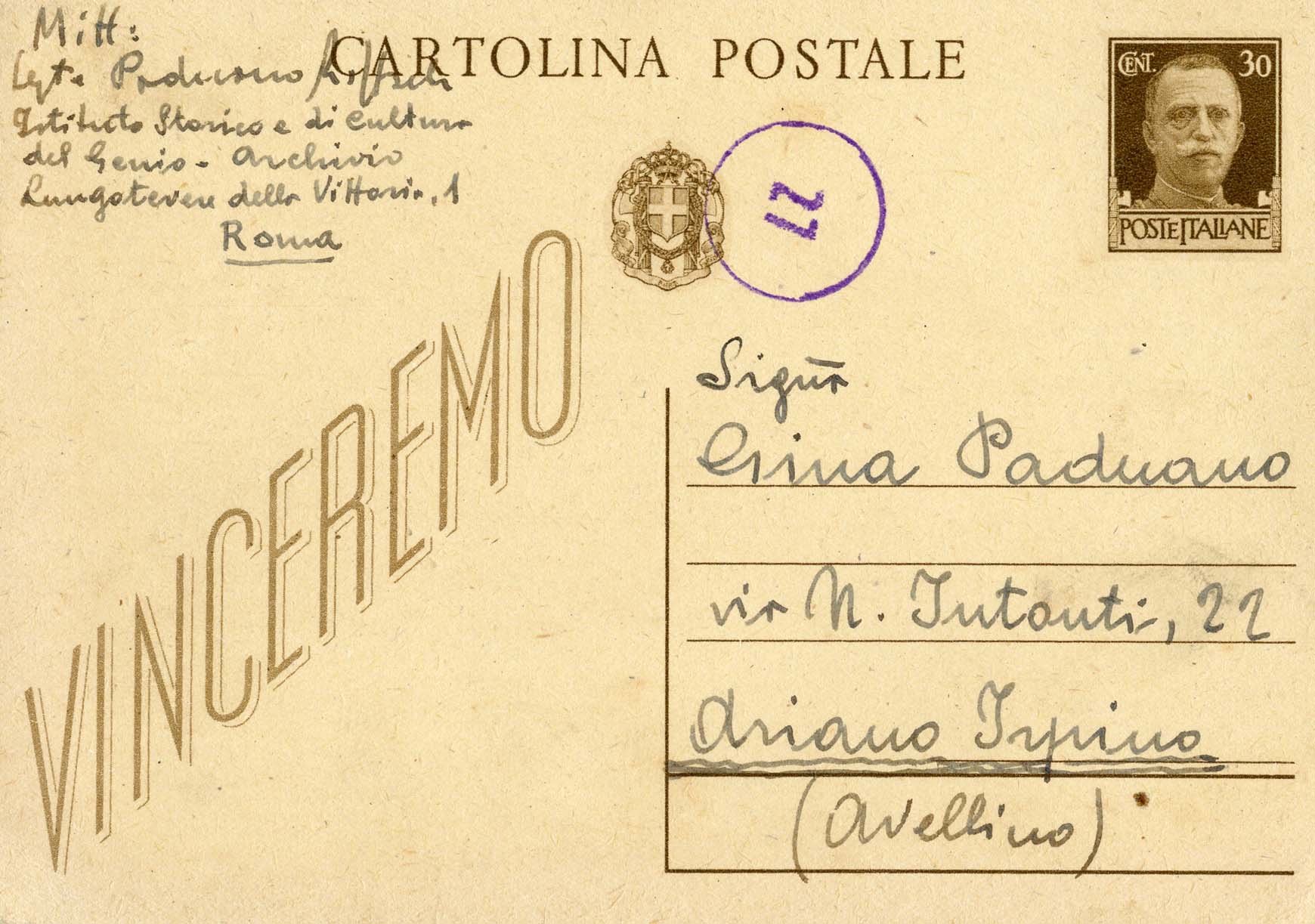
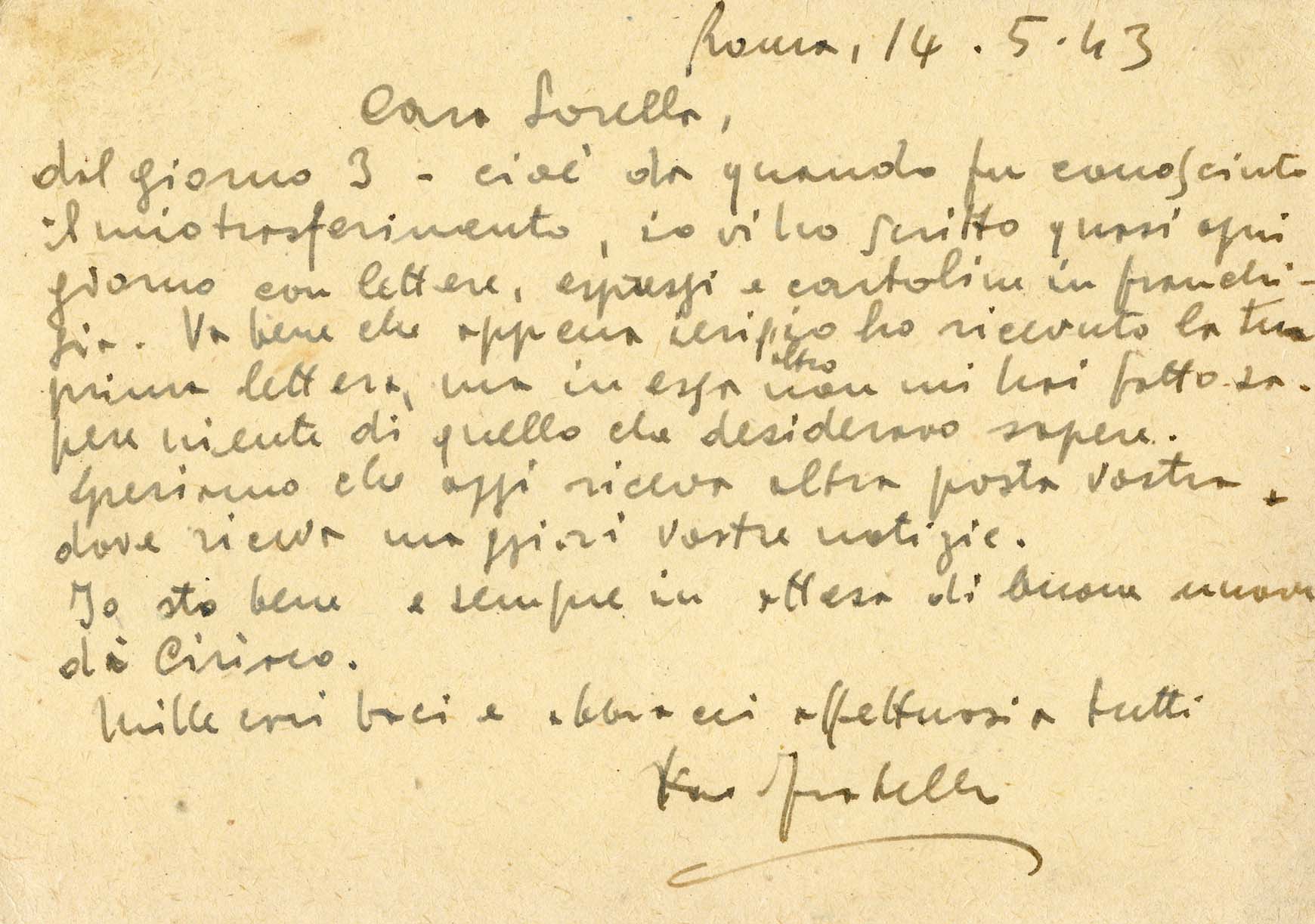
[Below: 'Vinceremo' (We Will Win). This has a censor mark. Front/reverse.]
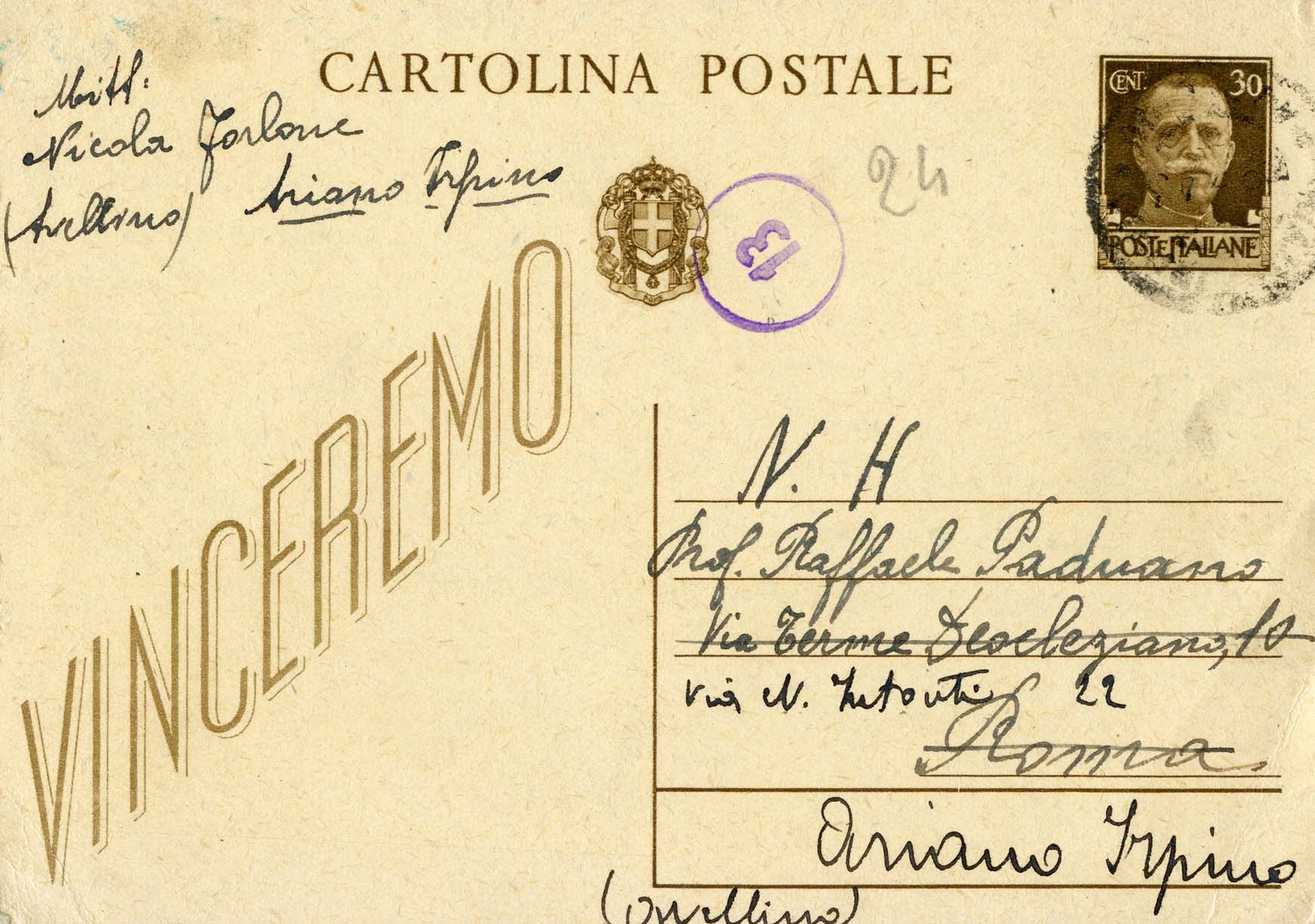
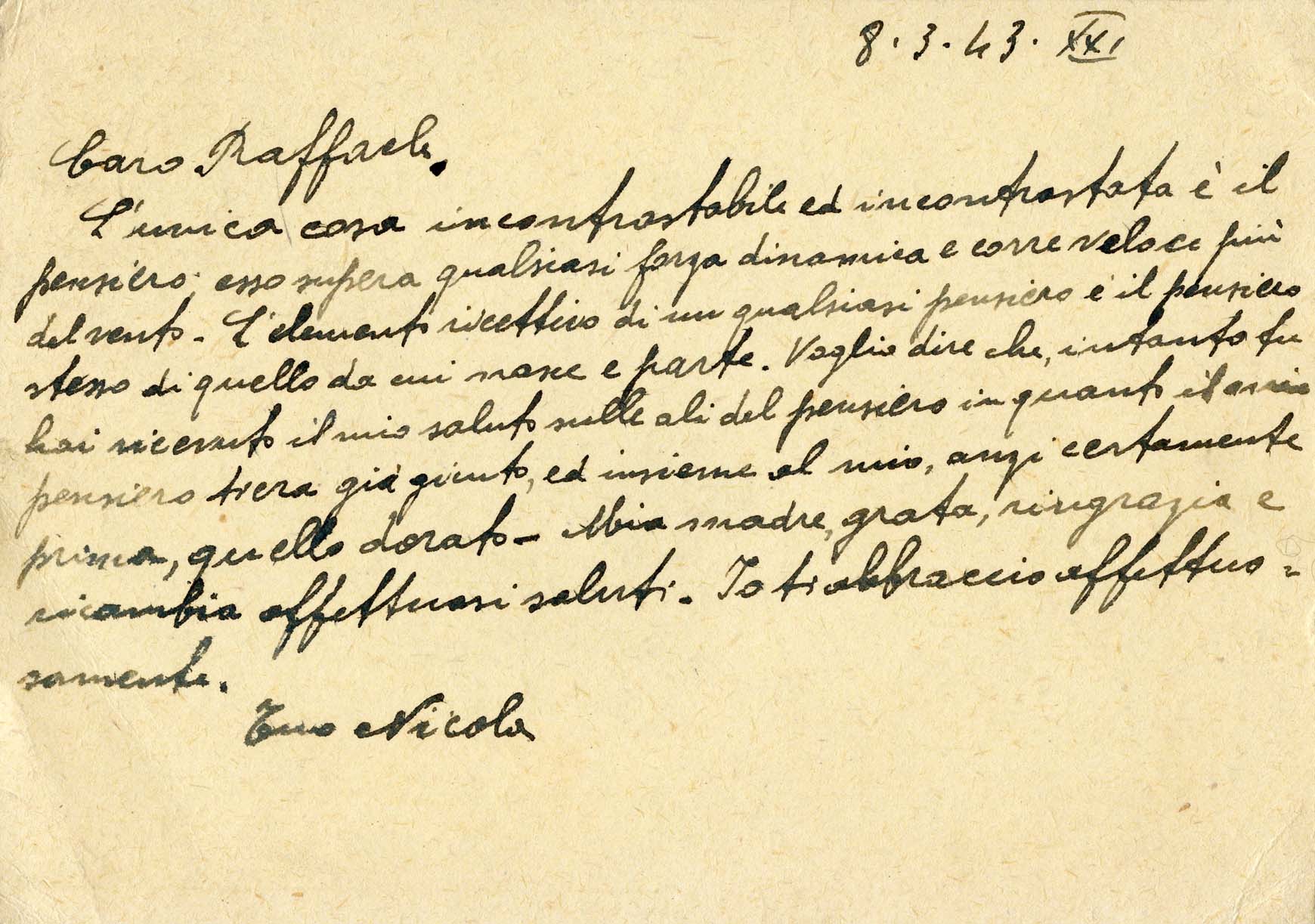
[Below: 'Vinceremo' (We Will Win). Front/reverse.]
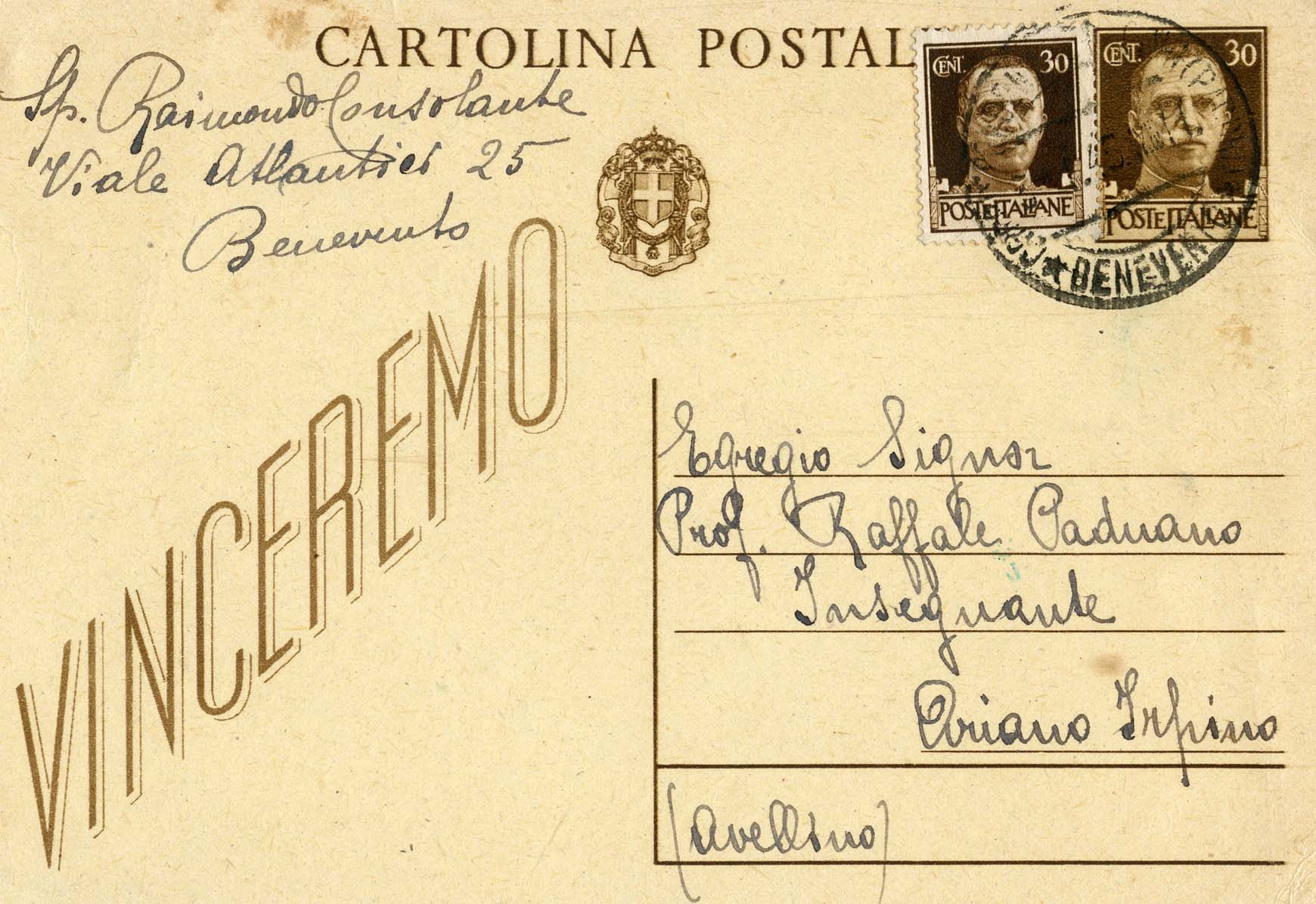
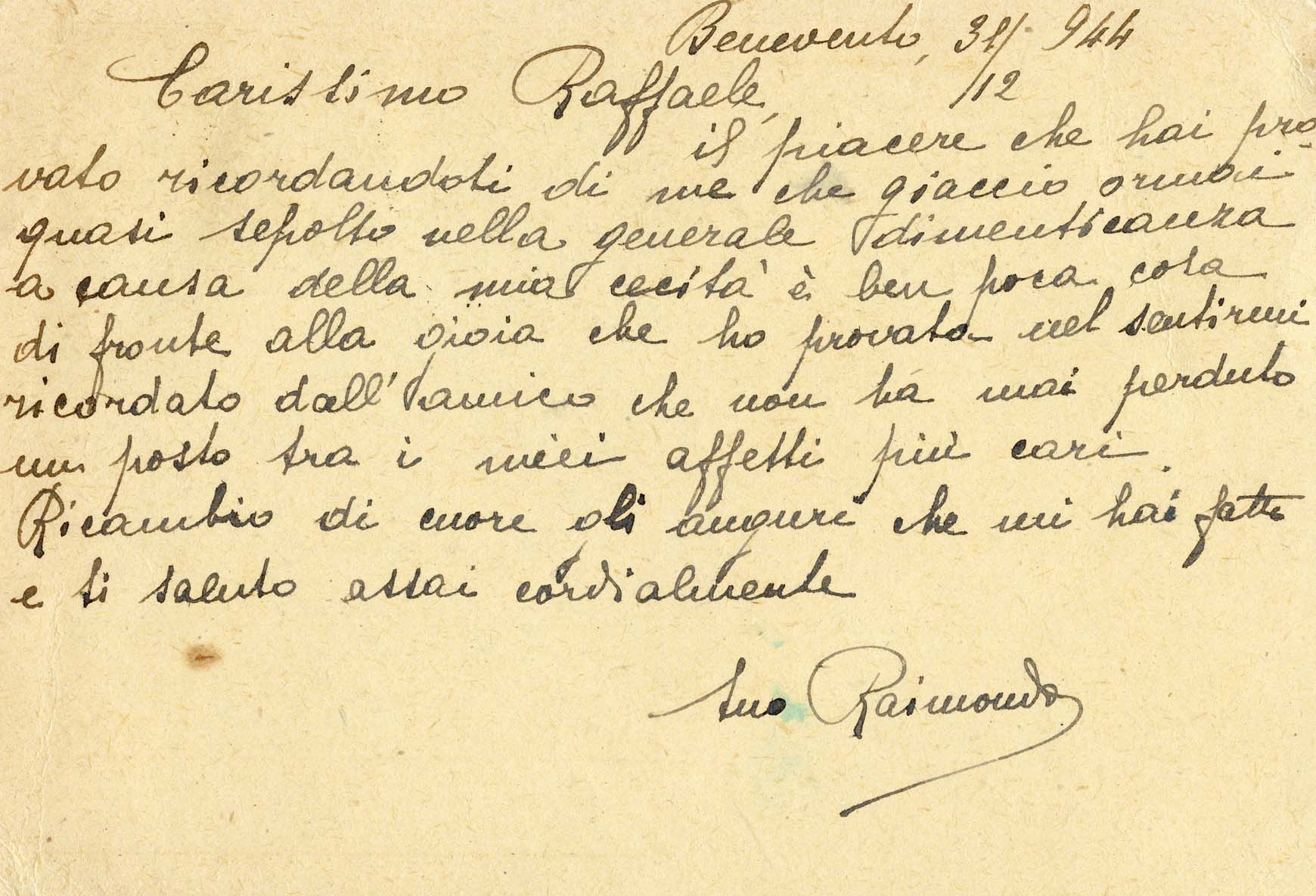
[Below: 'Vinceremo' (We Will Win). This was sent Feldpost. Front/reverse.]
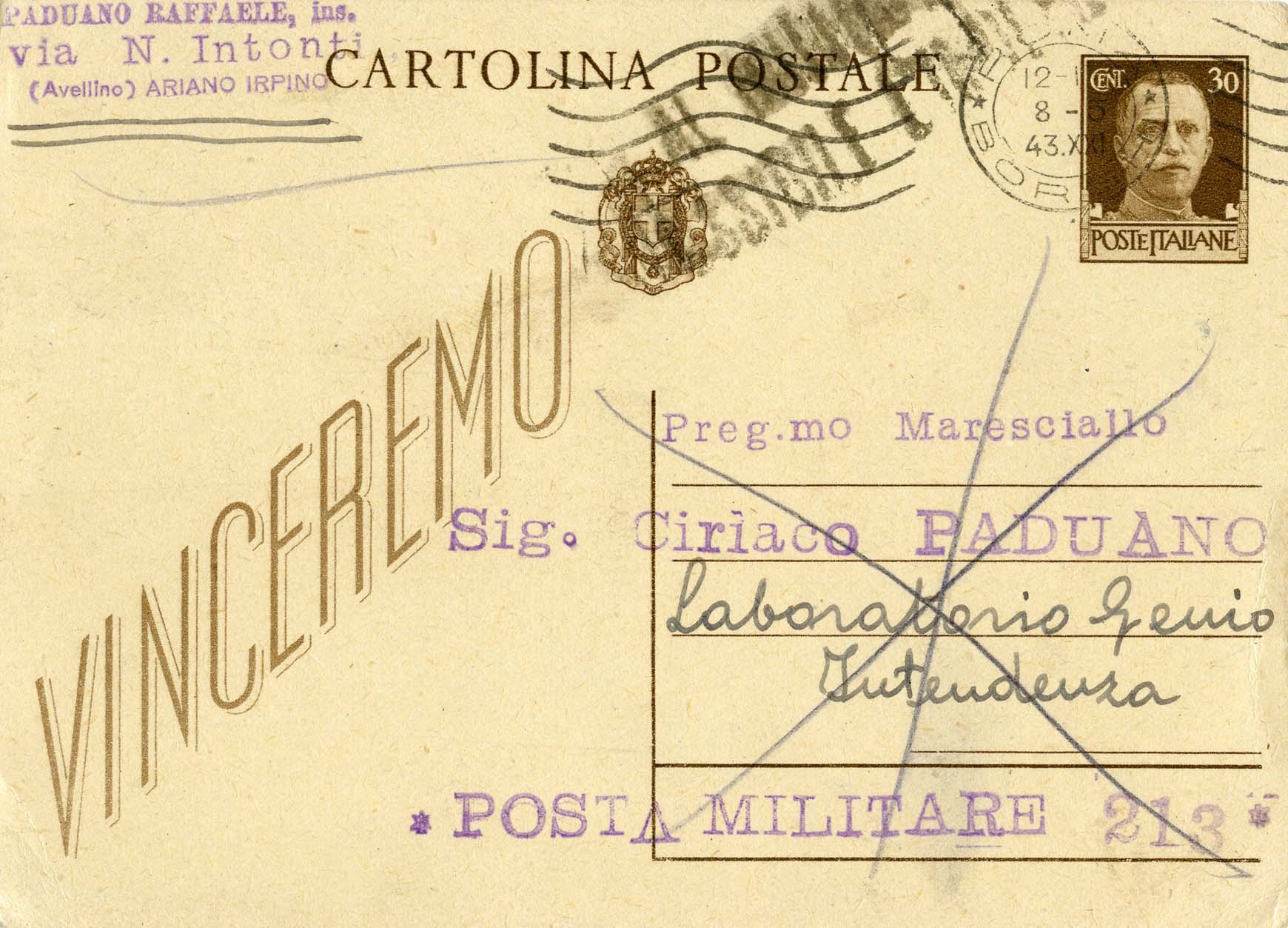
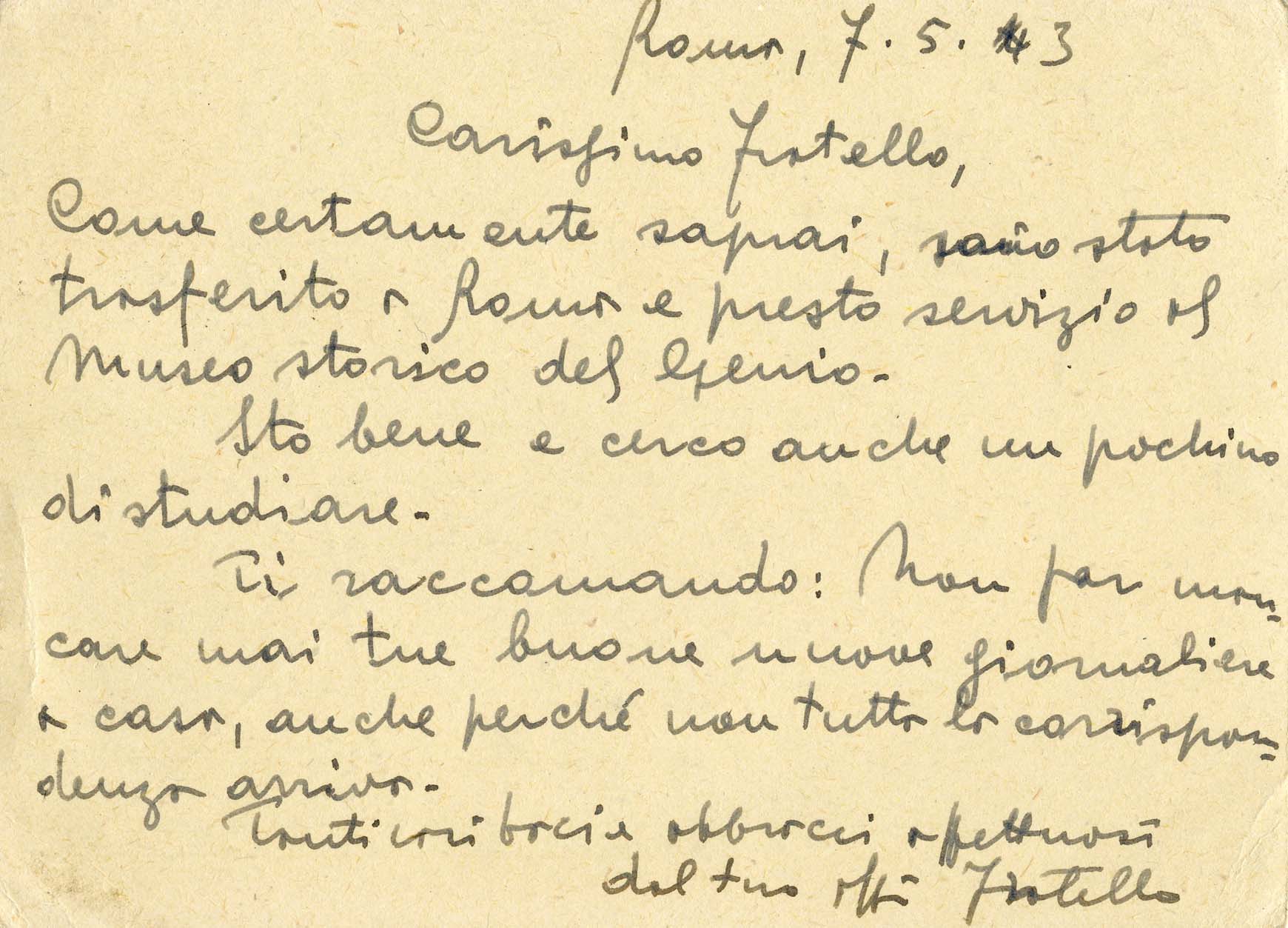
[Below: 'Vinceremo' (We Will Win). This has a censor mark. Front/reverse.]
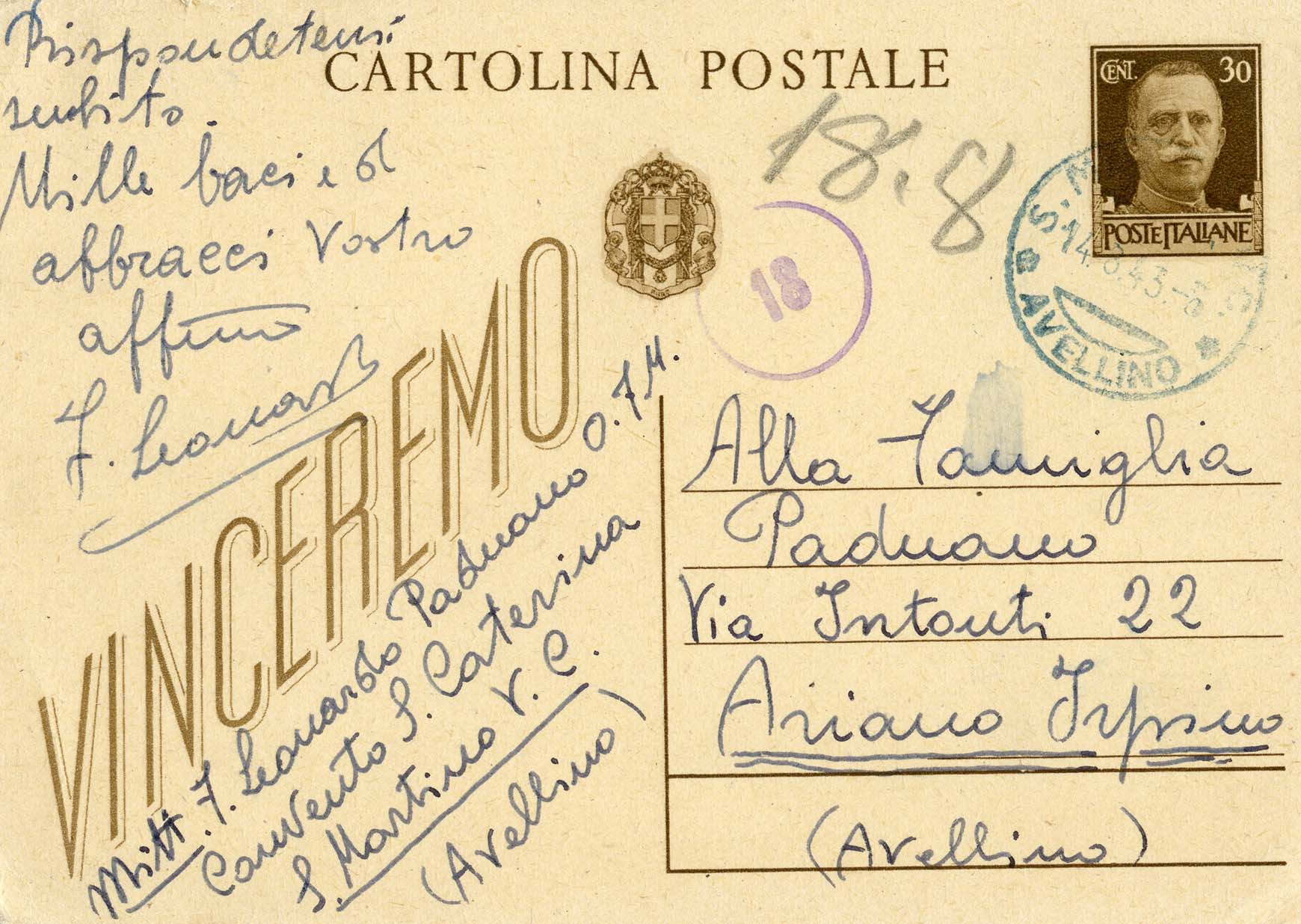
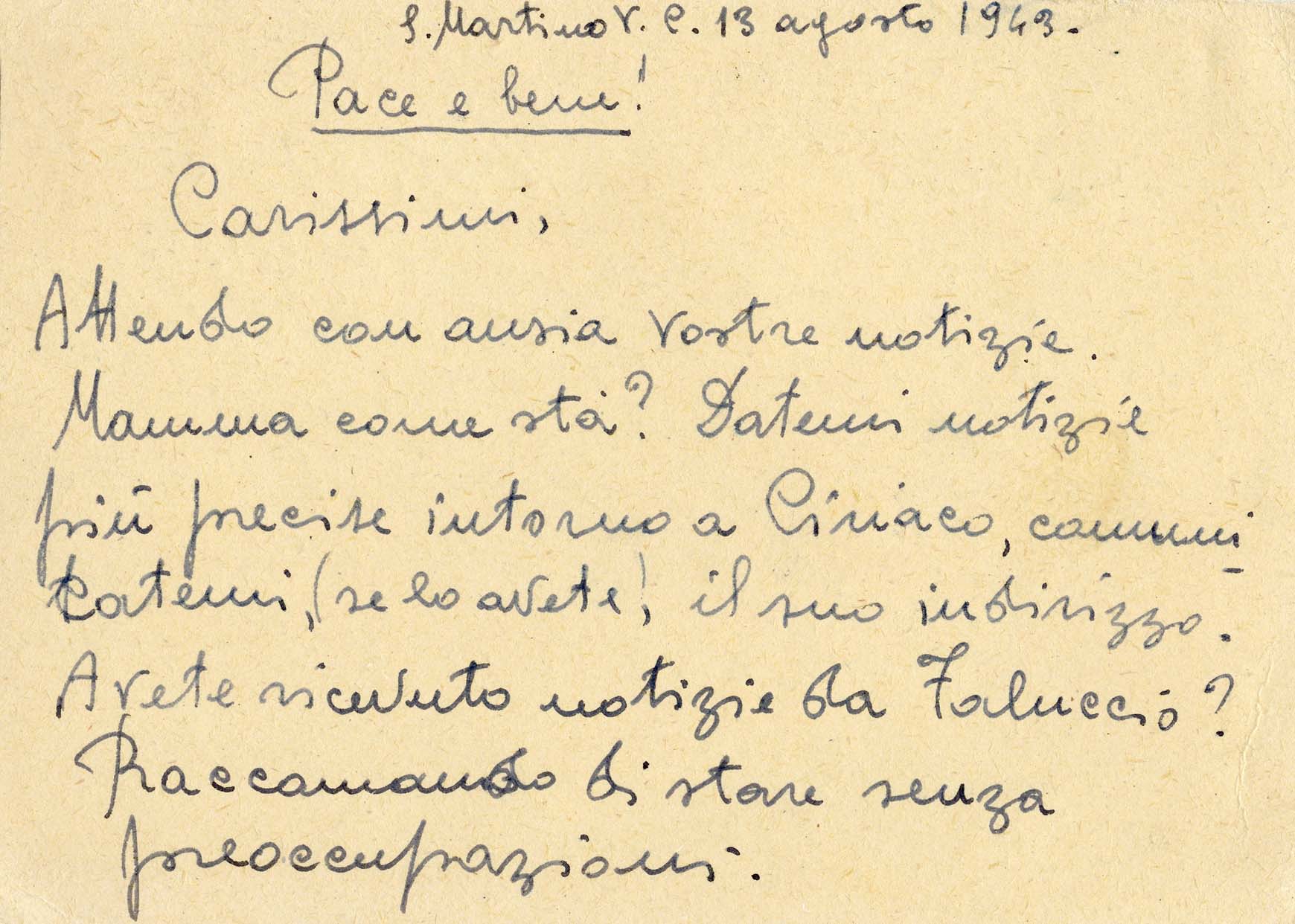
[Below: 'Vinceremo' (We Will Win). This has a censor mark. Front/reverse.]
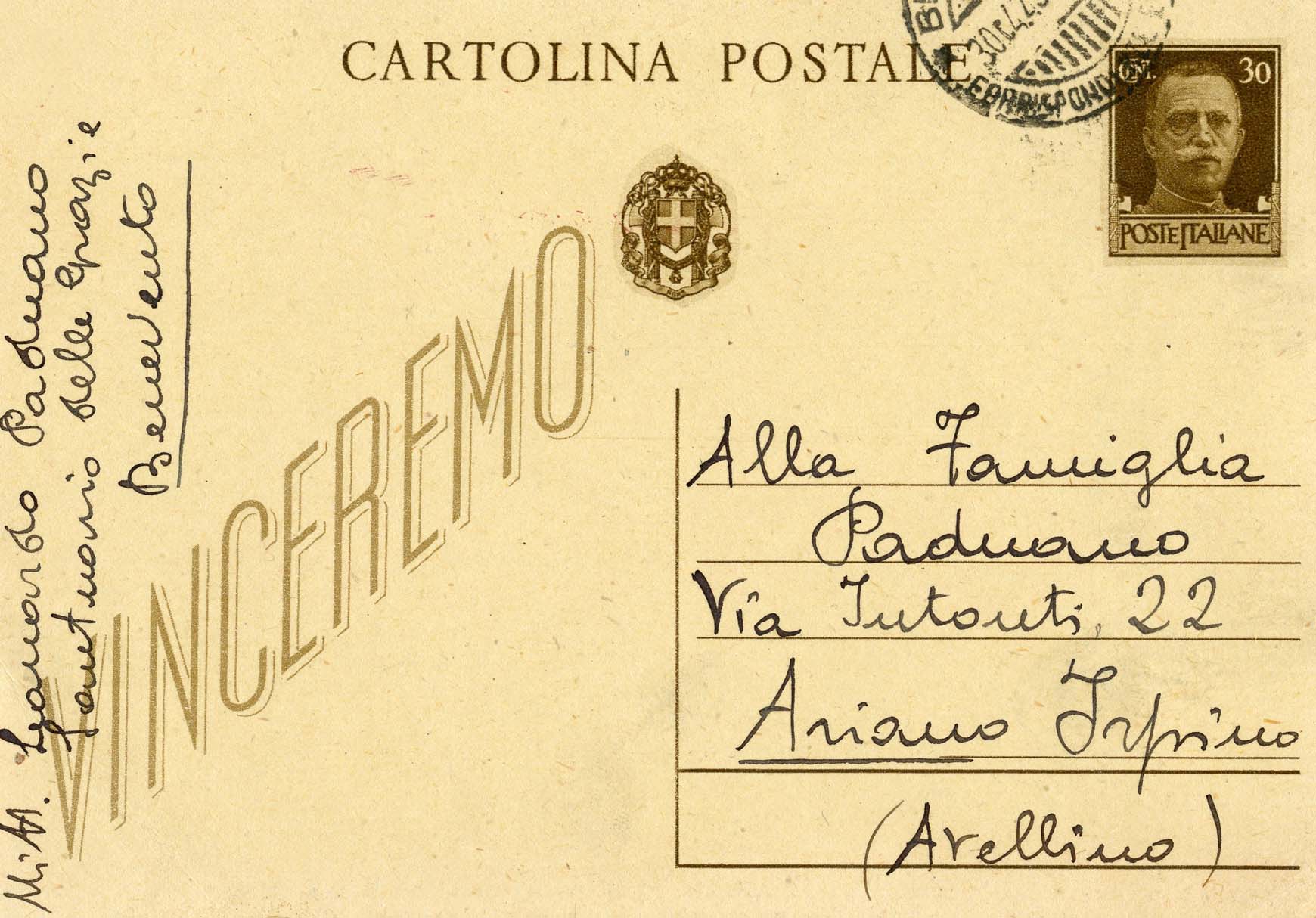
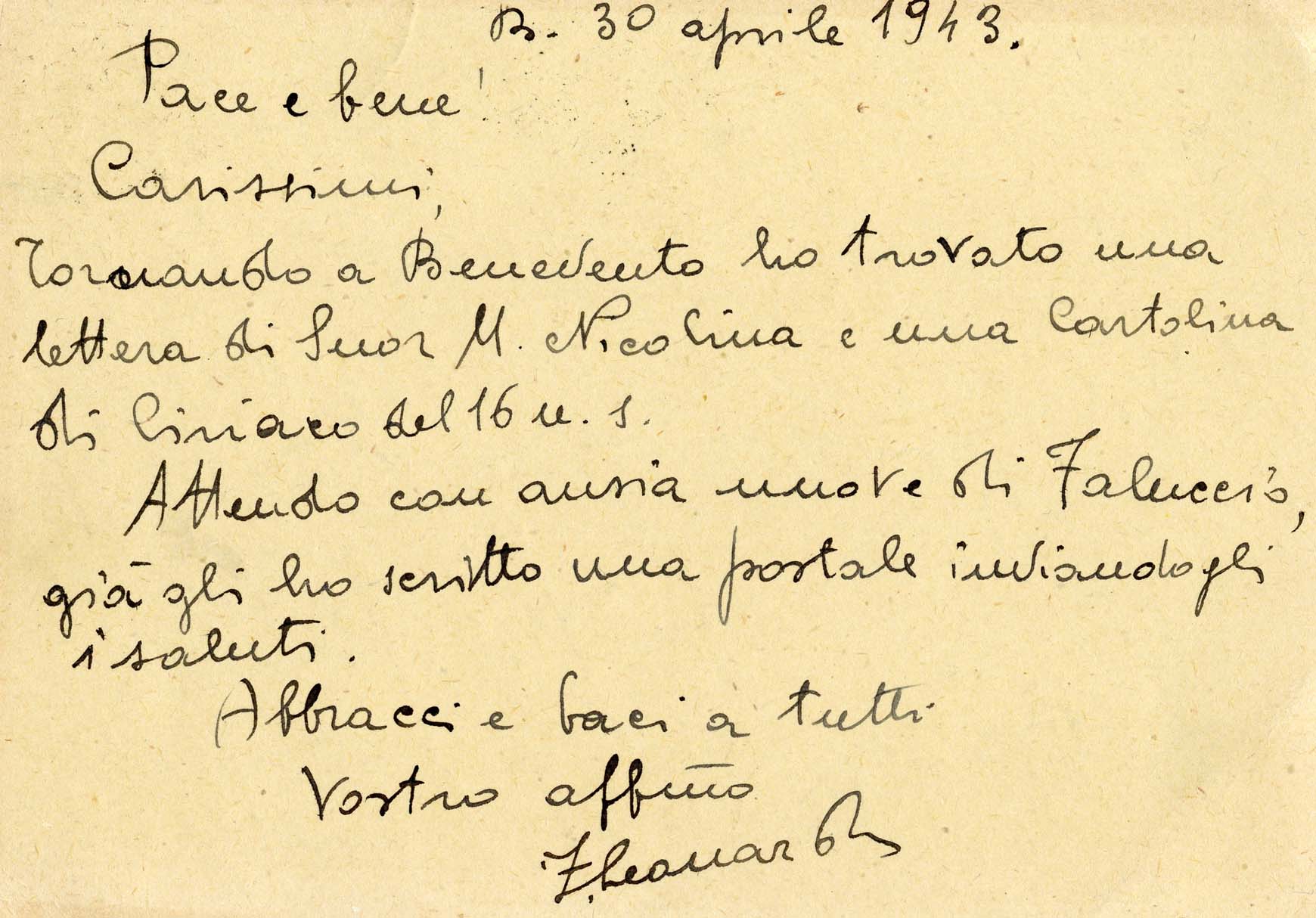
[Below: 'Vinceremo' (We Will Win). This has a censor mark. Front/reverse.]
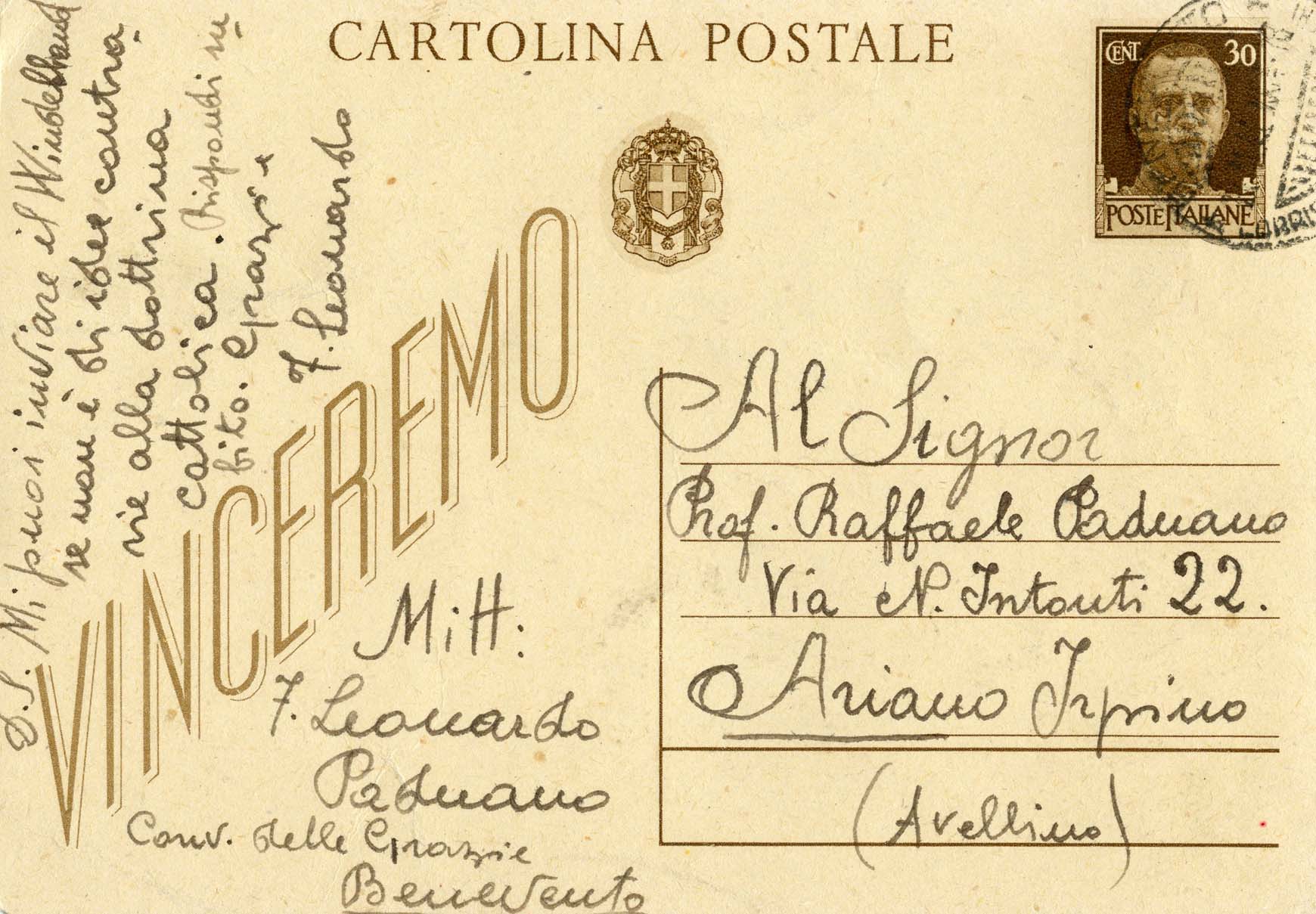
[Below: Reverse.]
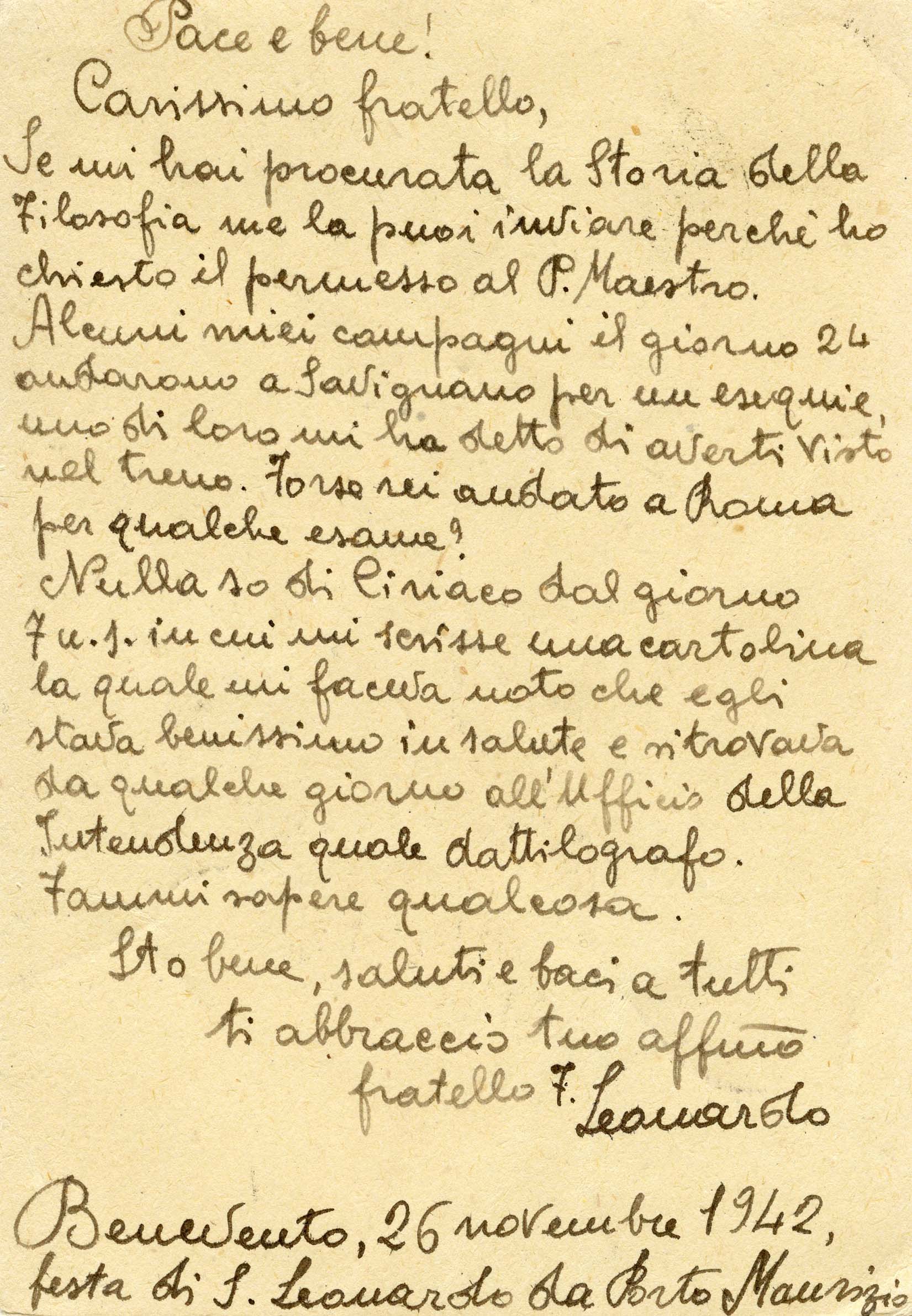
[Below: The reverse is blank.]
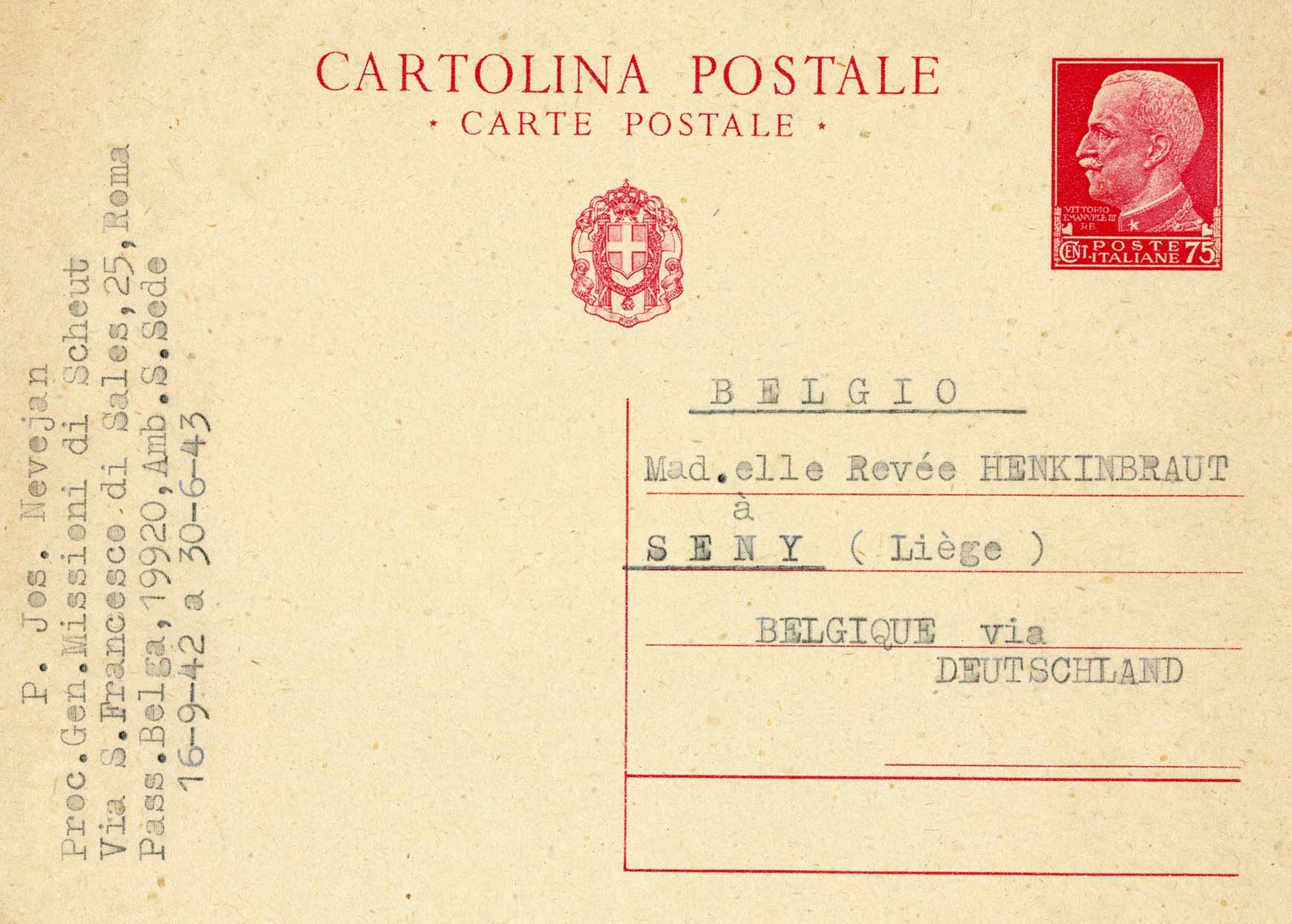
[Below: 'Vinceremo' (We Will Win). Here is an example of the slogan being crossed out. Front/reverse.]
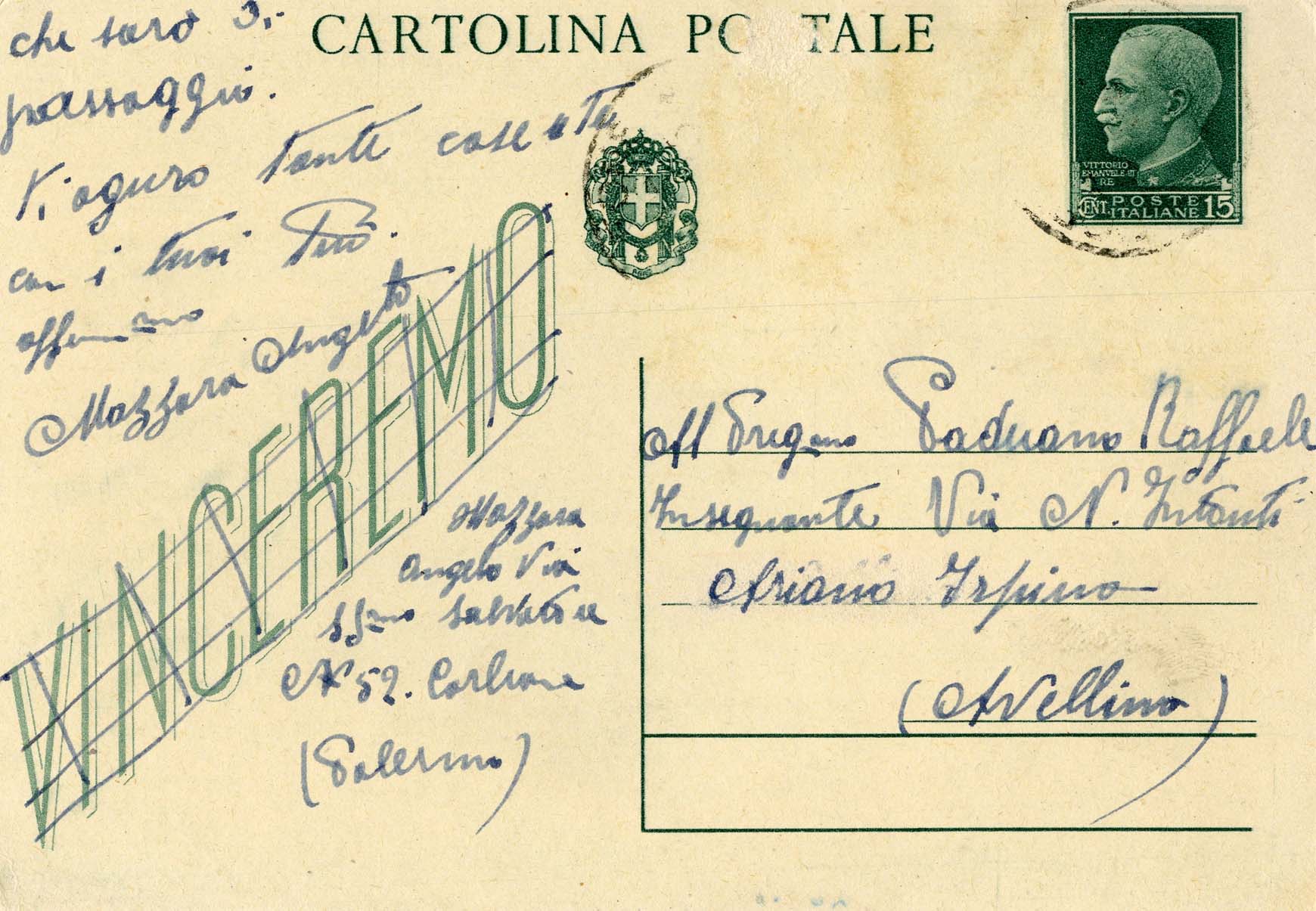
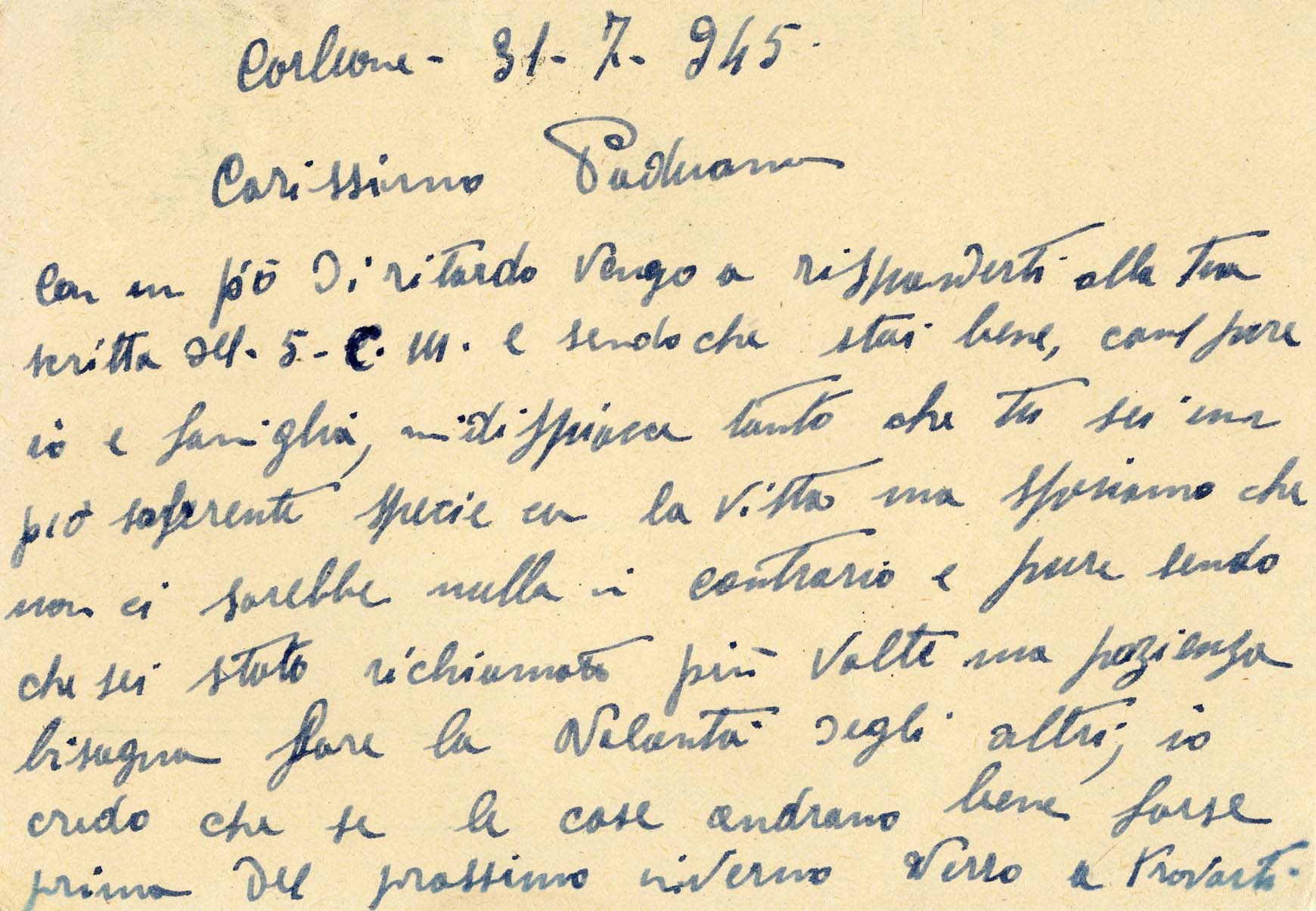
[Below: This has the autograph of a famous postage stamp forger Andre Frodel. Front/reverse.]
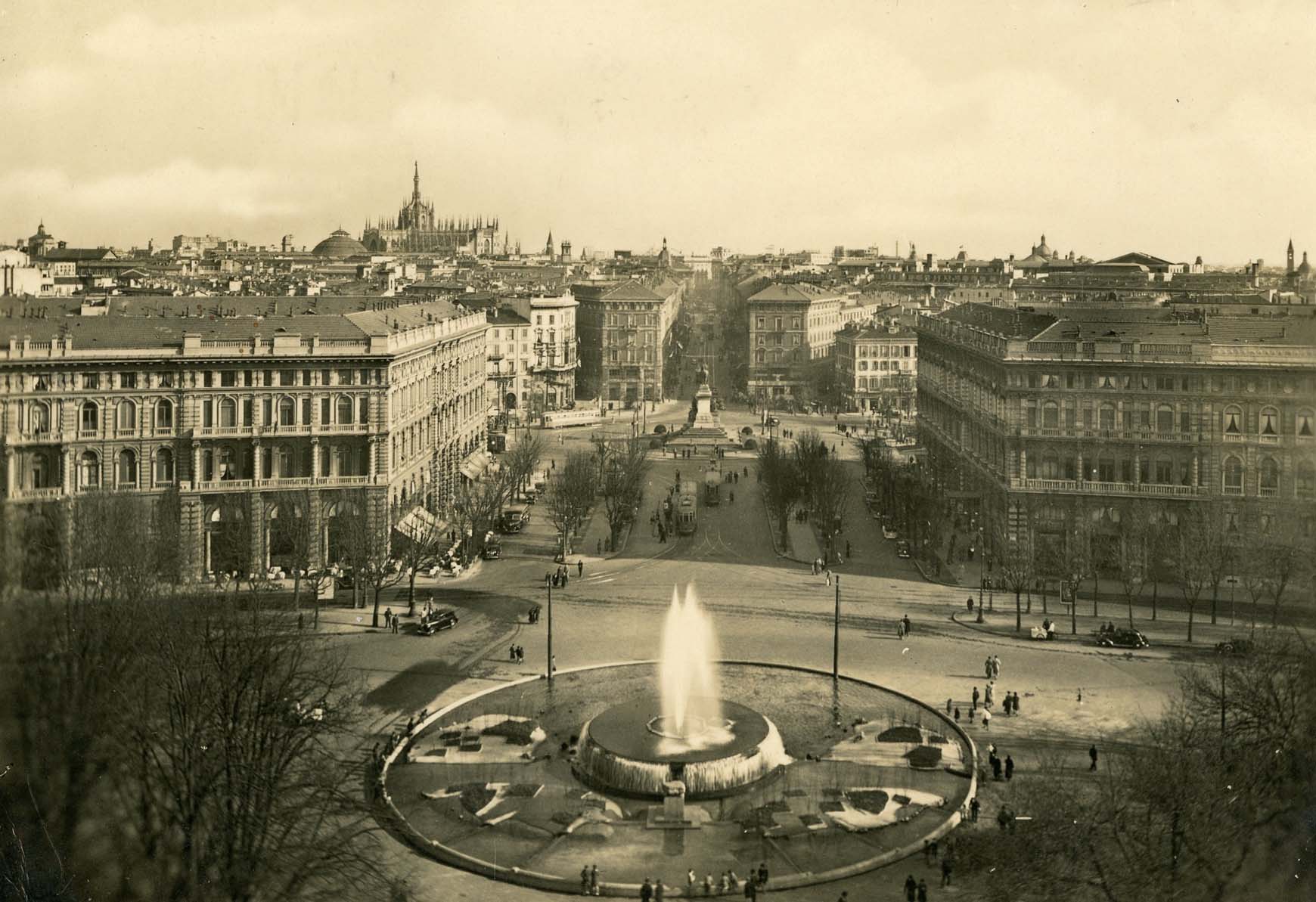
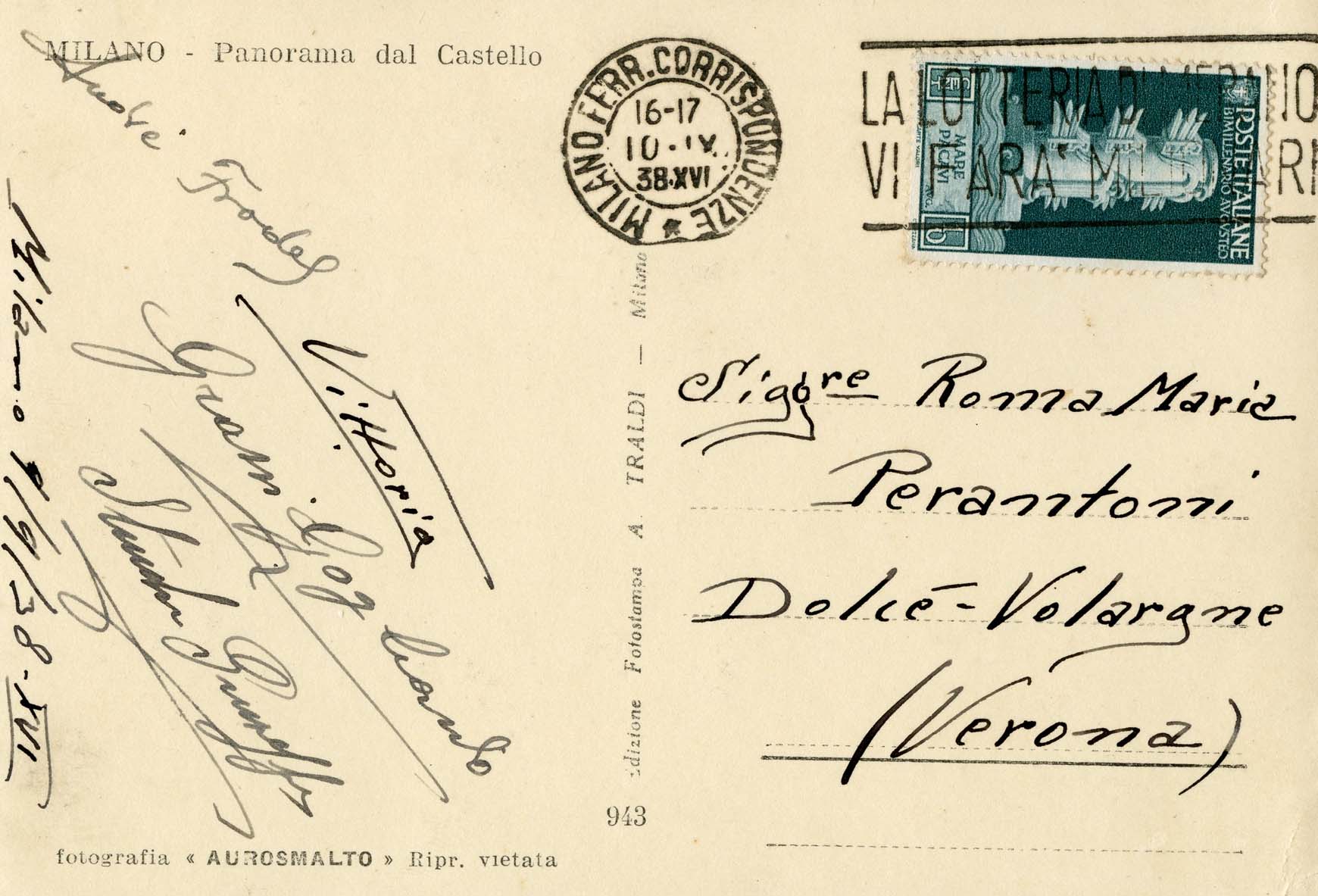
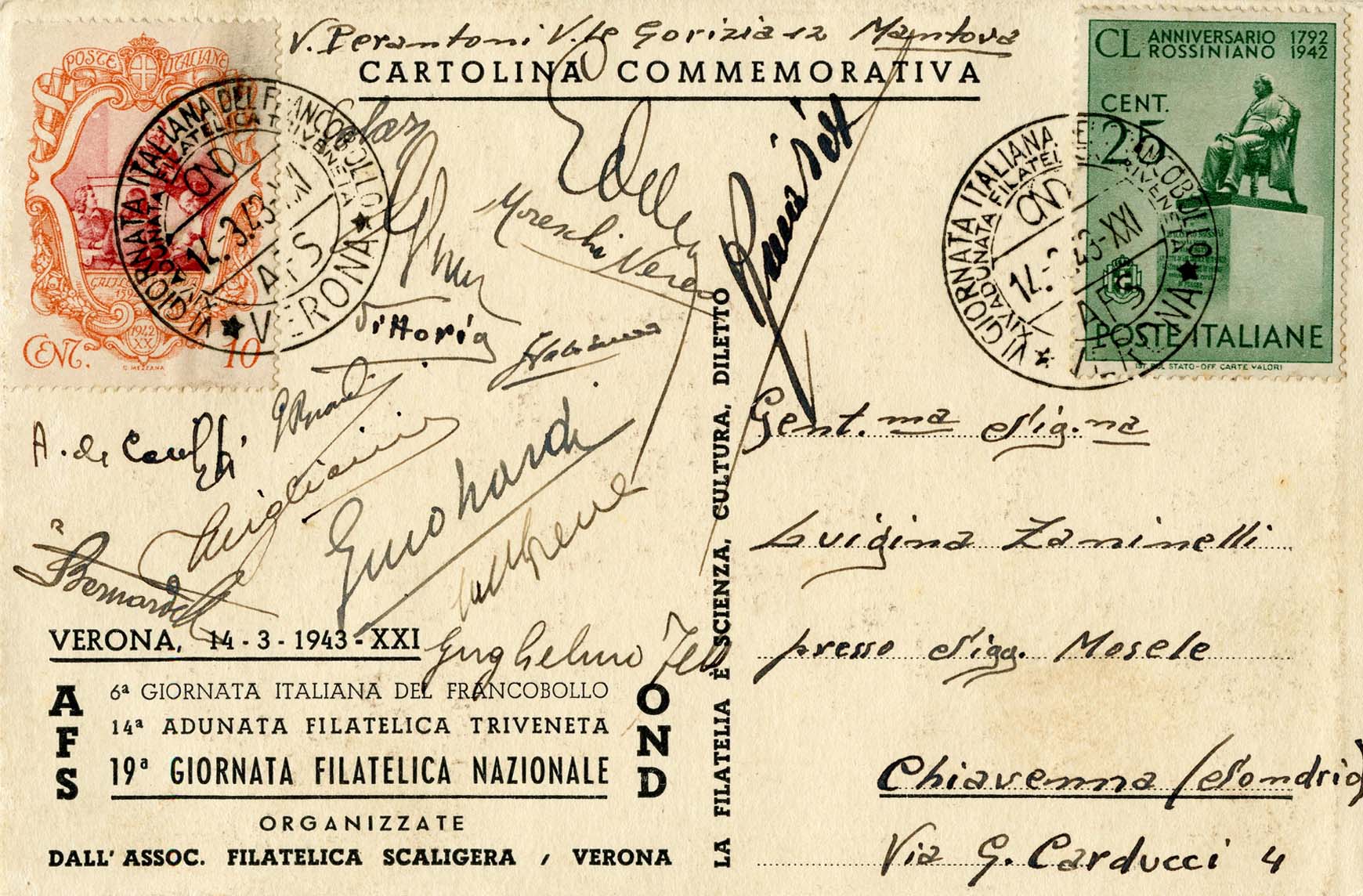
[Below: This celebrates a Verona Stamp Event by the A.F.S. Club in 1943 and has many autographs by event organizers and artists.]
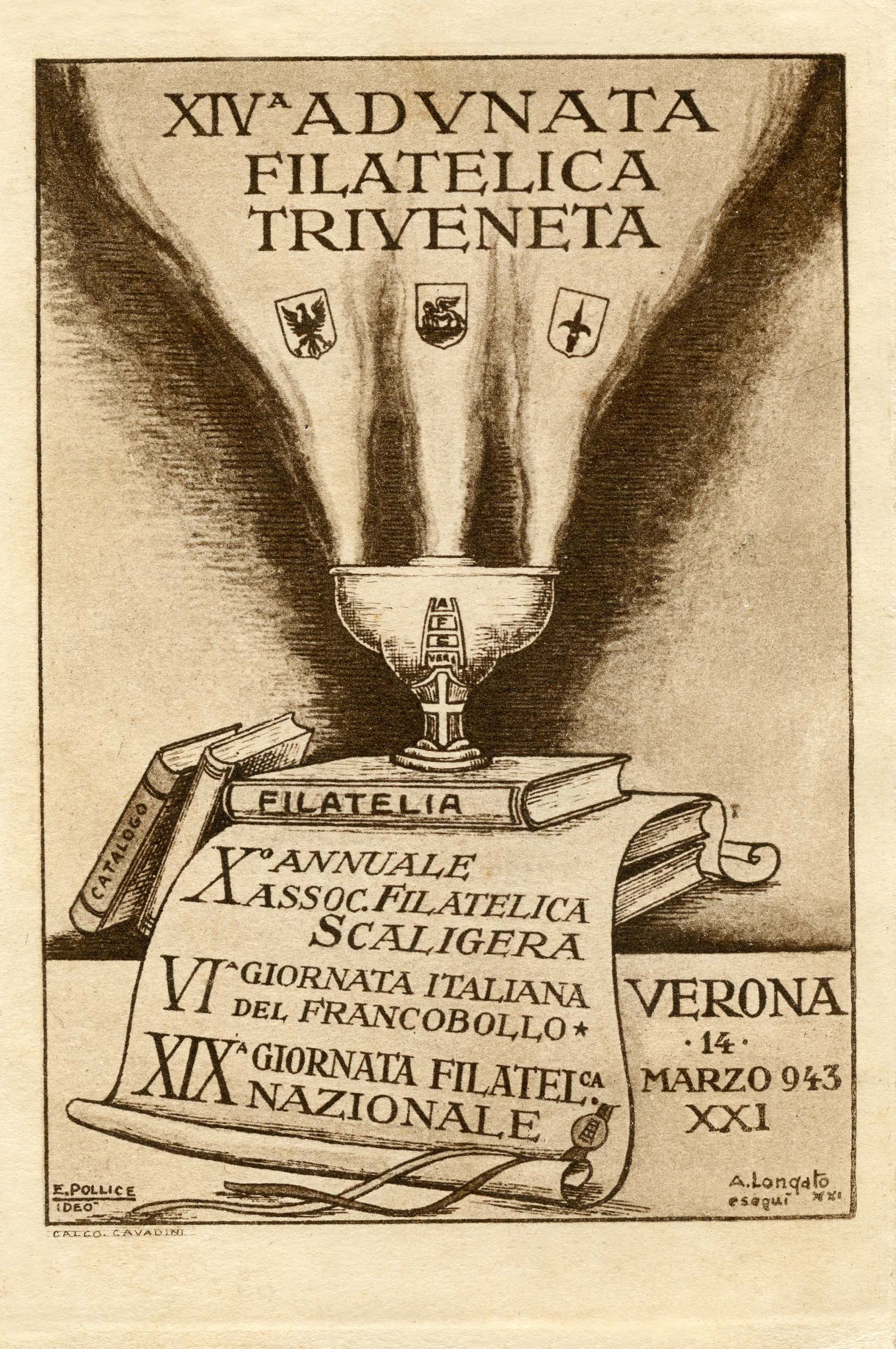
[Below: Reverse.]
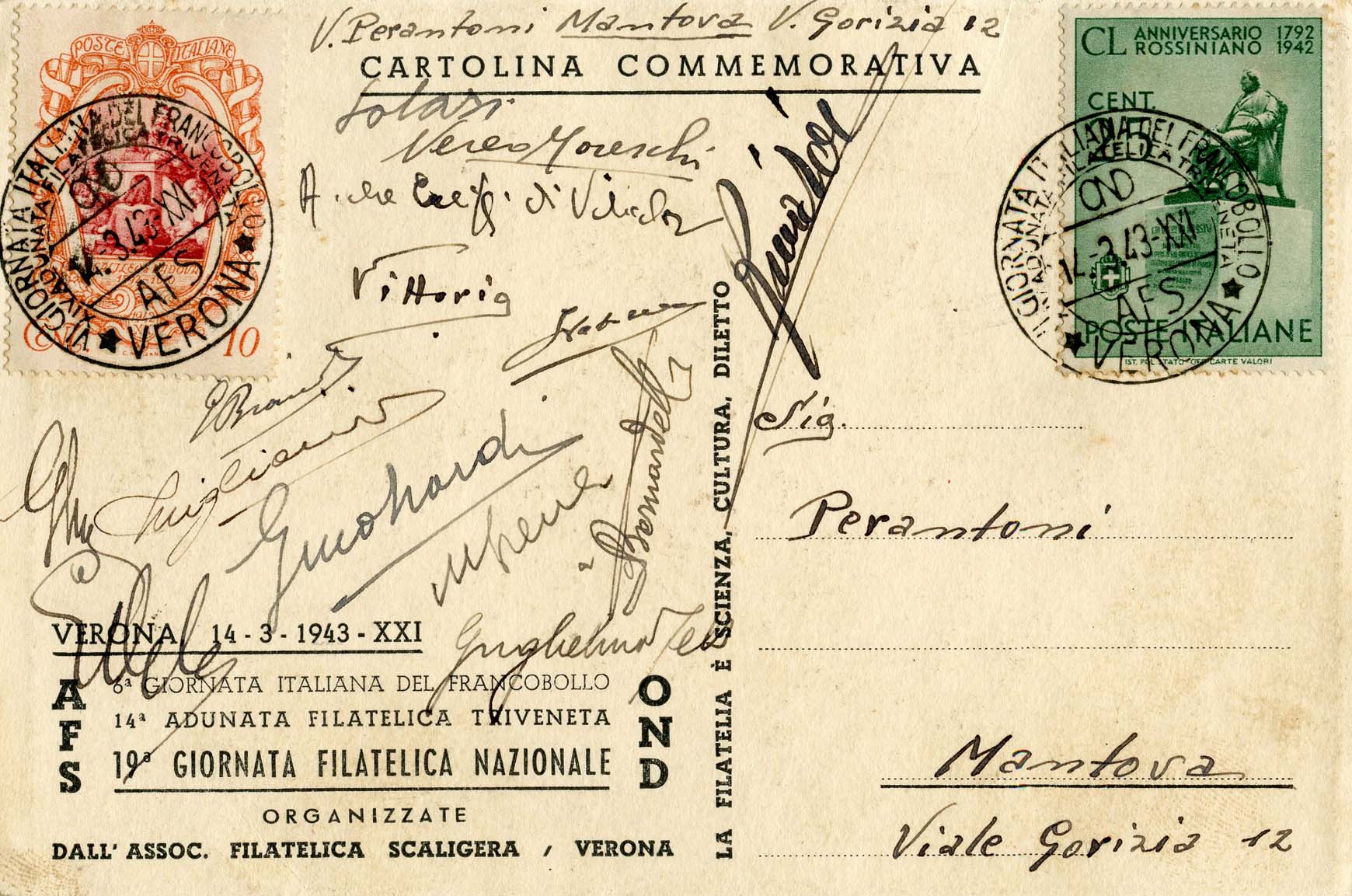
[Below: Another postcard that celebrates a Verona Stamp Event by the A.F.S. Club in 1943 and has many autographs by event organizers and artists.]
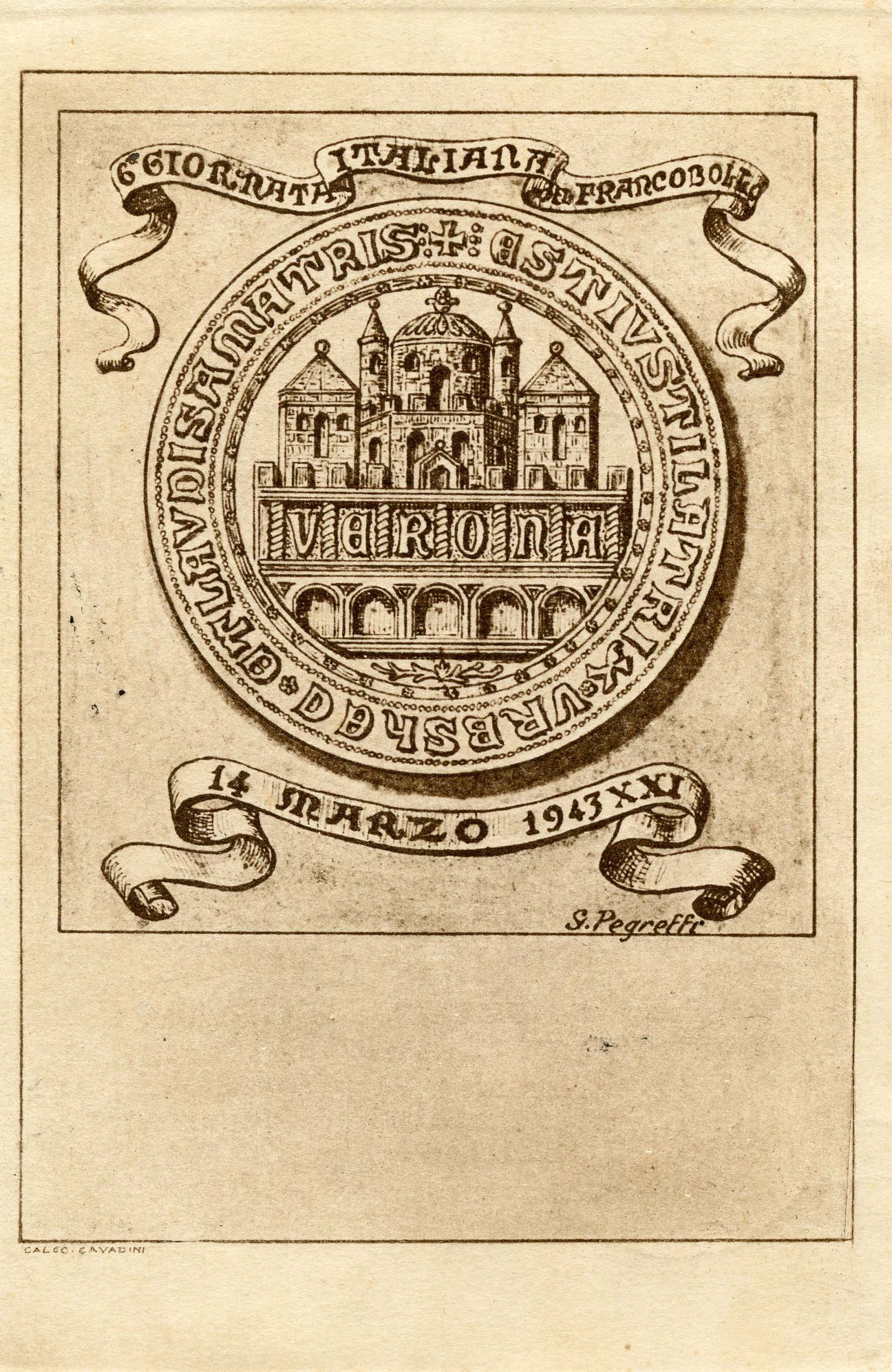
[Below: Reverse.]
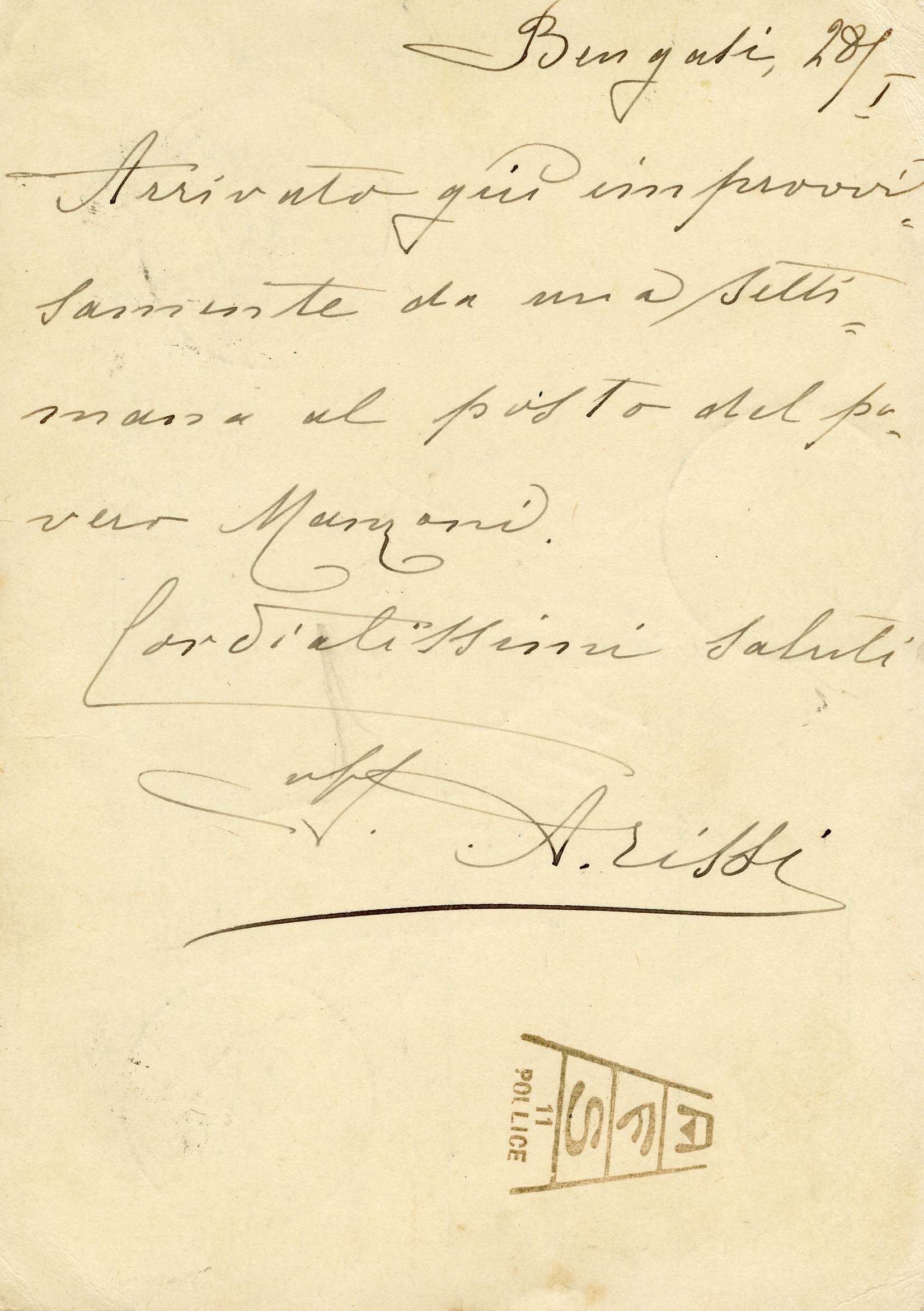
[Below: An Italian general in Benghazi, is the second-largest city in Libya, sent this Feldpost postcard to another general in Rome, February 3, 1936.]
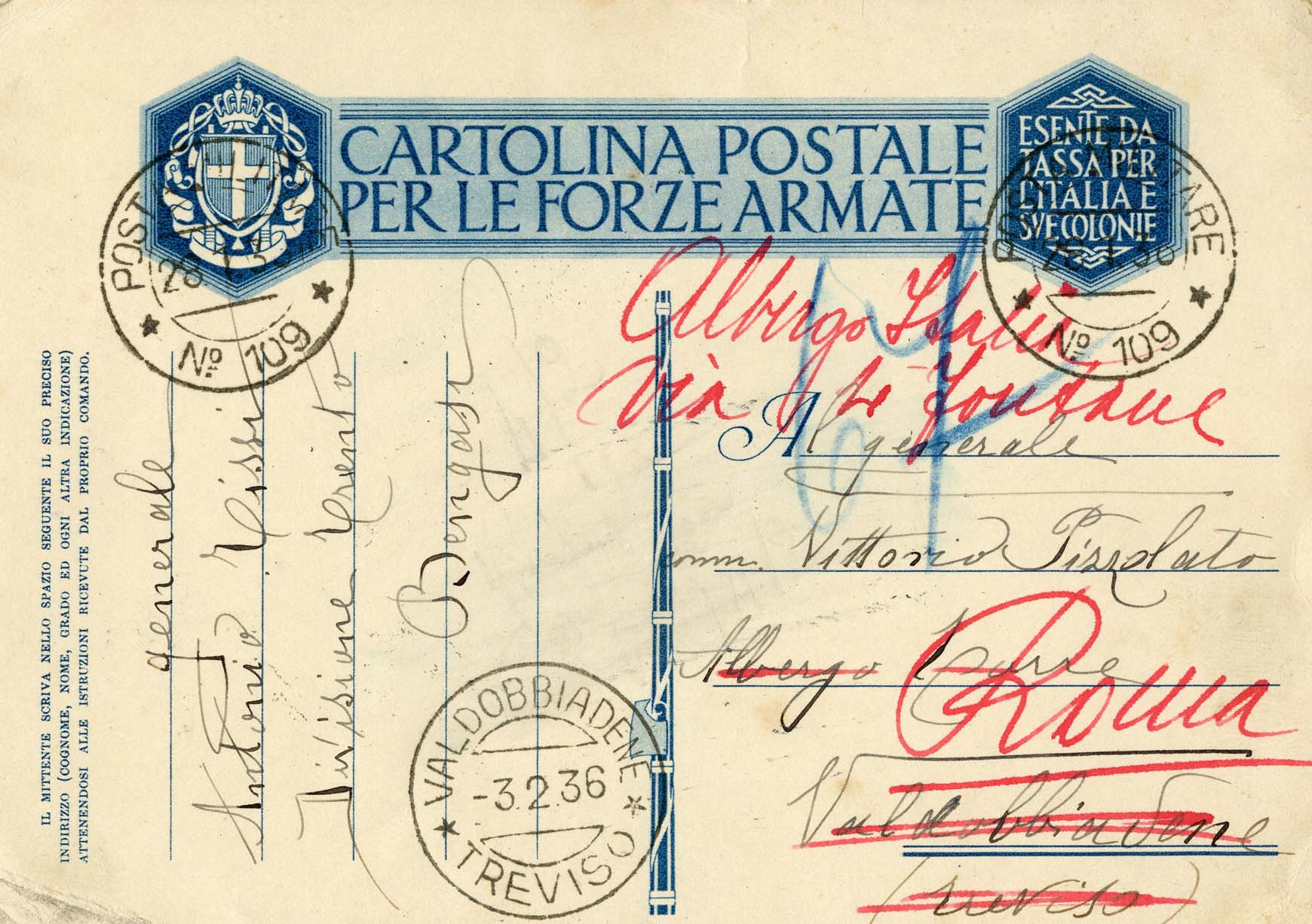
[Below: Reverse.]
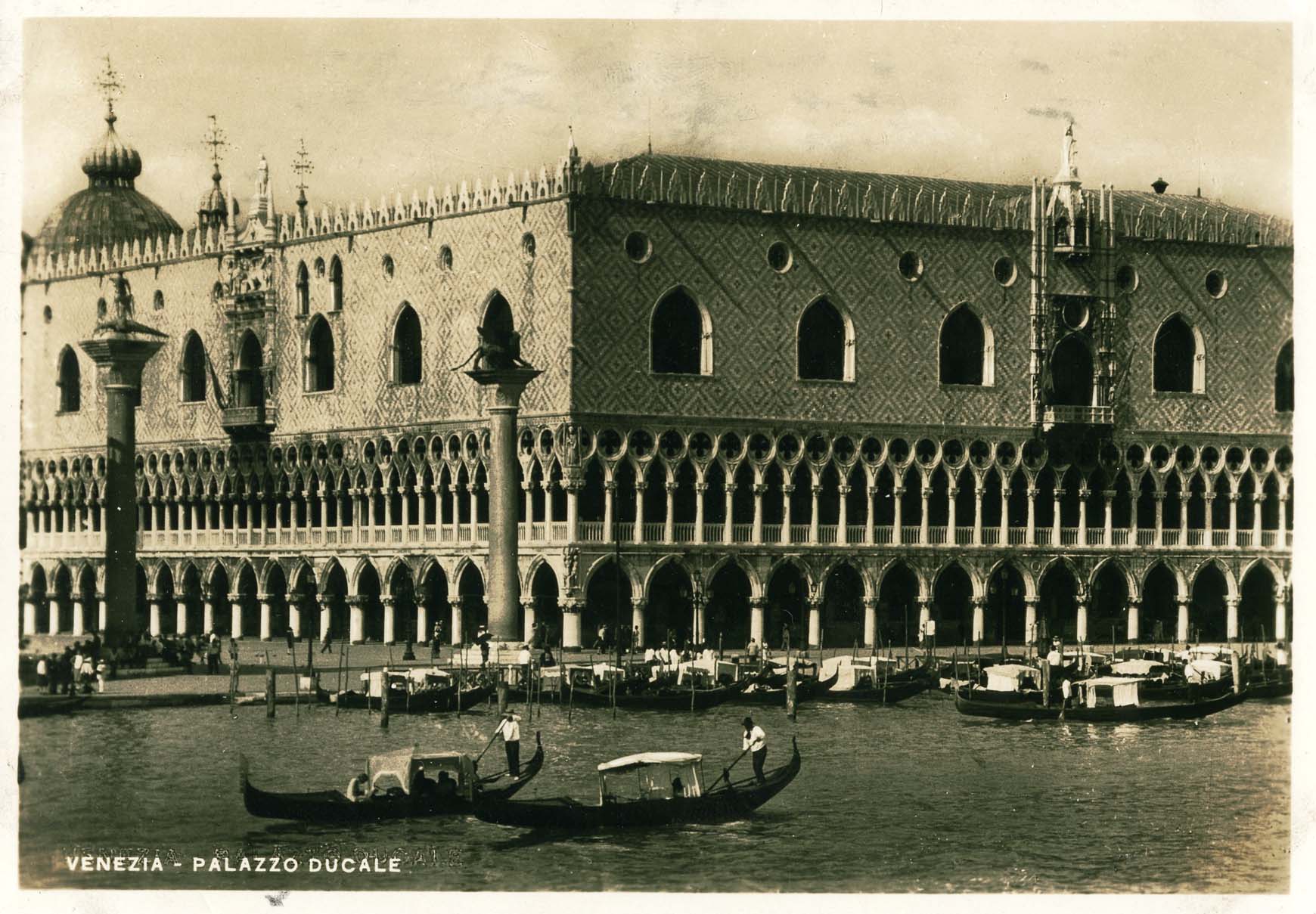
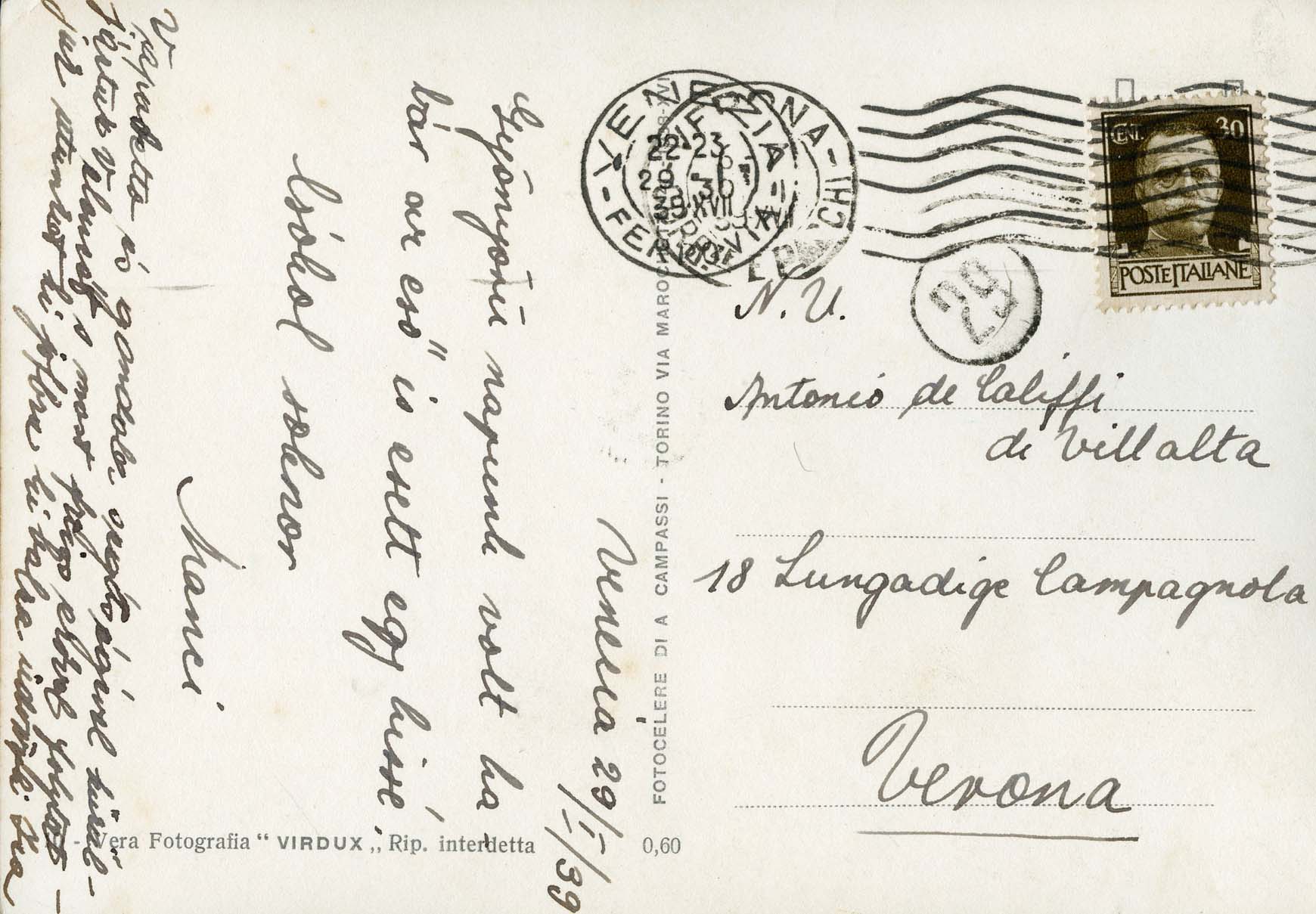
[Below: From Venice, this was written in German to Count Antonio Califfi, January 29, 1939. Front/reverse.]
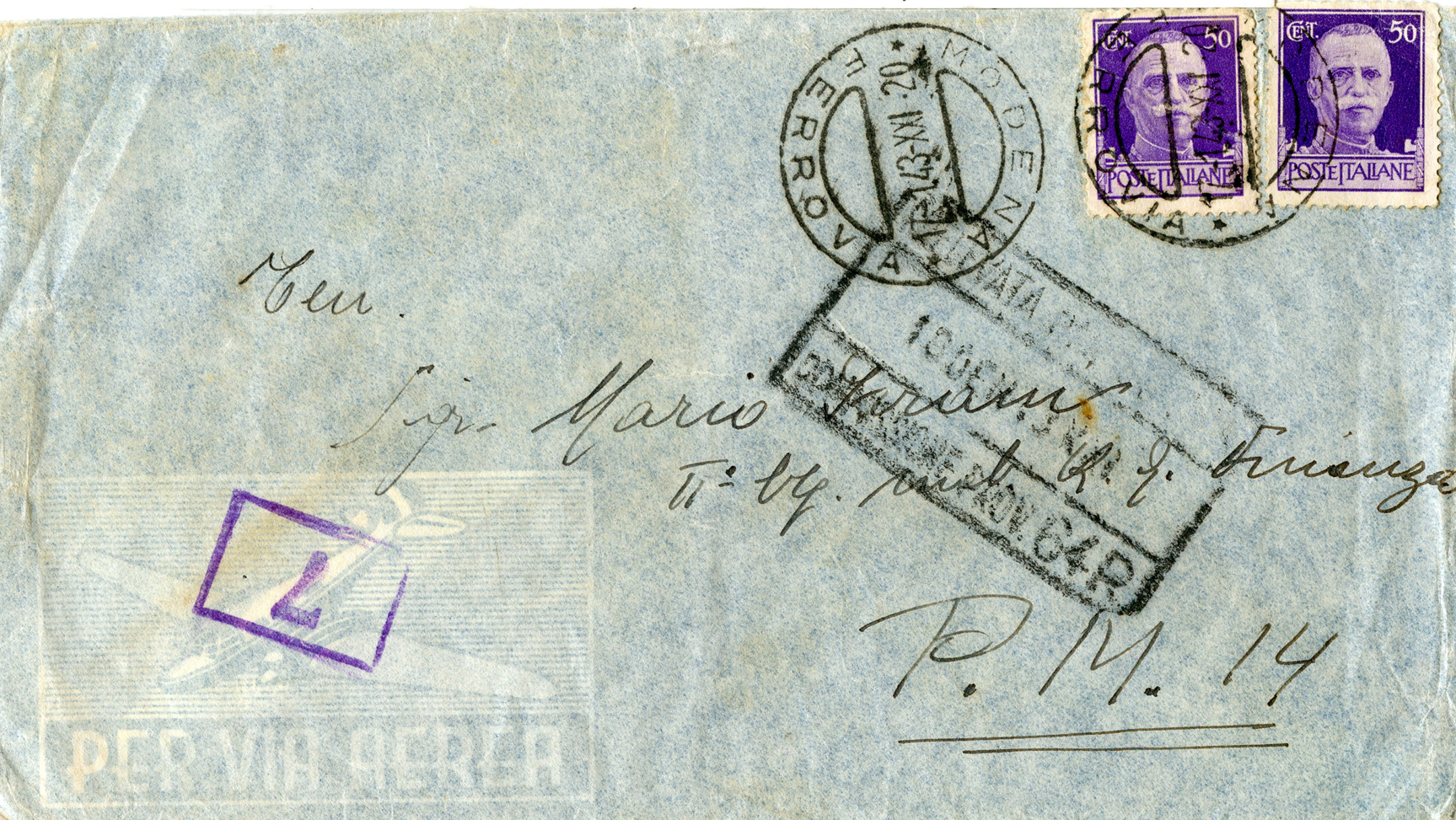
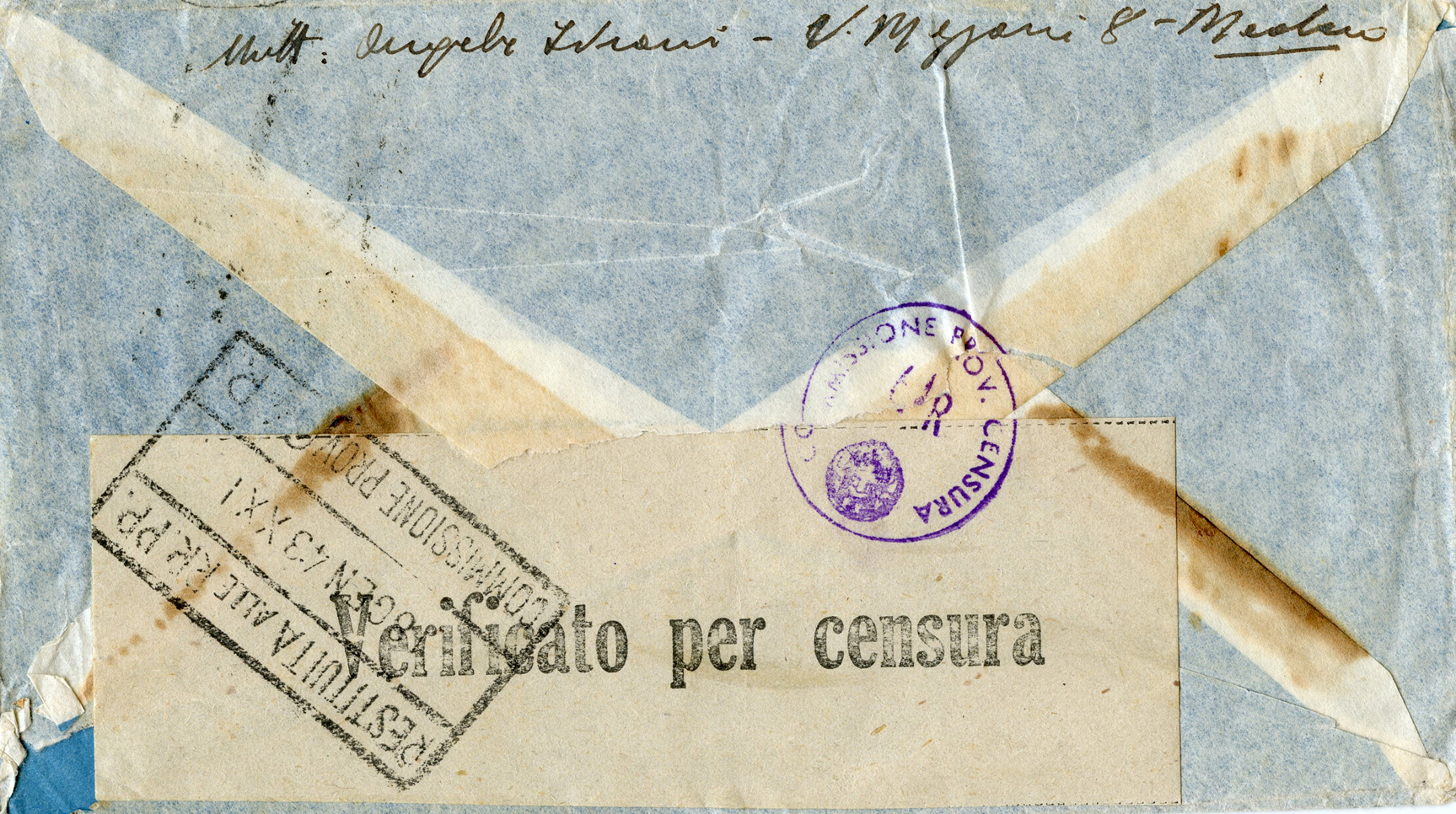
[Below: From Modena, this airmail letter was sent on January 17, 1943. It has censor marks as well, note the boxed '7' and the rectangular box. The reverse bears the same censor marks. Front/reverse.]
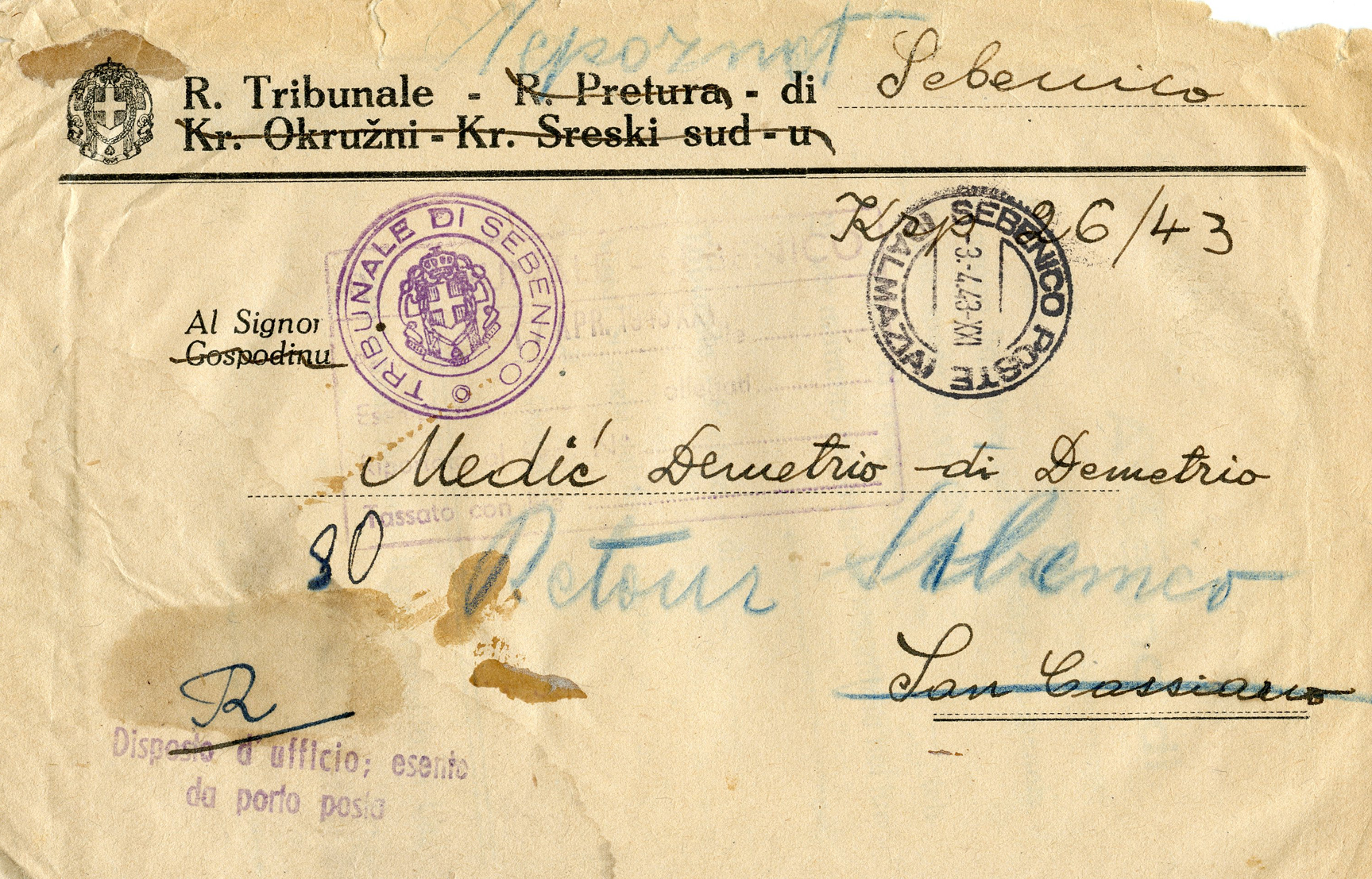
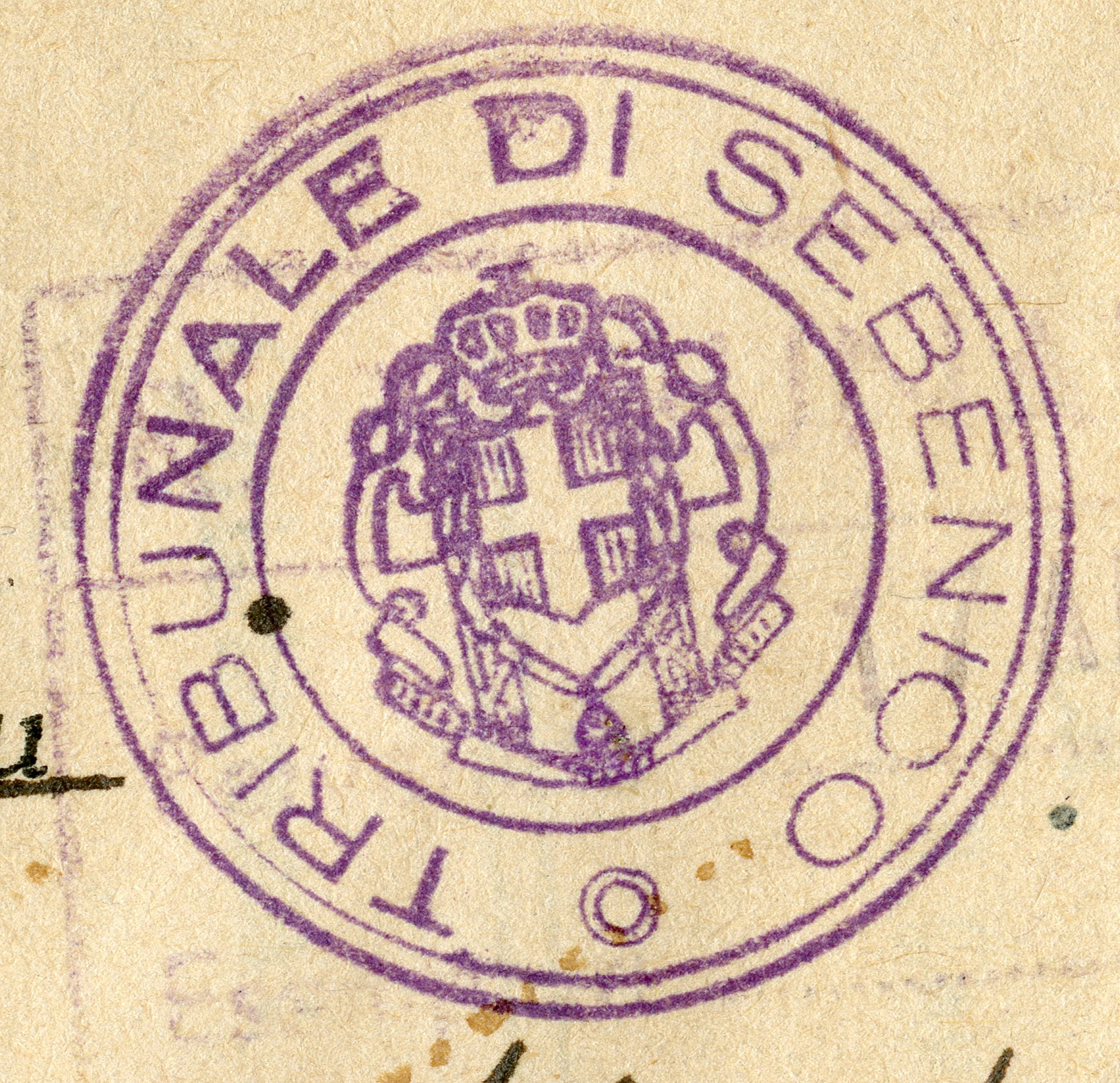
[Below: This is from a district court 'Tribunale', postmarked April 3, 1943. The stamp in the lower left corner says that it is official and exempt from postage requirements. This bears the cancel of Sebenico, which is the Italian spelling for Šibenik, a historic port city located in Croatia along the Adriatic Sea. It was annexed by Italy from 1941 to 1943 as part of the Province of Zara. Following Italy's surrender in September 1943, the German Wehrmacht occupied the city.]
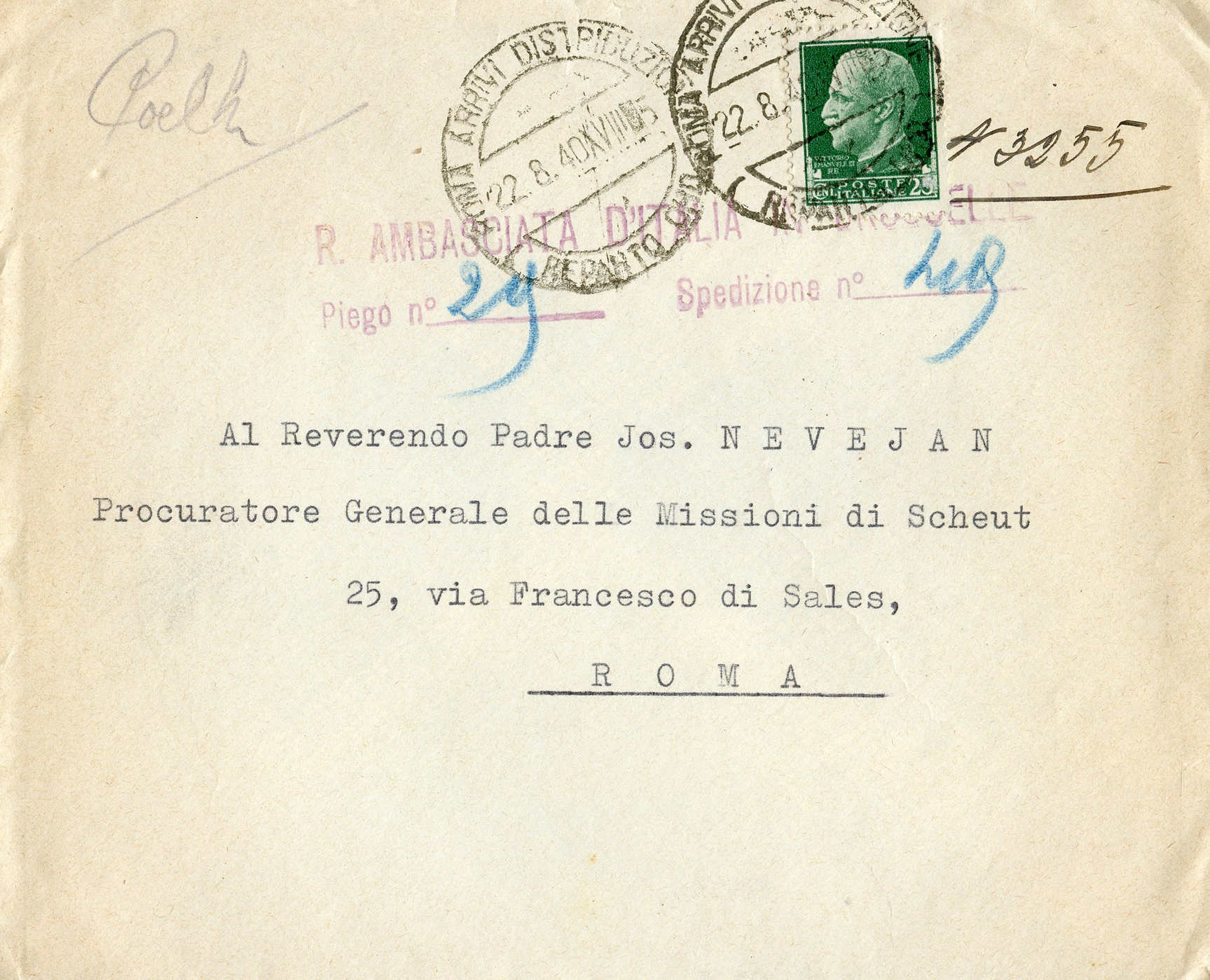
[Below: This is addressed to a Reverand in Rome, postmarked August 22, 1940. It is sent from the Office of Italian Consular Affairs in Belgium.]
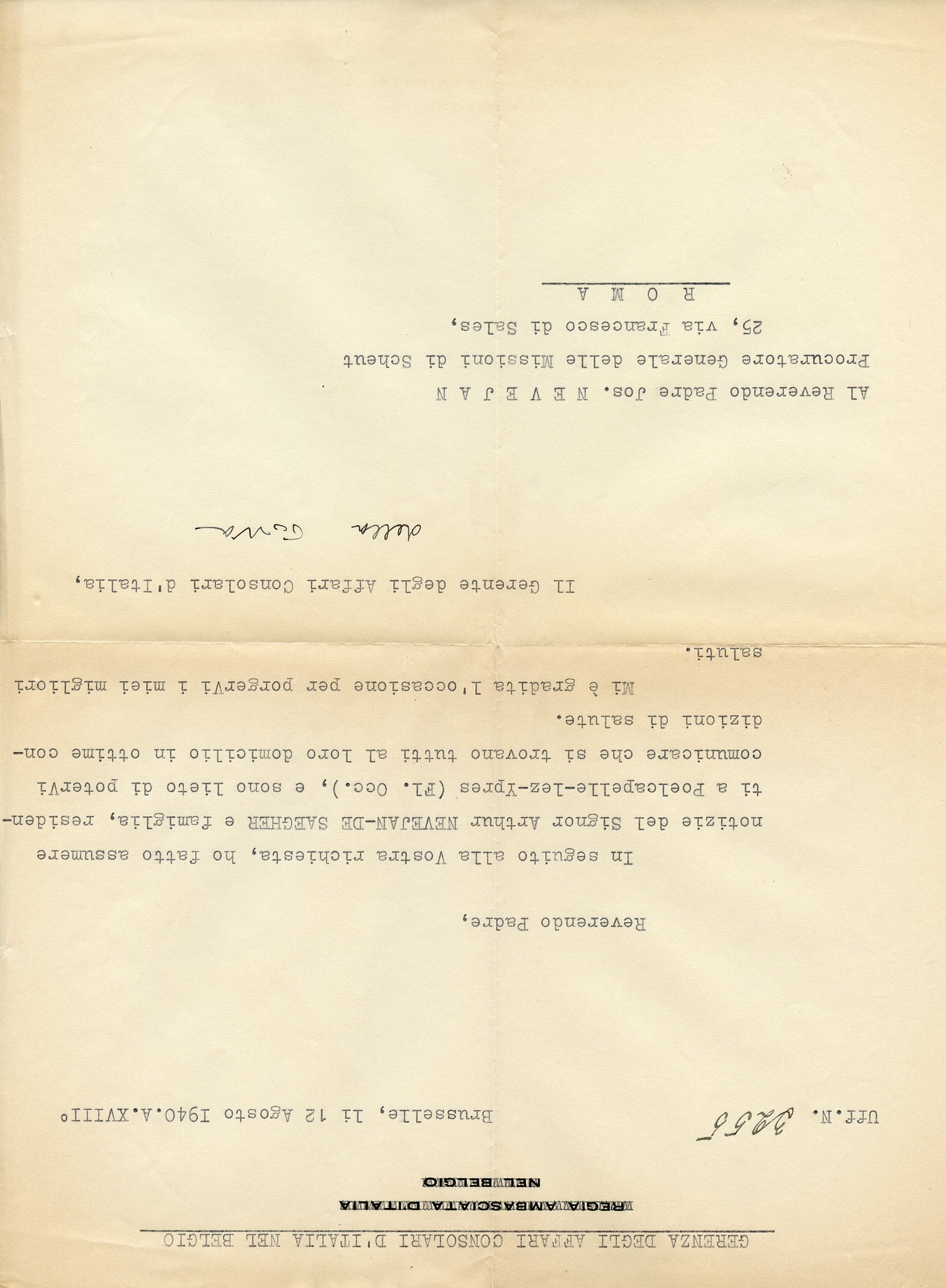
[Below: The envelope opens into a letter from the Director of Consular Affairs of Italy.]
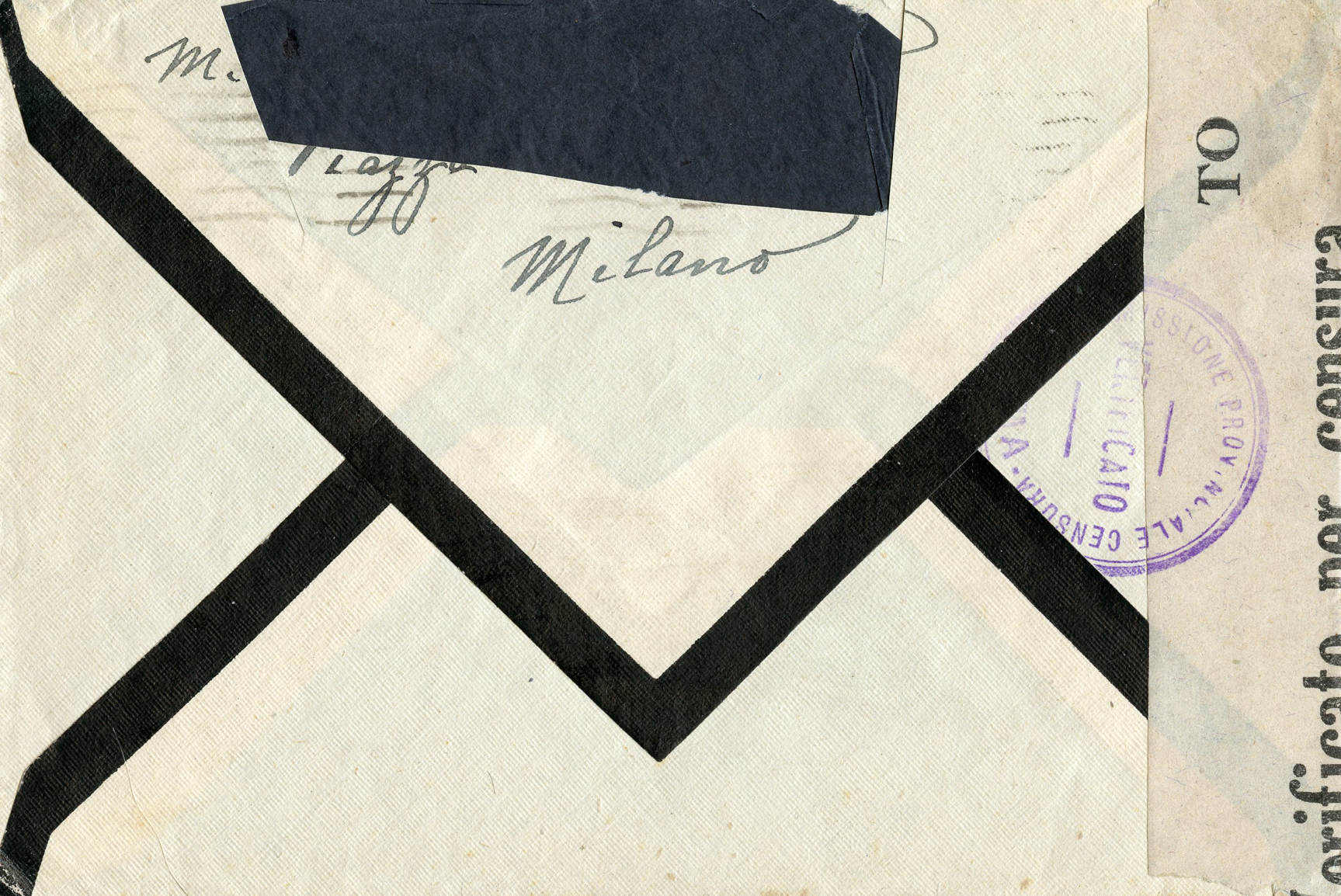
[Below: This envelope has a black border, signifying mourning. It was sent from Milan to Philadelphia, postmarked January 17, 1941. Also note this has a censor mark and censor tape. Front/reverse.]
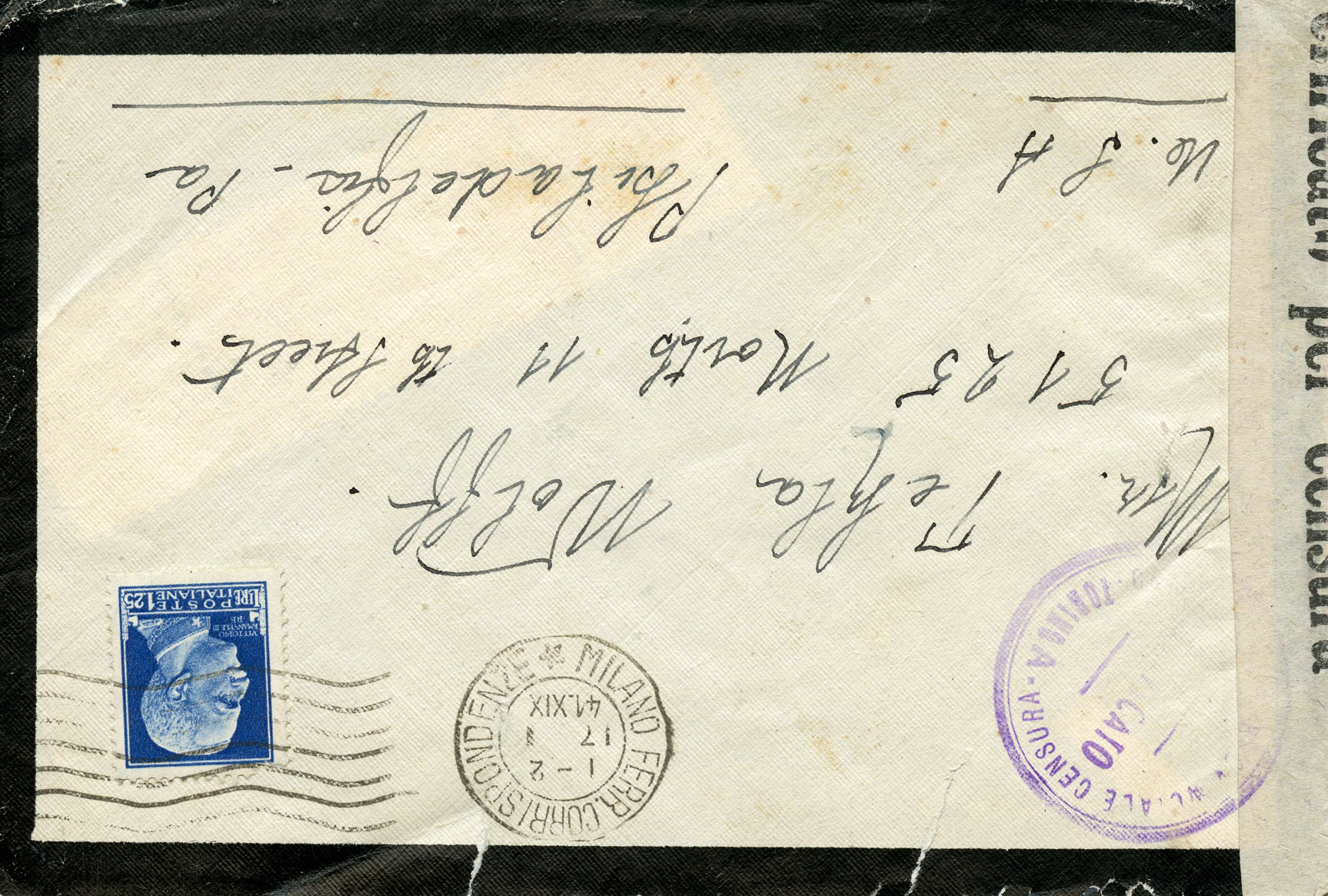
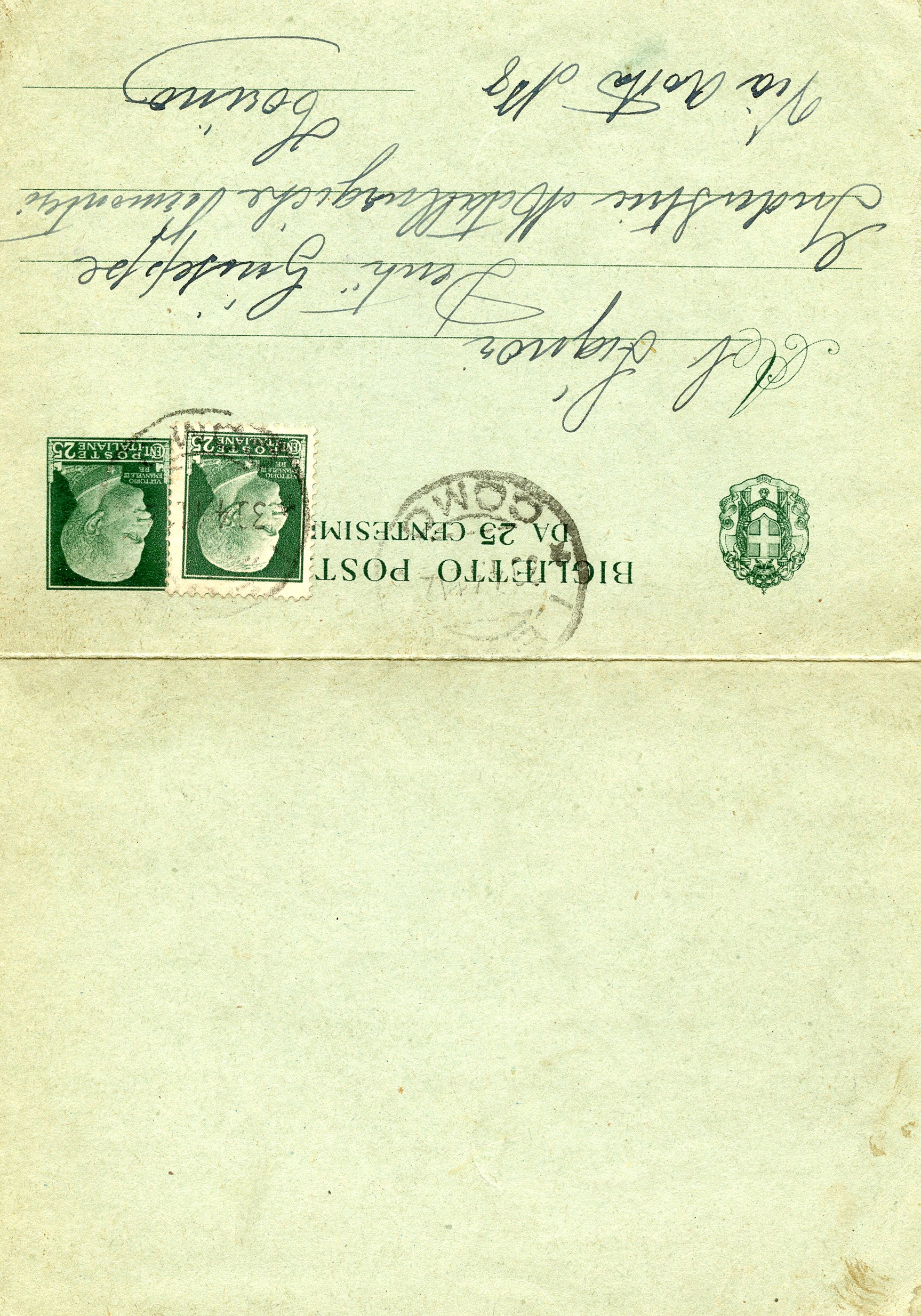
[Below: This was postmarked on April 30, 1941 and sent to Industrie Metallurgiche Piemontesi (Piedmontese Metallurgical Industries) in Turin.]
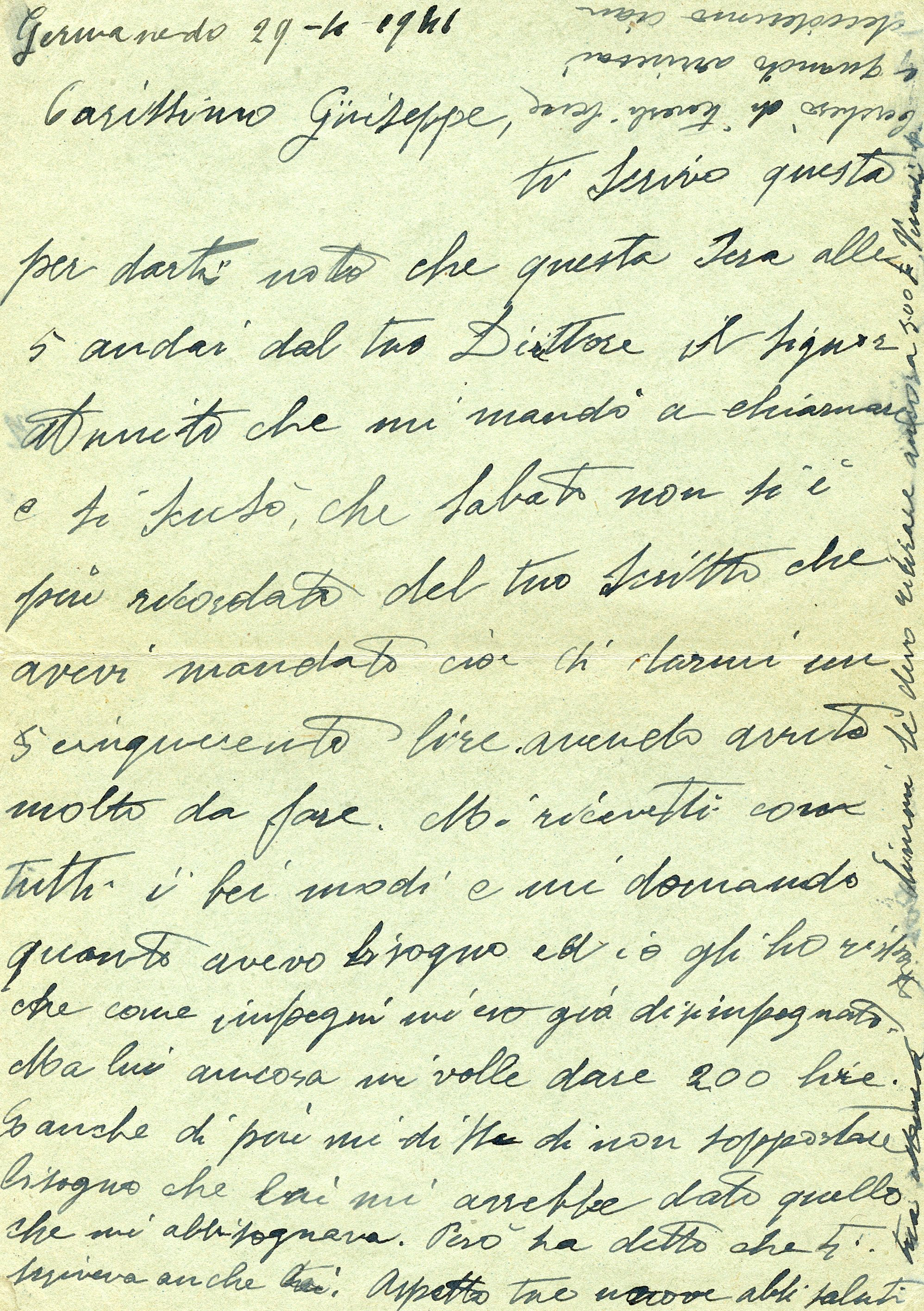
[Below: Inside.]
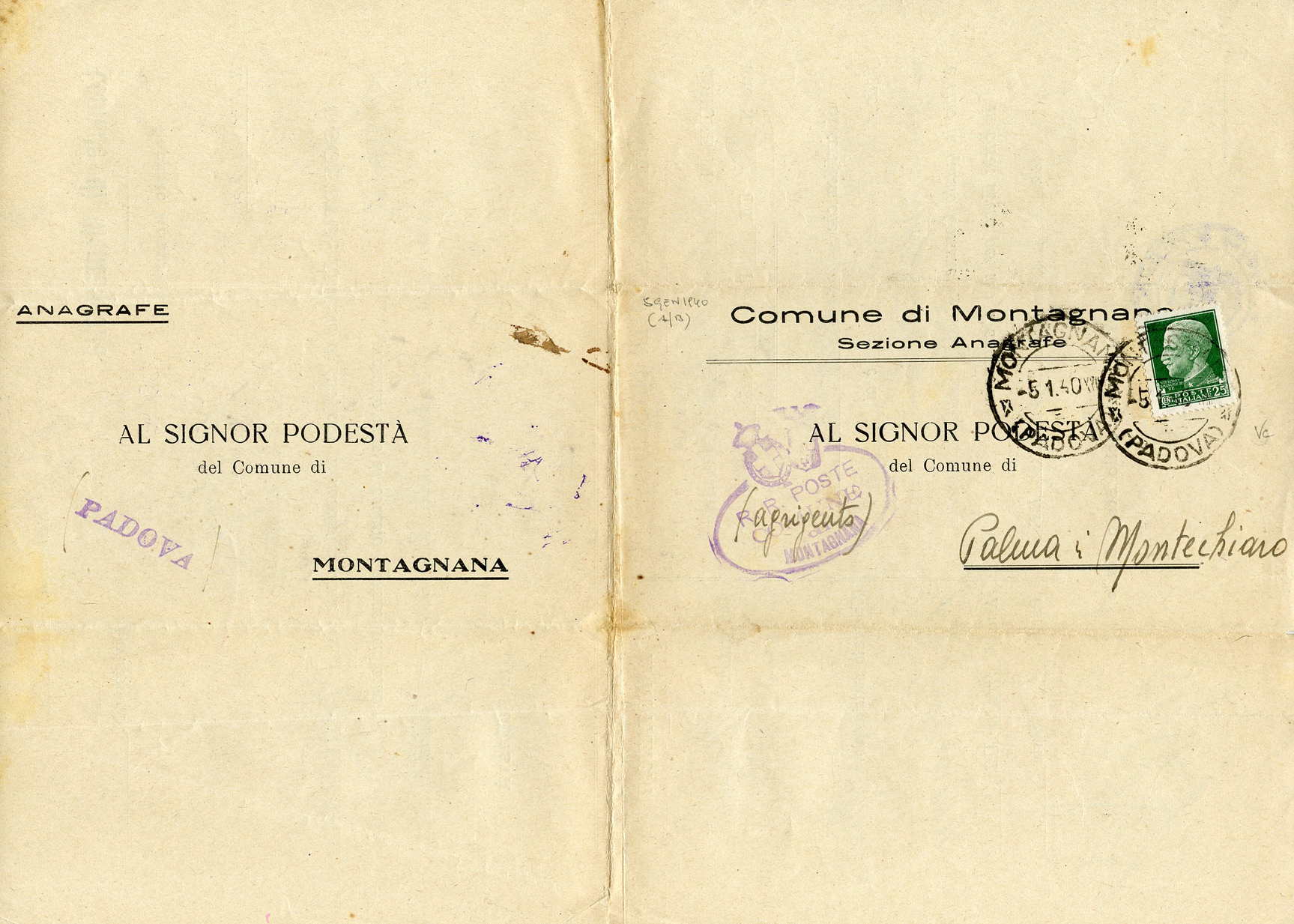
[Below: This is a document folded like an envelope, postmarked January 5, 1940. Note that after the war the fasces on either side of this popular postage stamp set were removed.]
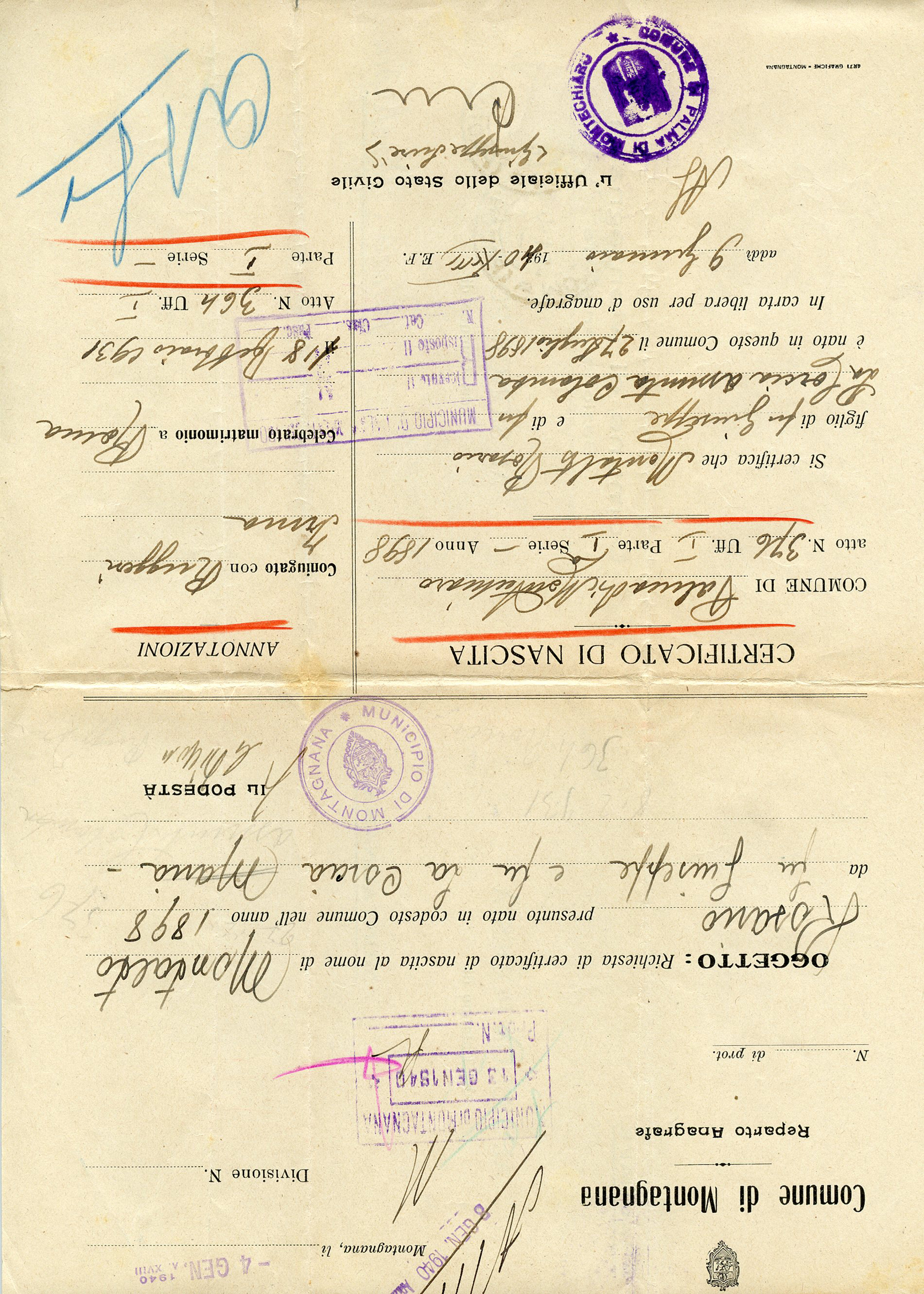
[Below: Inside. This is a request for a birth certificate.]
[Below: This is a document folded like an envelope, postmarked March 17, 1943. Next to the 1940 date at the bottom, you can see "XVIII E.F." (Era Fascista), denoting the 18th year of the Fascist regime.]
[Below: Inside. This is a formal request from the local mayor (Il Podestą) for a citizen's records to process a war pension. The purple stamp includes the Fascist calendar year 'Anno XXI' (the 21st year of Fascist rule, which began in October 1922).]
[Below: This document is a formal hospital expense reimbursement request from June 1942. This comes from a historic religious-run hospital (founded in the 16th century, this historic institution operated a major hospital complex that cared for the poor, pilgrims, and convalescents.) located in Naples to a rural municipality to collect payment for a resident's medical stay. The top right stamp reads 3 GIU 1942 XX (June 3, 1942). The roman numeral XX represents the 20th year of the Fascist Era. The hospital notes that a woman remained hospitalized for 9 days. The charge: the daily rate is 25 Lire, totaling 225 Lire.]
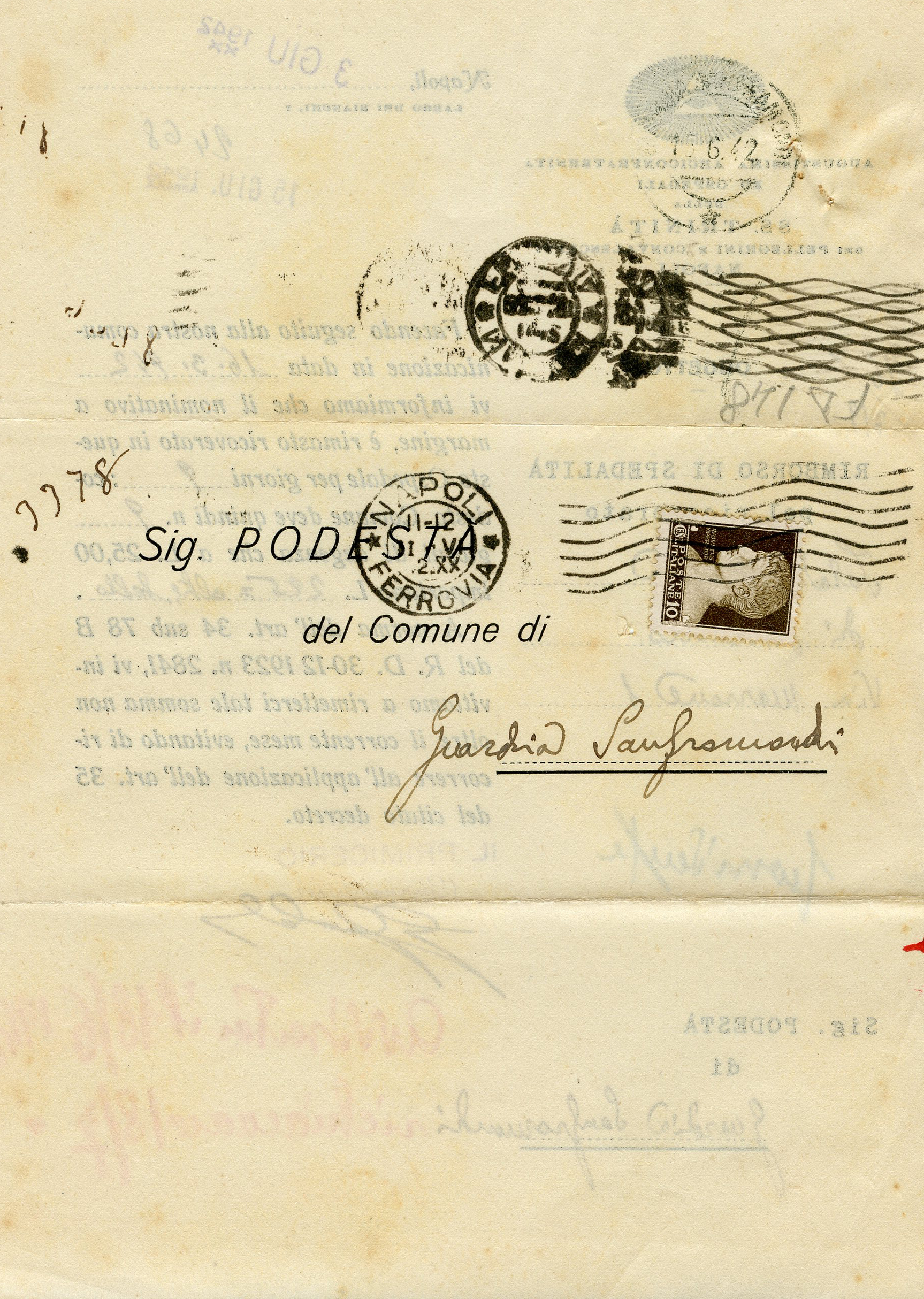
[Below: Inside.]
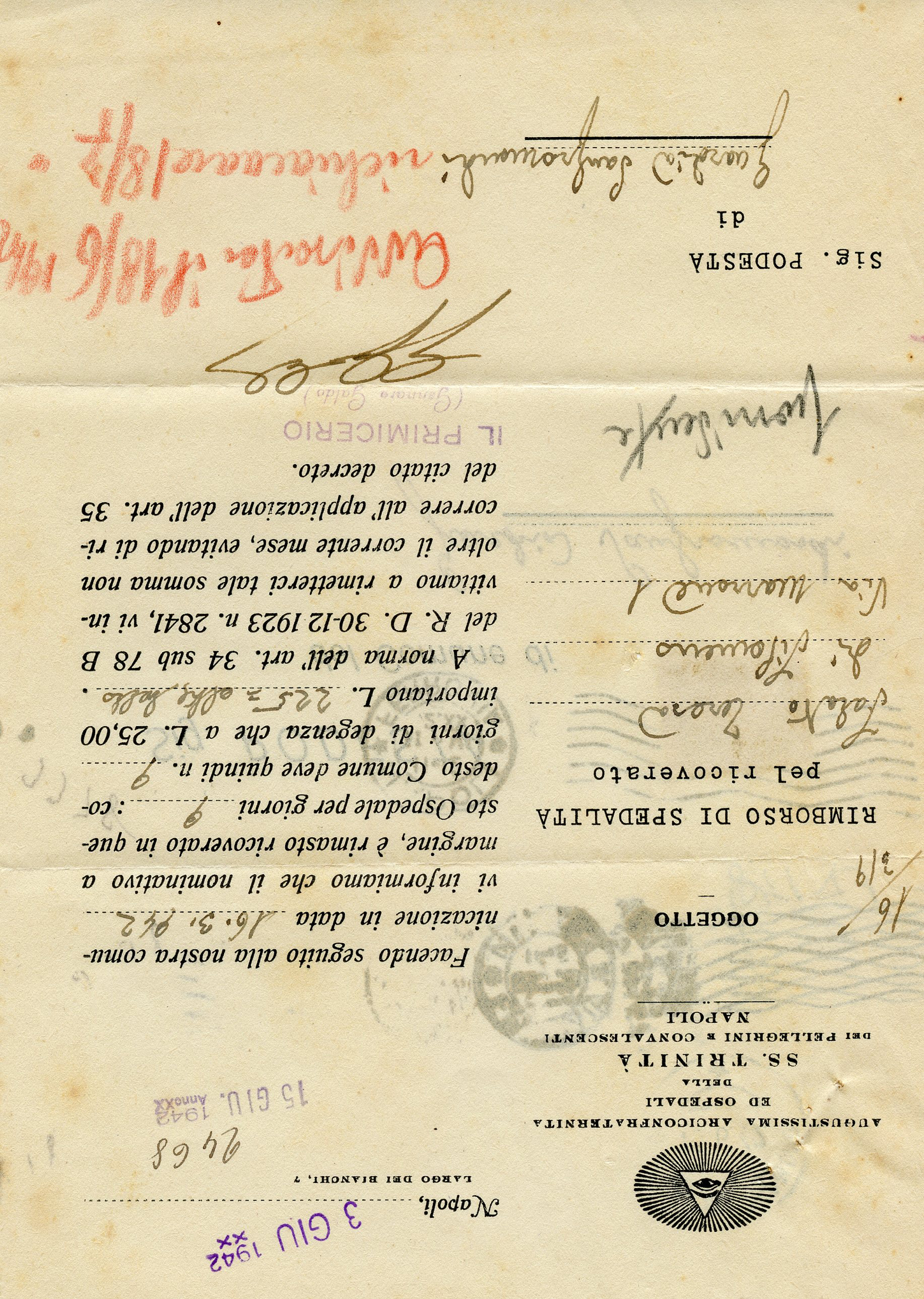
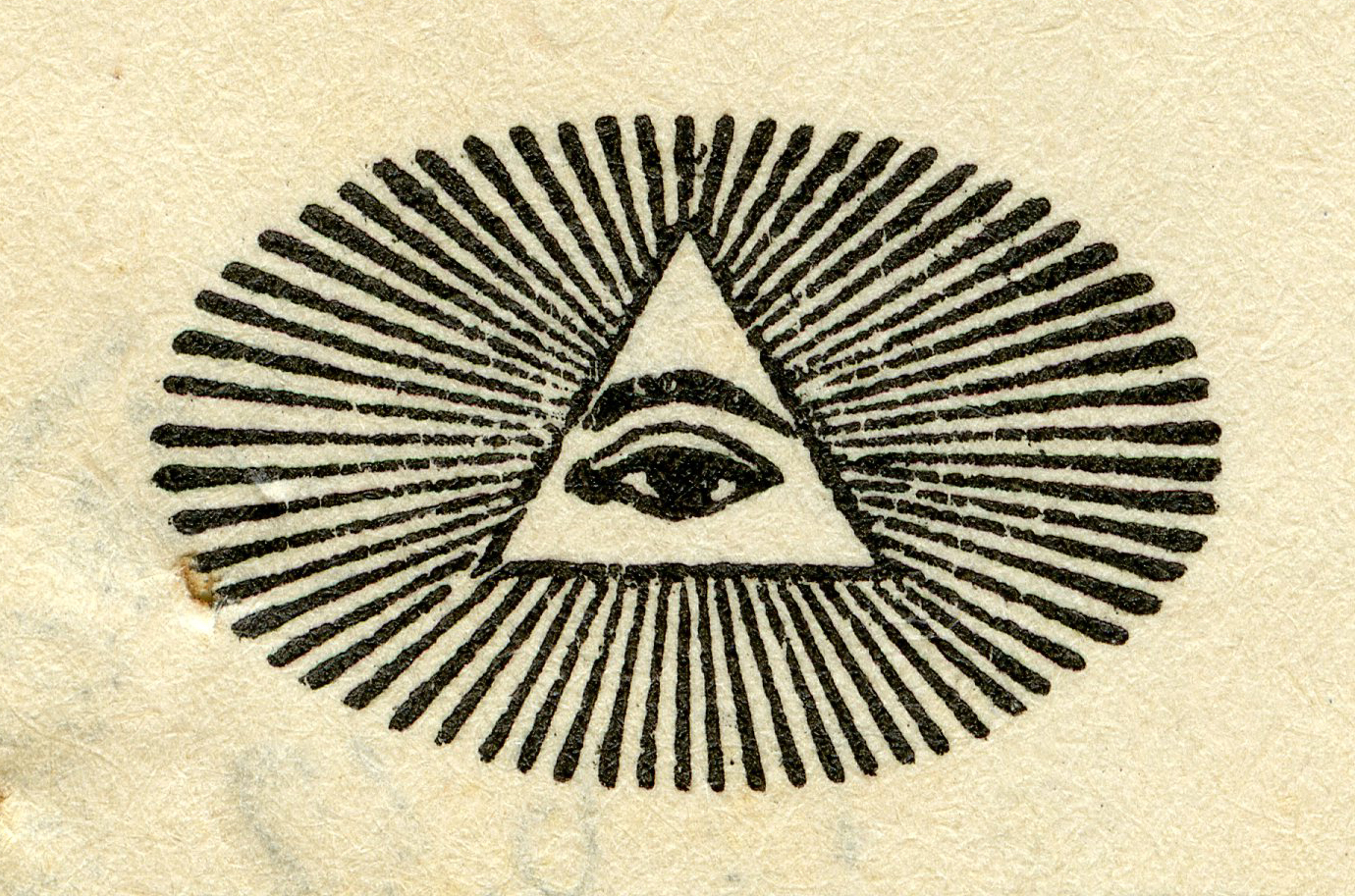
[Below: The All-Seeing Eye is watching you...]
[Below: This document is a dated June 1942.]
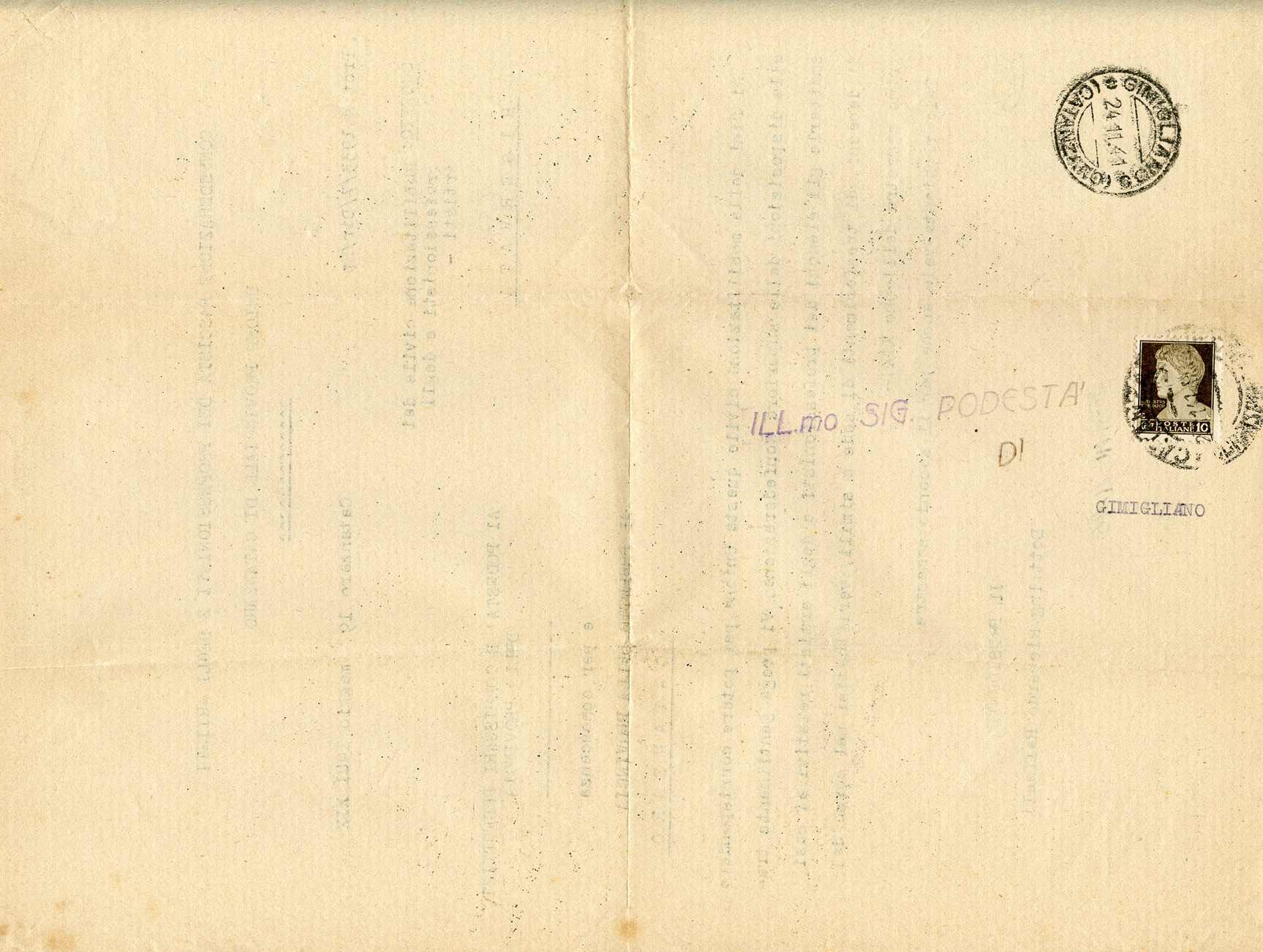
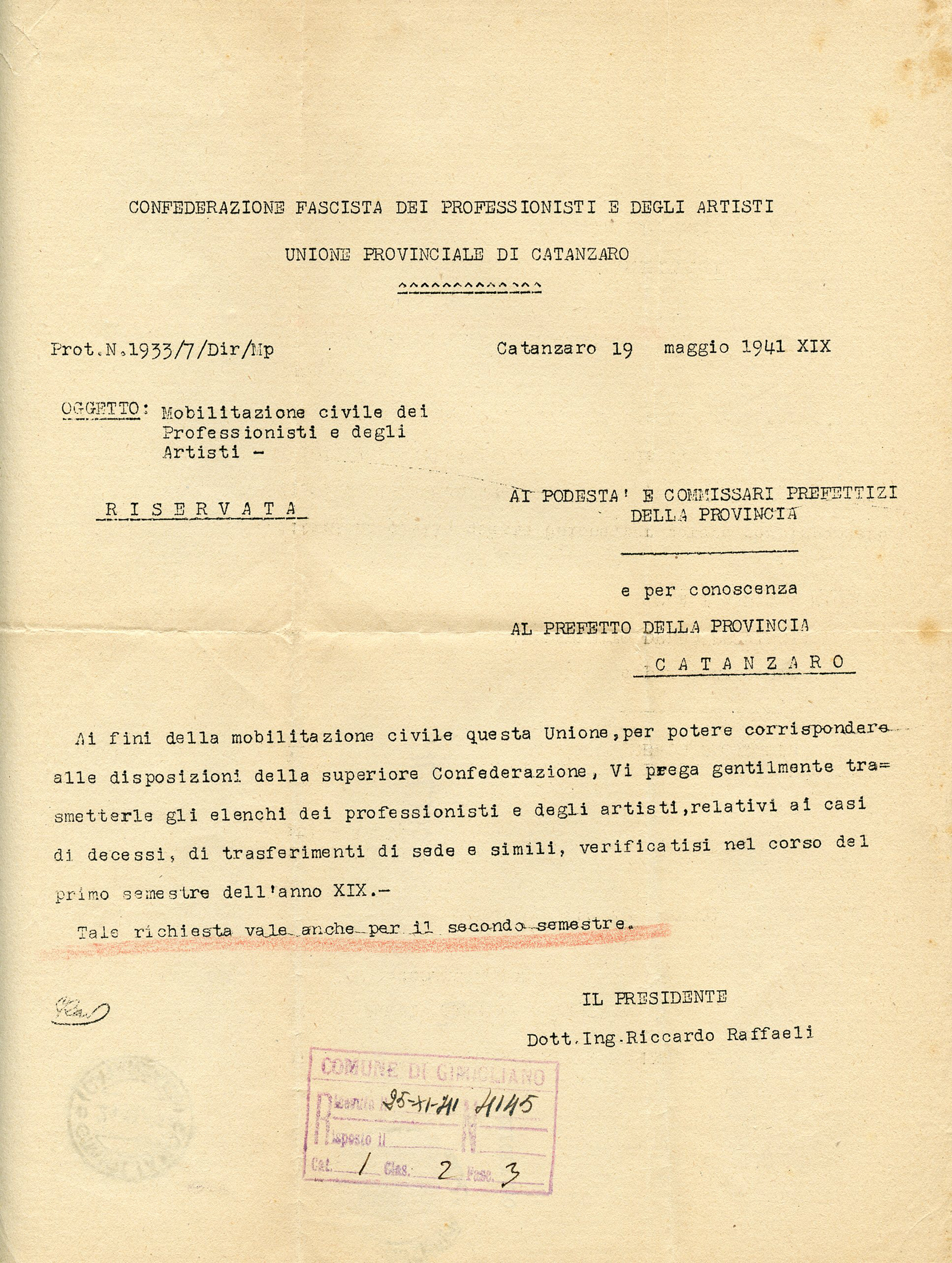
[Below: Inside. This document is a restricted wartime administrative circular issued in May 1941 by a Fascist state-controlled trade union syndication in Calabria. It directs local governments to update registry lists for a wartime population control measure known as civil mobilization. Civil mobilization was a war-effort policy enacted by Benito Mussolini's government to systematically organize, track, and requisition civilian labor, expertise, and resources for state and military production. The letterhead reads 'Confederazione Fascista dei Professionisti e degli Artisti - Unione Provinciale di Catanzaro' (Fascist Confederation of Professionals and Artists - Provincial Union of Catanzaro).]
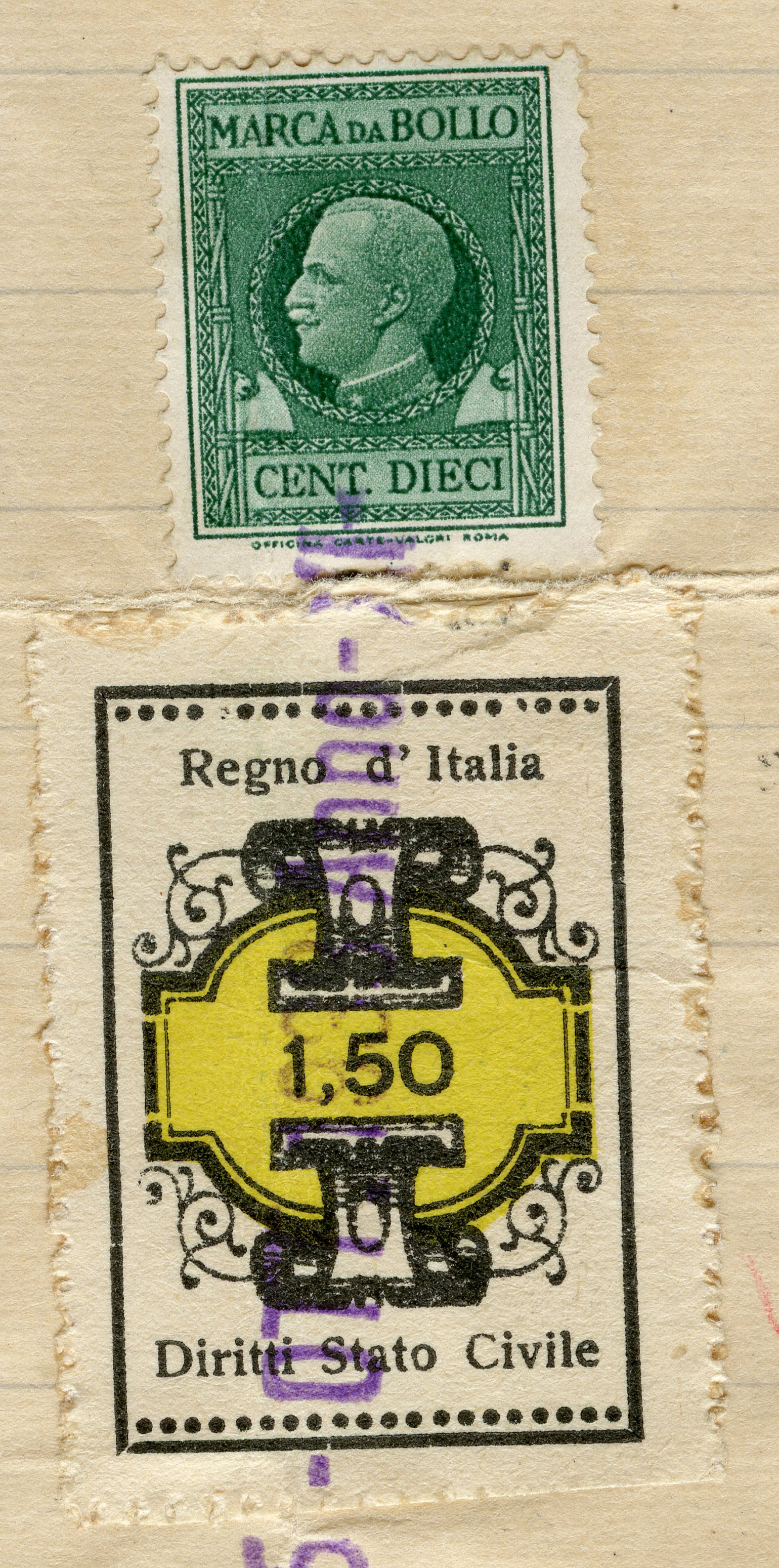
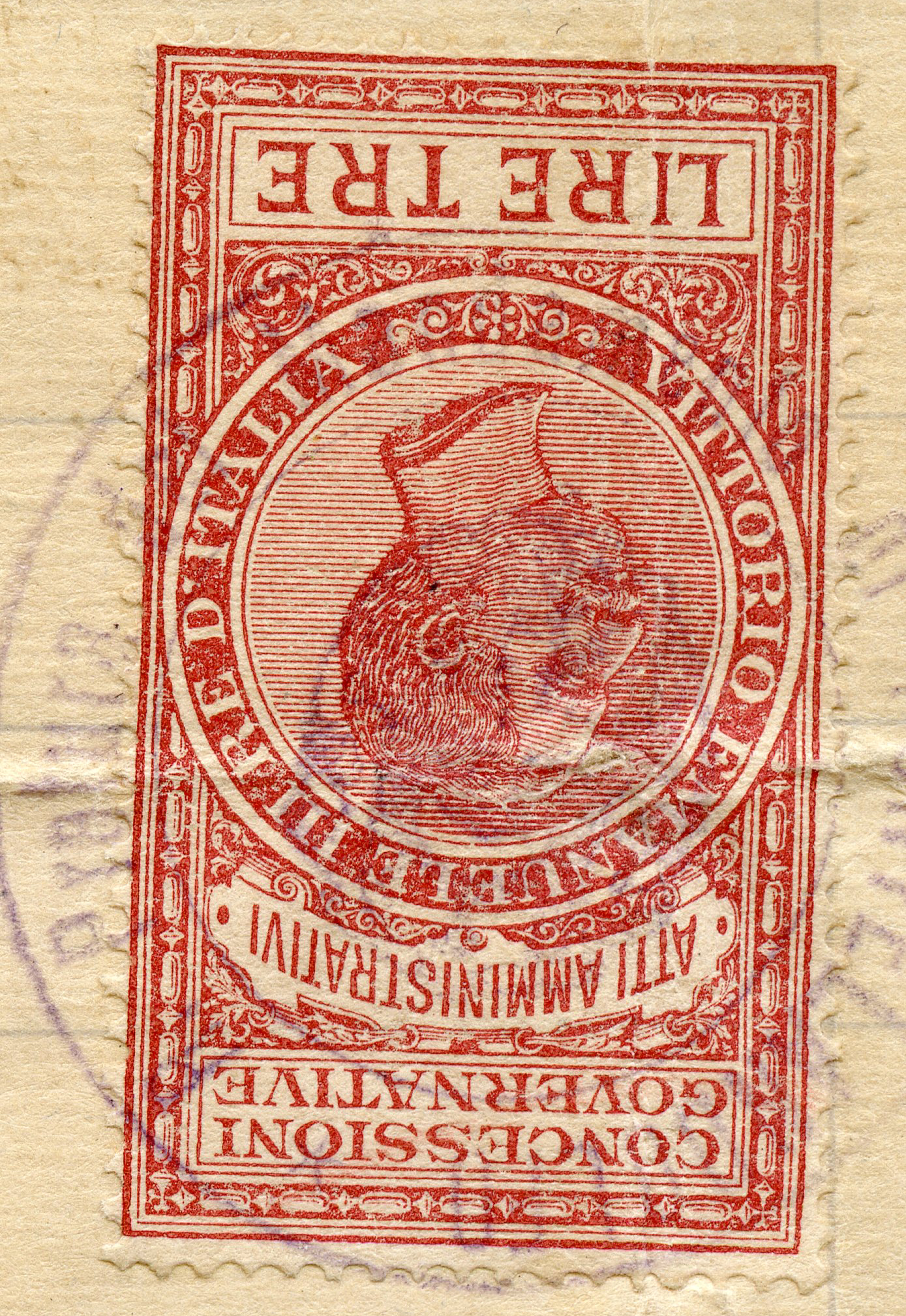
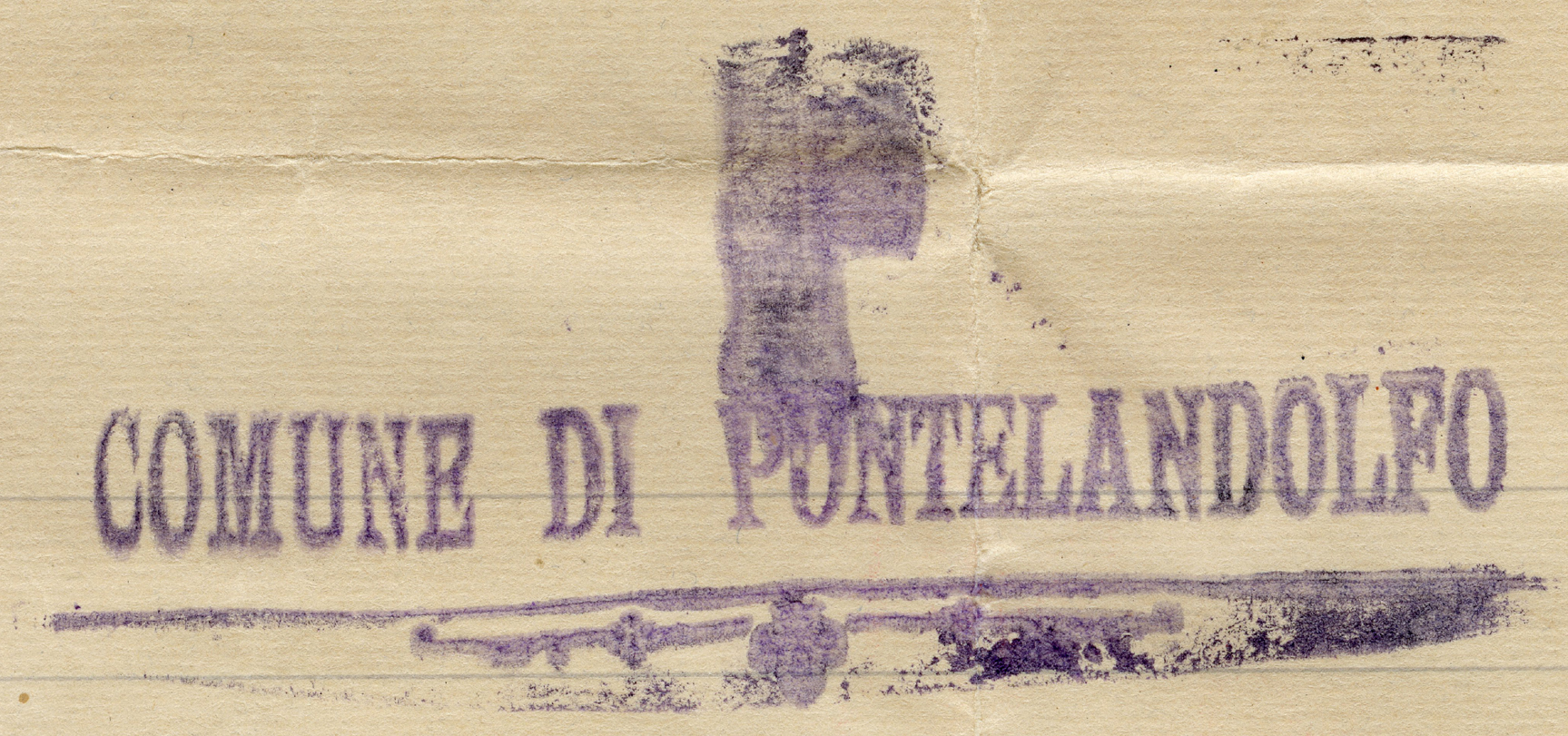
[Below: This document is an official marriage certificate extract (Certificato di Matrimonio) issued in October 1933 by the municipality of Pontelandolfo. It legalizes and proves a marriage that originally took place in 1905. The document was extracted and signed on October 5, 1933. It features the Roman numeral XI, marking the 11th year of the Fascist Era.]
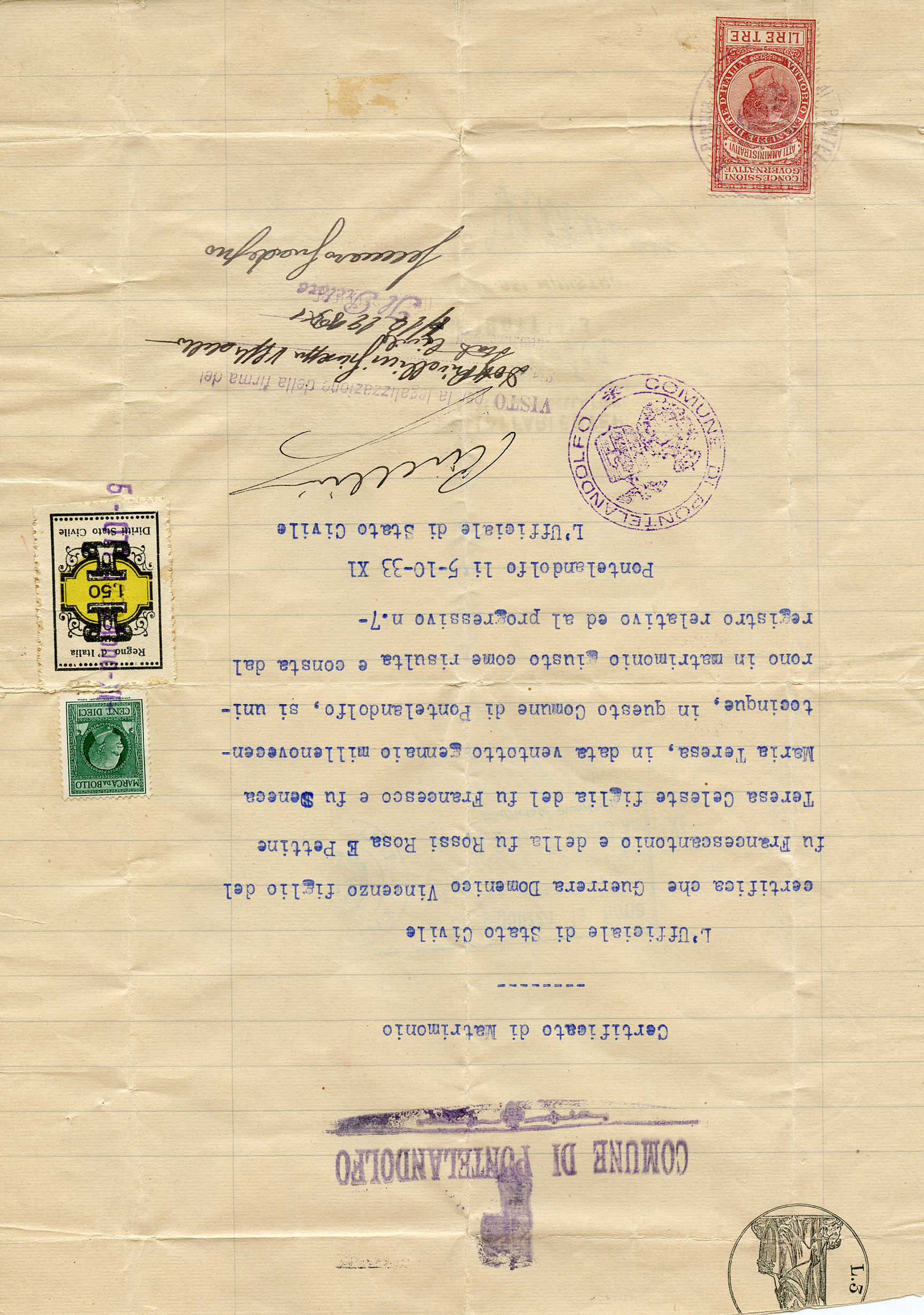
[Below: Close-up of tax stamps.]
[Below: Close-up of tax stamp.]
[Below: Ink stamp of smudged fasces.]
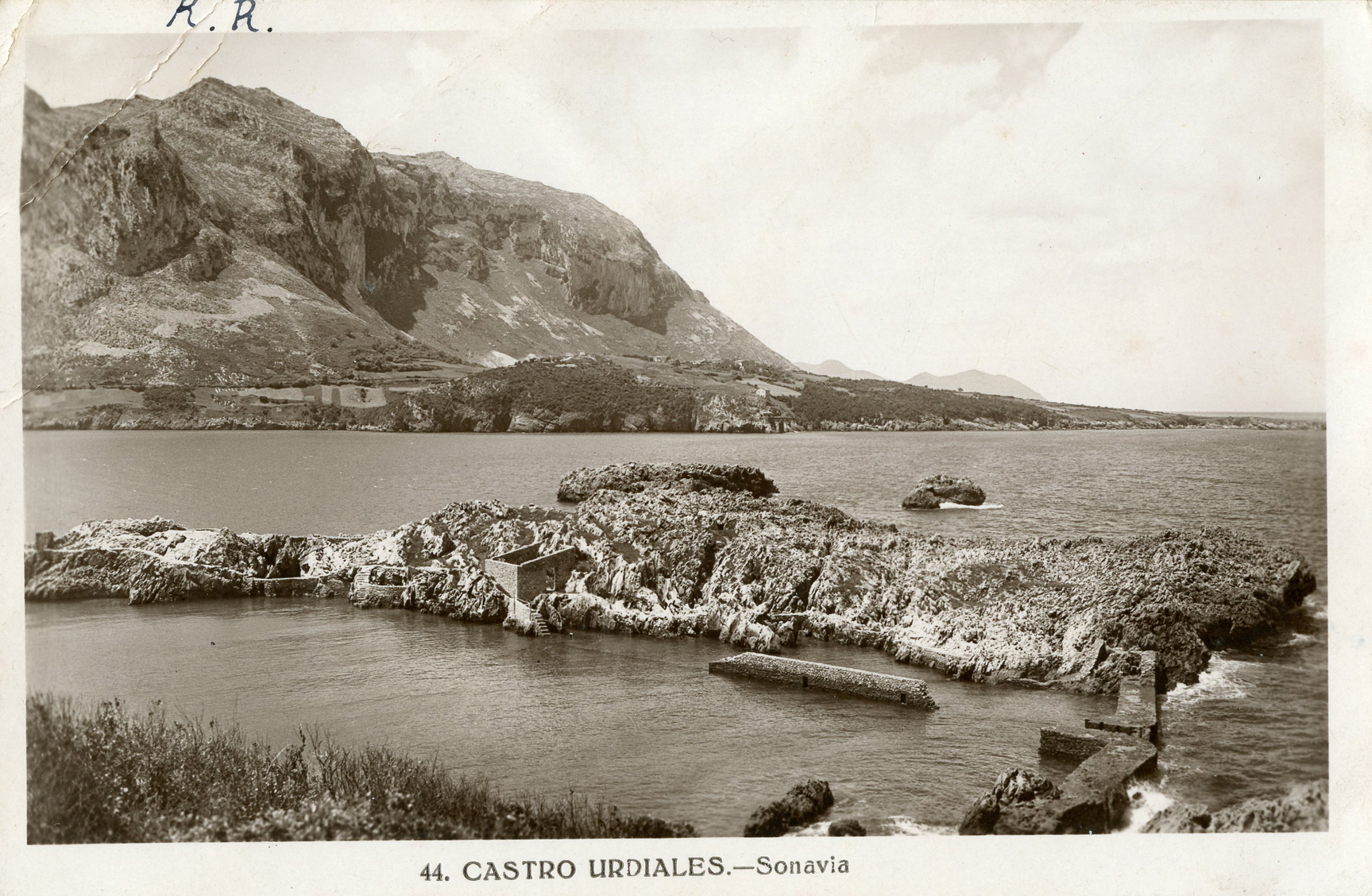
[Below: This postcard was sent by a member of the Corpo Truppe Volontarie (CTV), the Fascist Italian expeditionary force sent by Benito Mussolini to fight alongside General Francisco Franco's Nationalist forces. It is postmarked 'Algeciras', a vital, strategic hub for Franco's forces. Located directly across from Morocco, it was one of the primary ports where the Nationalist Army of Africa and arriving foreign troops—including the Italian CTV—landed on mainland Spain. The date (June 6, 1937) places this right during a shifting phase of the war, just months after the CTV fought in major battles like Mįlaga and Guadalajara. So why it does it have Italian postage stamps if it was mailed in Spain? Normally, mailing a card from Spain requires Spanish stamps. However, Italy set up a dedicated Italian Military Post Office network (Posta Militare) on Spanish soil to serve the CTV. Because it went through this autonomous Italian military postal pipeline, soldiers bought and validated their mail using their own domestic Poste Italiane stamps. The 'SPECIALE' cancellation mark you see across the stamps is the military censor/transit postmark assigned to handle these foreign volunteer mail securely. Front/Reverse.]
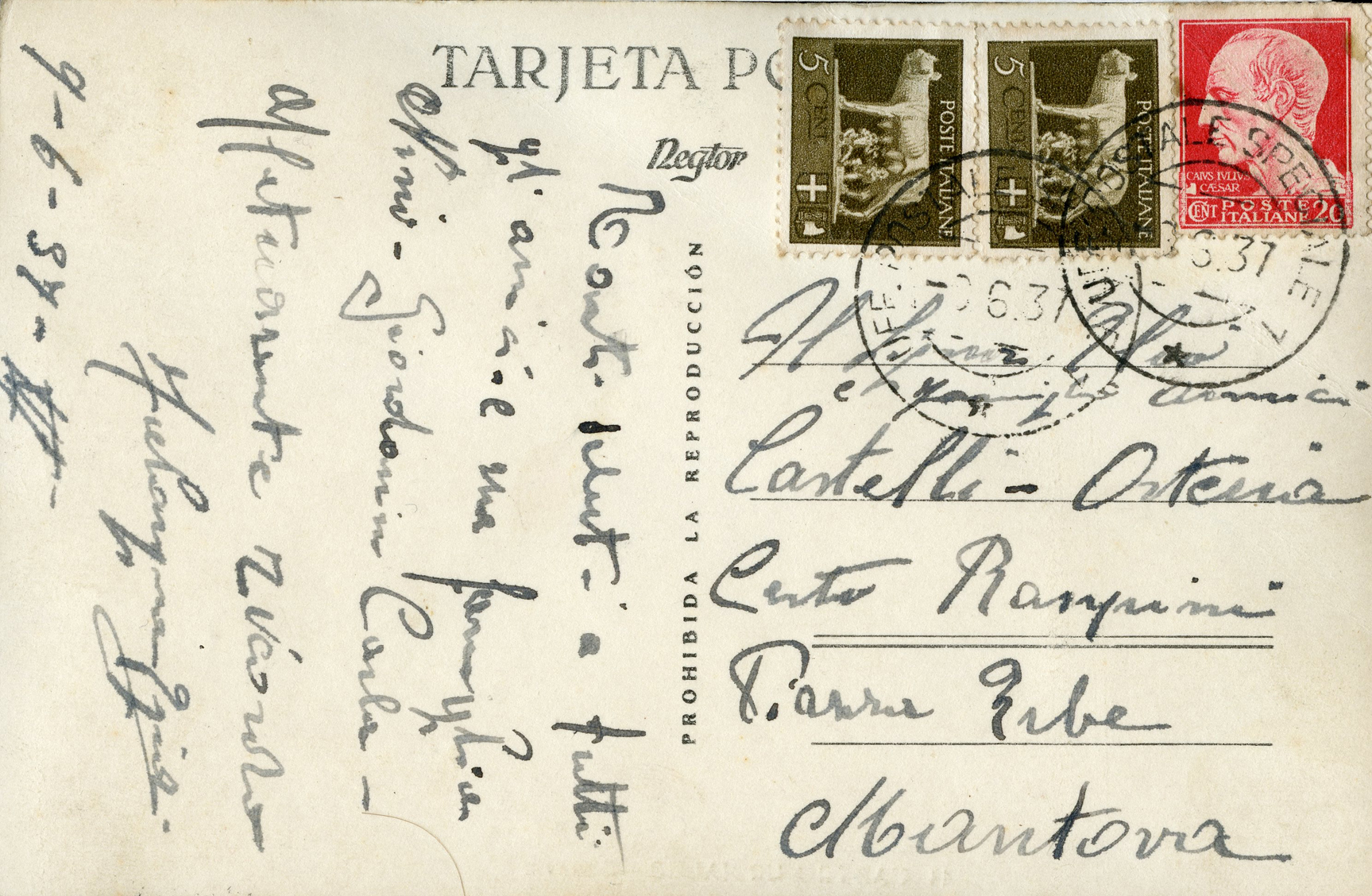
[Below: Spanish civil war. Front/Reverse.]
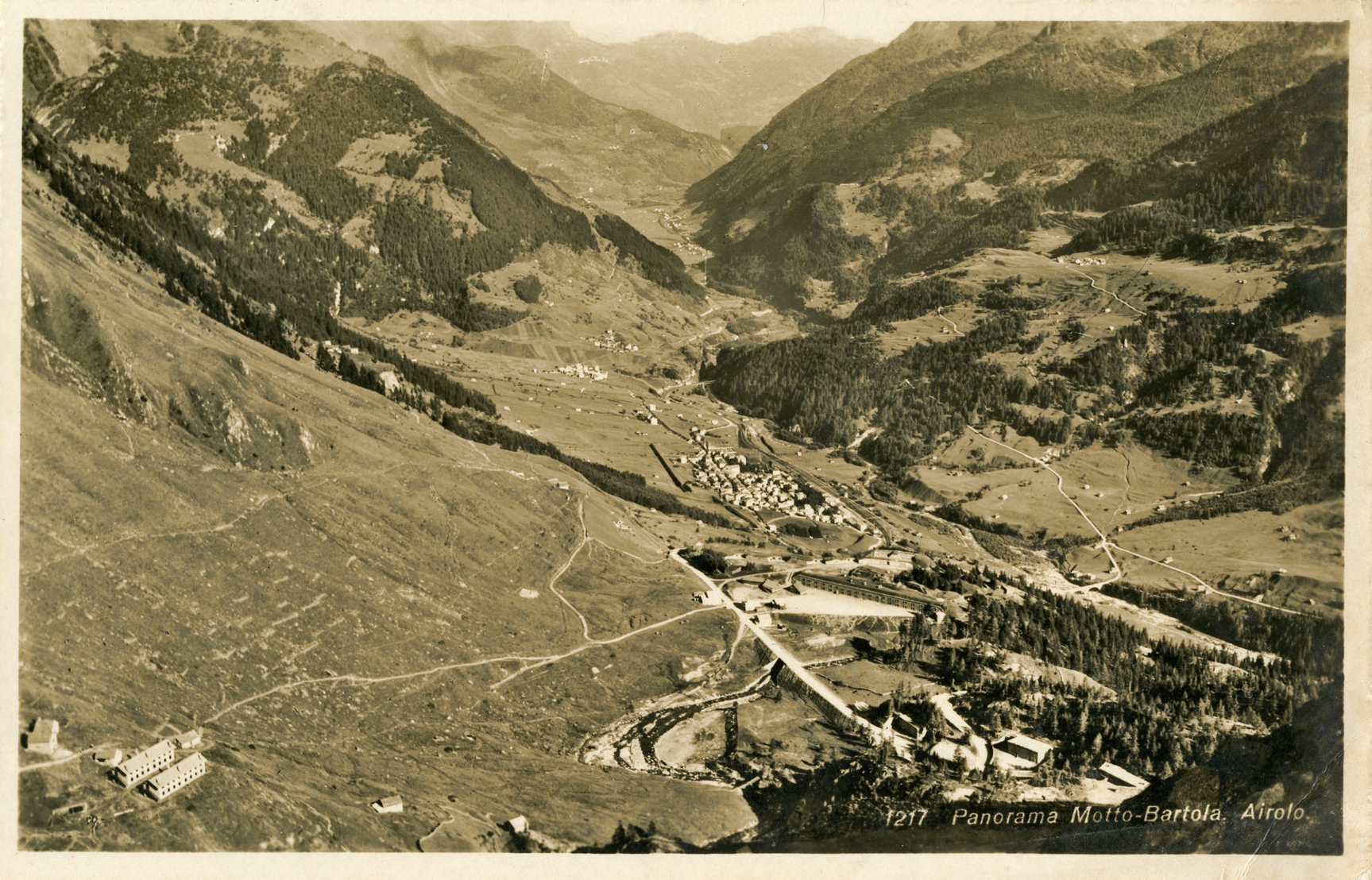
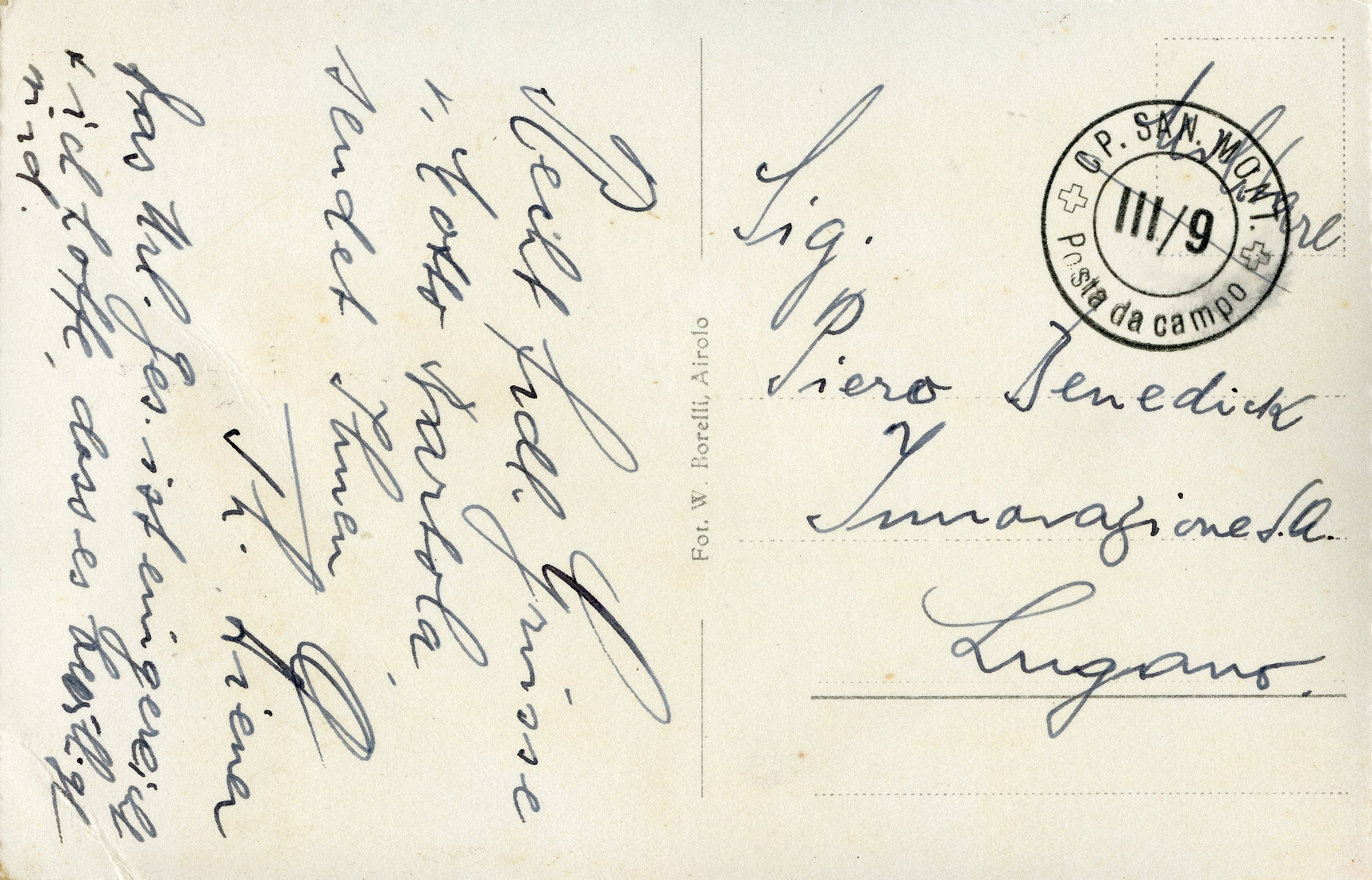
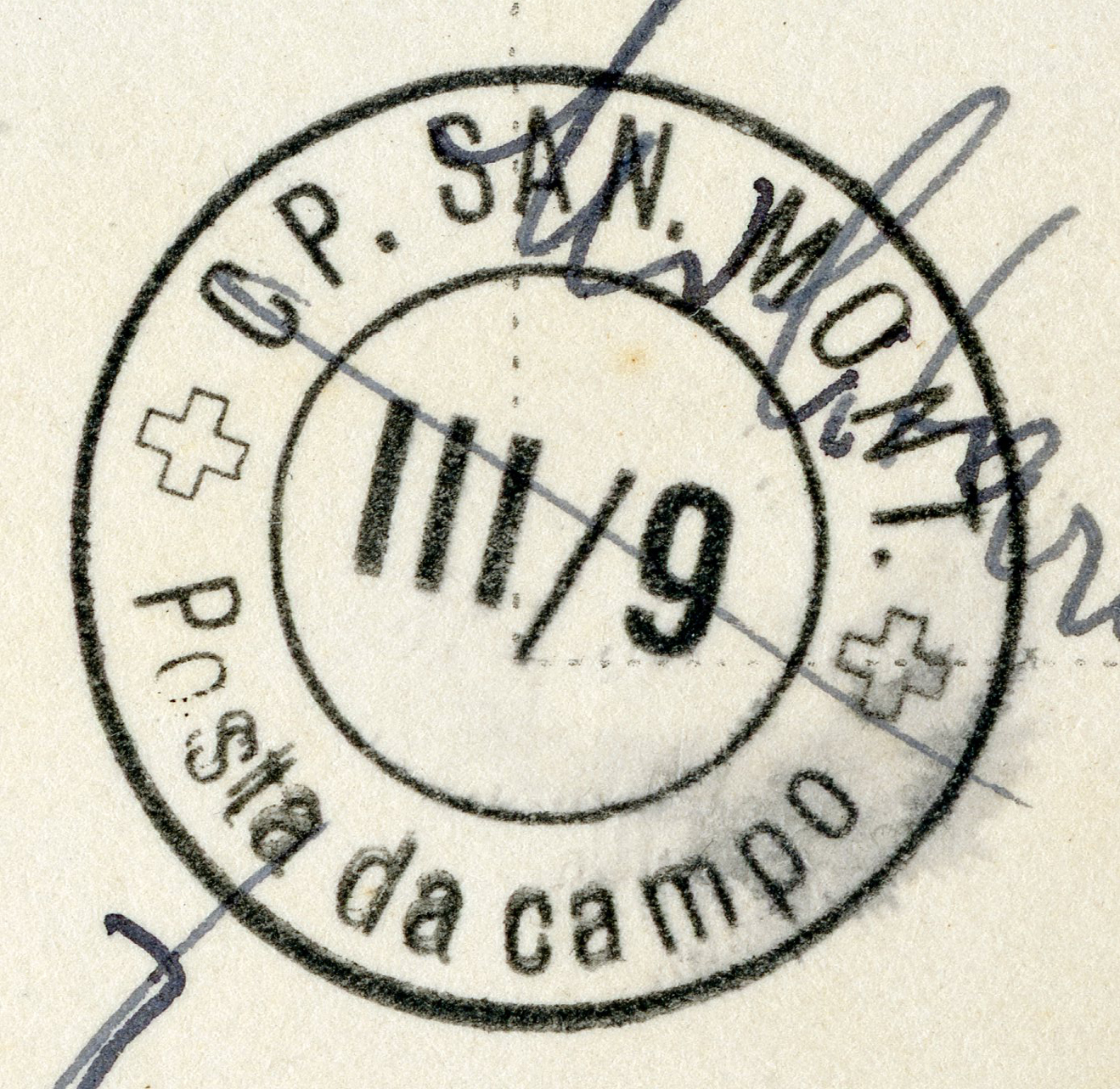
[Below: Close-up.]
[Below: Spanish civil war field post. Two Italian officers write to their hometown, postmarked November 22, 1937 (and arrived in Porto Ceresio on December 3, 1937). By November 1937, the Italian volunteers in Spain had been heavily involved in major campaigns, including the capture of Santander and the Northern Campaign. In November 1937, the front lines were shifting toward the grueling winter battles that would culminate around Teruel.]
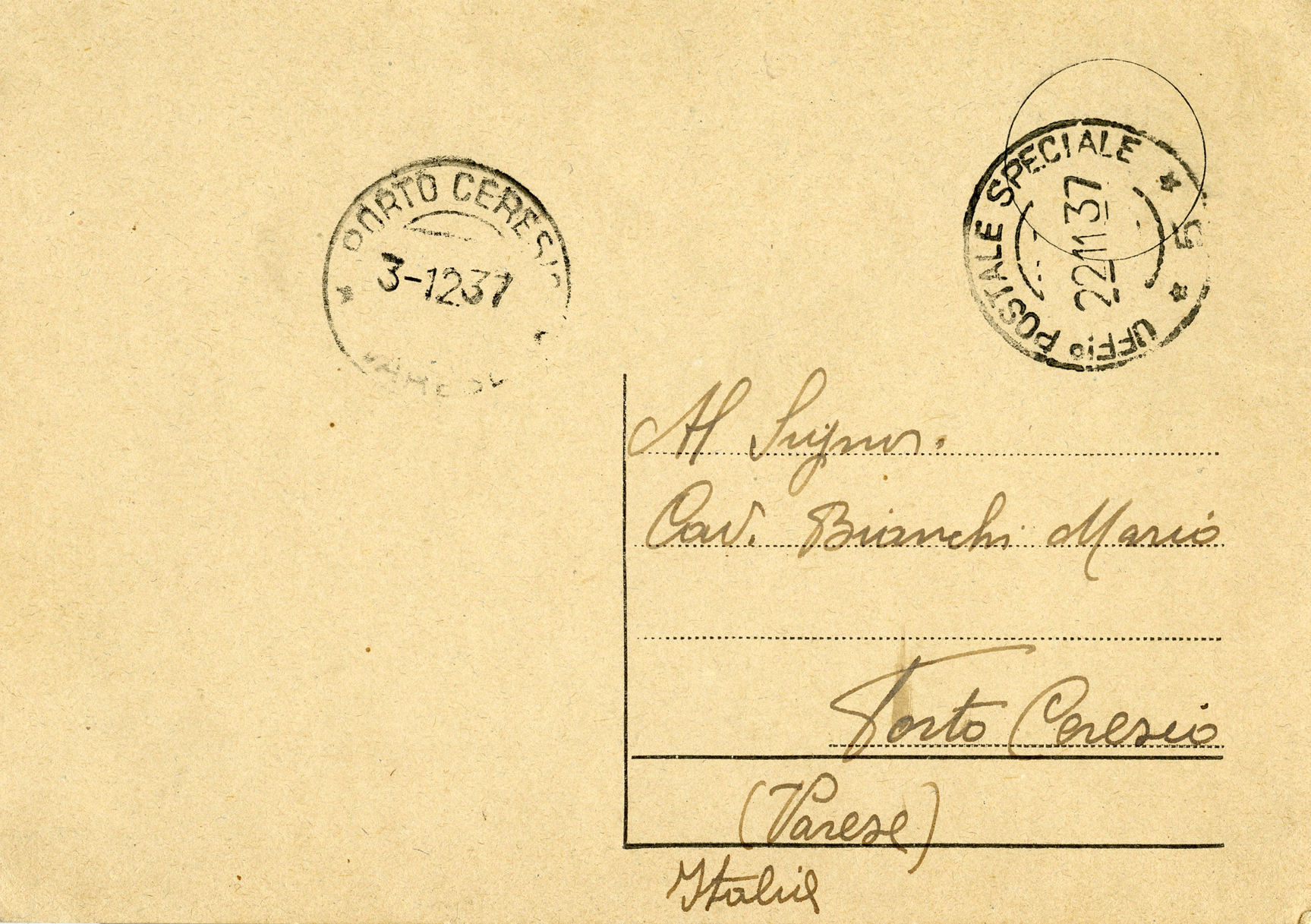
[Below: Reverse. It says:
'Esteemed Mr. Knight
Mario Bianchi,
Always remembering you, I send my most sincere and cordial greetings to
you and your kind family.My health is excellent, as I hope it is for you and your family.
Sending infinite greetings to you and your family,
Fascist Greetings,
C.N. [Camicia Nera] Andrea D'Alessandro
C.N. Sc. [Camicia Nera Scelta] Renato Calvi
Fuenmayor, 21-11-1937 [Fascist Year] XVI'
The abbreviations C.N. and C.N.Sc. stand for Camicia Nera (Blackshirt) and Camicia Nera Scelta (Chosen Blackshirt, a rank equivalent to a corporate corporal). The writers belong to the Italian MVSN (Voluntary Militia for National Security) serving within the Corpo Truppe Volontarie (CTV). The card was signed in Fuenmayor, a town in the La Rioja region of northern Spain. Following the capture of the northern fronts earlier in 1937, Italian units used towns in this region as rear-guard bases, hospitals, and staging areas to rest, regroup, and refit before their next major deployment.]
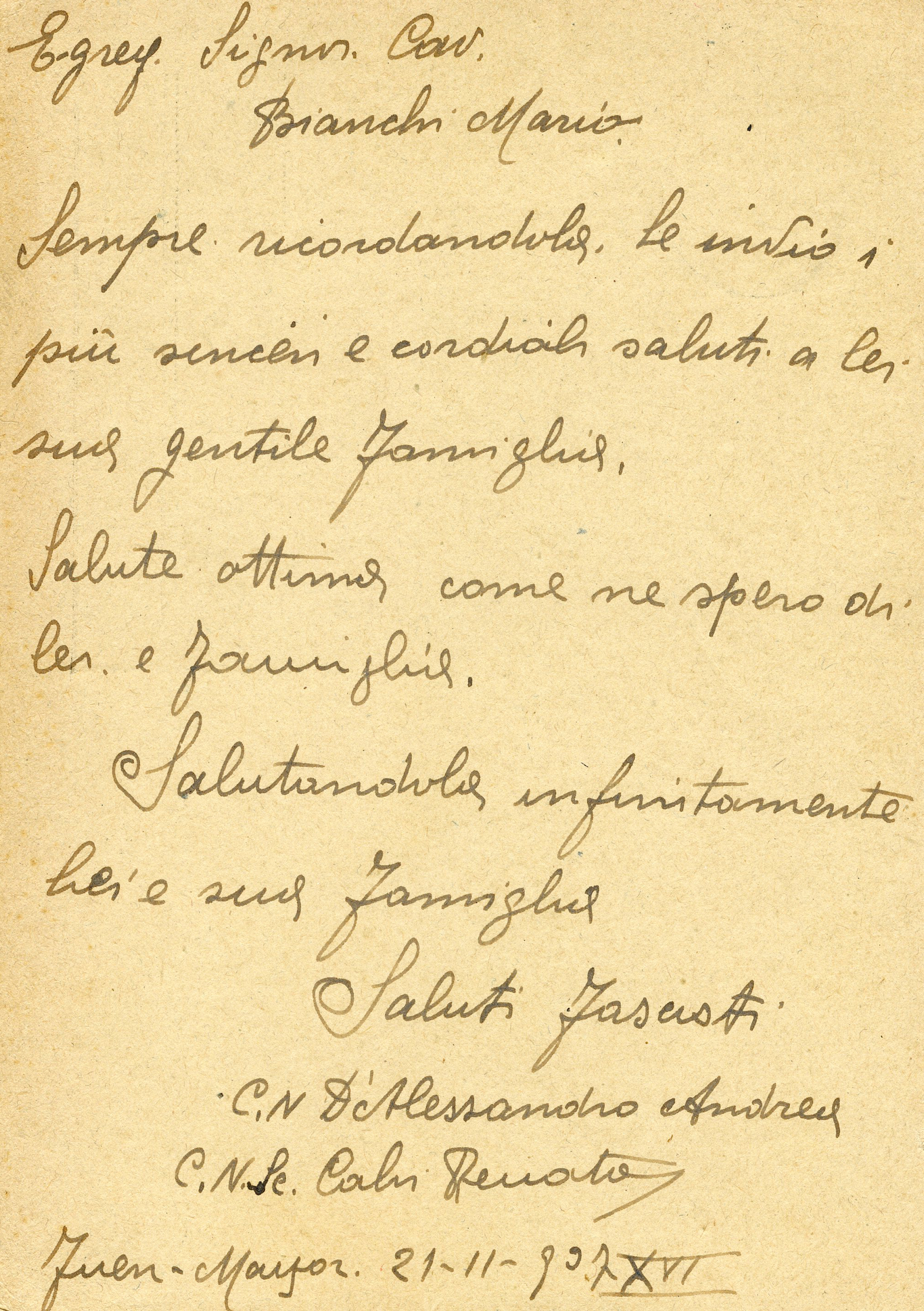
[Below: Italian Albanian occupation field post. Front/reverse.
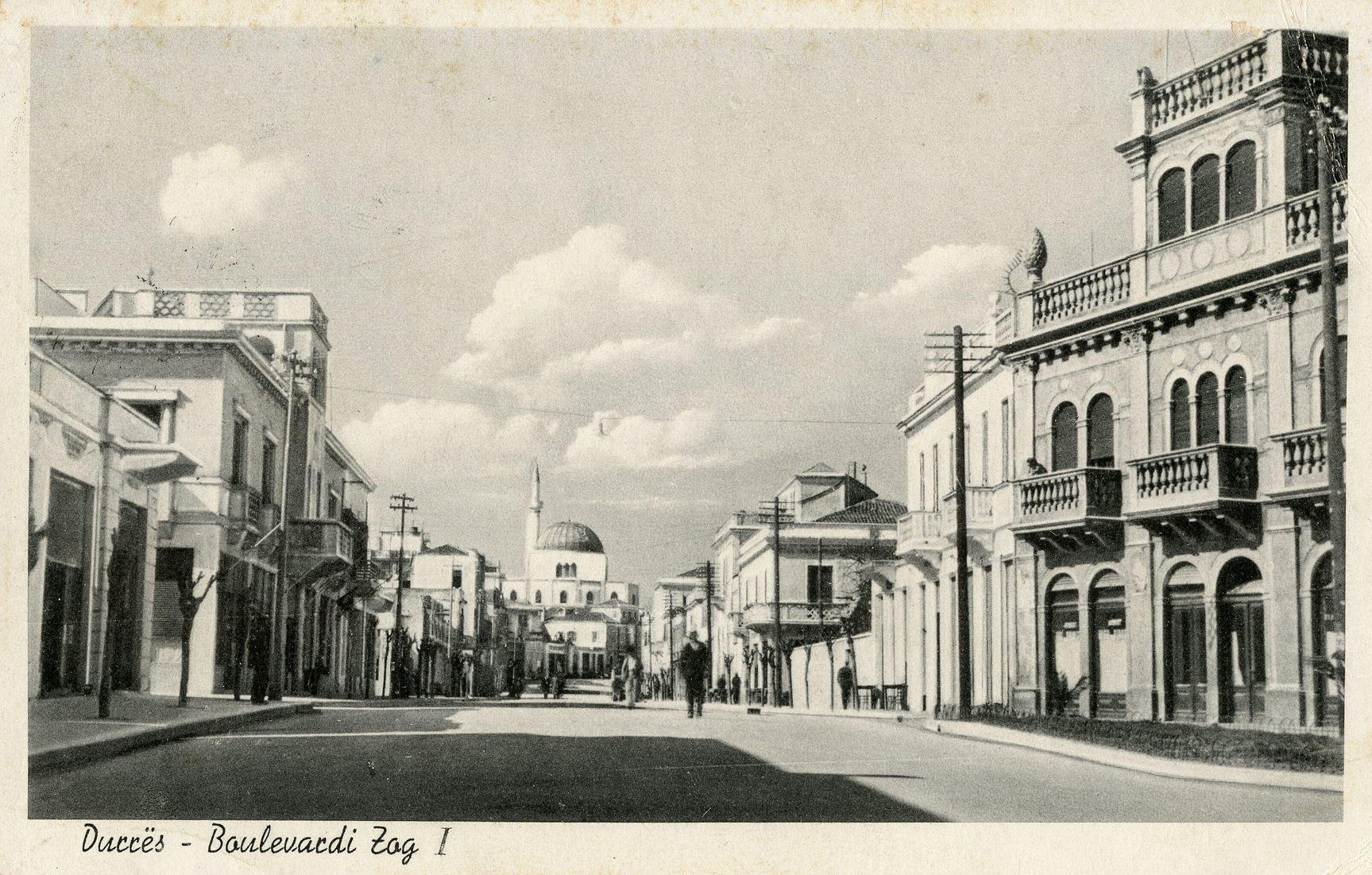
First the front of the postcard:
'Durrės - Boulevardi Zog I', Durrės was historically known in Italian as 'Durazzo', a major port city on the coast of Albania. 'Boulevardi Zog I' means the boulevard was named in honor of King Zog I, who ruled the Kingdom of Albania from 1925 until 1939. When Italy invaded and occupied Albania in April 1939, King Zog I was forced into exile.]
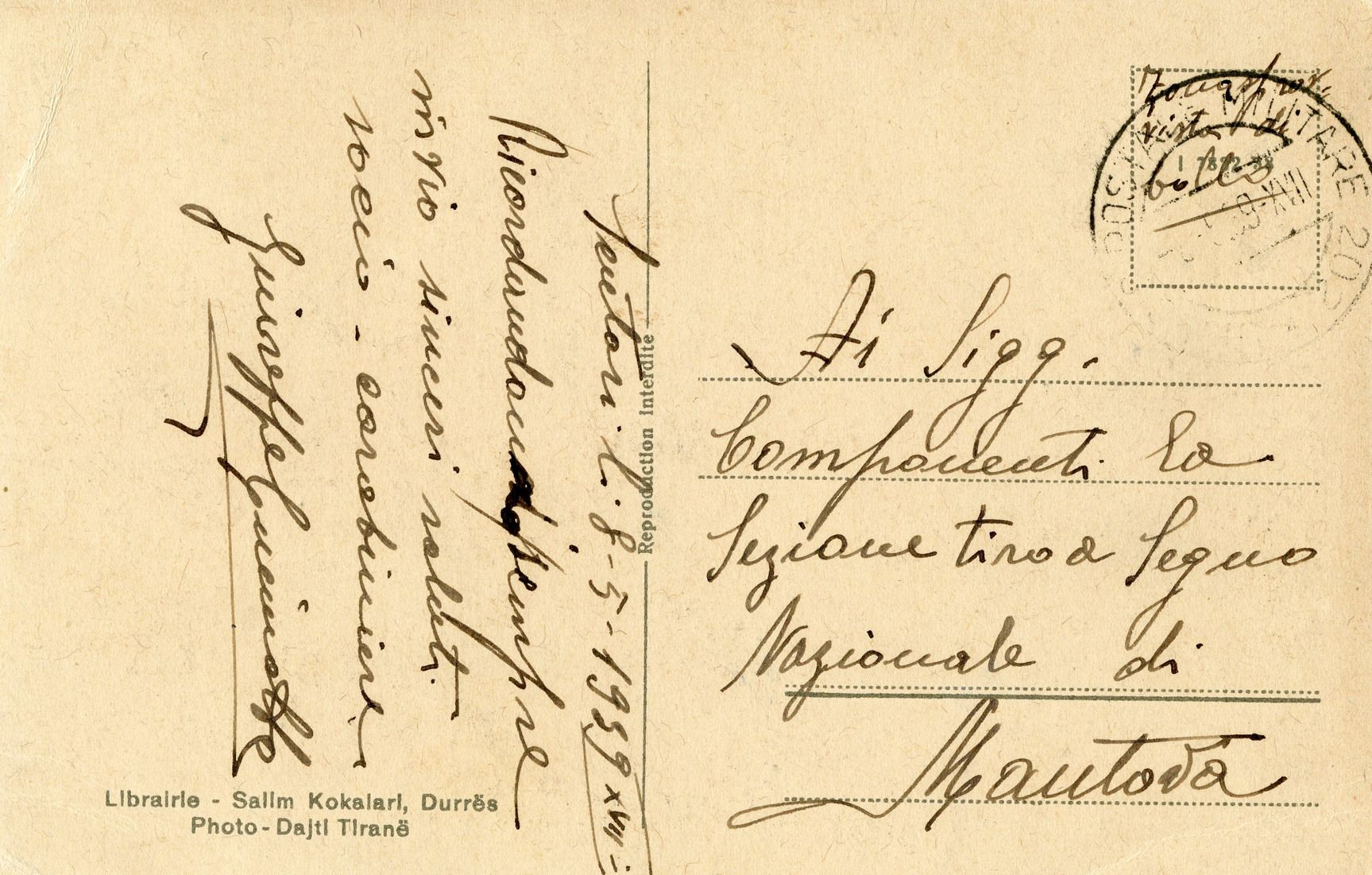
Now the reverse: This was sent by an Italian Carabiniere (military police) deployed to occupied Albania and addressed to a patriotic rifle shooting club back home in Italy. It was field postmarked May 9, 1939.
It says:
'To the Gentlemen members of the National Target Shooting Section of Mantua [Mantova] Shkodėr [Scutari], 8-5-1939 [Fascist Year] XVII Always remembering you, I send sincere greetings. Your Carabiniere Giuseppe Guazzotti'
Under the military cancel is a censor mark.]
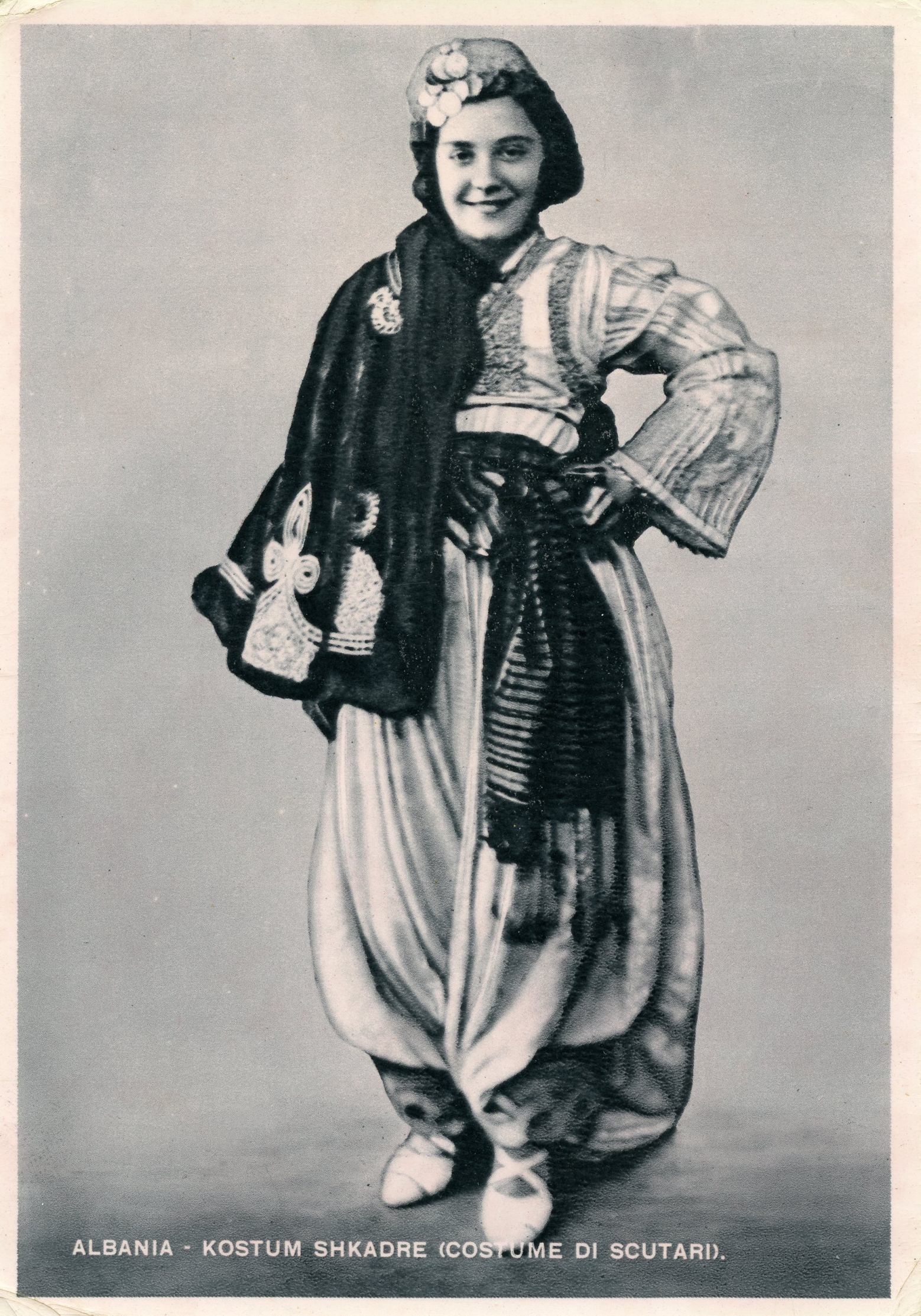
[Below: Italian Albanian occupation field post. Let's see what AI has to say about this one:
'The printed caption at the bottom reads: "ALBANIA - KOSTUM SHKADRE (COSTUME DI SCUTARI)." Cultural Breakdown of the Image
This postcard depicts a young woman wearing the highly distinct, traditional urban bridal and festive costume of Shkodėr (Scutari) from northwestern Albania. It is one of the most famous and elaborate traditional garments (veshje kombėtare) in the Balkans.
Dimizot (The Silk Trousers): The massive, billowing satin or silk trousers (dimit) are gathered tightly at the ankles. They are an architectural marvel of tailoring, often using several meters of fine fabric.
The Xhubleta/Jelek (The Vest and Jacket): Over her embroidered blouse, she wears a heavily ornamented velvet waistcoat or jacket (jelek), intricately embroidered with gold or silver metallic thread threads (sari or gajtan).
The Headpiece: On her head rests a traditional small cap embellished with coins (daspra) or fine metal ornaments, reflecting the wealth and status of her family or her status as a newlywed.
The Sash: A heavy, woven silk or wool sash is wrapped around her waist to anchor the heavy layers of the outfit.'
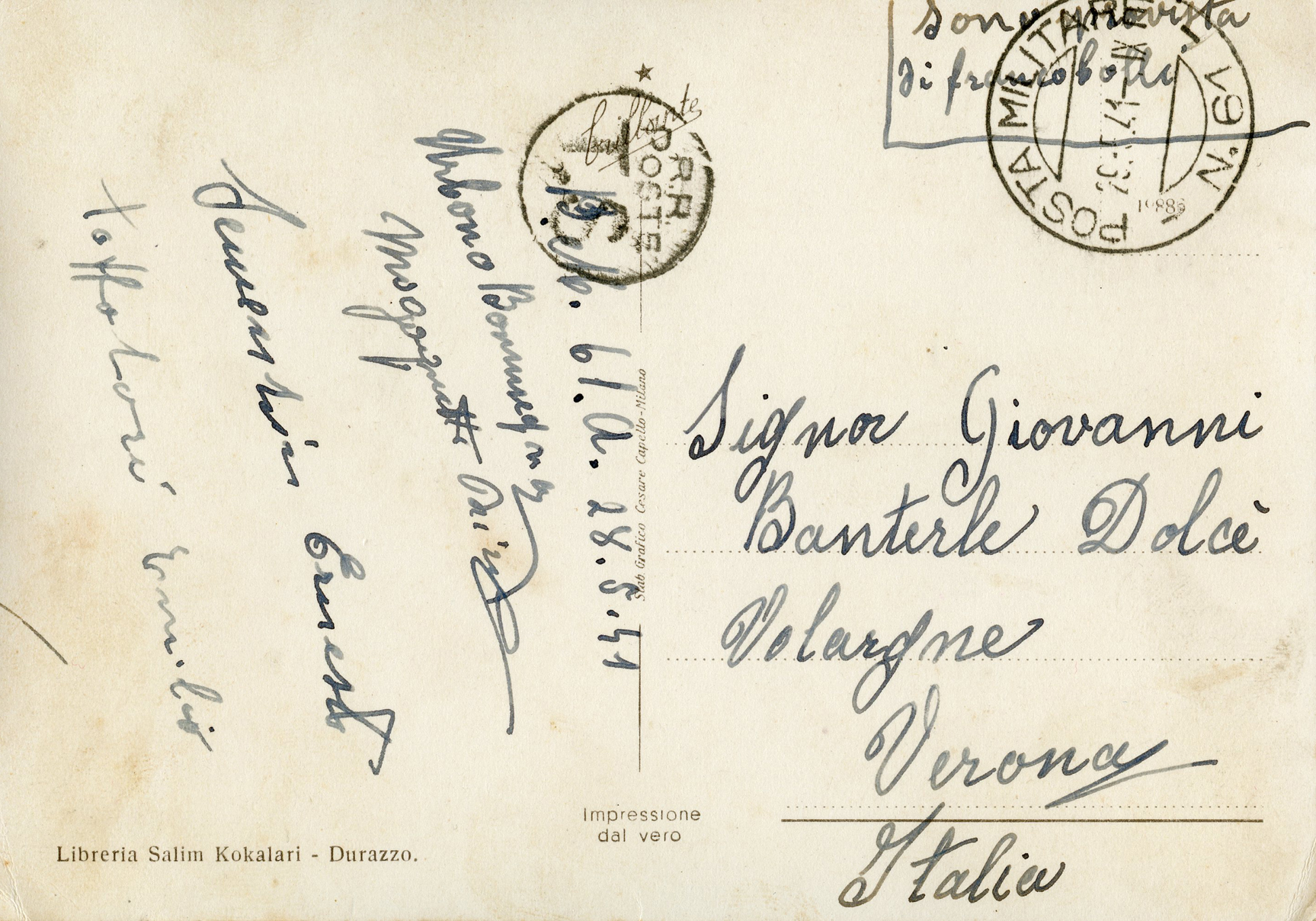
[Below: AI goes on to say:
'This back side reveals a completely different chapter of World War II military history! We have moved forward in time from the initial 1939 invasion into the heat of the Greco-Italian War in 1941.
Instead of a single soldier, this card was signed by four different Italian servicemen who were deployed together in Albania.
Part 1: Transcription of the Italian Text
Right (Address Side):
Signor Giovanni
Banterle Dolce
Volargne
Verona
Italia
Center & Left (Signatures & Text, written vertically):
S.M. 61.a. 28.5.41
Urbano Bonvicini
Mazzocut Luigi
Fumanti Ernesto
Toffalori Emilio
Top Right (Censor Note):
Part 2: English Translation - Address:
To Mr. Giovanni Banterle Dolce
Volargne [a village near Dolcč]
Verona
Italy
Message: S.M. [Stato Maggiore / Military Station] 61.a, May 28, 1941
[Signed by:]
(four soldiers)
Top Right Note:
"I am without stamps"
The Timeline (May 1941):
The date is 28.5.41 (May 28, 1941). This is just one month after the conclusion of the brutal Greco-Italian War and the subsequent German intervention in the Balkans. Italian troops were now transitionary garrison units occupying a stabilized, but deeply scarred, Albania.
The Postmarks:
The large circular stamp reads POSTA MILITARE N. 61, dated 28-5-41. Posta Militare 61 was a mobile field office explicitly assigned to the Bari Infantry Division (47Ŗ Divisione fanteria "Bari"). The Bari Division fought on the grueling Albanian-Greek mountain front, sustaining massive casualties during the winter of 1940-1941.
The smaller circular stamp reads R.R. POSTE with a Fascist symbol (the Fascio Littorio) inside.
The Missing Stamps Note:
At the top right, written over the box where a stamp usually goes, a soldier wrote: "Sono sprovvisto di francobolli" ("I am without stamps"). In active combat zones or newly occupied territories, field post offices frequently ran completely out of adhesive postage stamps. Writing this phrase allowed the military mail system to accept the card under military free-franking (Franchigia) privileges so it could still reach Italy.
The Printers:
At the bottom left, we see the card was published by Libreria Salim Kokalari - Durazzo. This is the exact same prominent bookstore chain that produced your previous cards, showing that even soldiers stationed further inland or up north in Scutari bought their souvenir cards from the major port hub of Durrės (Durazzo).'
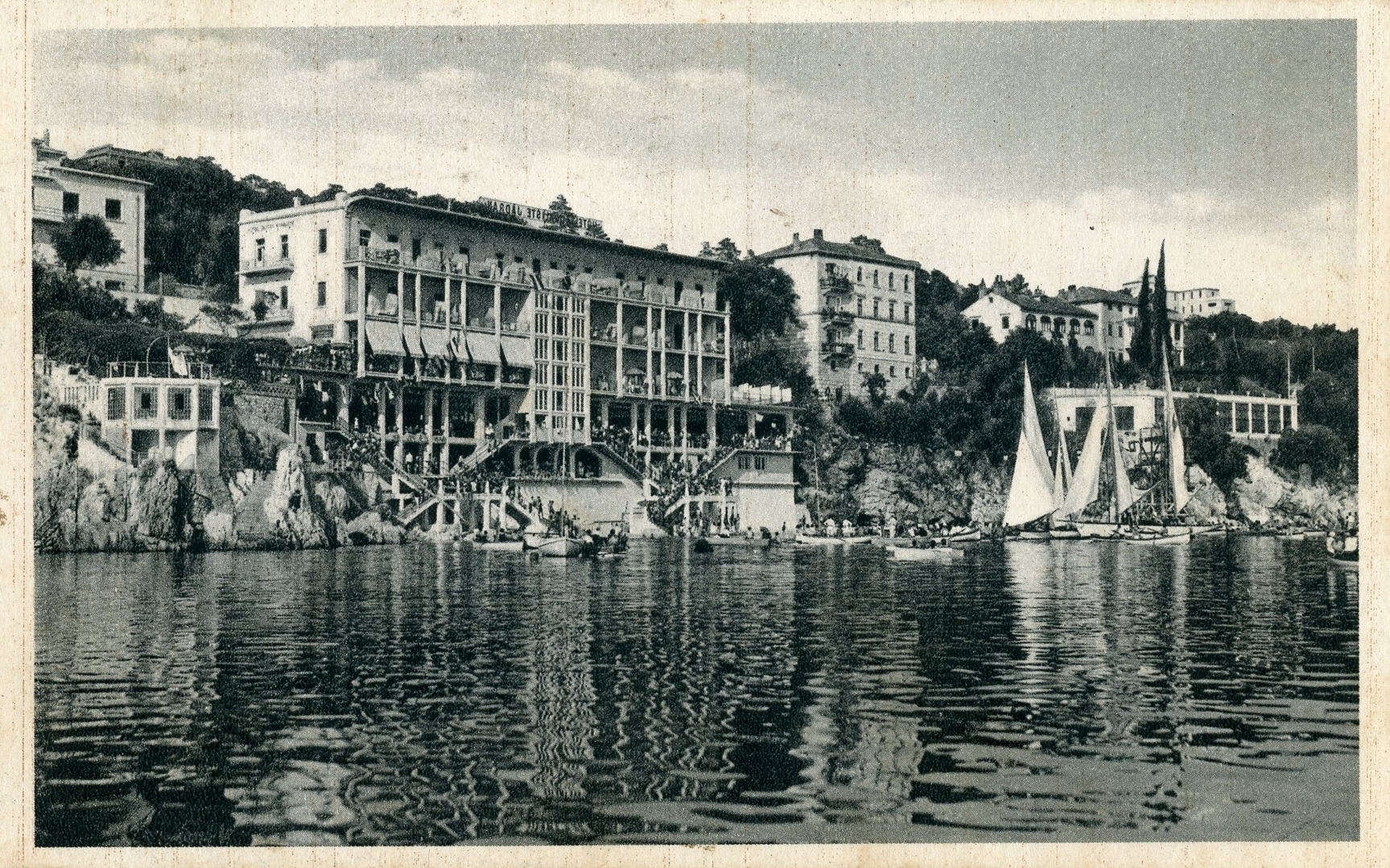
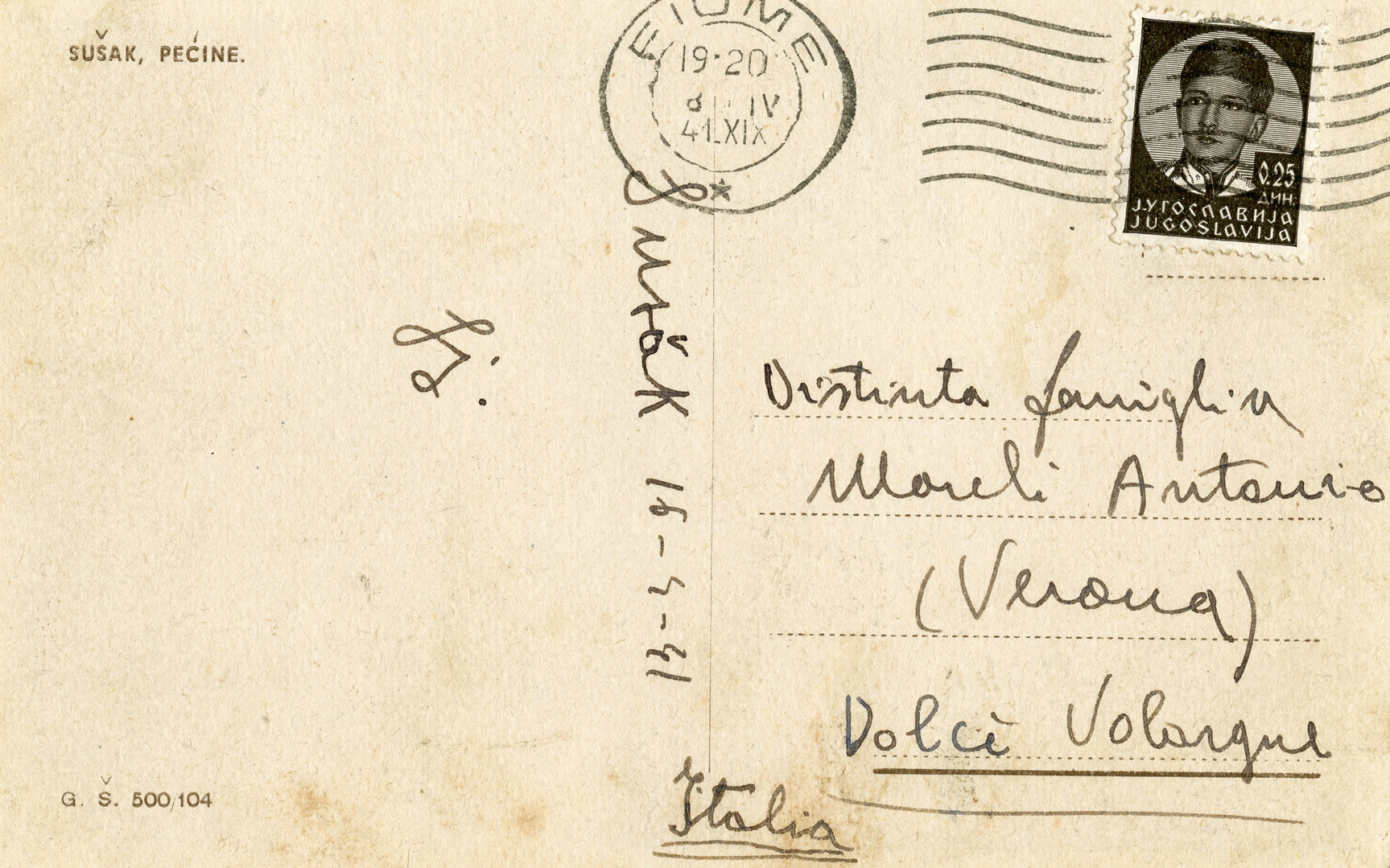
[Below: Italian occupation postcard from the Italian occupation of Yugoslavia, from the Italian city of Fiume, 1941. This shows SUSAK, PECINE. Susak is a coastal town located directly across the Rjecina river from Fiume. Historically, Fiume belonged to Italy, while Susak was the primary port town for the Kingdom of Yugoslavia. Pecine is a coastal neighborhood in Susak famous for its beaches and hotels.
This postcard features a standard Yugoslav 0.25 Dinar stamp showing the portrait of the young King Peter II of Yugoslavia. The postmark is dated 19 IV 41 (April 19, 1941). The Axis invasion of Yugoslavia began on April 6, 1941, and Yugoslav forces surrendered on April 17, 1941. This card was mailed exactly two days after the surrender. Because the occupation was so new, Italian authorities had not yet overprinted the local Yugoslav stamps with occupation markings—they simply accepted the conquered nation's postage and cancelled it using the Italian post office stamp in Fiume.
Front/reverse.]
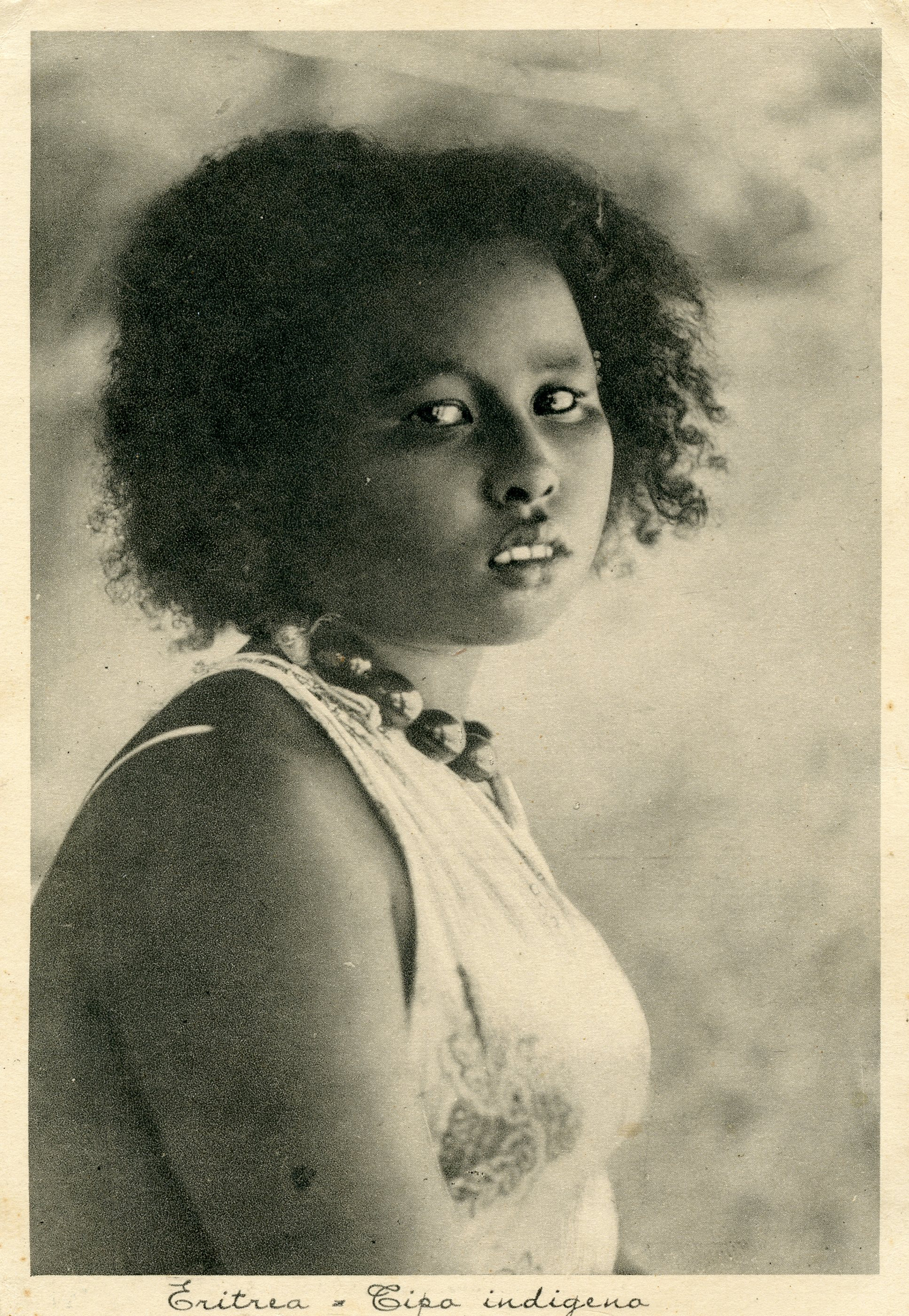
[Below: This Italian colonial postcard features a portrait of a young Horn of Africa woman in traditional attire. It says 'Eritrea - Native Type']
[Below: Reverse. The circular ink cancellation stamp reads 'POSTA MILITARE N. 84' with the central date of 7.2.37 (February 7, 1937). This is from right after the Second Italo-Ethiopian War (1935–1936), when many Italian soldiers were stationed in the newly formed territory of Africa Orientale Italiana (Italian East Africa). This was sent back to Italy with the words 'Salutissimi' (Very warmest greetings/Best wishes).]
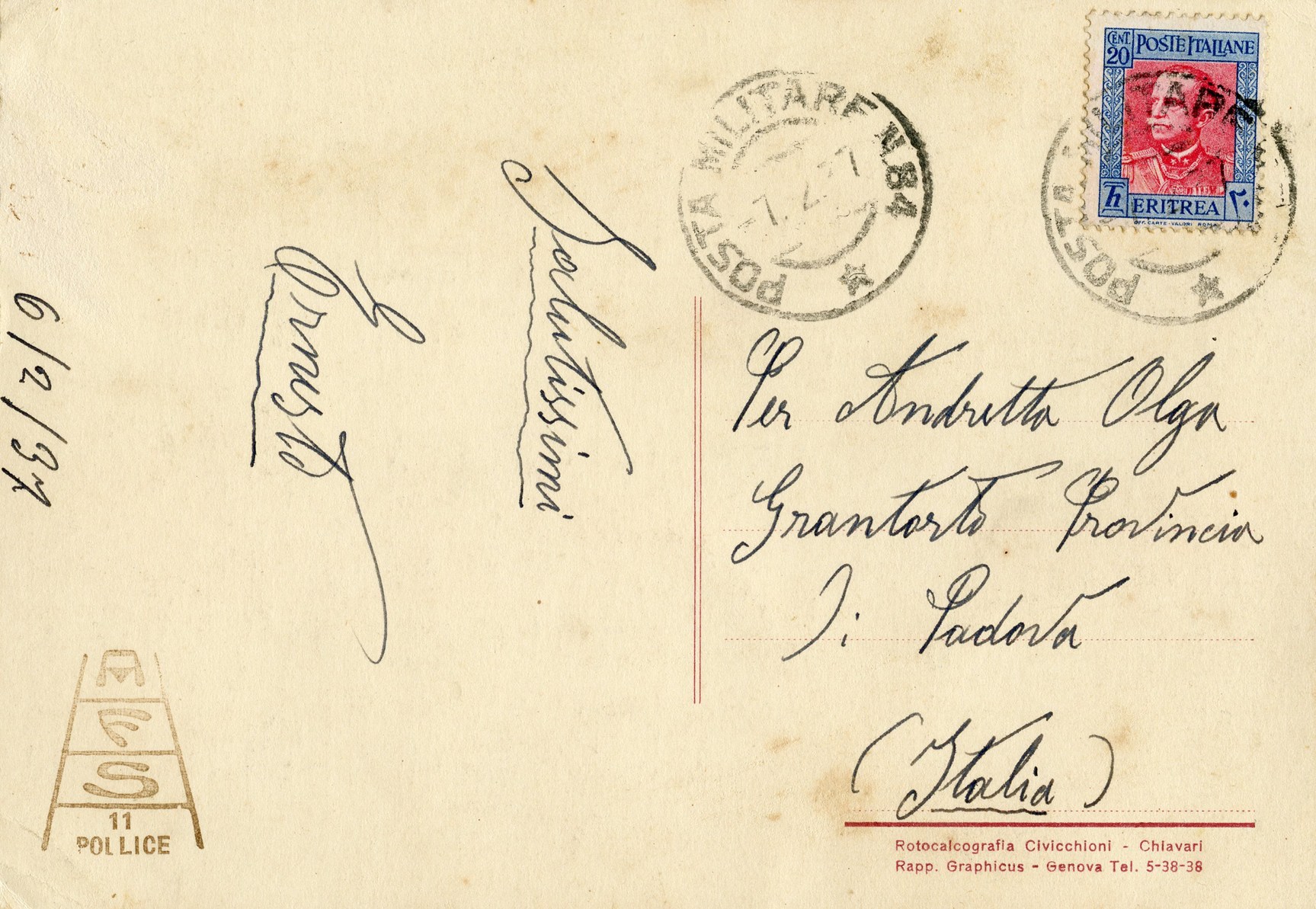
[Below: Close-up. This stamp depicts King Victor Emmanuel III of Italy, who was declared Emperor of Ethiopia.]