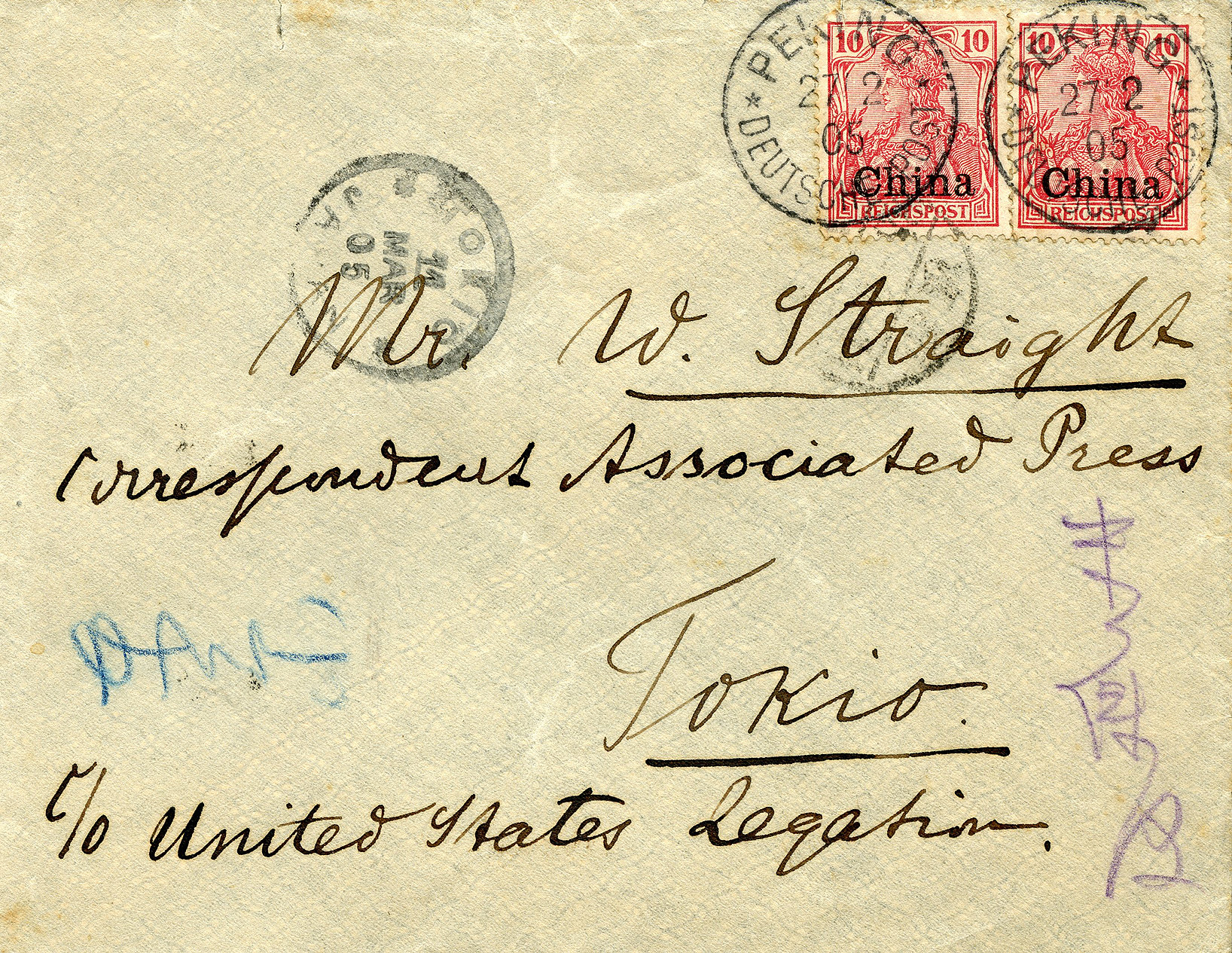
[Below: Let's start this page with something a little different - an envelope from 'German Offices in China'. This was canceled in Peking, China on February 27, 1905. It was sent to:
Mr. W. Straight
Correspondents Associated Press
Tokio
c/o United States Legation
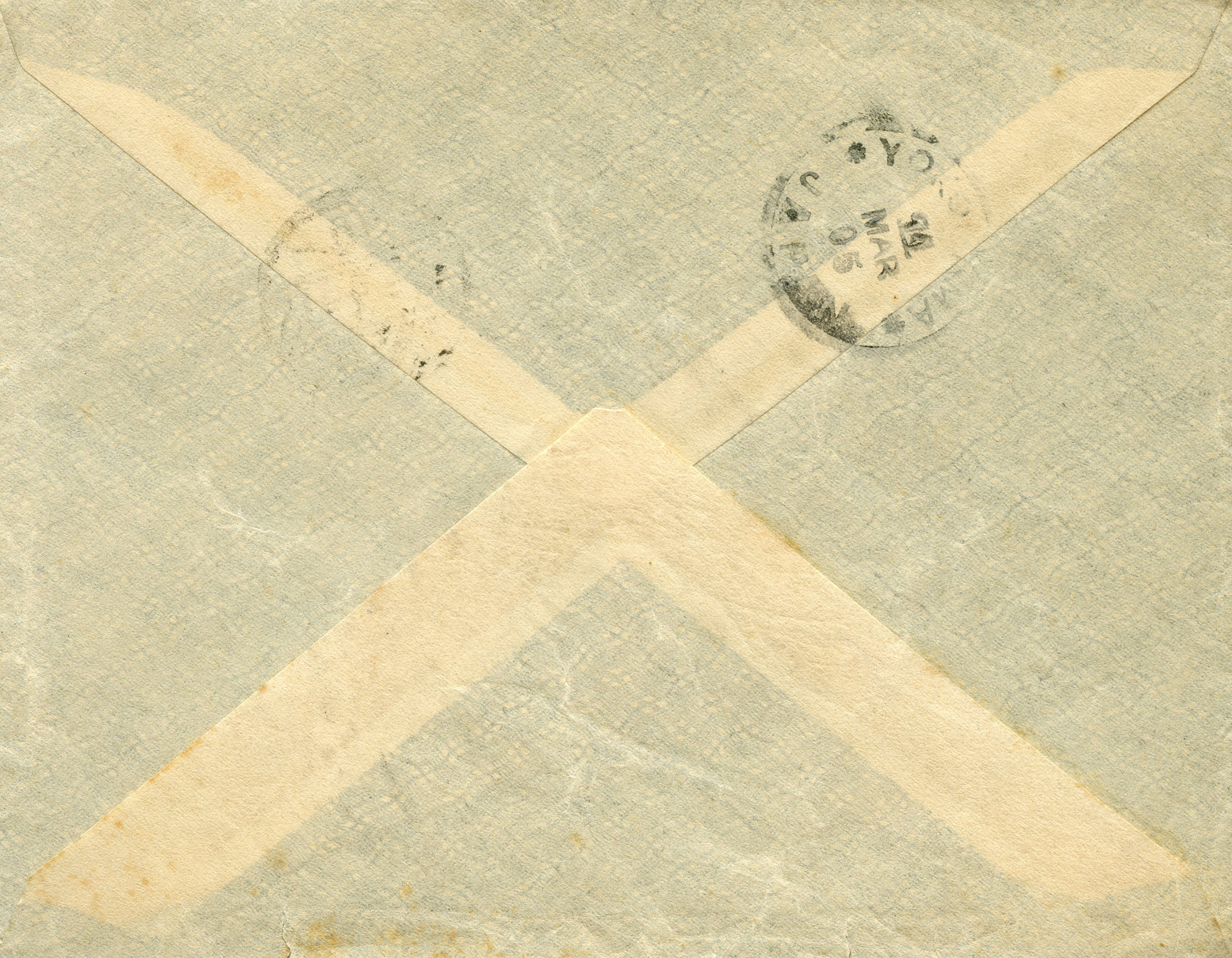
This was postmarked in Peking on February 27, 1905 and received in Yokohama and its destination of Tokyo on March 11, 1905 (Yokohama is a port city south of Tokyo). Click to enlarge.]
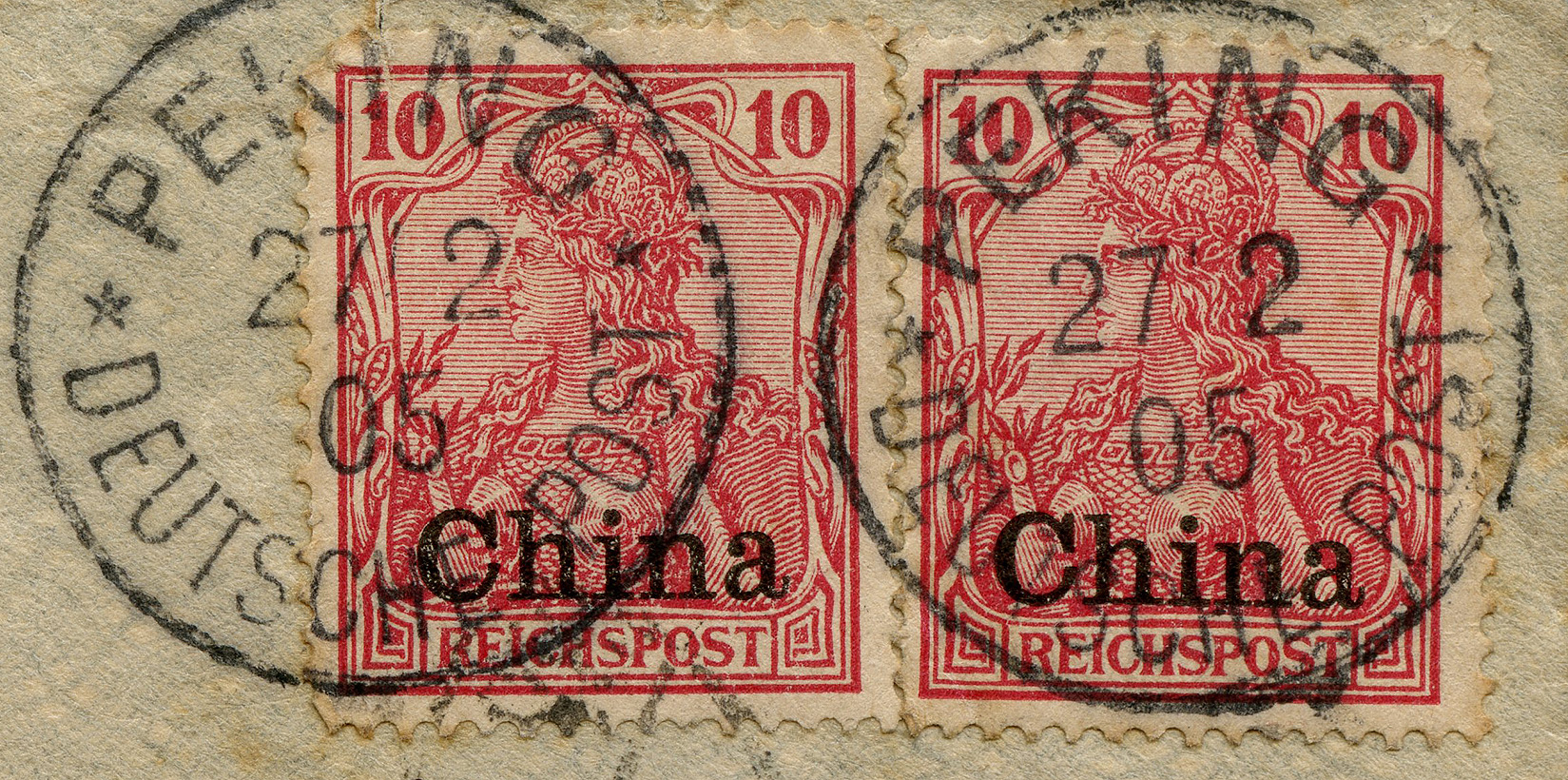
[Below: Close-up. Click to enlarge.]
[Below: Reverse. Click to enlarge.]

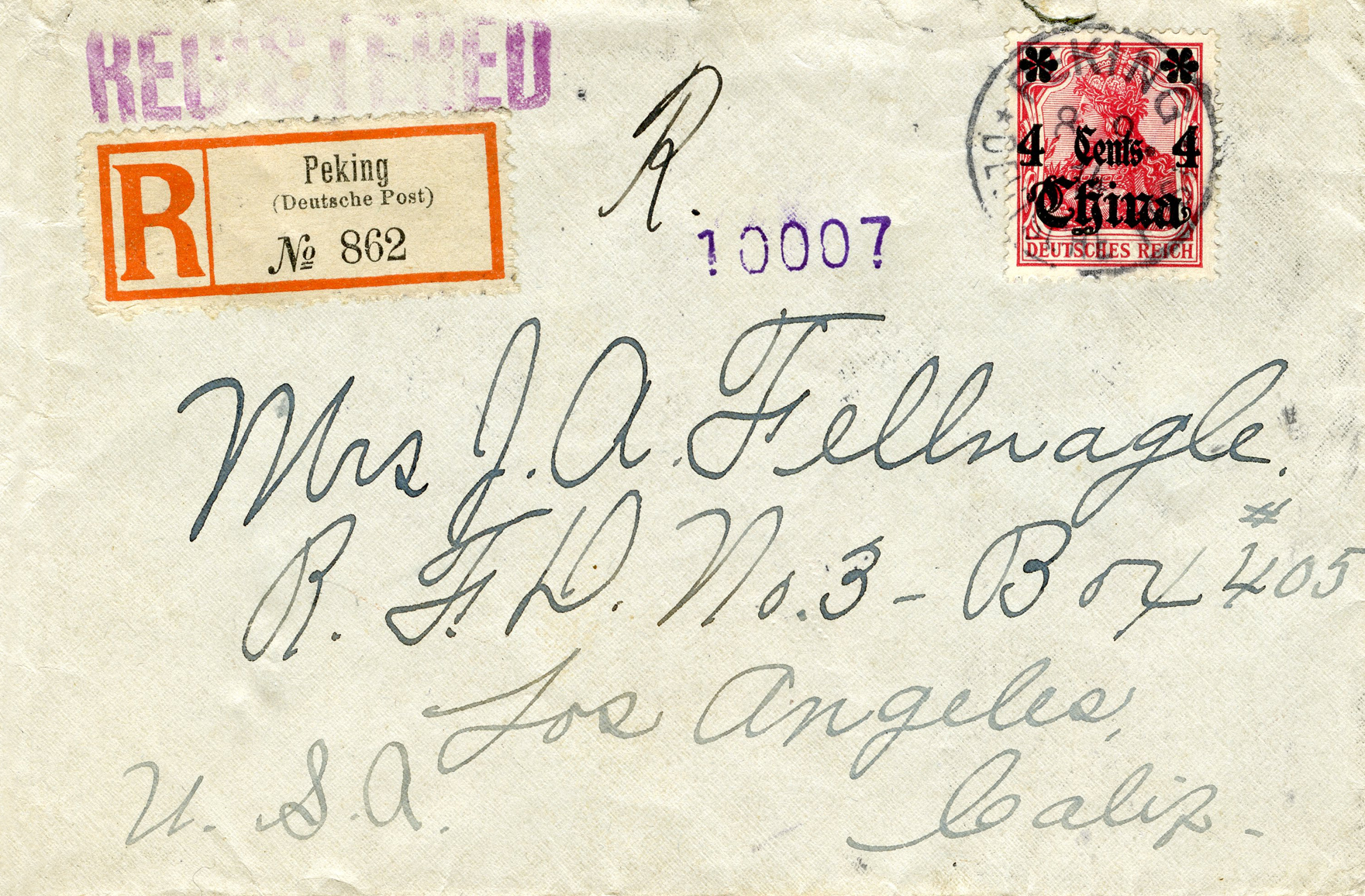
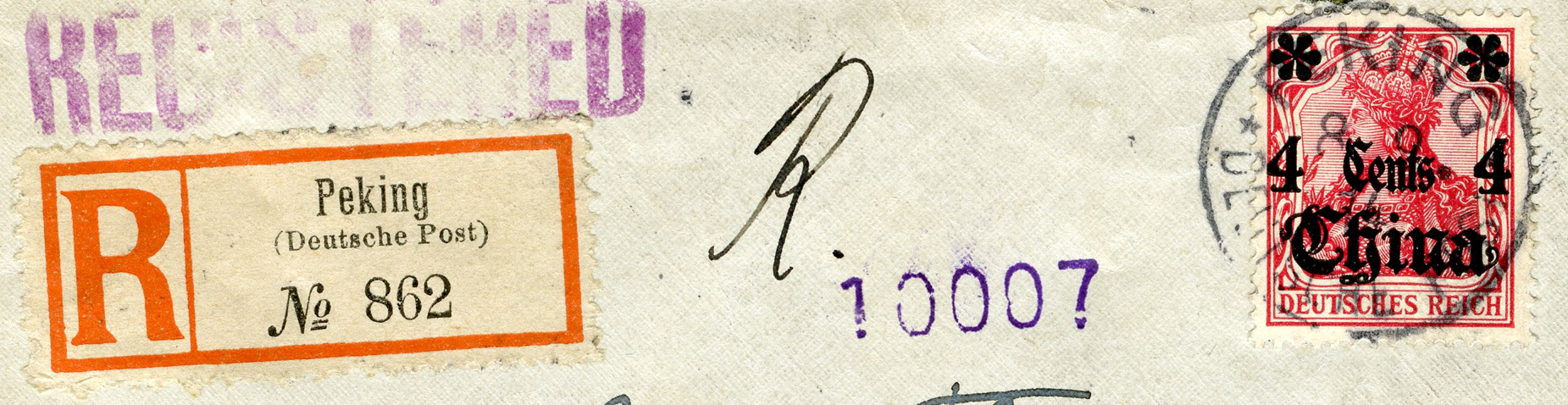
[Below: Here is another envelope that was used in the German office in China, you'll notice this one bears a different, later overprint. This was sent registered to Los Angeles, arriving October 8, 1914. Click to enlarge.]
[Below: Close-up. Click to enlarge.]
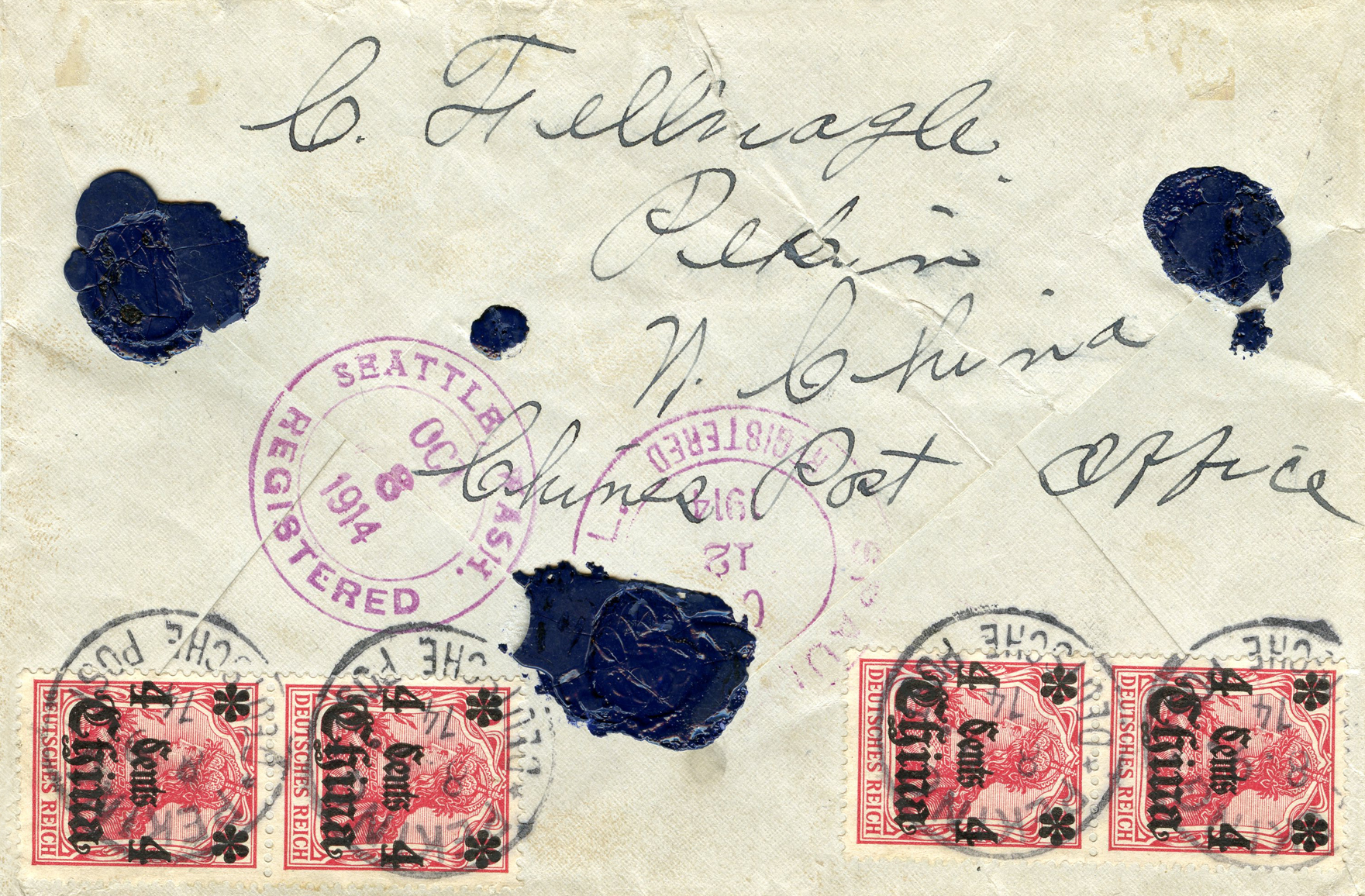
[Below: Reverse. Here we see more postage and Los Angeles arrival stamps. Those dark blue blobs are wax seals. Click to enlarge.]
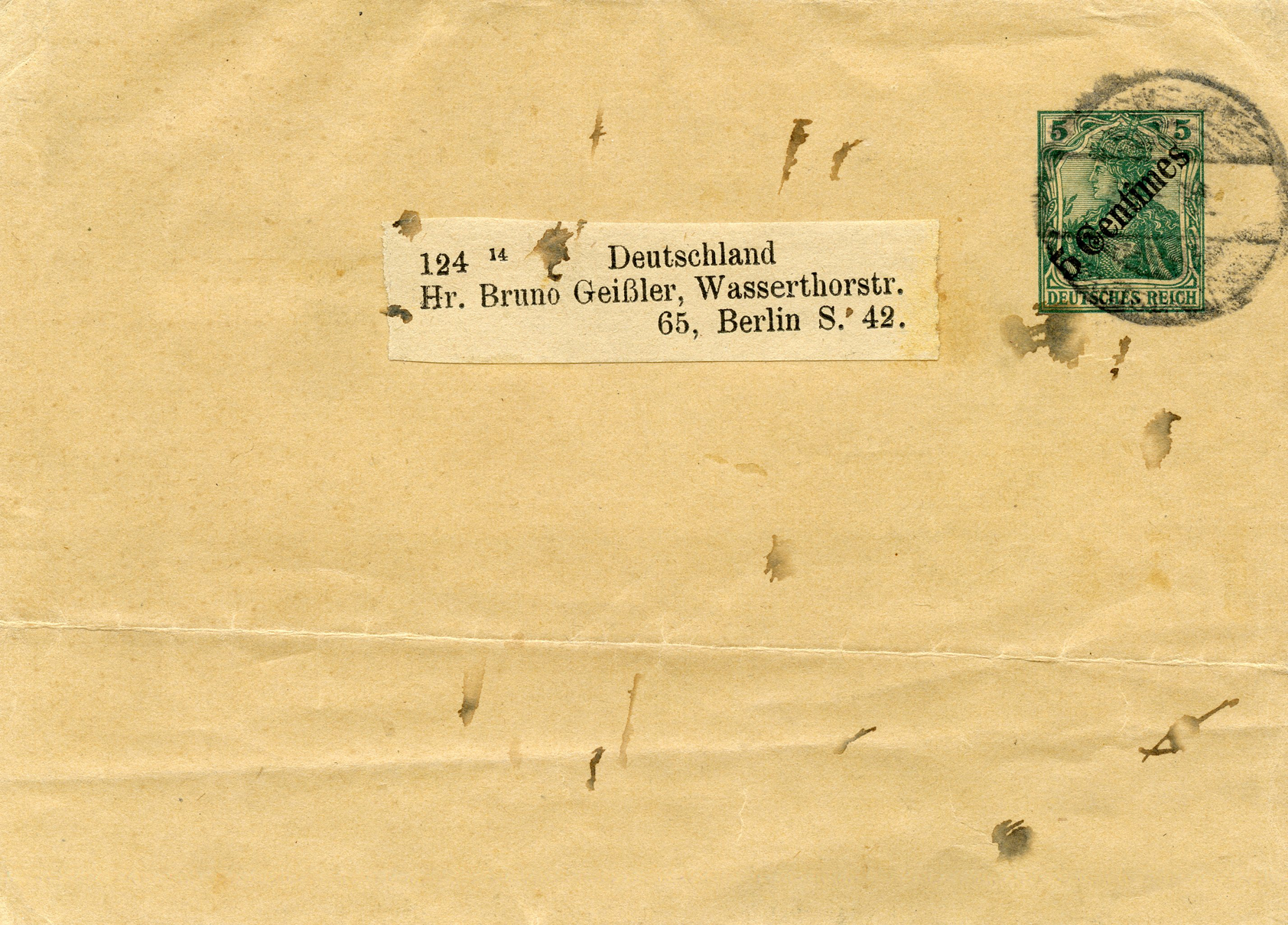
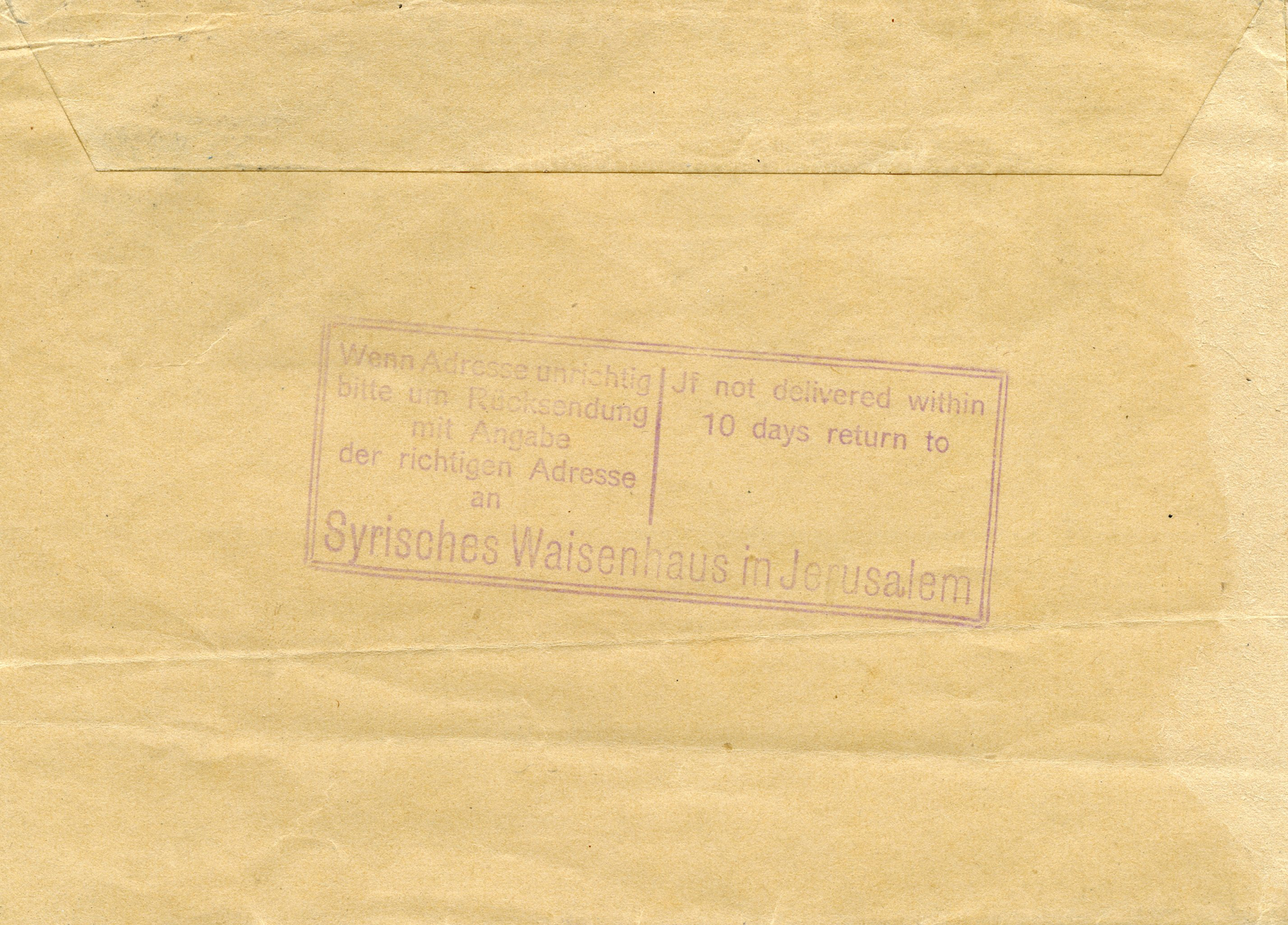
[Below: Here is an envelope sent to Germany from a Syrian Orphans' Home in Jerusalem. Although you can't see the postmark, this type of stamp (with the overprint) was issued in 1908. Click to enlarge.]
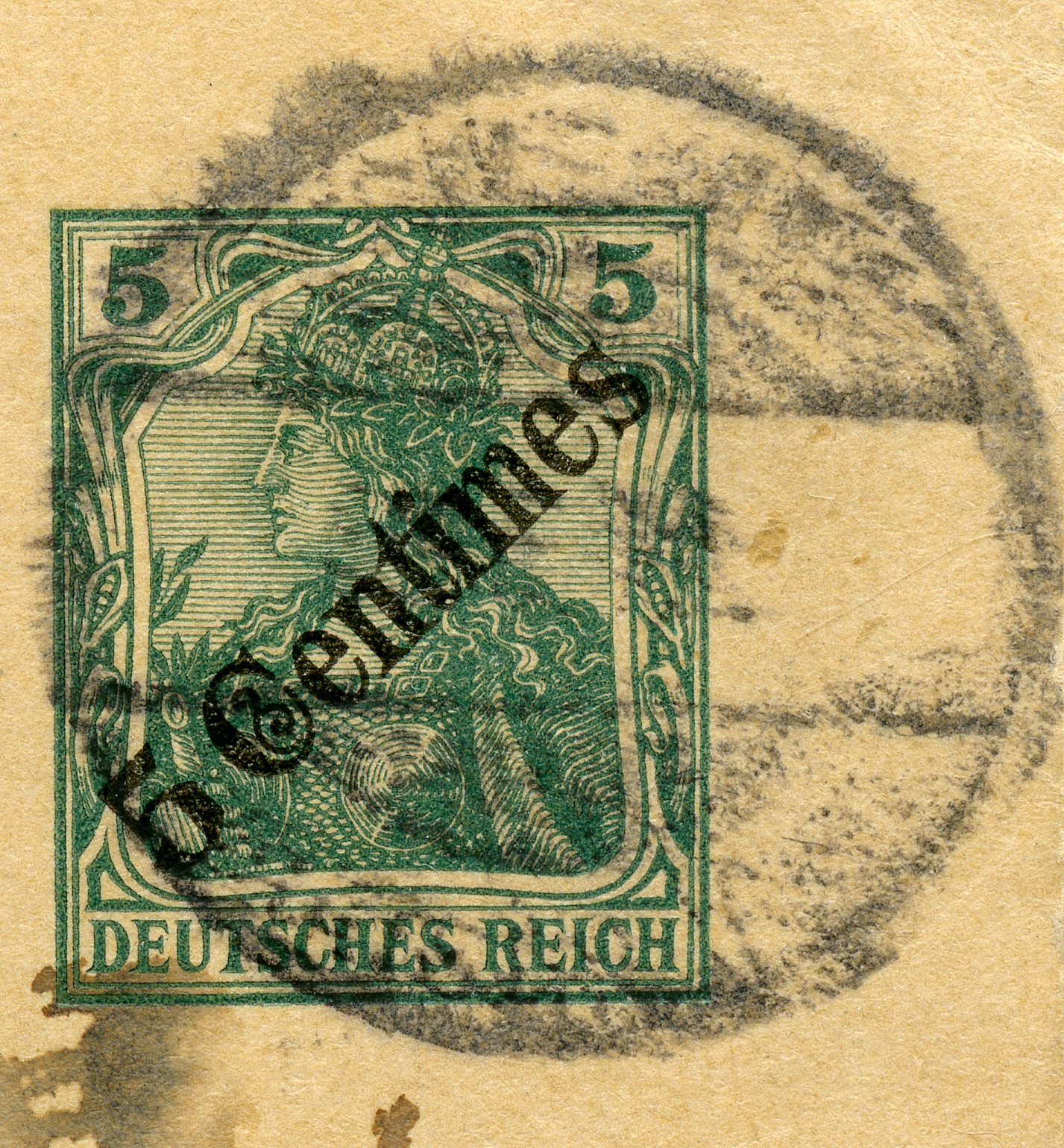
[Below: Close-up. Click to enlarge.]
[Below: Reverse. Click to enlarge.]
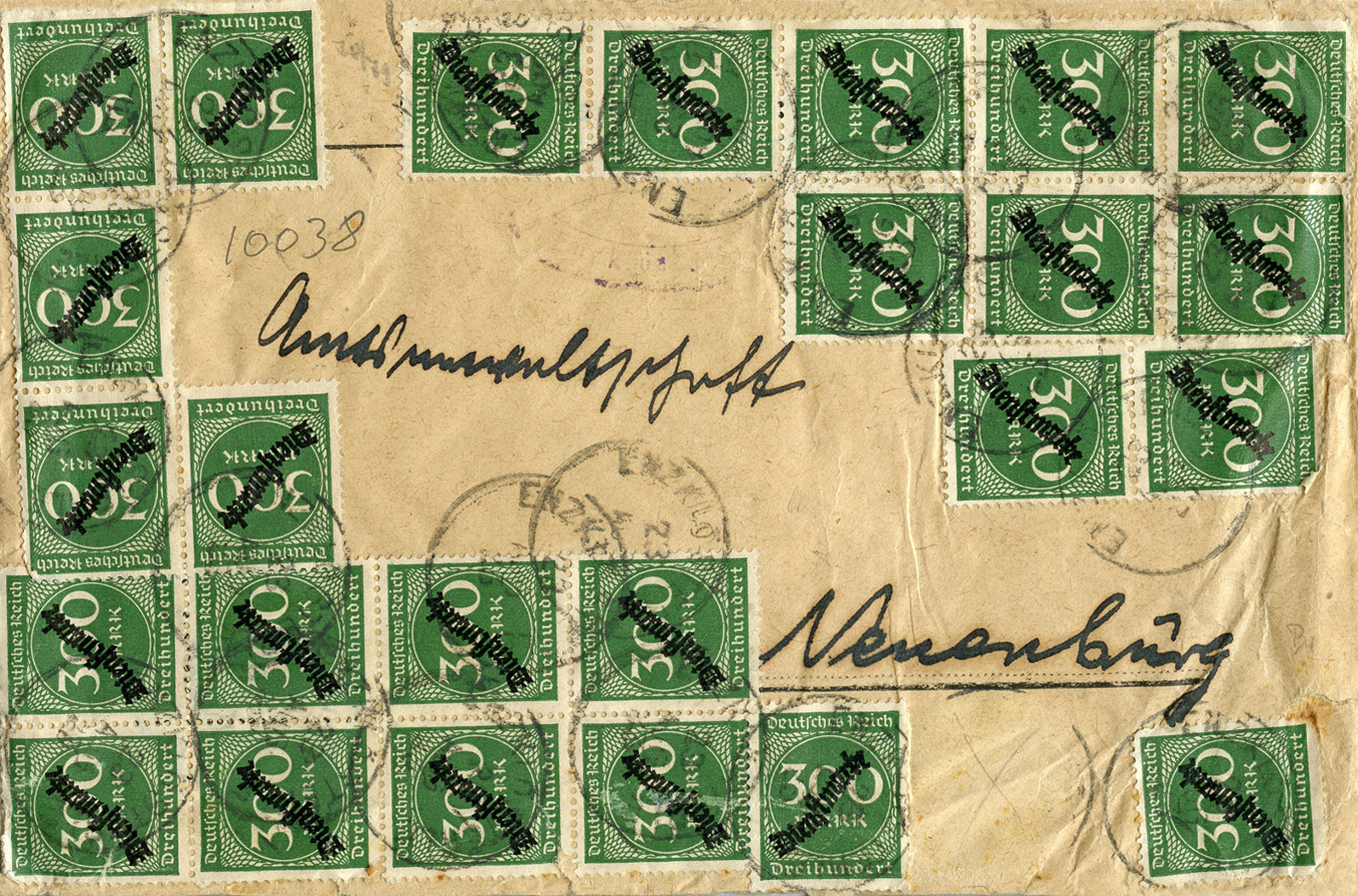
[Below: Here is an example of the insanity of the inflation in Germany in the 1920s. This uses official stamps issued in 1921. It was canceled on August 28, 1923 and uses every inch of the envelope and more for postage. Each stamp, overprinte 'Dienstmarke' (Service Mark), is only 300 marks, which is nothing compared to what was to come, with stamp prices being in the BILLIONS! Click to enlarge.]
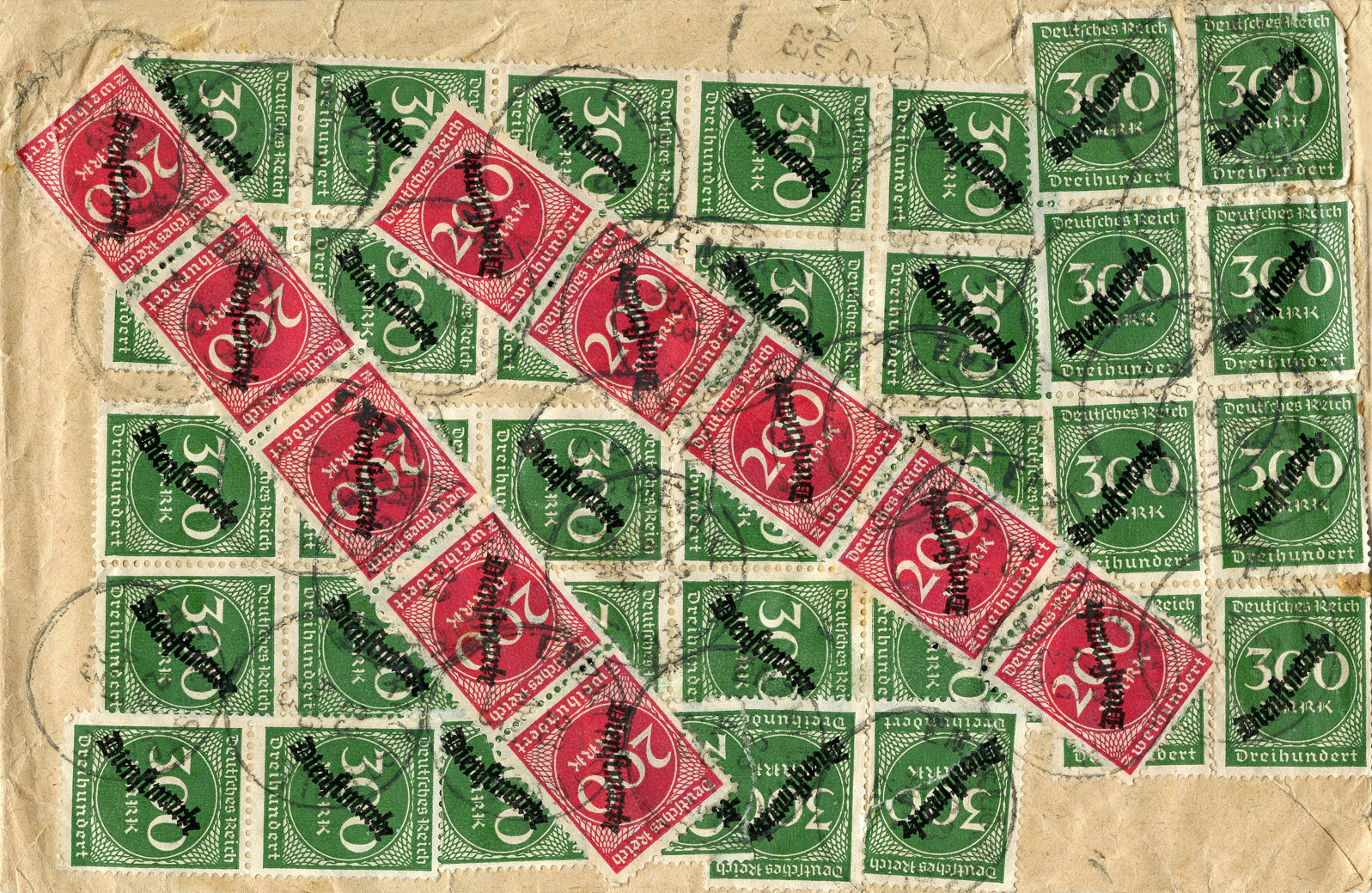
[Below: Reevrse. Here we see additional 200 mark stamps laid over the 300 mark stamps! Click to enlarge.]
[Below: This is a neat, but strange envelope. It was canceled on October 21, 1921, in Hannover. Click to enlarge.]
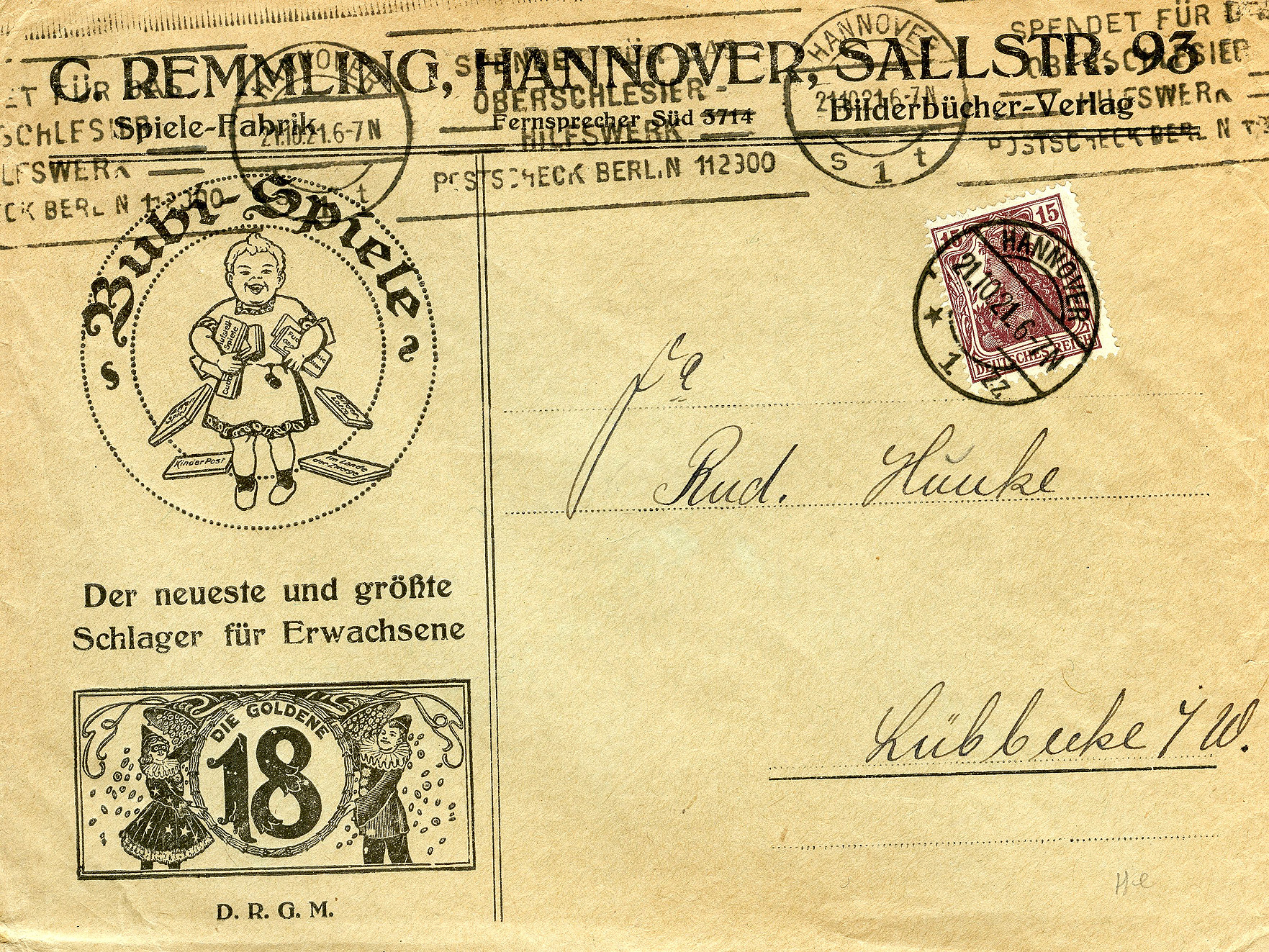
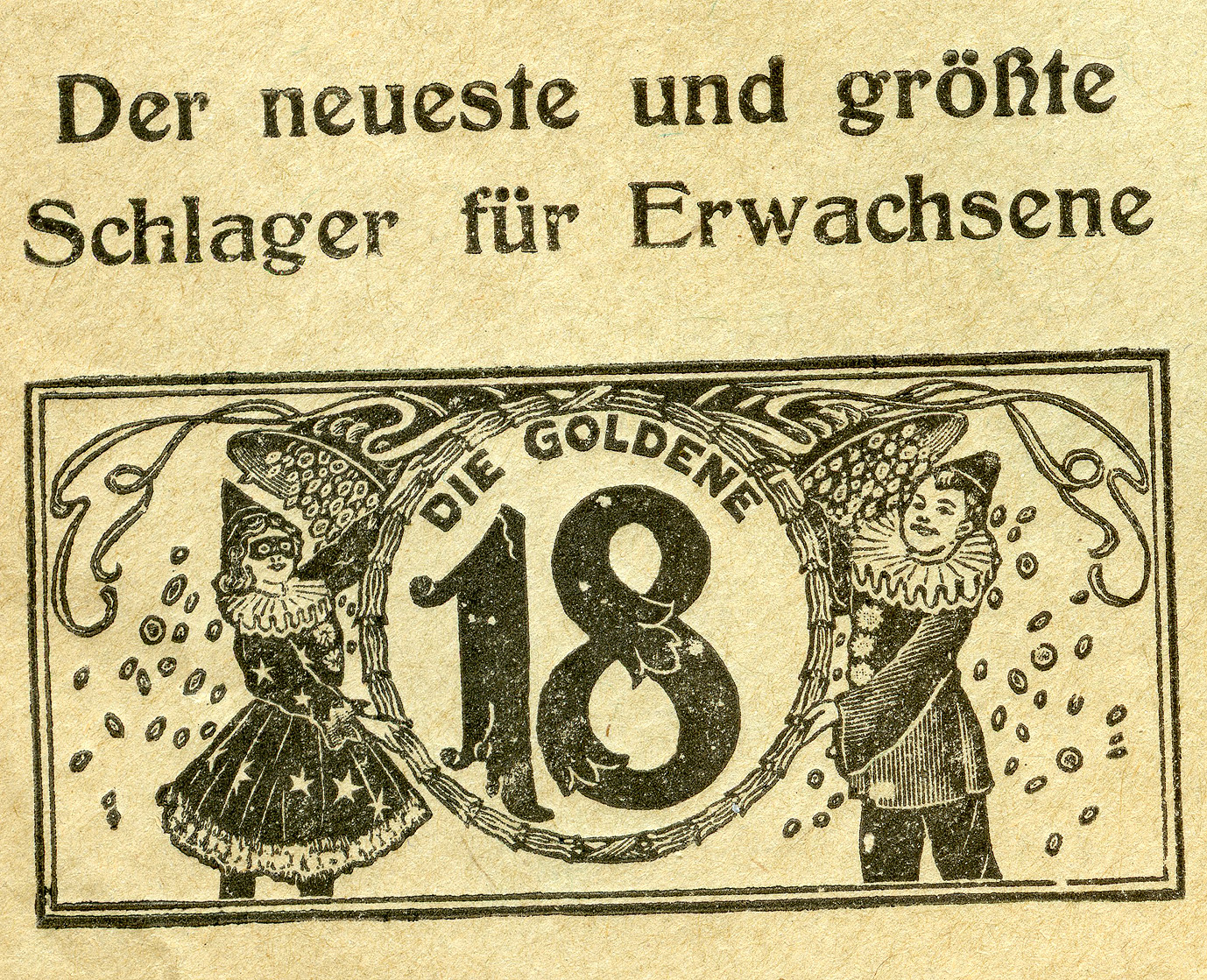
[Below: 'Der neueste und größte Schlager für Erwachsene' (The newest and largest Schlager for adults). Schlager means basically a popular song. I'm not sure what this 'Die Goldene 18' was... maybe a song? Click to enlarge.]
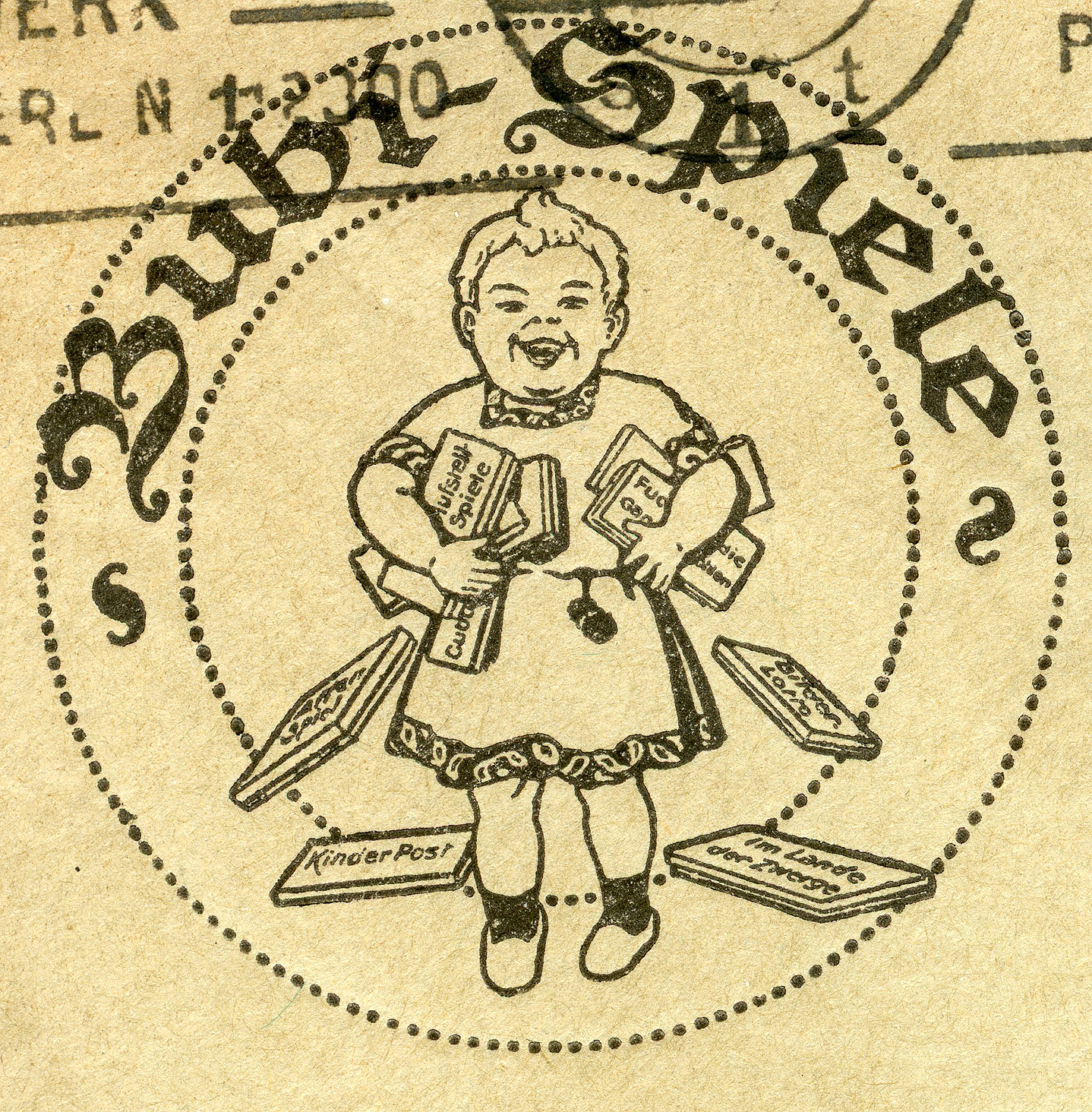
[Below: 'Bubi-Spiele' (Young Boy Games)... not sure what this means. If it involves a boy, why do they show a girl, wearing a dress? Oh wait... nevermind, we have those in this day and age too! Haha... 'She' is holding objects that say, for example, 'Im Lande der Zwerge' (In the Land of the Dwarves) and Kinder Post (Children's Mail). No idea what all this means. Close-up. Click to enlarge.]
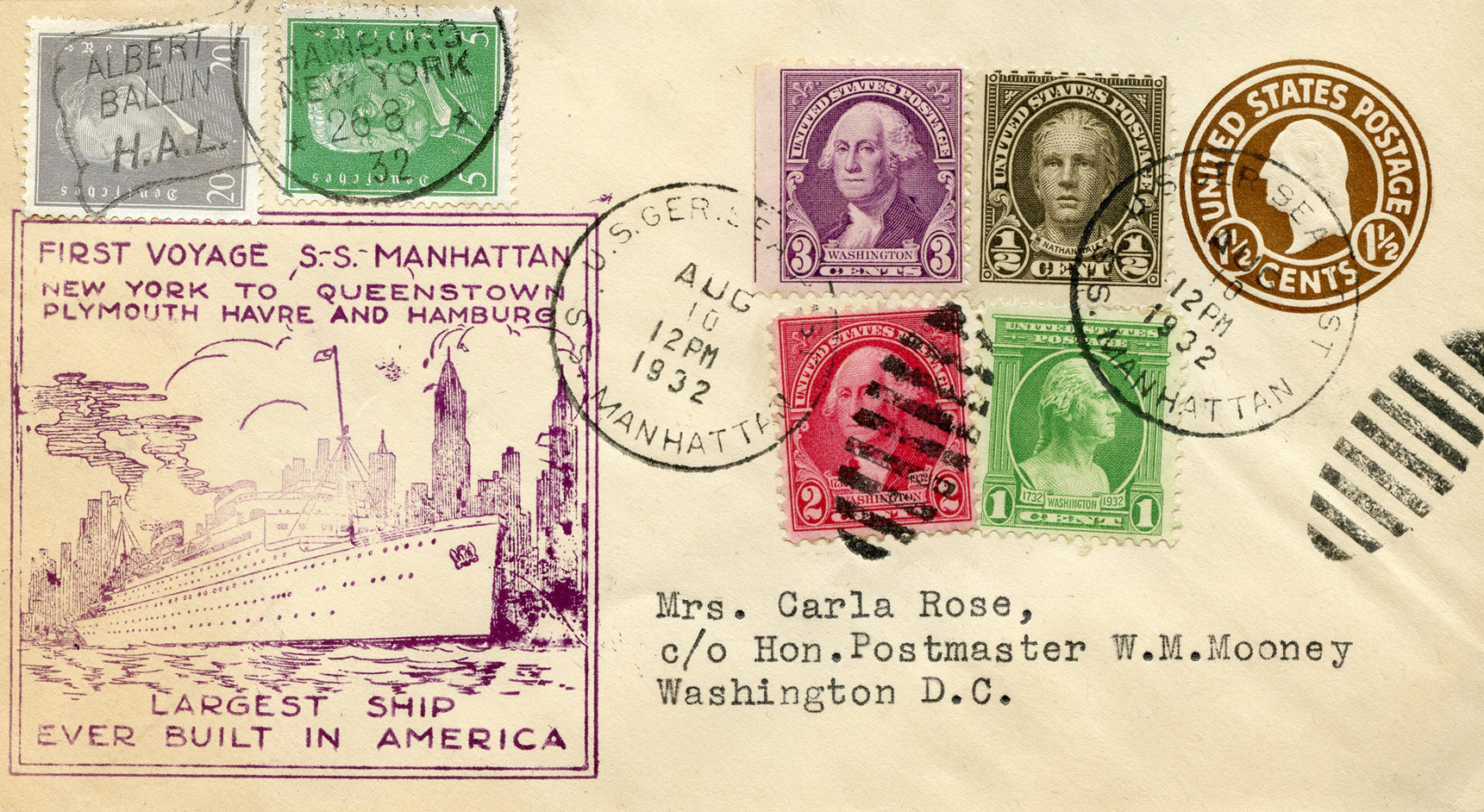
[Below: This is interesting. It was sent to Washington D.C. aboard the ship S.S. Manhattan, on its maiden voyage in August 1932. The S.S. Manhattan, and her sister ship, were the largest liners ever built in the United States. It cost a whopping $21 million (equivalent to over $441 million in 2023)! It was considered a very high cost during the Depression and a massive gamble, that would never pay off.
Her history would see her used for purposes other than as a pleasure ocean liner:
'On June 15, 1941 she was commissioned as USS Wakefield (AP-21) and became the largest ship ever operated by the US Coast Guard. In 1942 she caught fire and was rebuilt as a troop ship. Post-war, she was moored in New York in May, before decommissioning in June 1946. She was laid up in reserve at Jones Point, New York. She never saw commercial service again, and was sold for scrap in 1965.'
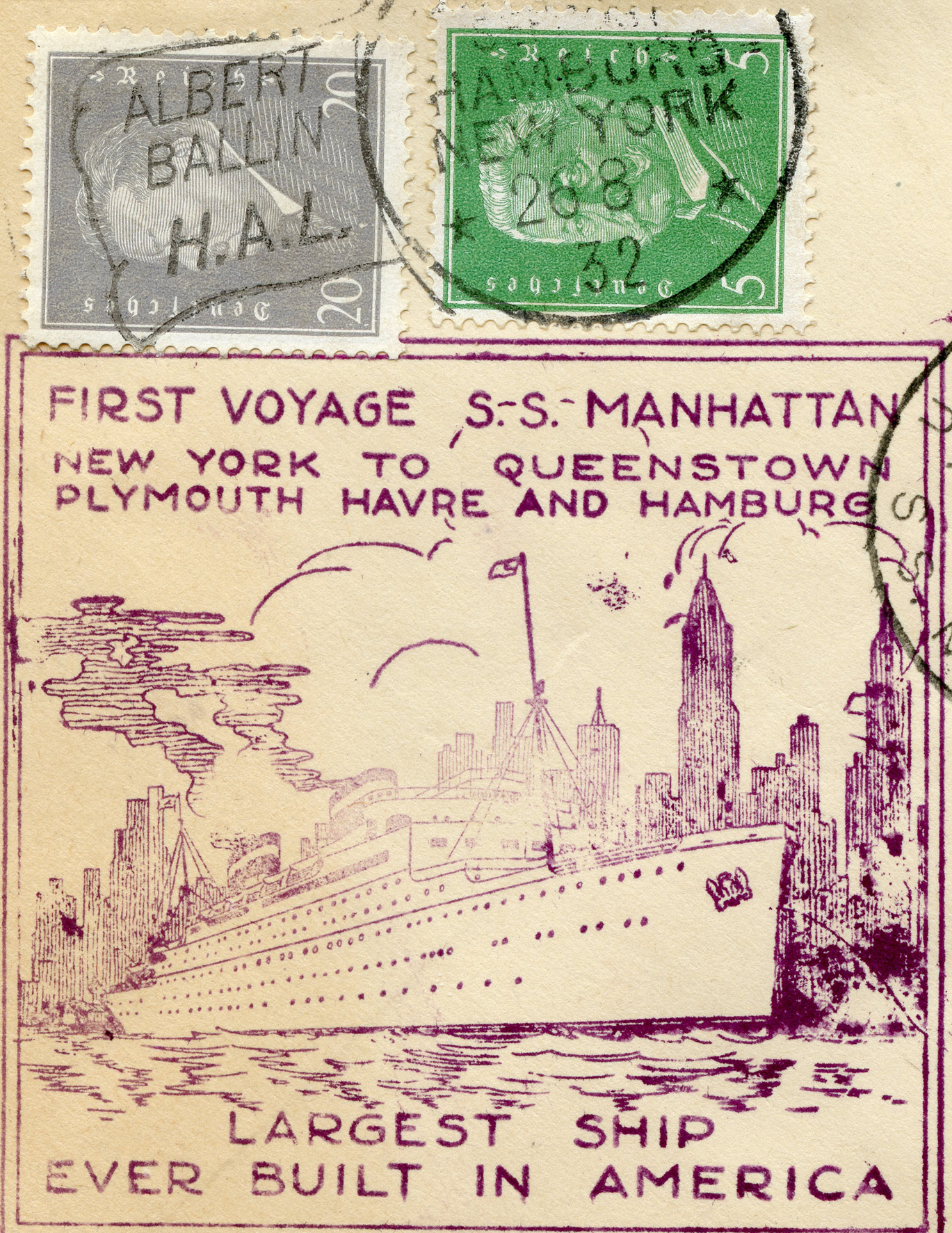
It's interesting that two German stamps are canceled on the top left of the envelope. Click to enlarge.]
[Below: Close-up. Click to enlarge.]
[Below: The S.S. Manhattan.]
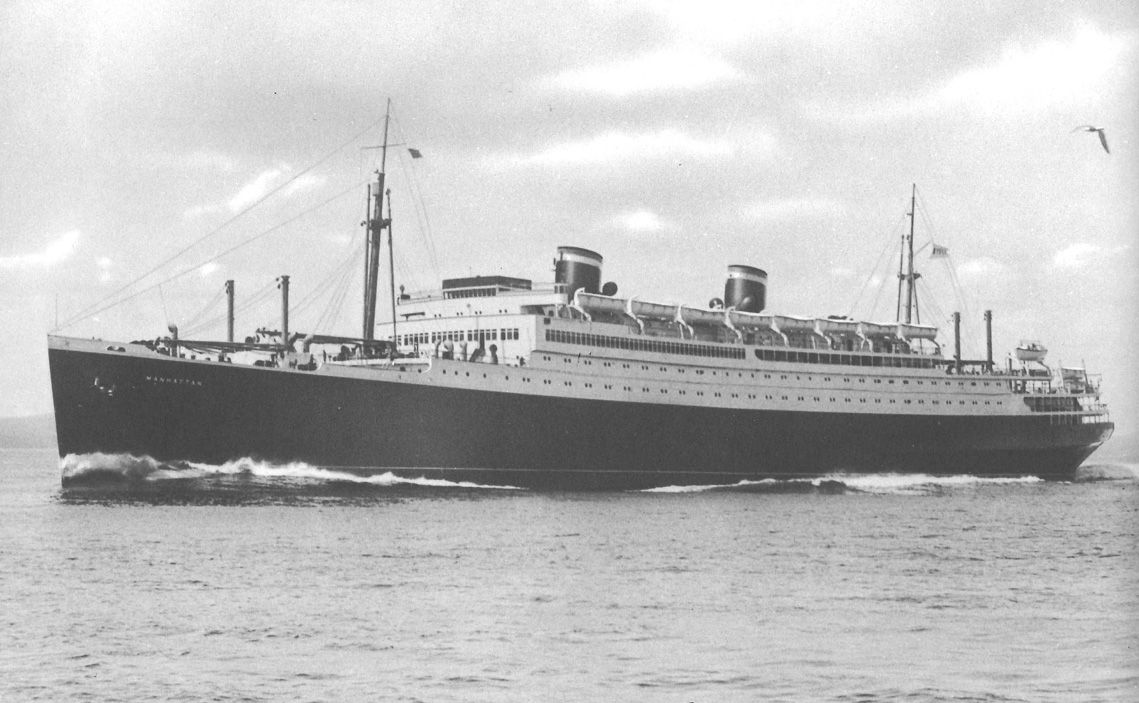
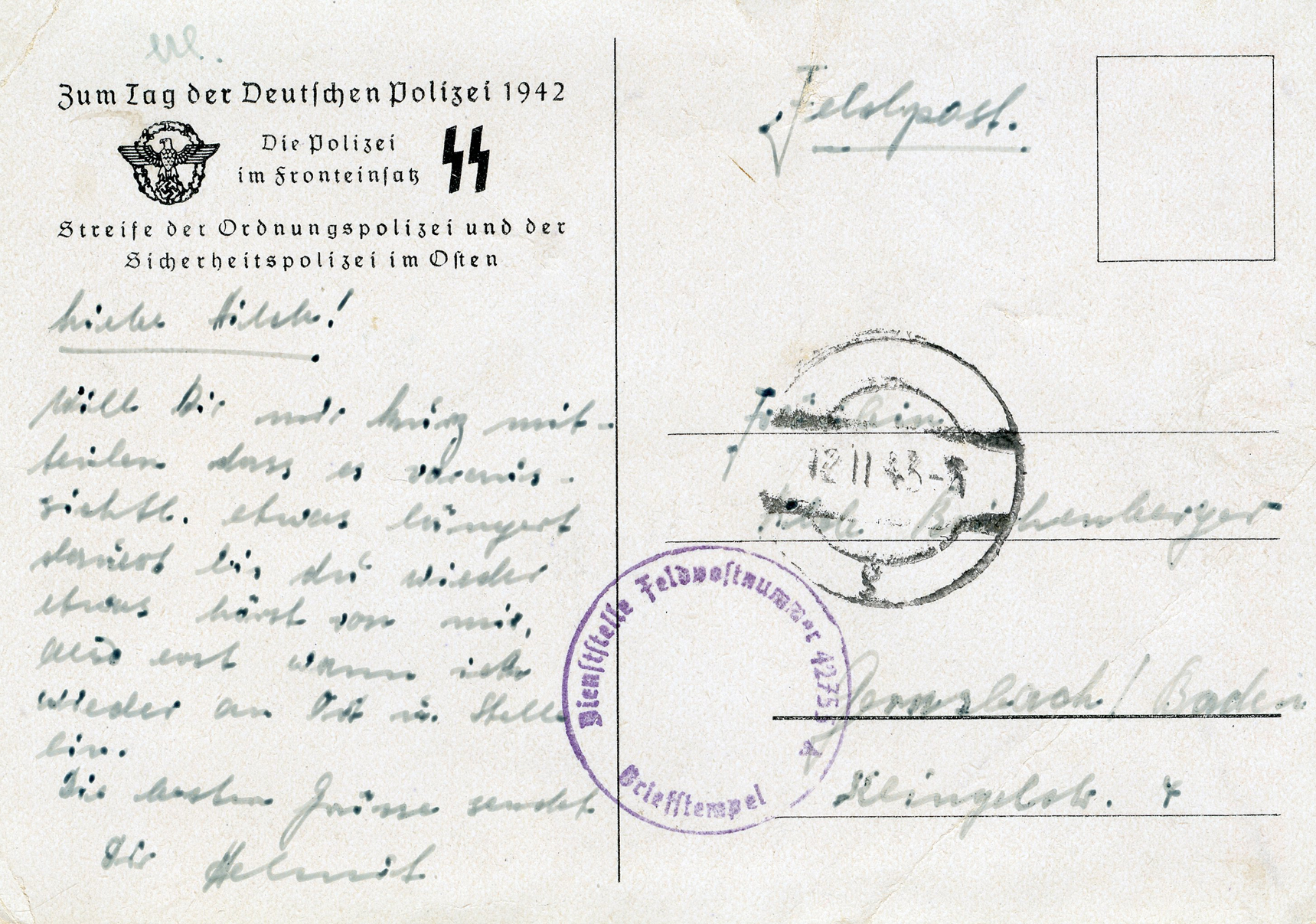
[Below: Okay, it's time for some flashy postcards. This one celebrates police on the front lines, which were under the control of the SS. Click to enlarge.]
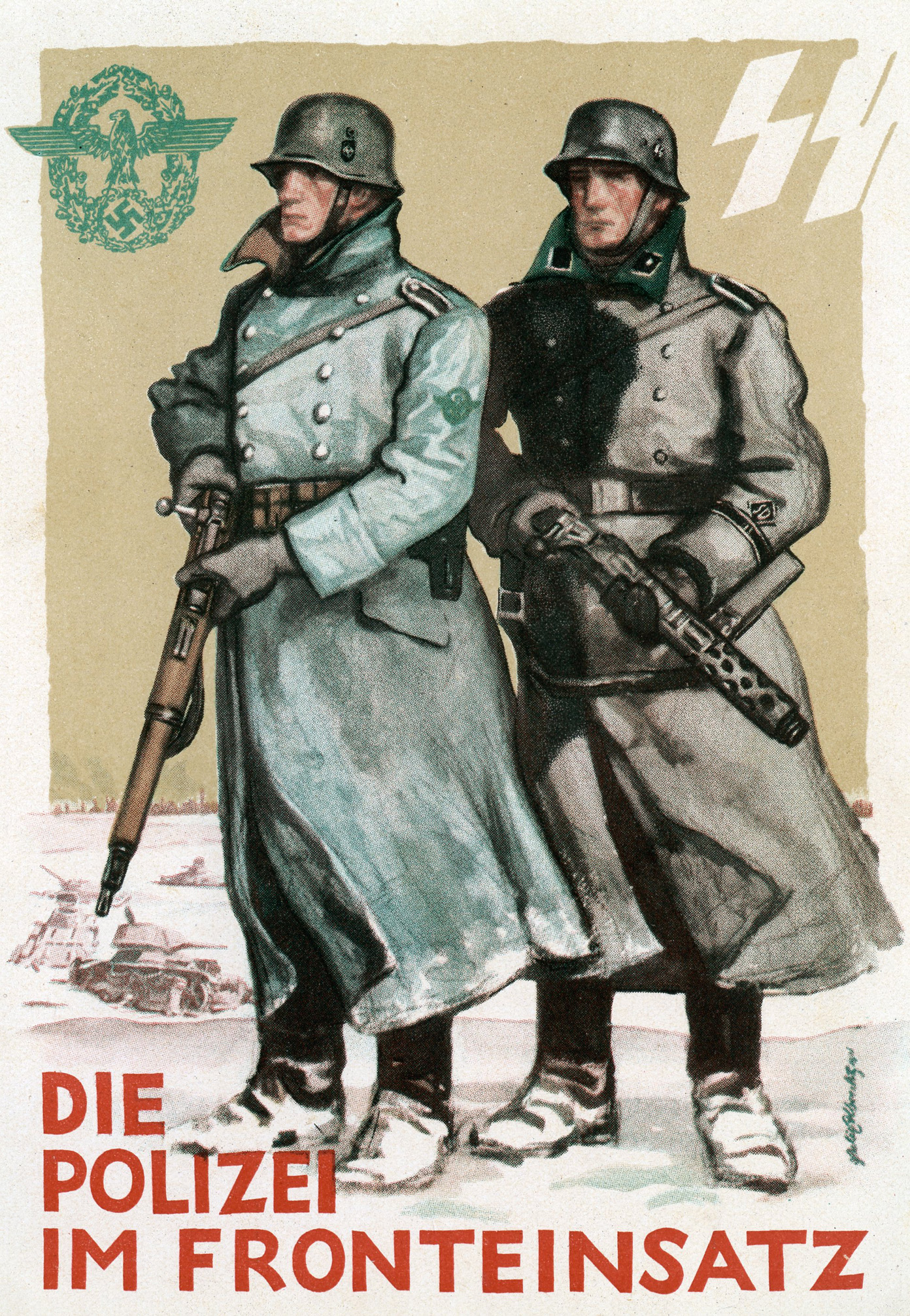
[Below: Reverse. It says: 'Zum Tag der Deutschen Polizei 1942' (On the Day of the German Police 1942). Click to enlarge.]
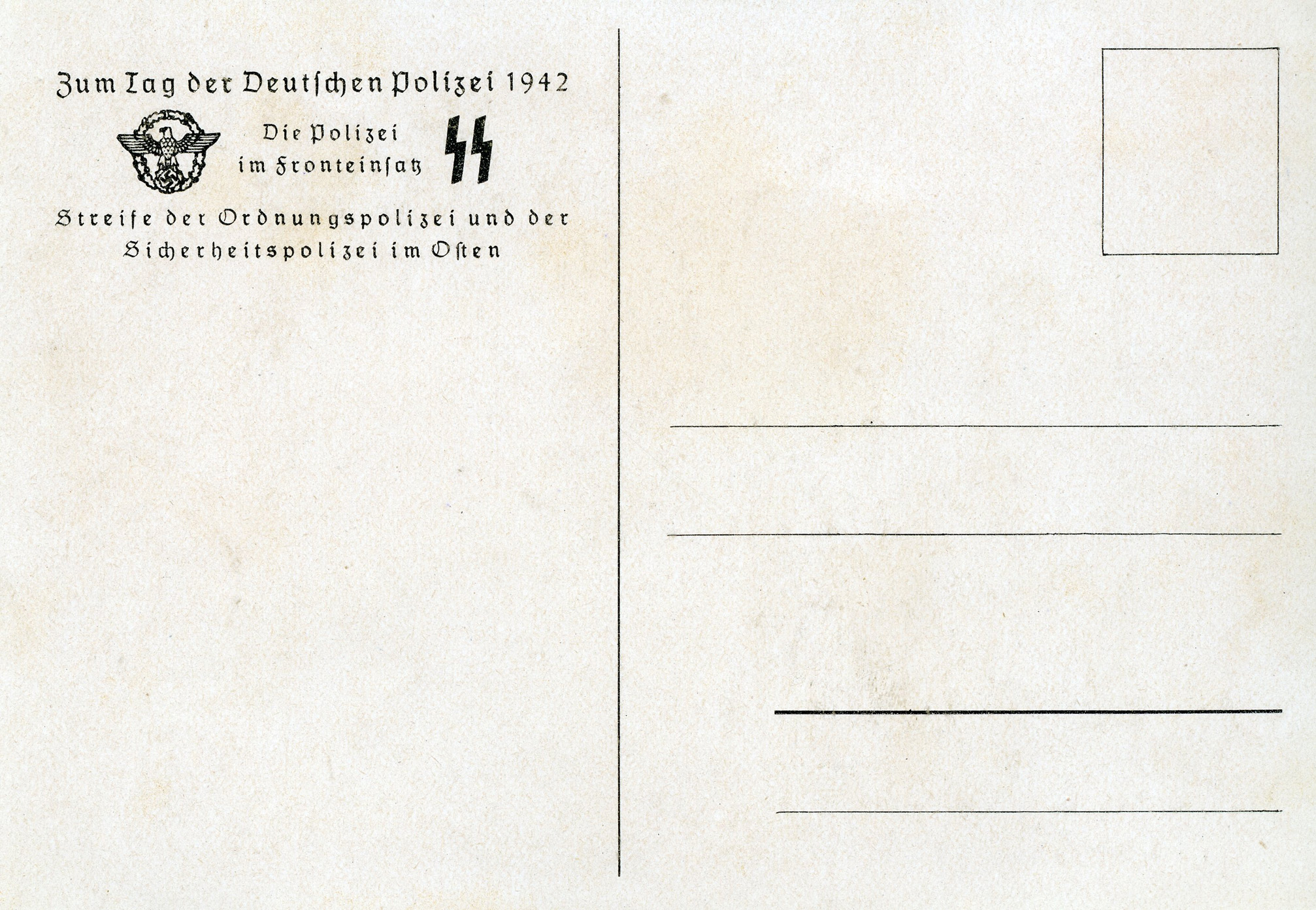
[Below: Used version. Click to enlarge.]
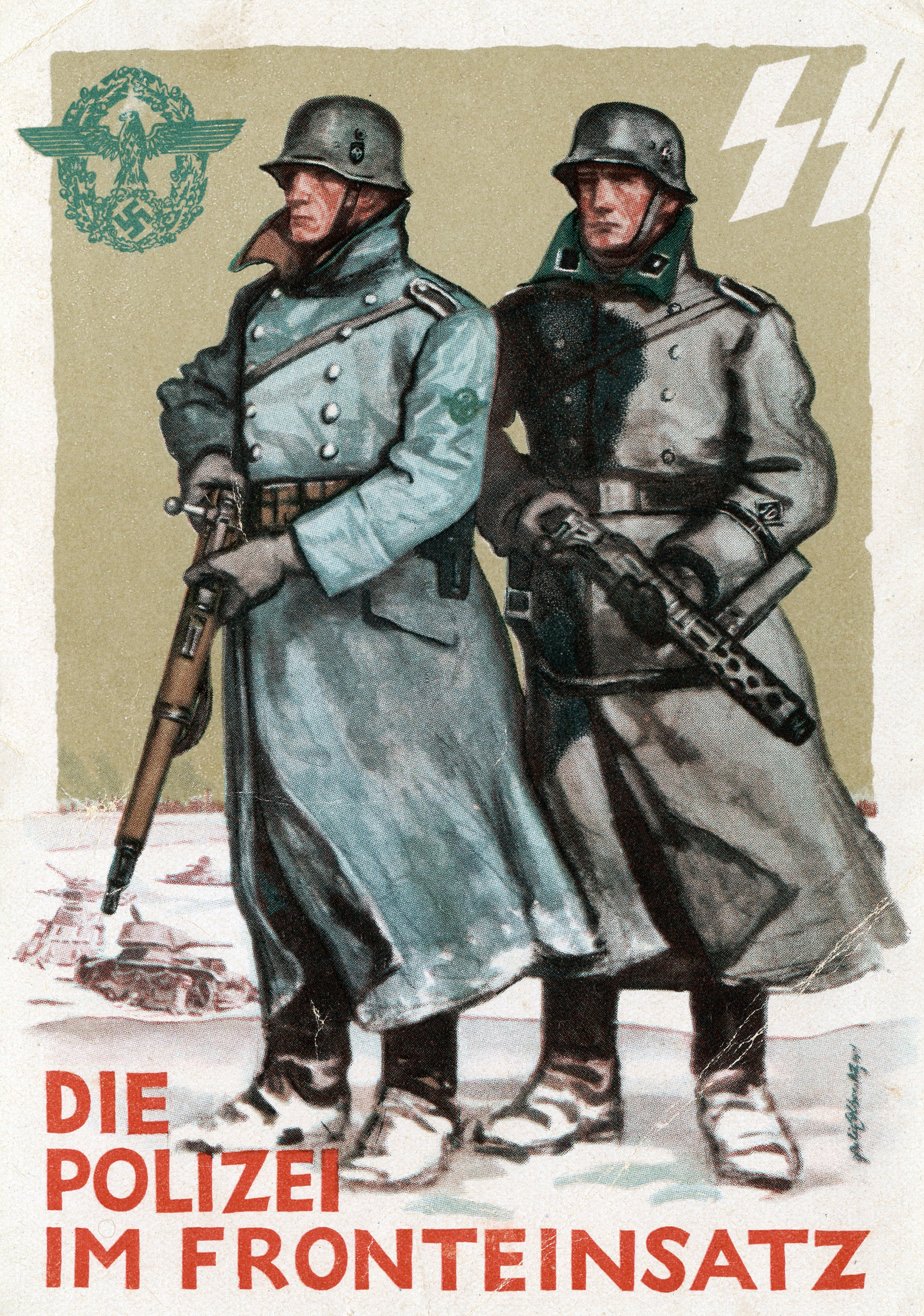
[Below: This was sent Feldpost on November 12, 1943. Click to enlarge.]
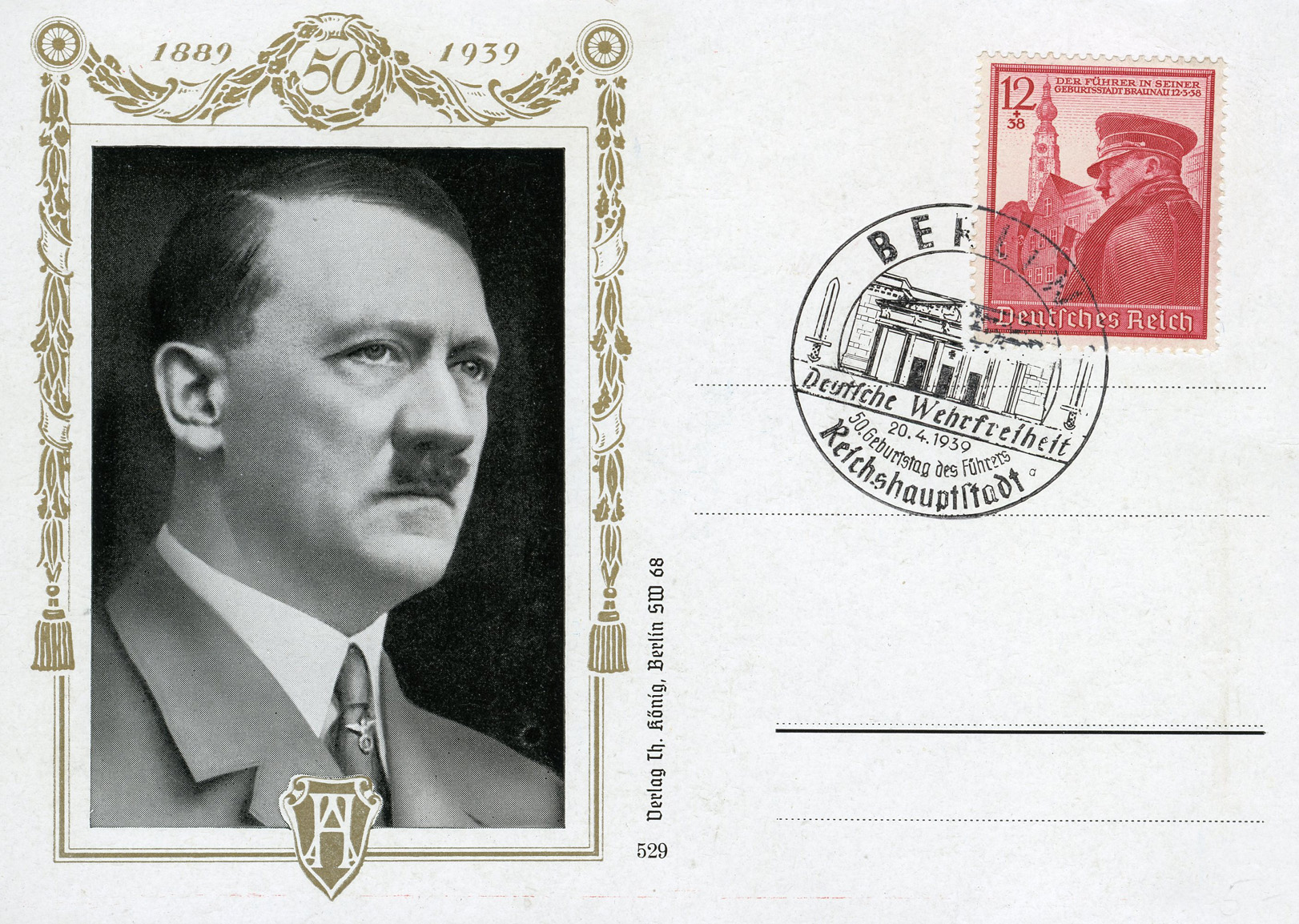
[Below: This is a postcard celebrating the 50th birthday of Adolf Hitler. What a beautiful cancel... Click to enlarge.]
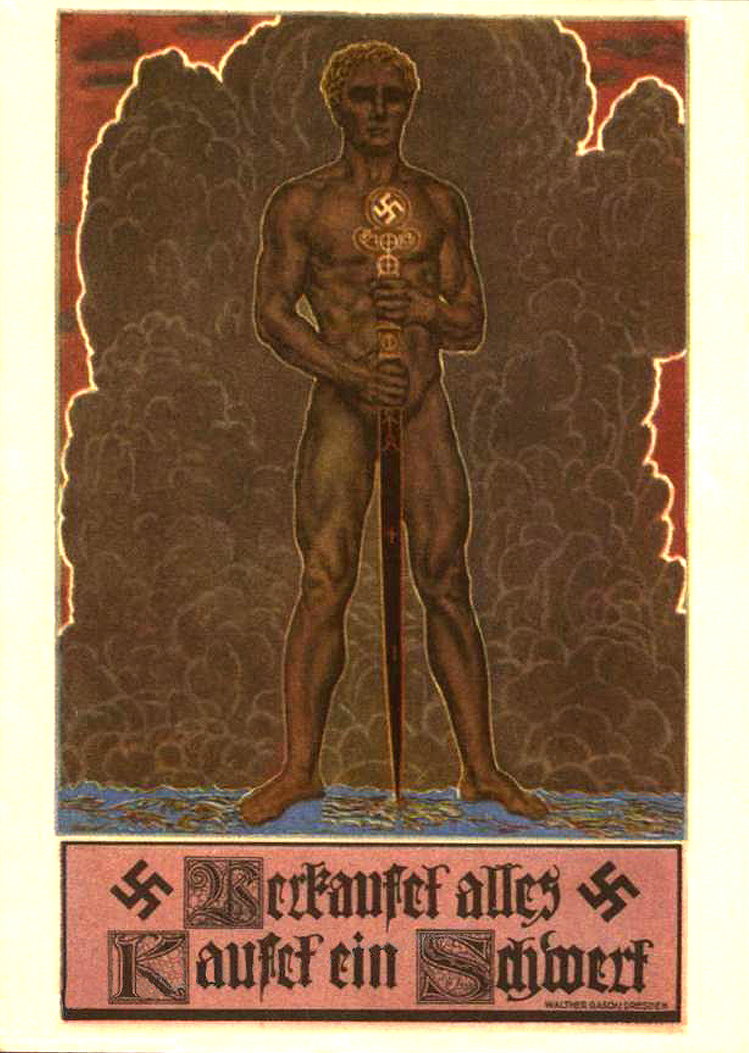
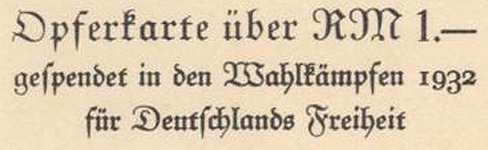
[Below: This is an extremely rare postcard. It sold for one Reich Mark which used for a donation to the NSDAP 1932 elections. It boldly proclaims 'Sell everything and buy a sword.' This phrase originates from the Gospel of Luke (22:36), where Jesus says "sell your cloak and buy a sword".]
[Below: Text on reverse.]
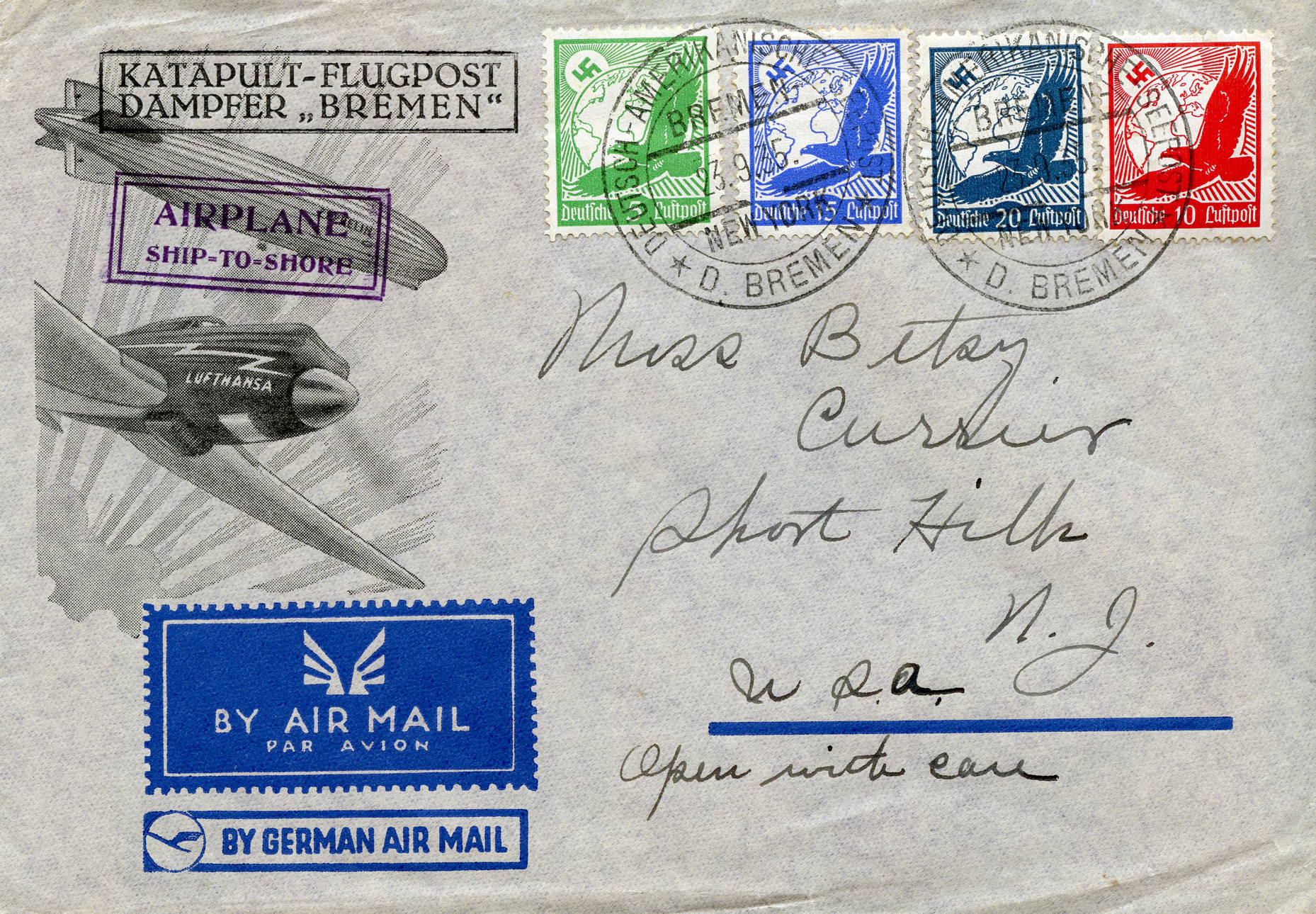
[Below: This deluxe envelope with plane and Zeppelin graphics was sent from Bremen to New York on a ship. As you can read in the upper left-hand corner, some of these are actually catapulted from the ship to the shore in mail bags. But this one has been stamped 'Airplane - Ship to Shore'. The back of the envelope is blank. Click to enlarge.]
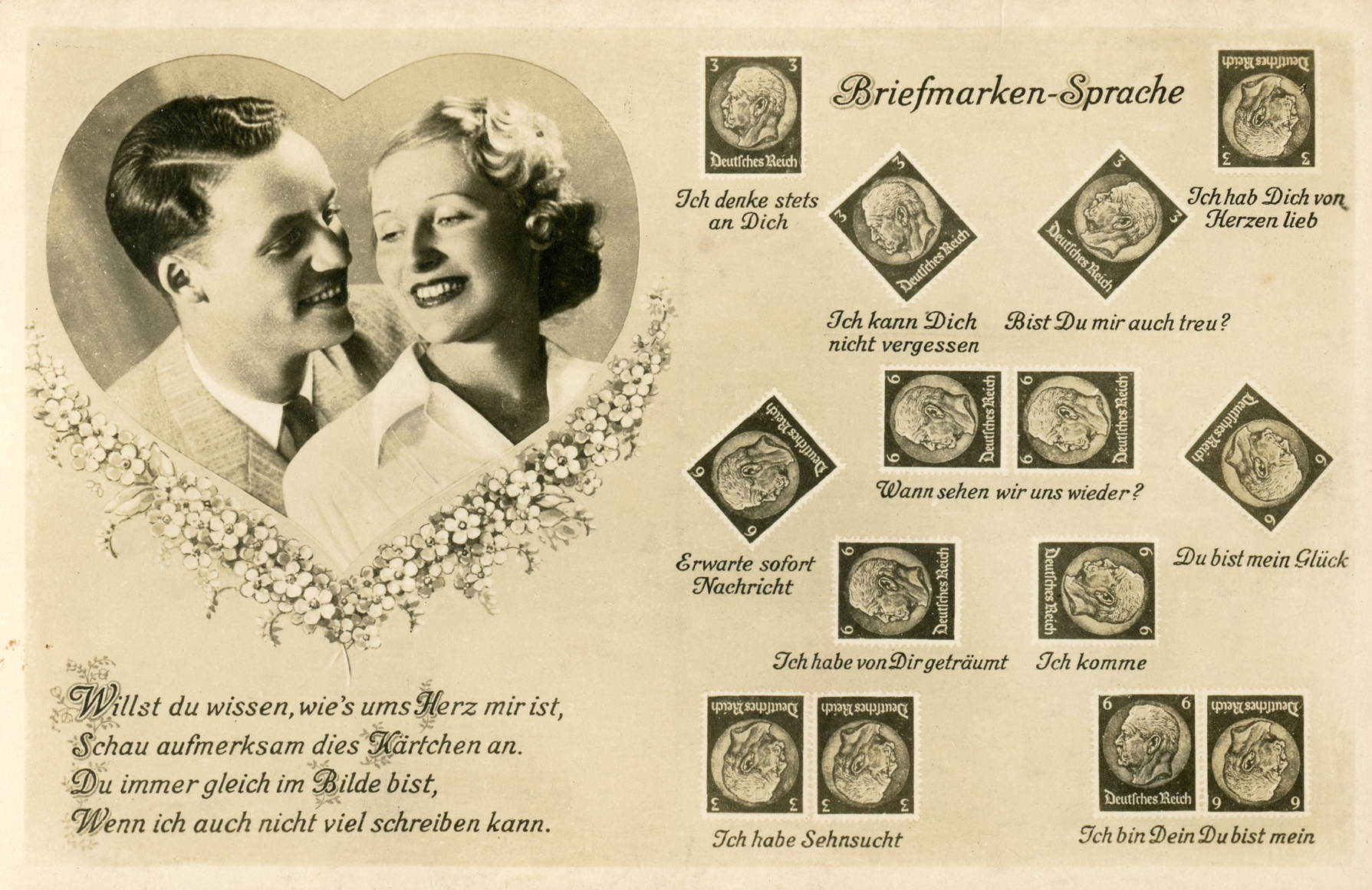
[Below: This shows the messages that could be relayed using the positioning of postage stamps. Click to enlarge.]
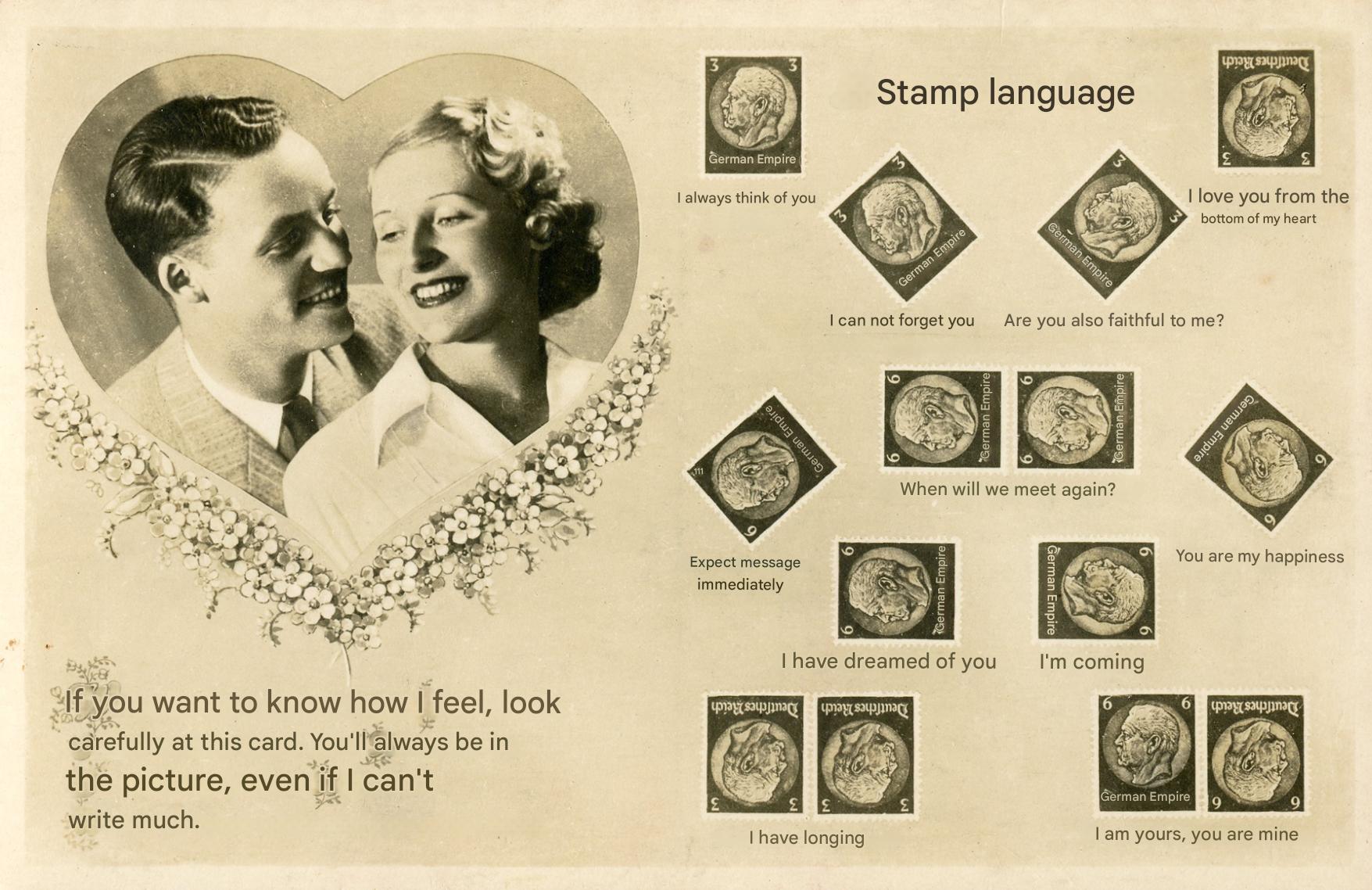
[Below: Here is a translation. It was such a better world... imagine the messages of today. 'I wanna fuck', 'I need an abortion', 'You gave me an STD', 'You cheated on me'... Click to enlarge.]
[Below: Reverse. Click to enlarge.]
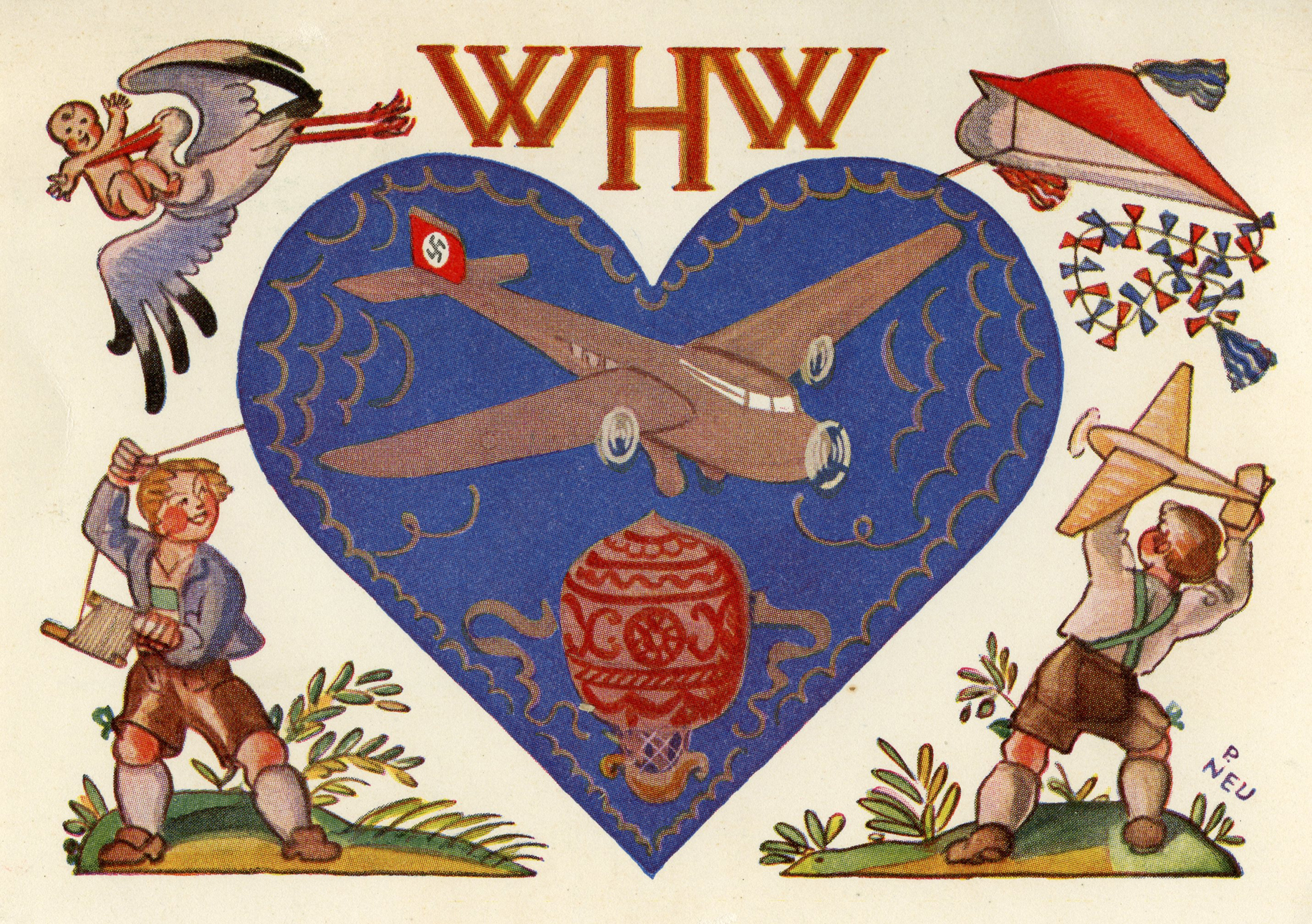
[Below: This is a fairly rare WHW (Winterhilfswerk des Deutschen Volkes, or Winter Relief of the German People) postcard. Click to enlarge.]
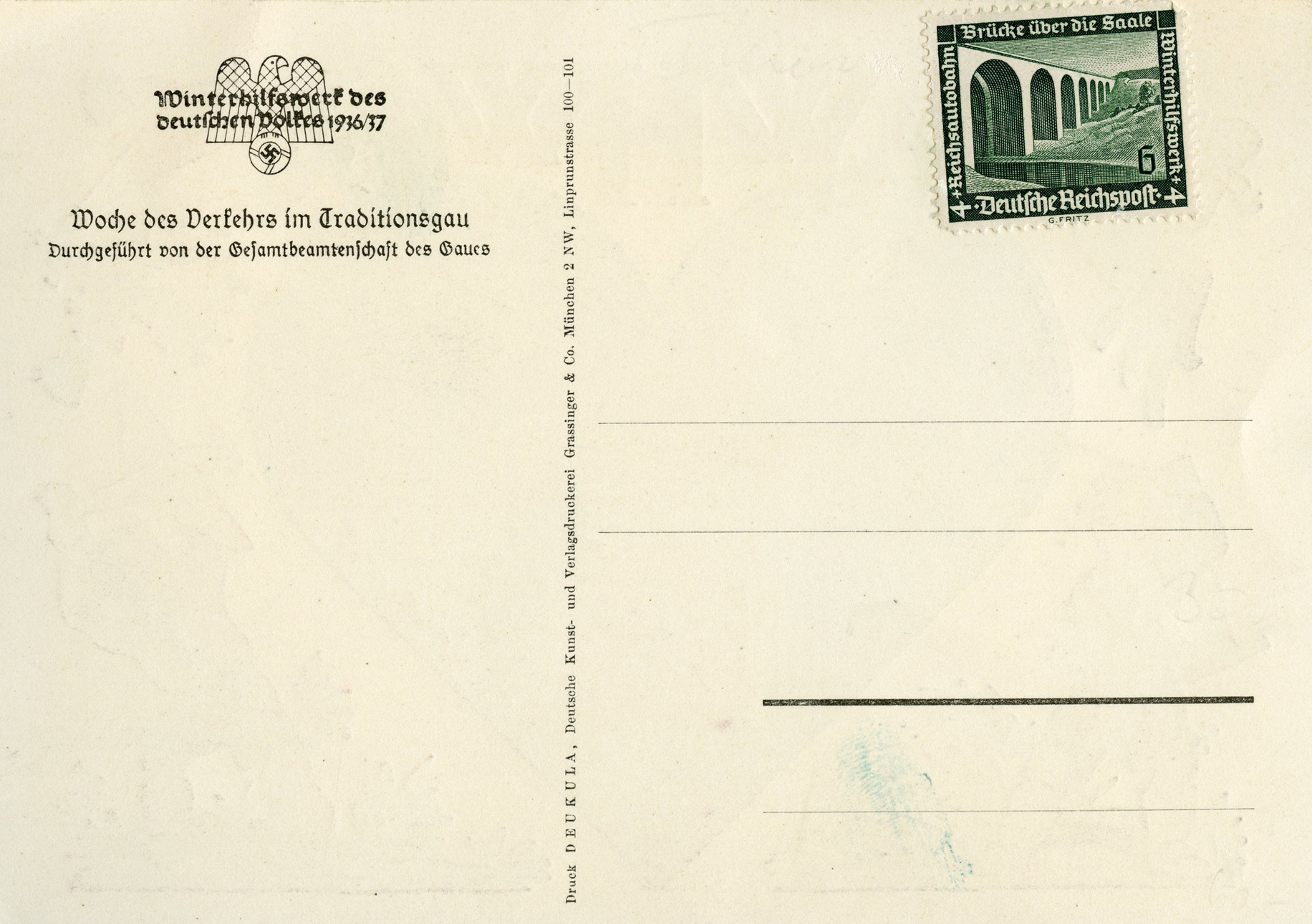
[Below: Reverse. For some reason someone added a stamp but never sent it. Click to enlarge.]
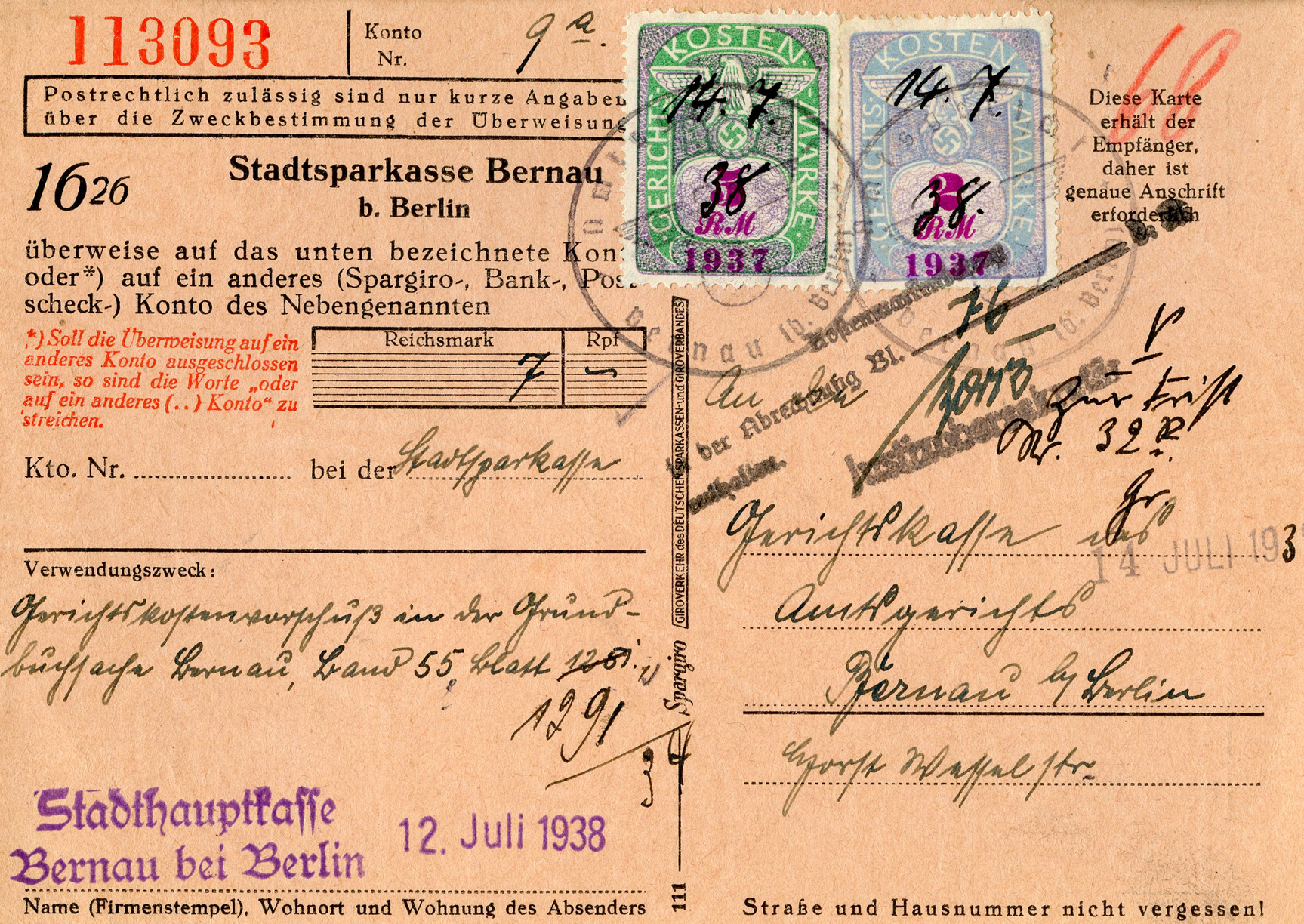
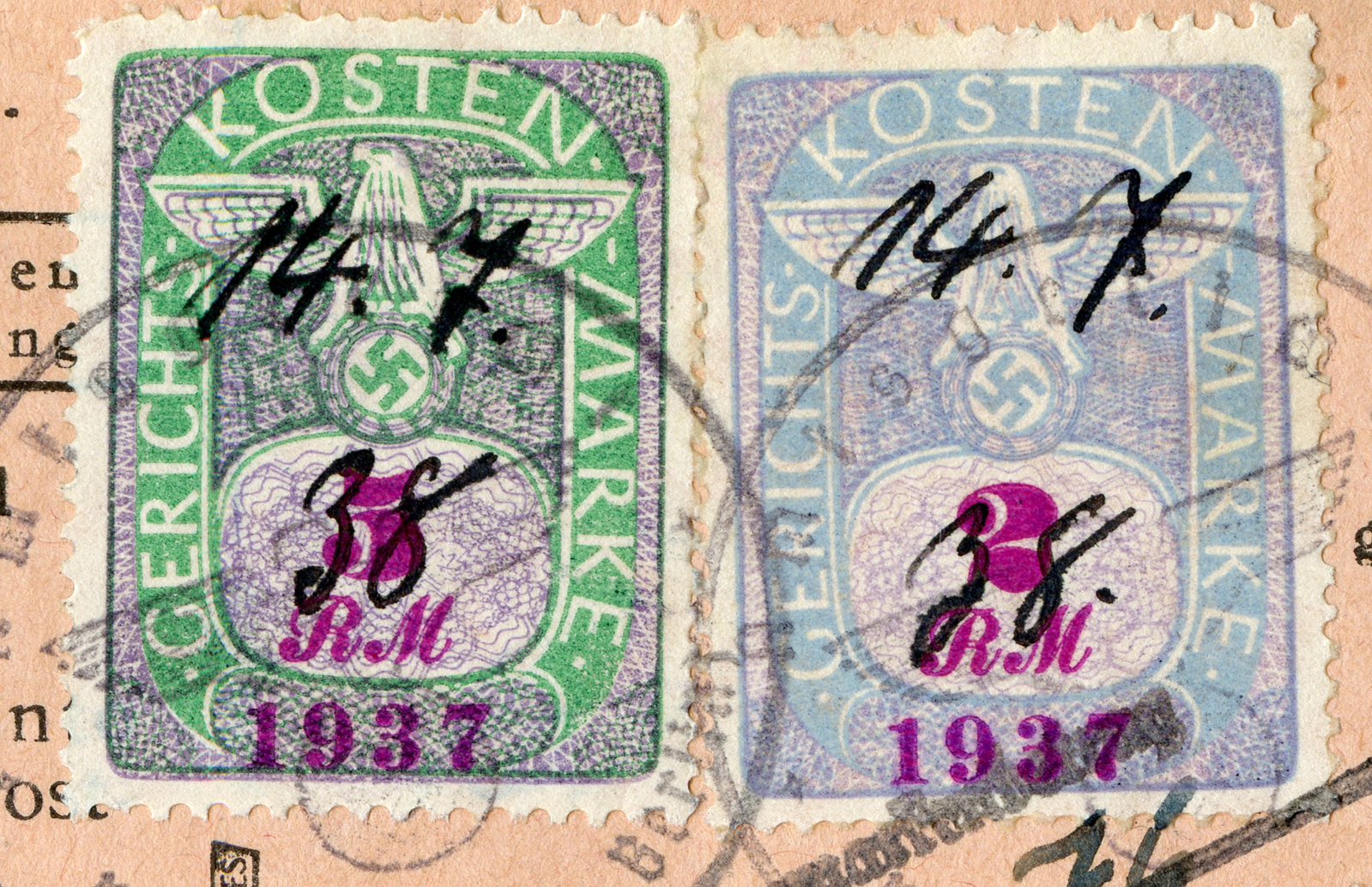
[Below: Now this is a strange postcard. I've never seen this type of postcard before. The stamps are court fees stamps, not postage stamps, which is interesting. As far as I can tell this has something to do with court fees. Click to enlarge.]
[Below: Close-up. Click to enlarge.]
[Below: Reverse. Click to enlarge.]
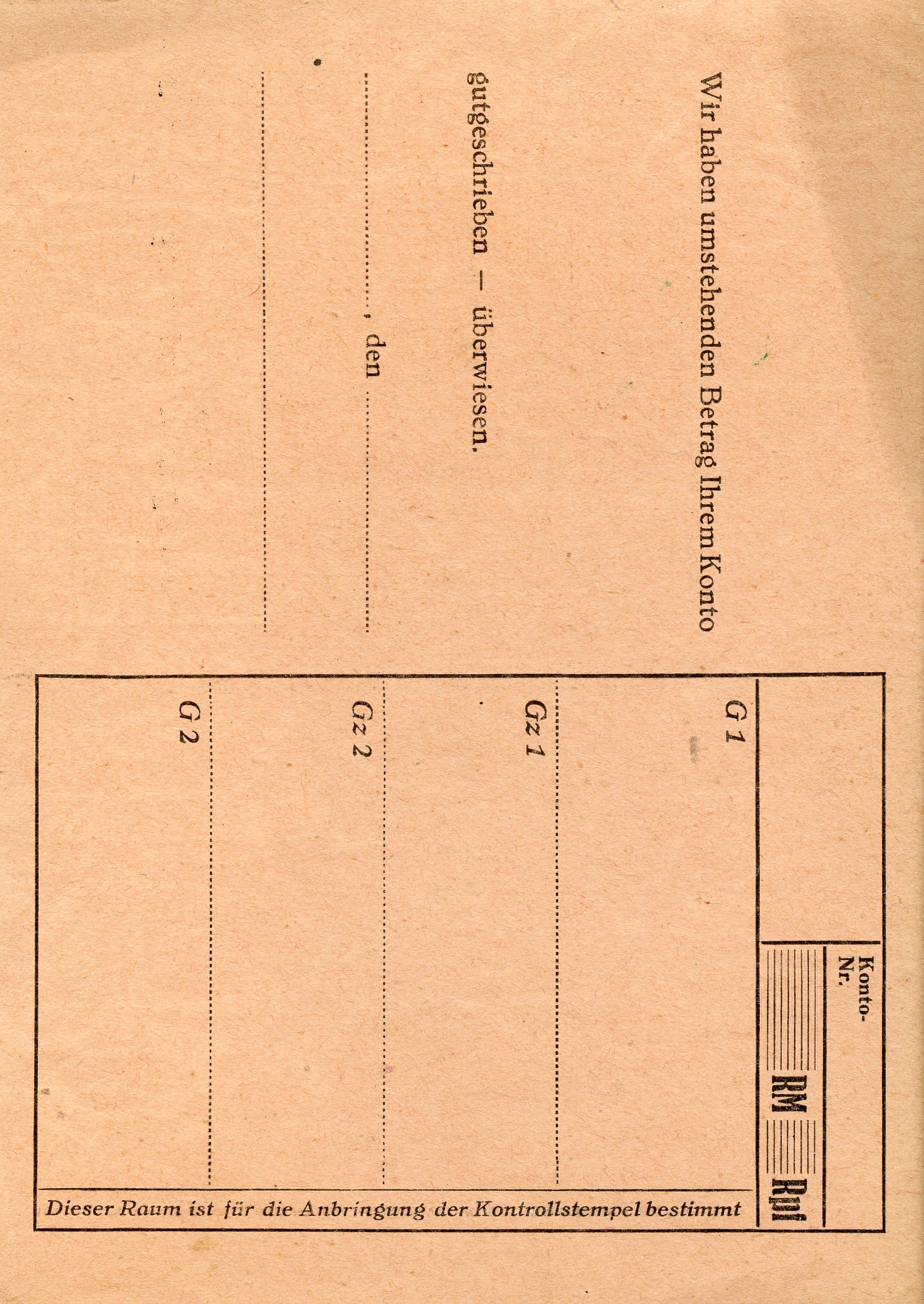
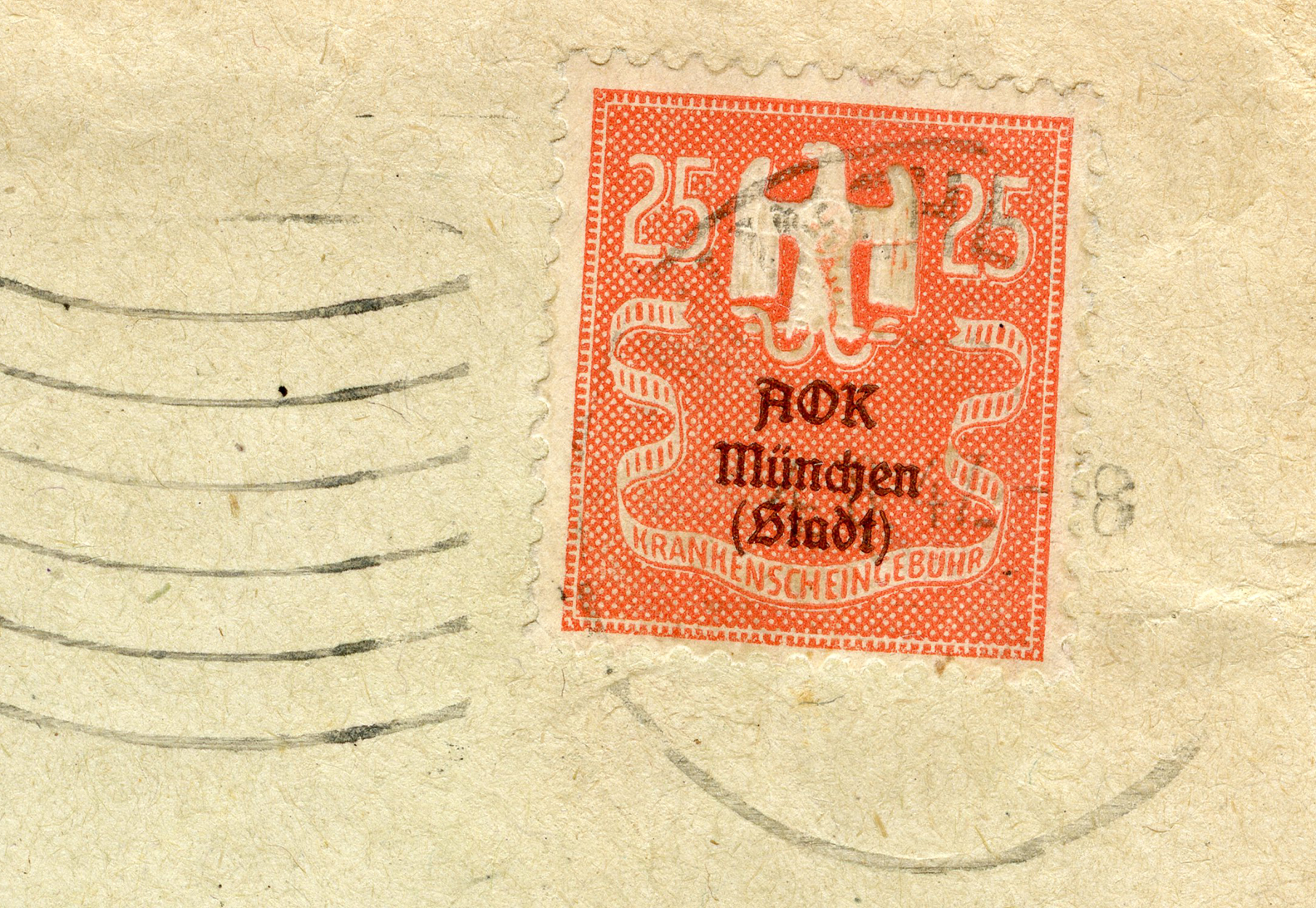
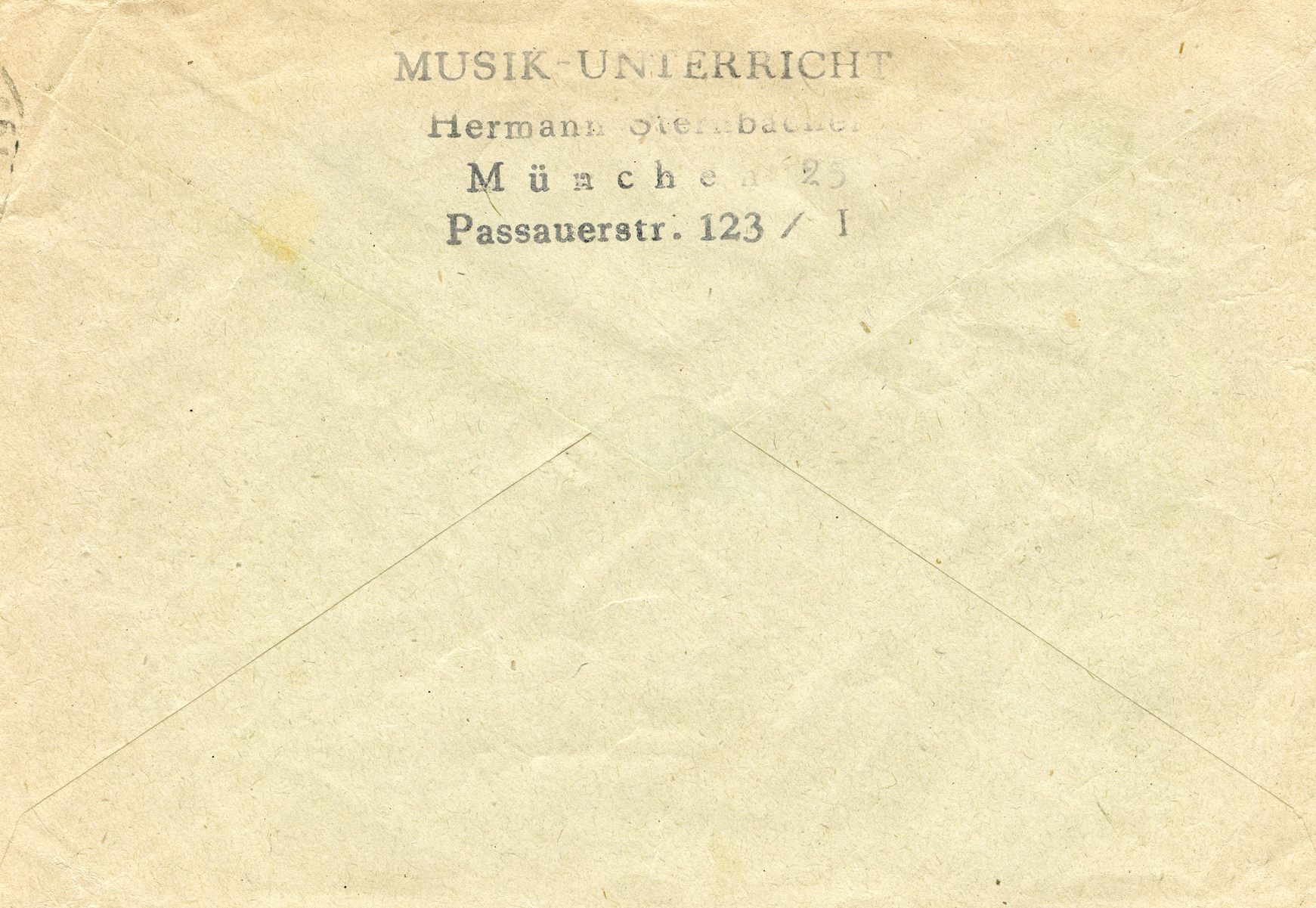
[Below: Here is a strange one. This uses a Munich medical tax stamp as postage. I've never seen this used in this way before and it is a rare stamp to find on its own (note the swastika is embossed in the middle of the eagle's chest). Stranger still it is sent by 'Musik Unterricht' (Music Lessions). Lastly, it was sent in 1947!? Did someone just sneak this by the postal authorities? Hmm... Click to enlarge.]
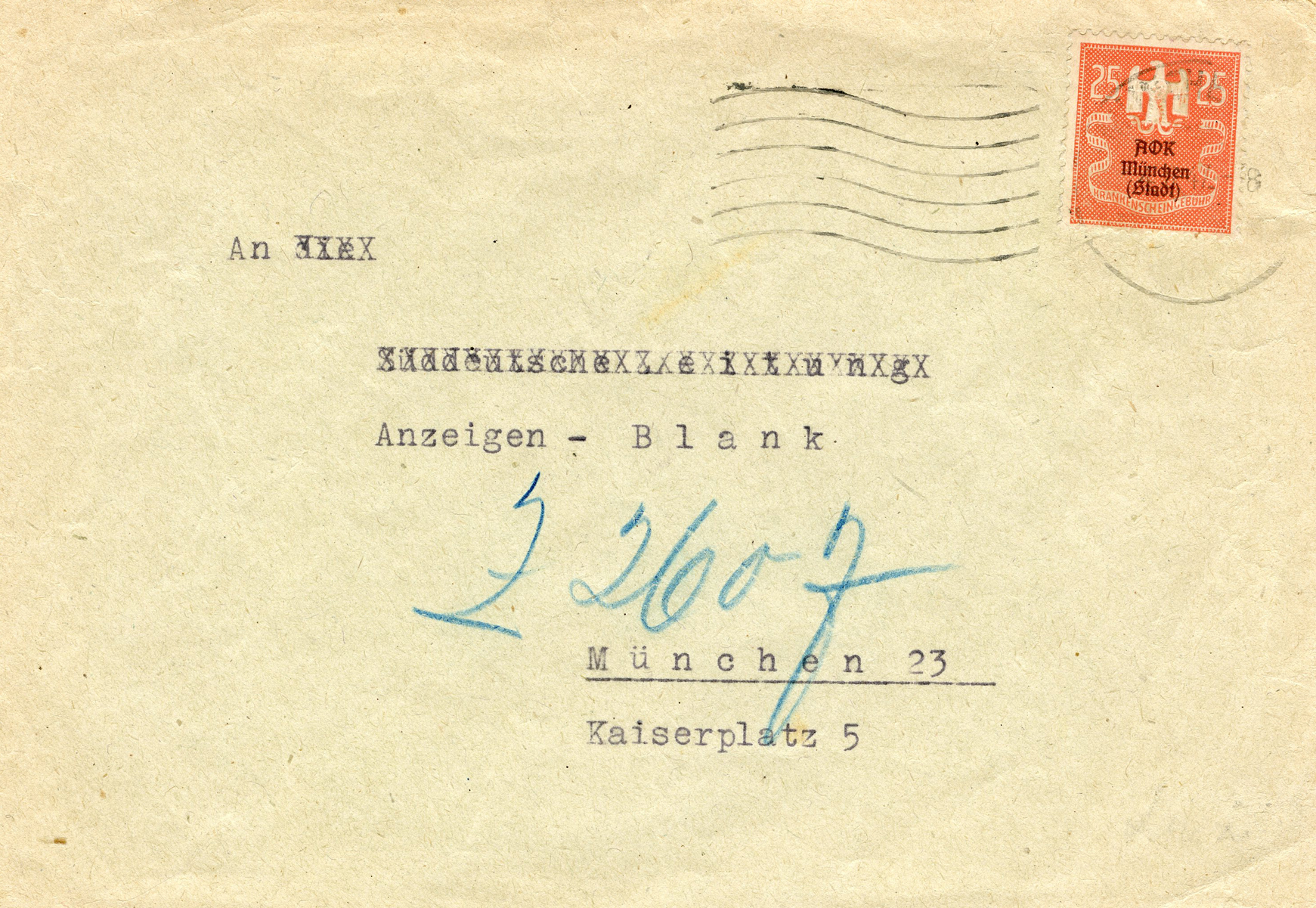
[Below: Close-up. Click to enlarge.]
[Below: Reverse. Click to enlarge.]
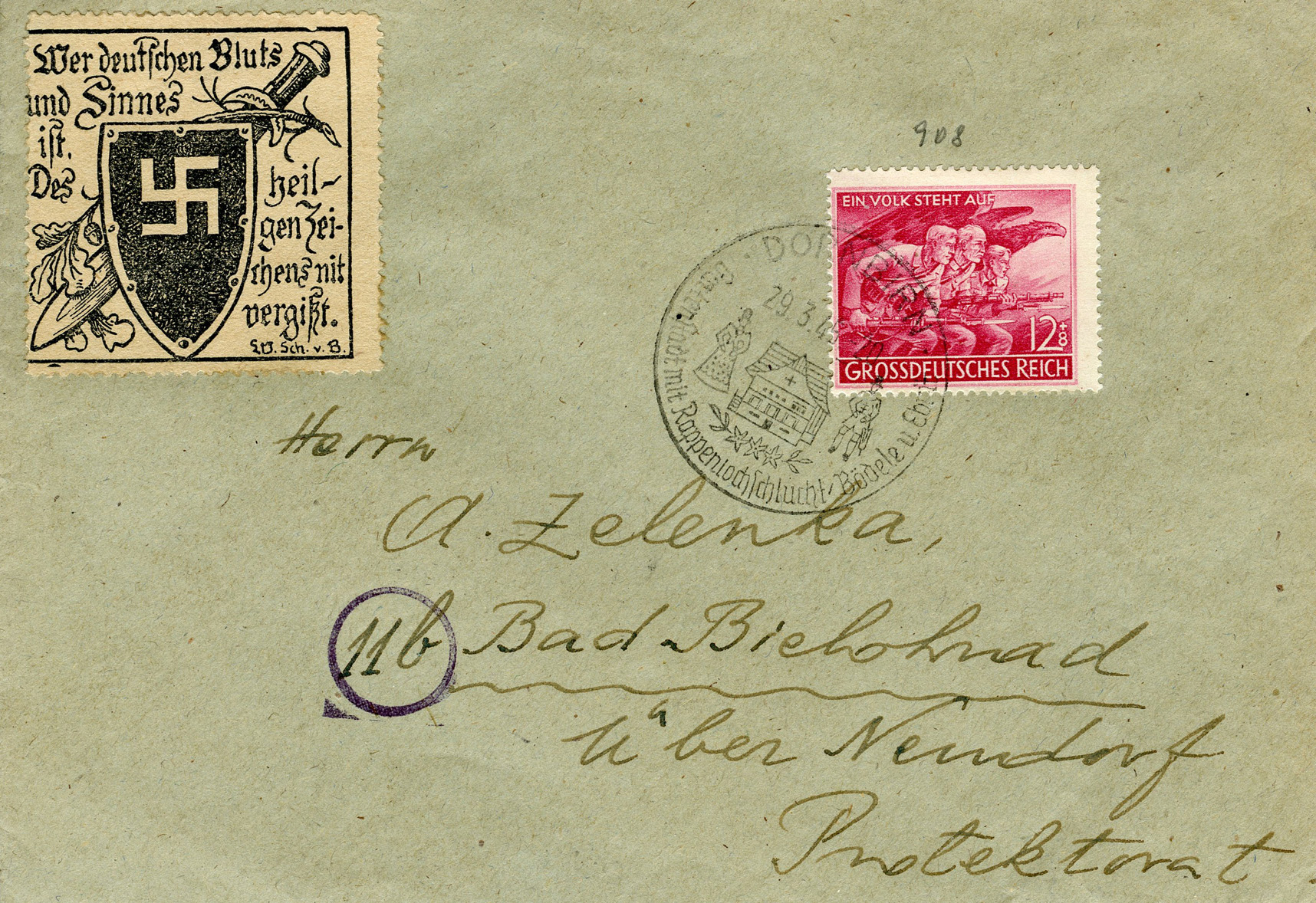
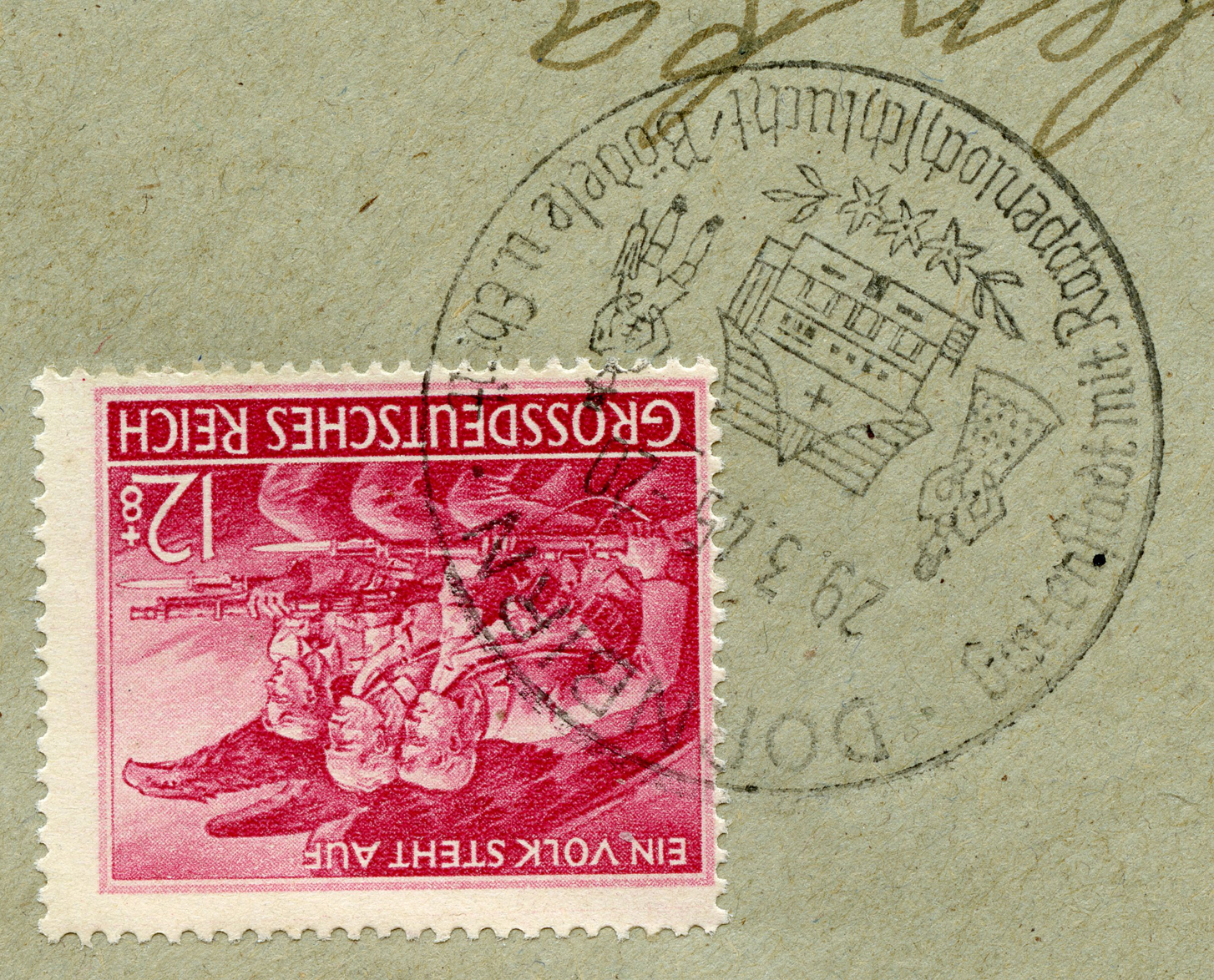
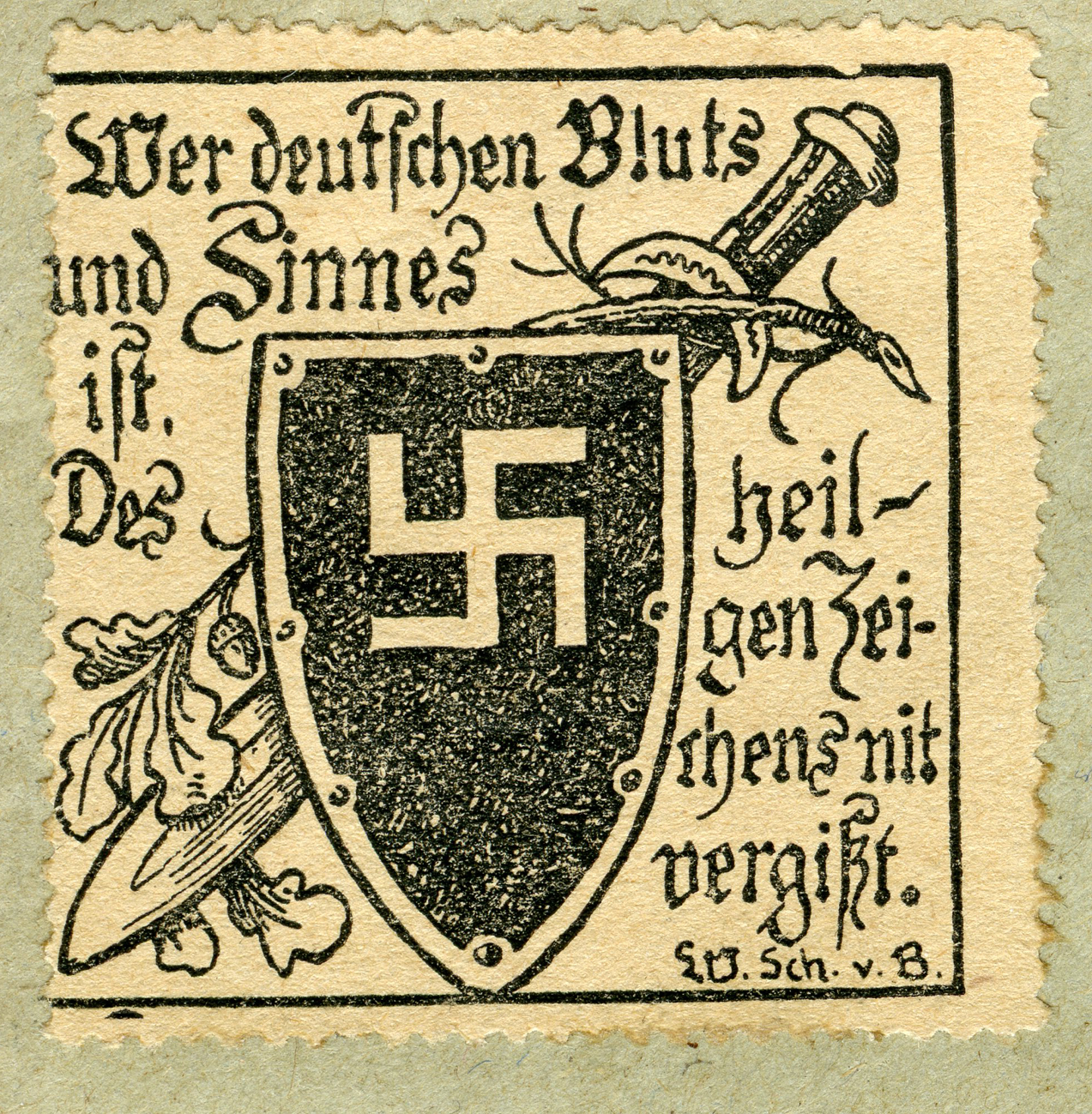
[Below: Here is a very special one, canceled close to the end of the war, on March 29, 1945. It has a rare vignette which says:
'Wer deutschen Bluts und Sinnes ist.
Des heilgen Zeirhens nit vergißt.'
(Whoever is of German blood and mind,
does not forget the holy symbol.)
Incredible. Awesome saying. Click to enlarge.]
[Below: Close-up. Click to enlarge.]
[Below: Close-up. Click to enlarge.]

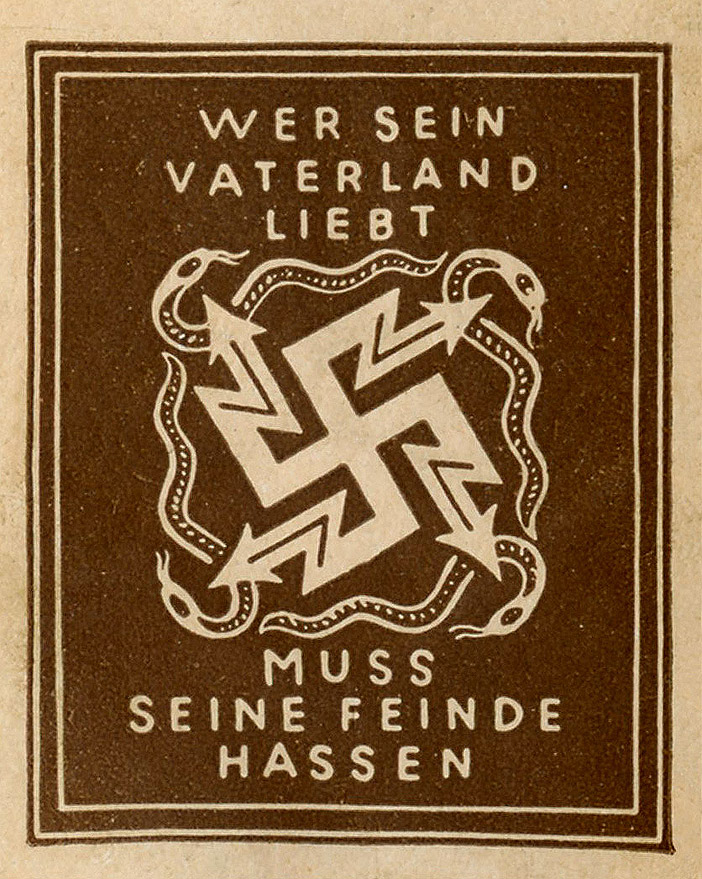
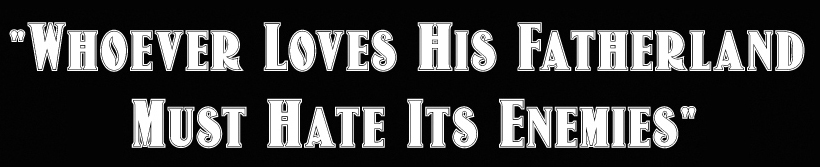
[Below: The above reminds me of this vignette. It says:
'Wer Sein Vaterland Liebt Muss Seine Feinde Hassen'
(Whoever Loves His Fatherland Must Hate Its Enemies).]
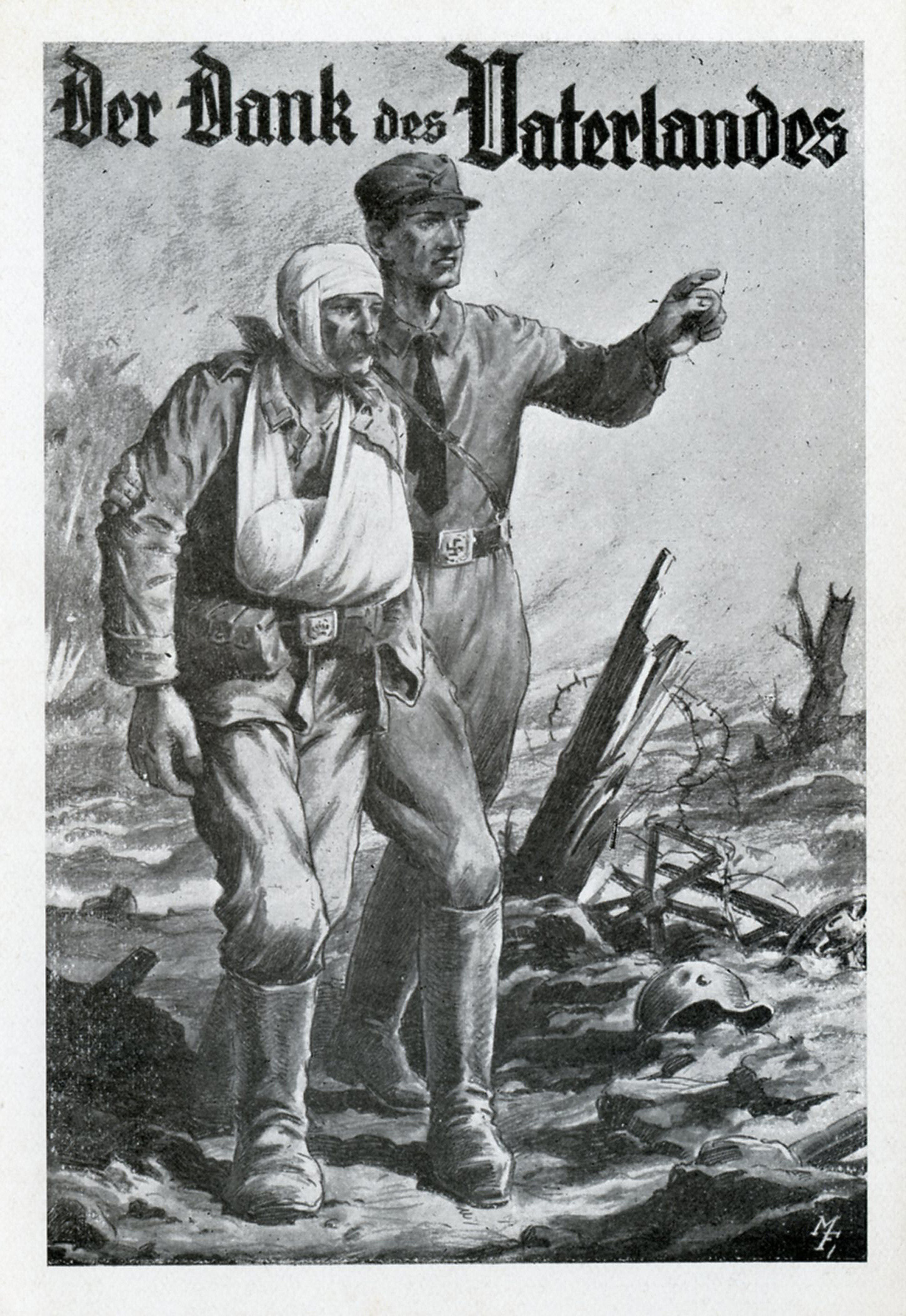
[Below: This is neat. It's an early postcard that cost ten Pfennig (ten cent). It shows an SA man helping a wounded soldier. It says 'Der Dank des Vaterlandes (The gratitude of the fatherland). Click to enlarge.]
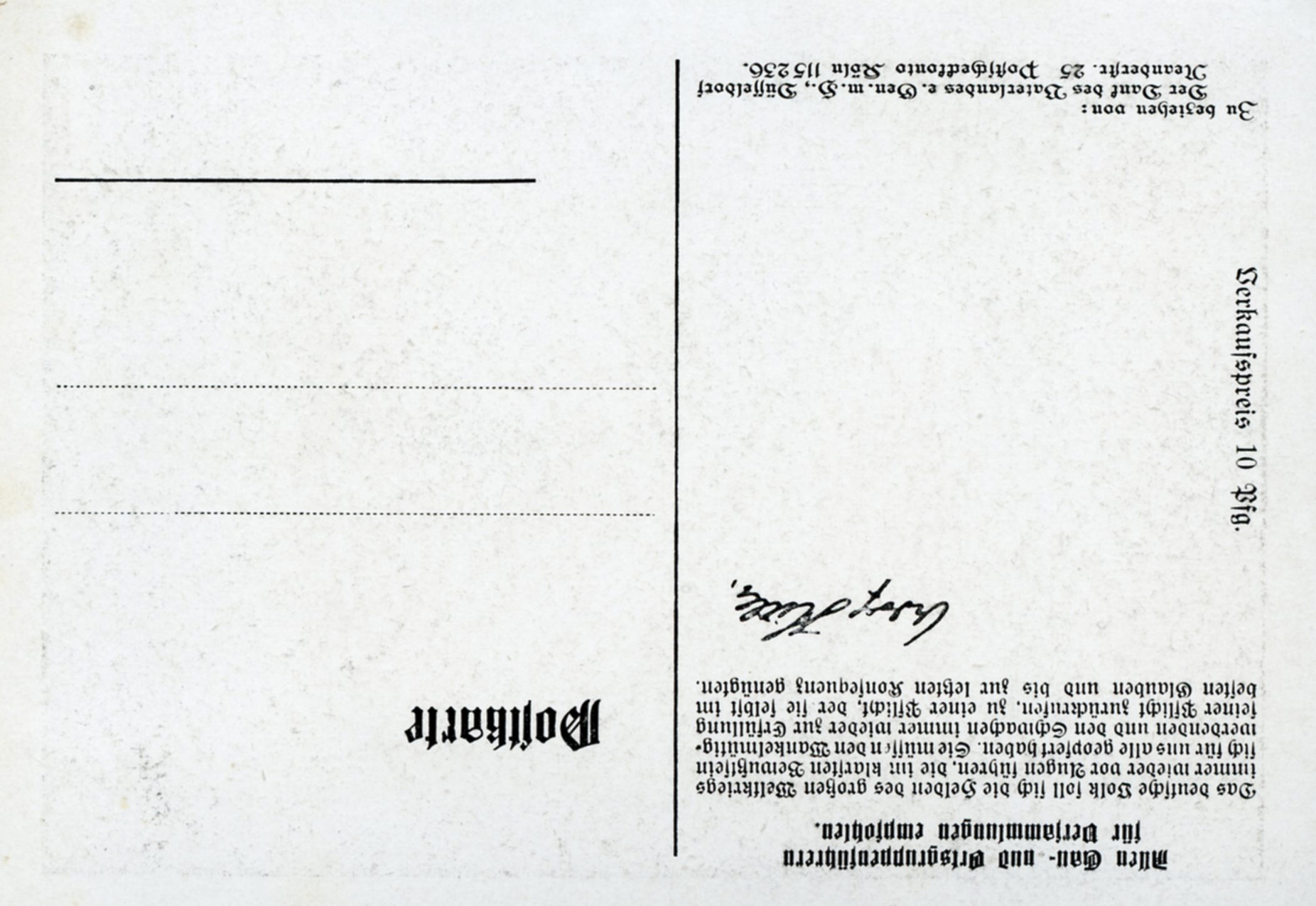
[Below: Reverse. The quote from Adolf Hitler says:
'The German people should continually remind themselves of the heroes of the Great World War,
who, with the clearest of conscience, sacrificed themselves for us all.
They must continually call the wavering and the weak back to the fulfillment of their duty,
a duty they themselves fulfilled in good faith and to the utmost consequence.'
Another great quote from Adolf Hitler. Click to enlarge.]
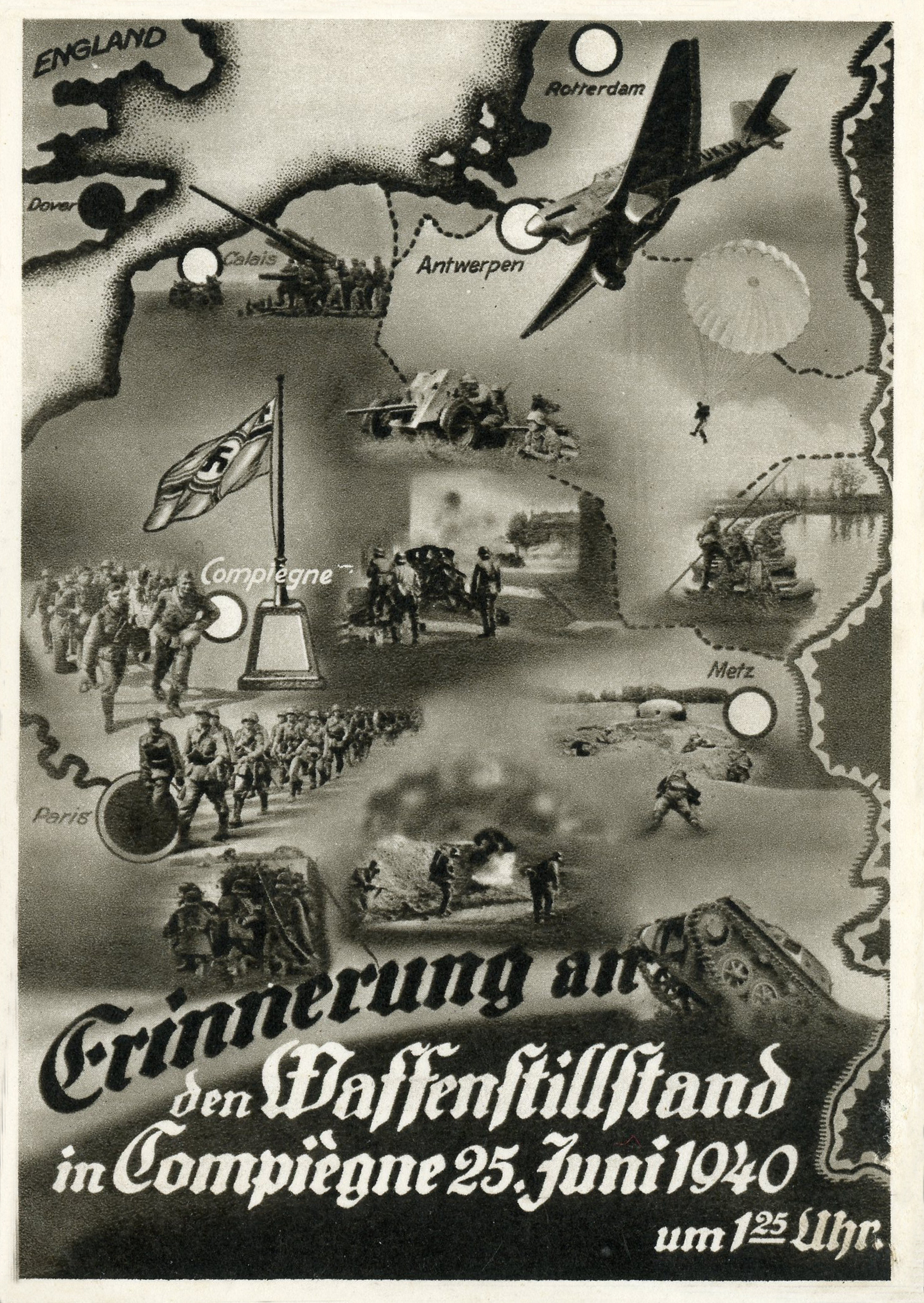
[Below: This postcard commemorates the fall of France to the Germans. It says:
'Erinnerung an
den Waffenstillstand
in Compiegne 25. Juni 1940
um 1:25 Uhr.'
(Commemoration of
the Armistice
in Compiègne, June 25, 1940,
at 1:25 o'clock.)
Click to enlarge.]
[Below: Reverse. Click to enlarge.]
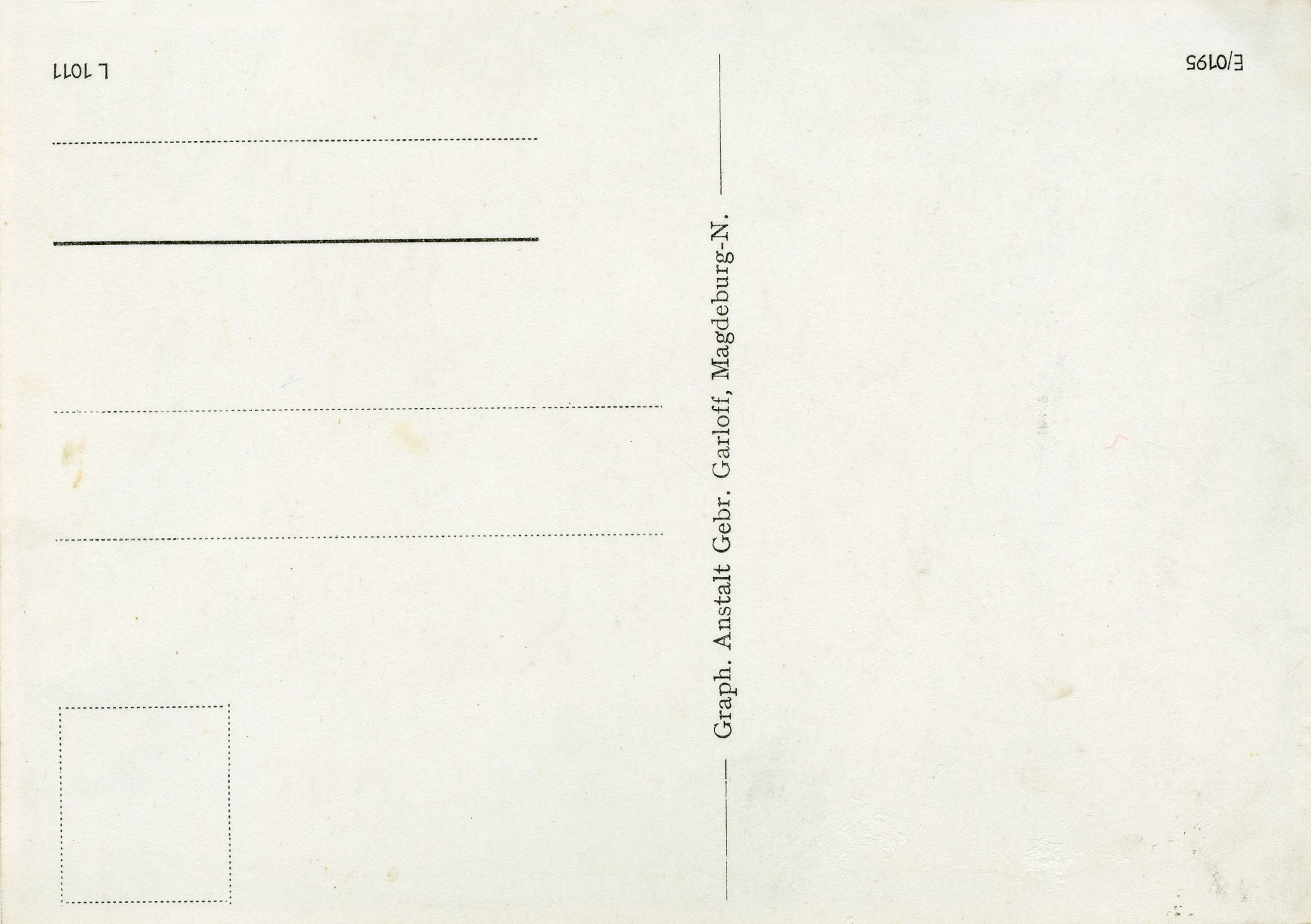
[Below: This postcard says: 'Unser Wehrmacht' (Our Army). Click to enlarge.]
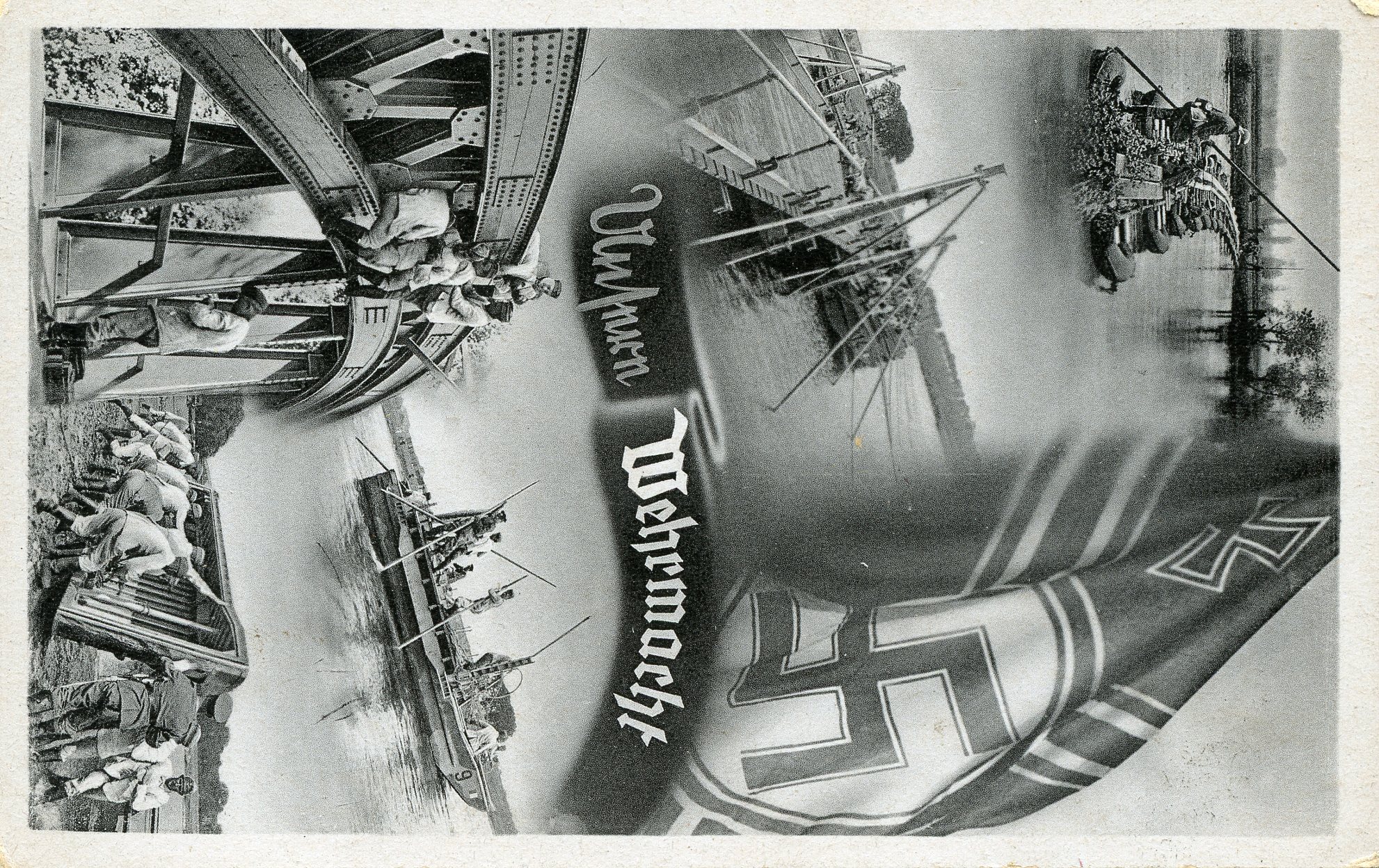
[Below: Reverse. This says:
'Wehrmacht-Bildserie
Herausgegeben mit dem Einvernehmen
des Oberkommandos der Wehrmacht'
(Wehrmacht Photo Series
Published with the consent of the High Command
of the Wehrmacht).
Click to enlarge.]
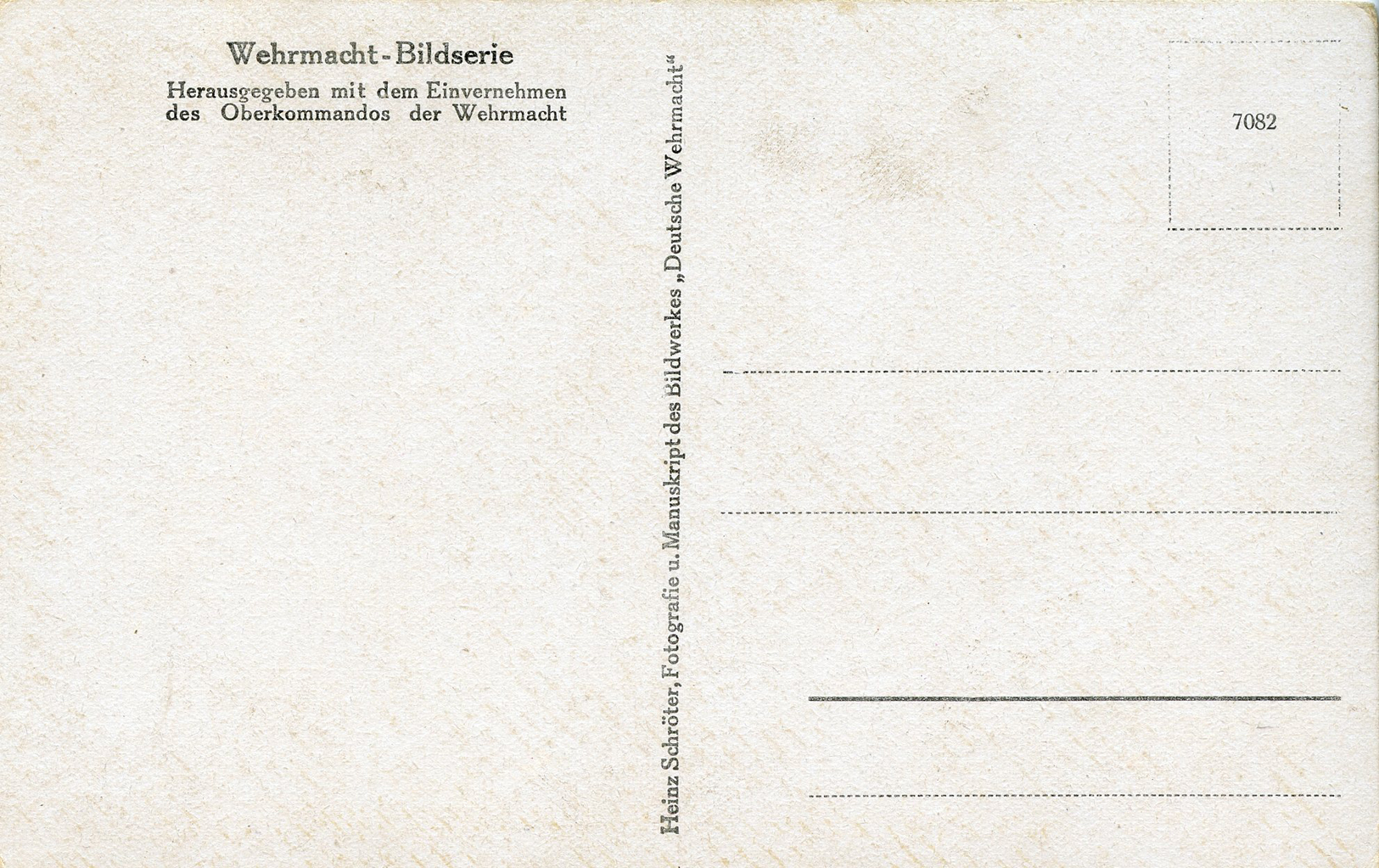
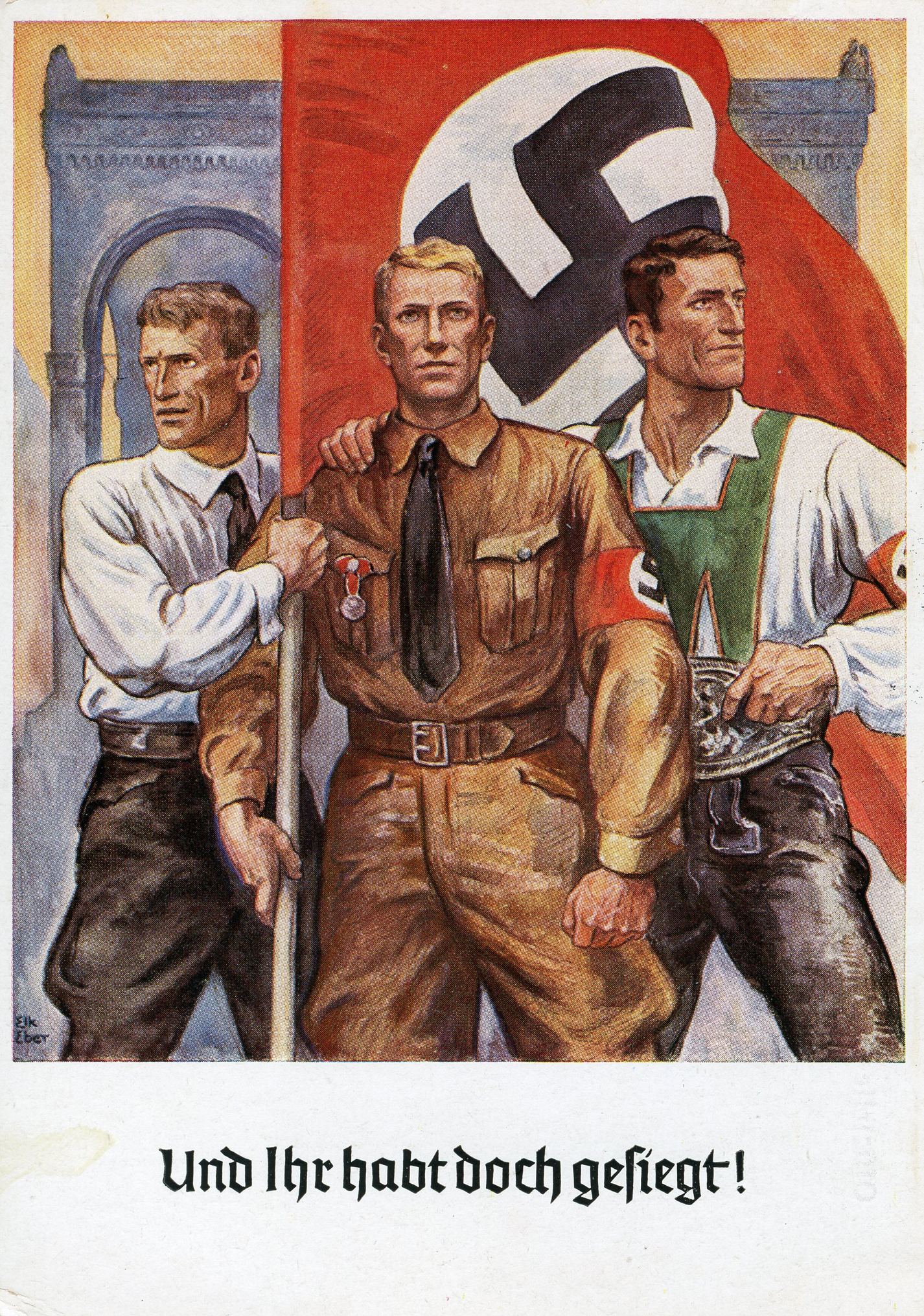
[Below: New & used postcards. These postcards says: 'Und Ihr Habt Doch Gesiegt!' (Despite All You Were Victorious). Click to enlarge.]
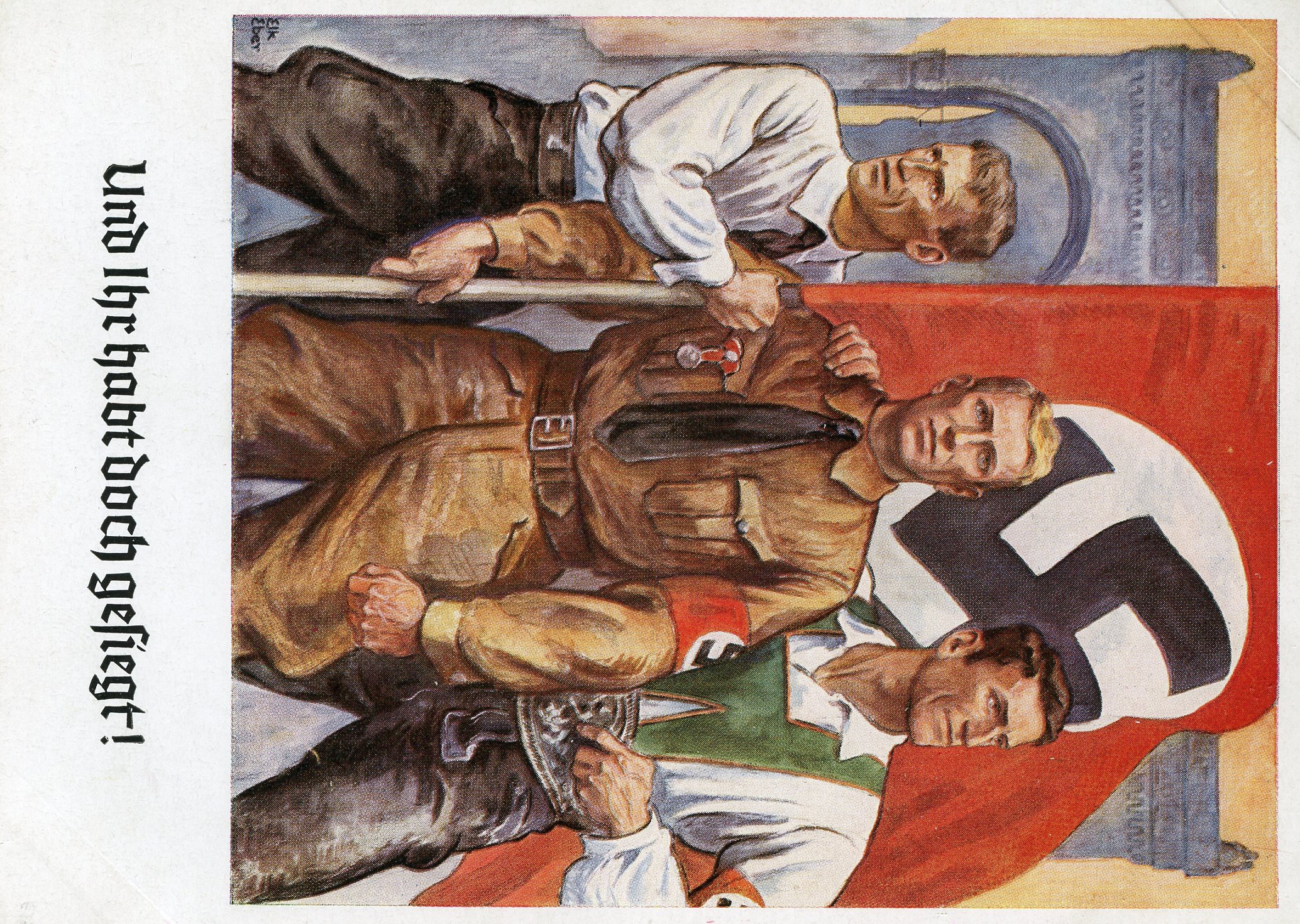
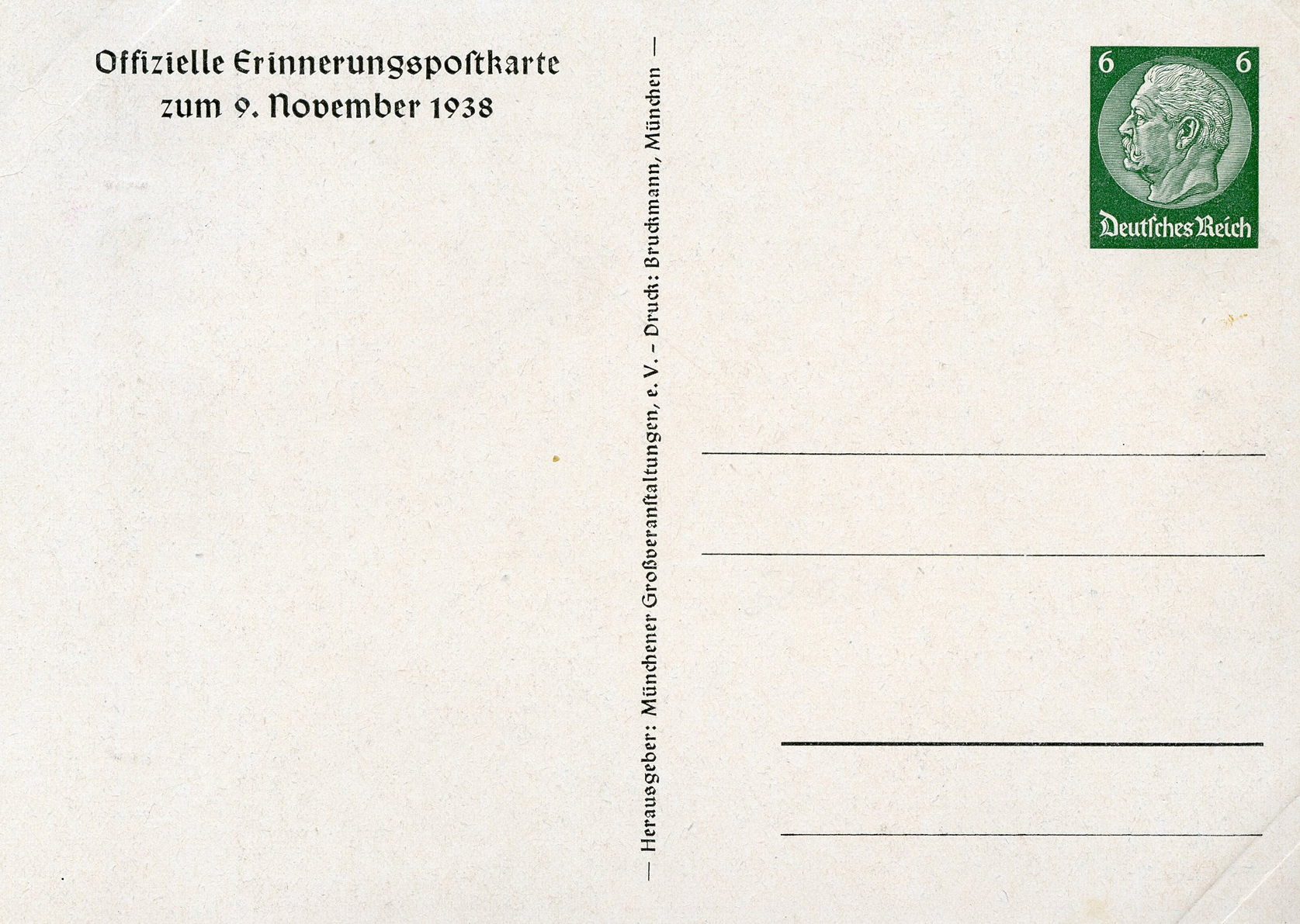
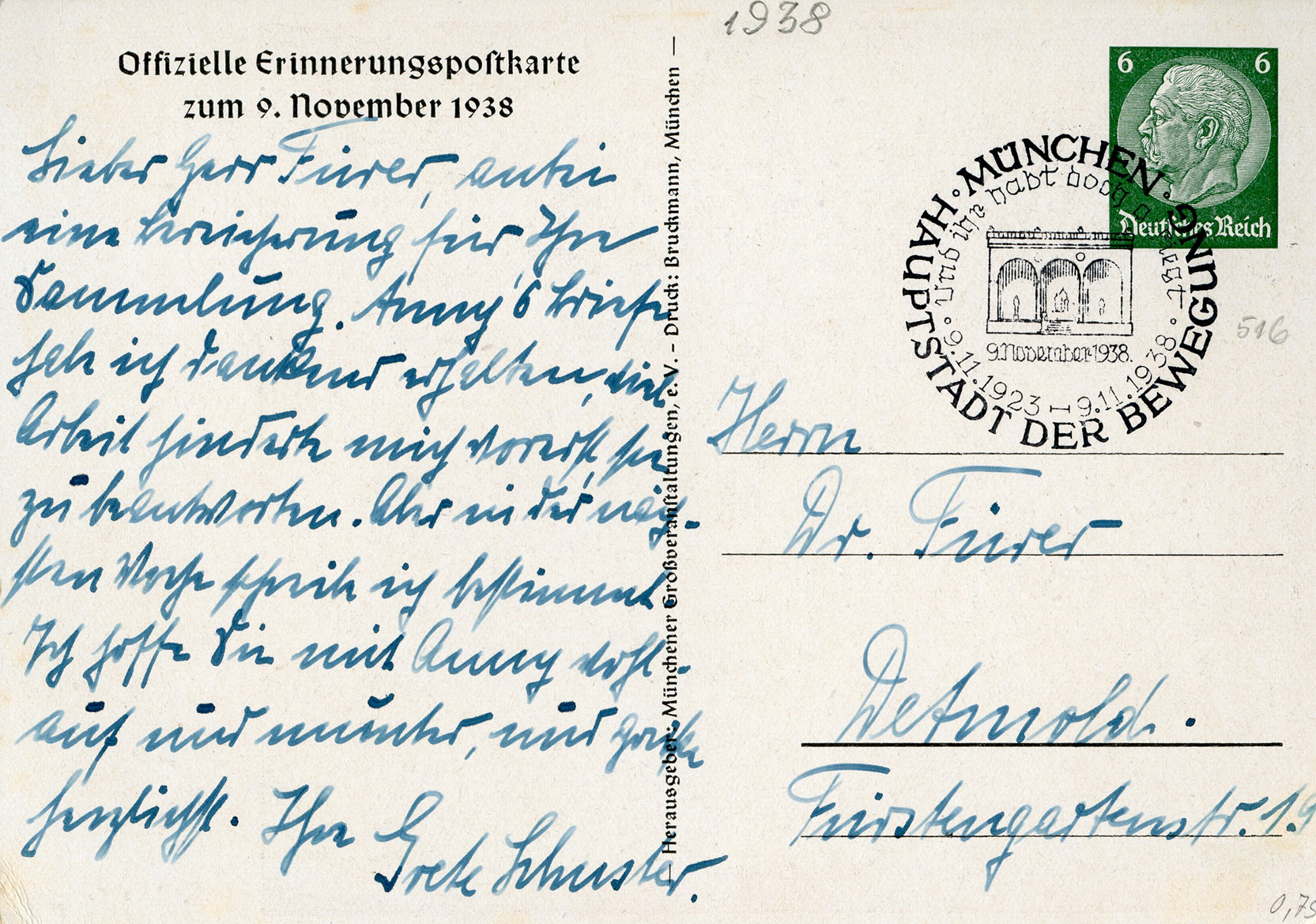
[Below: Reverse. (left) This says: 'Offizielle Erinnerungspostkarte zum 9. November 1938' (Official commemorative postcard for November 9, 1938). (left) Used with special event cancel. Click to enlarge.]
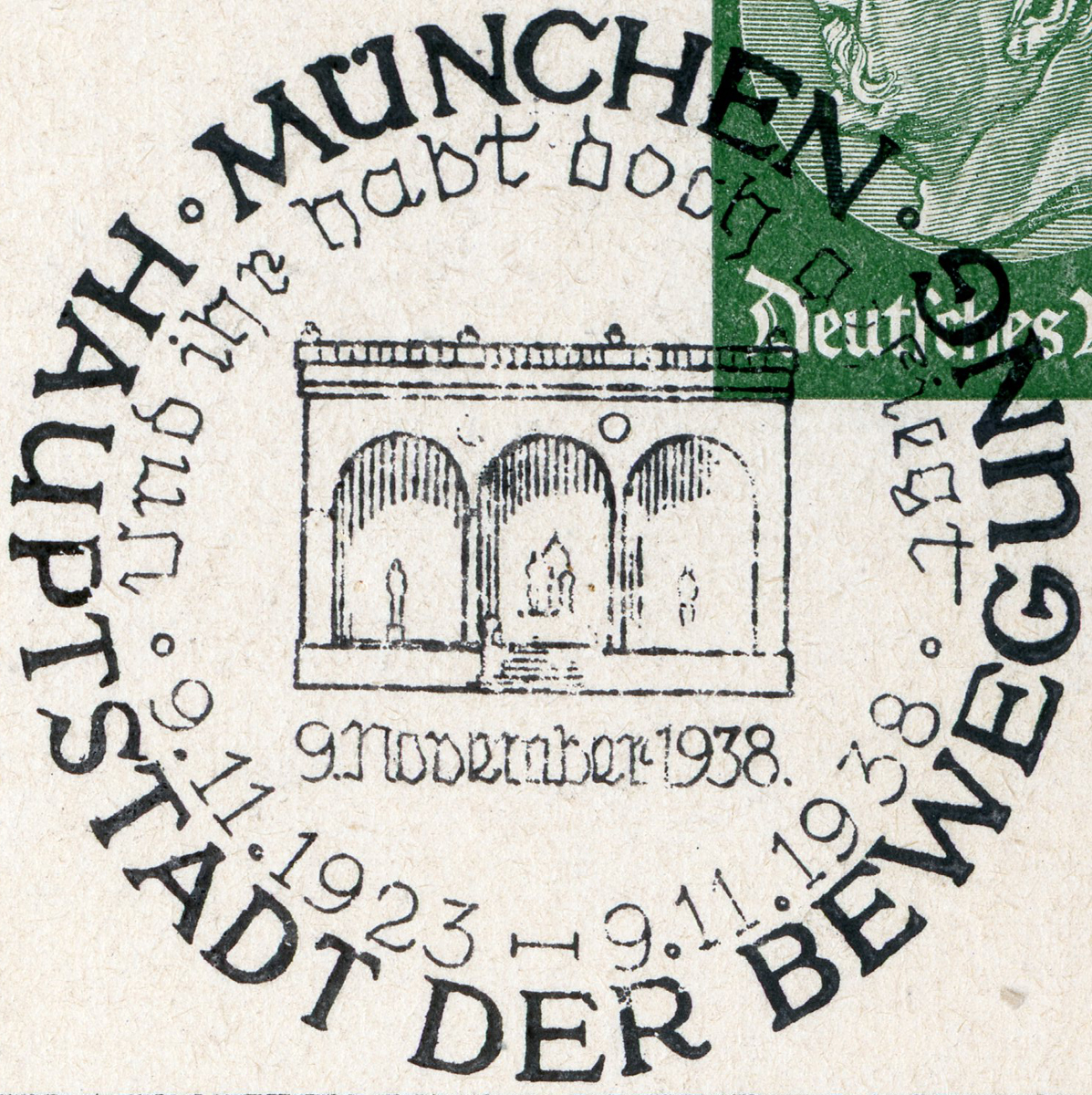
[Below: Cancel enlarged - The Feldherrnhalle in Munich. Click to enlarge.]
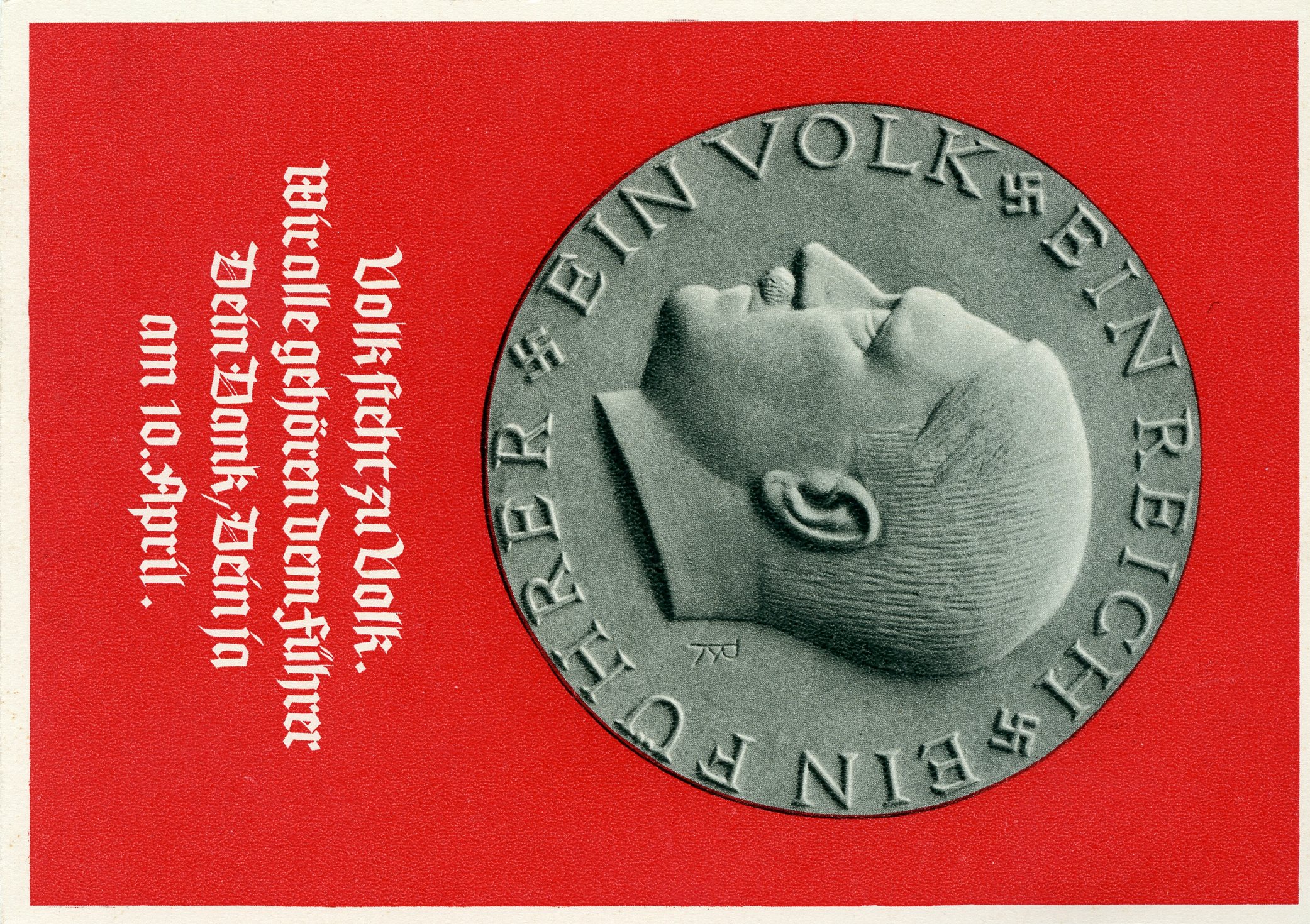
[Below: This Anschluss postcard says:
'Volk Steht zu Volk.
Wir alle gehören dem Führer
Dein Dank Dein ja
am 10. April.'
(People stand by people.
We all belong to the Führer.
Your thanks, your yes.
on April 10th.)
Click to enlarge.]
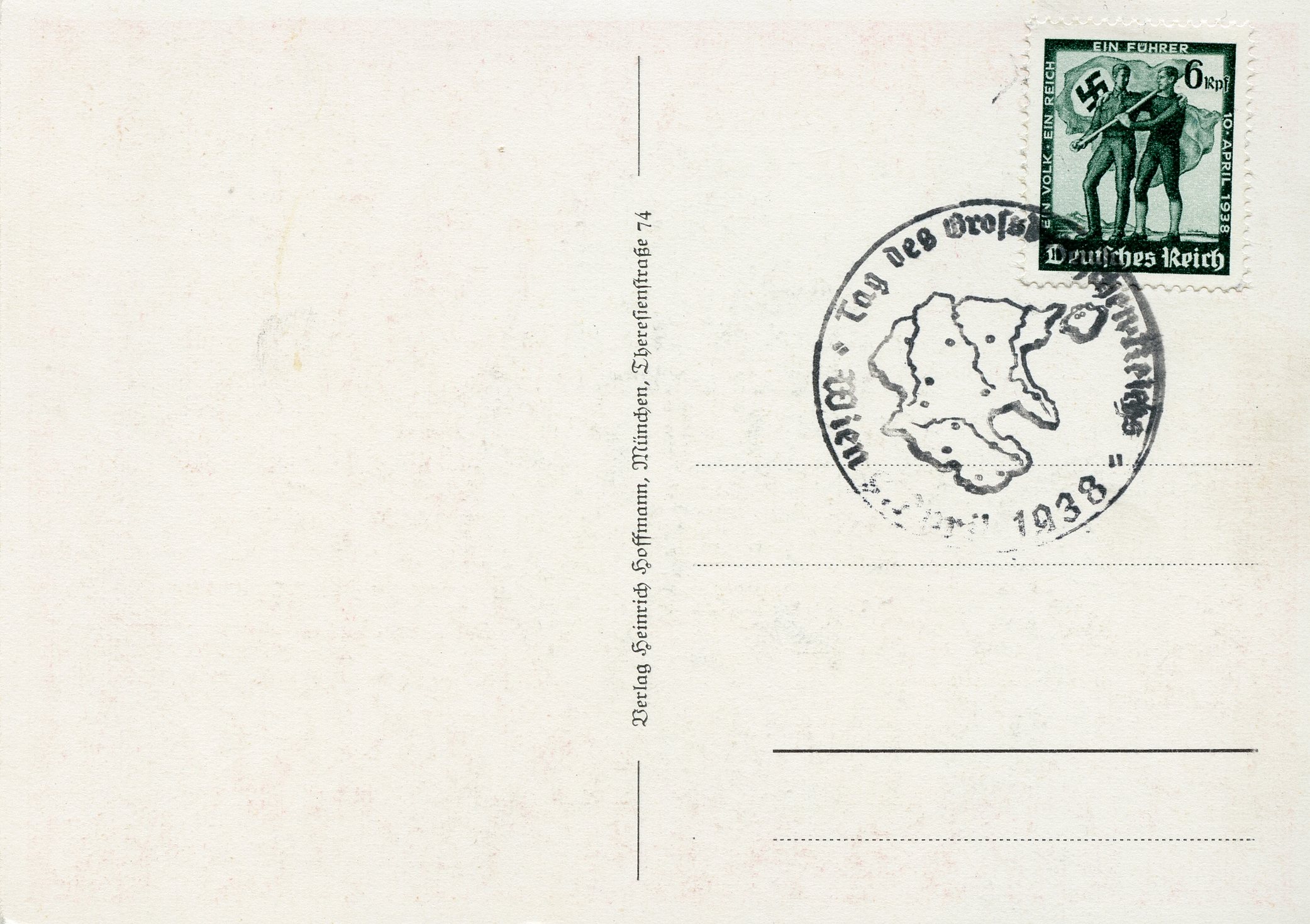
[Below: Reverse. This shows an Anschluss postmark and postage stamp. Click to enlarge.]
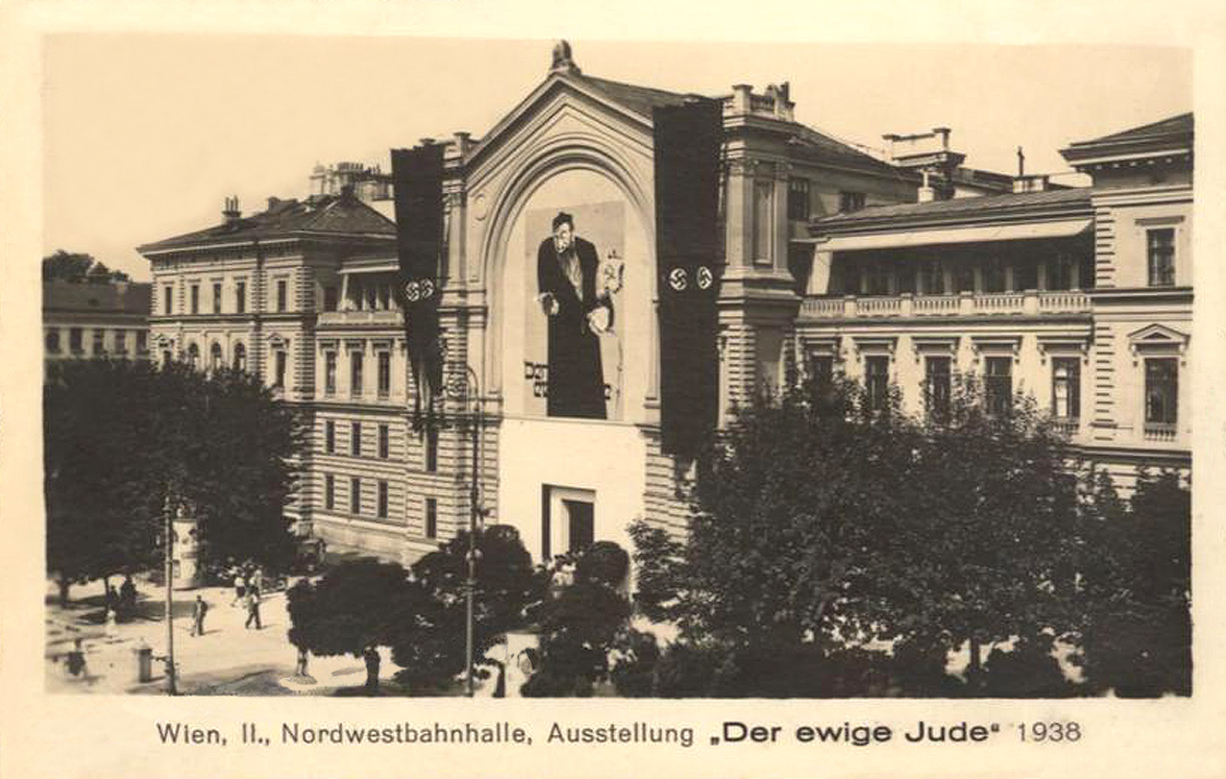
[Below: The Eternal Jew Exposition in Vienna, 1938.]
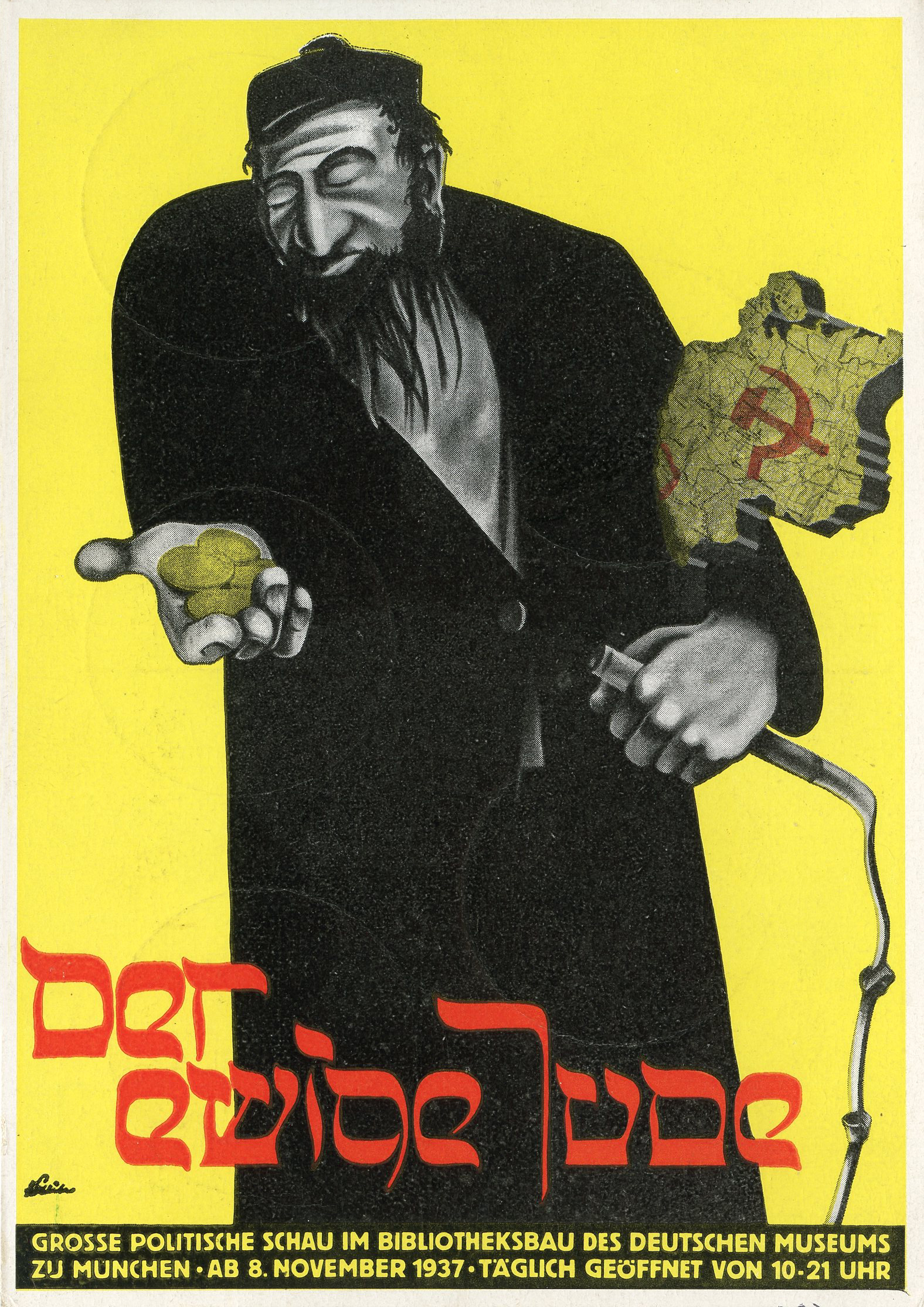
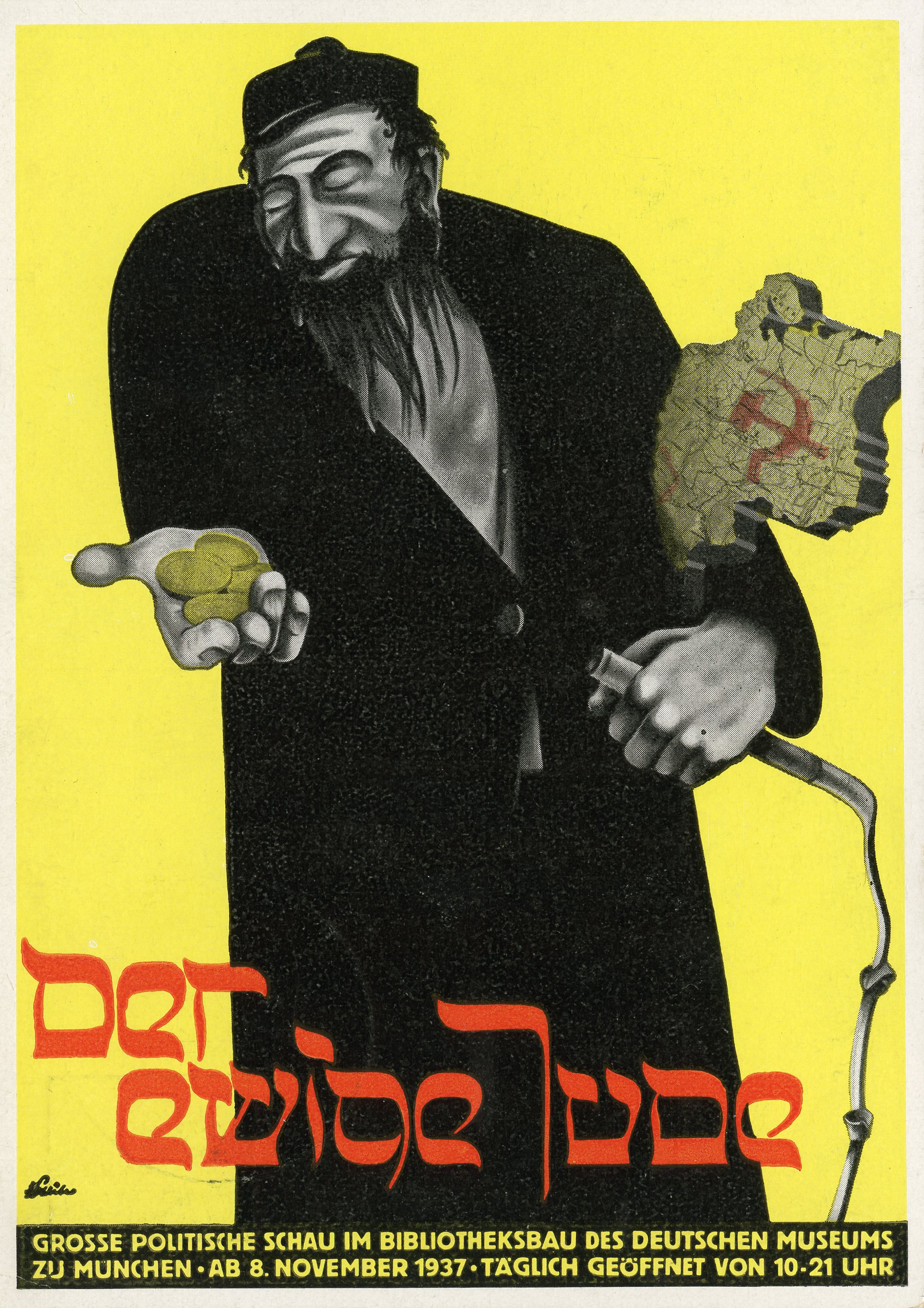
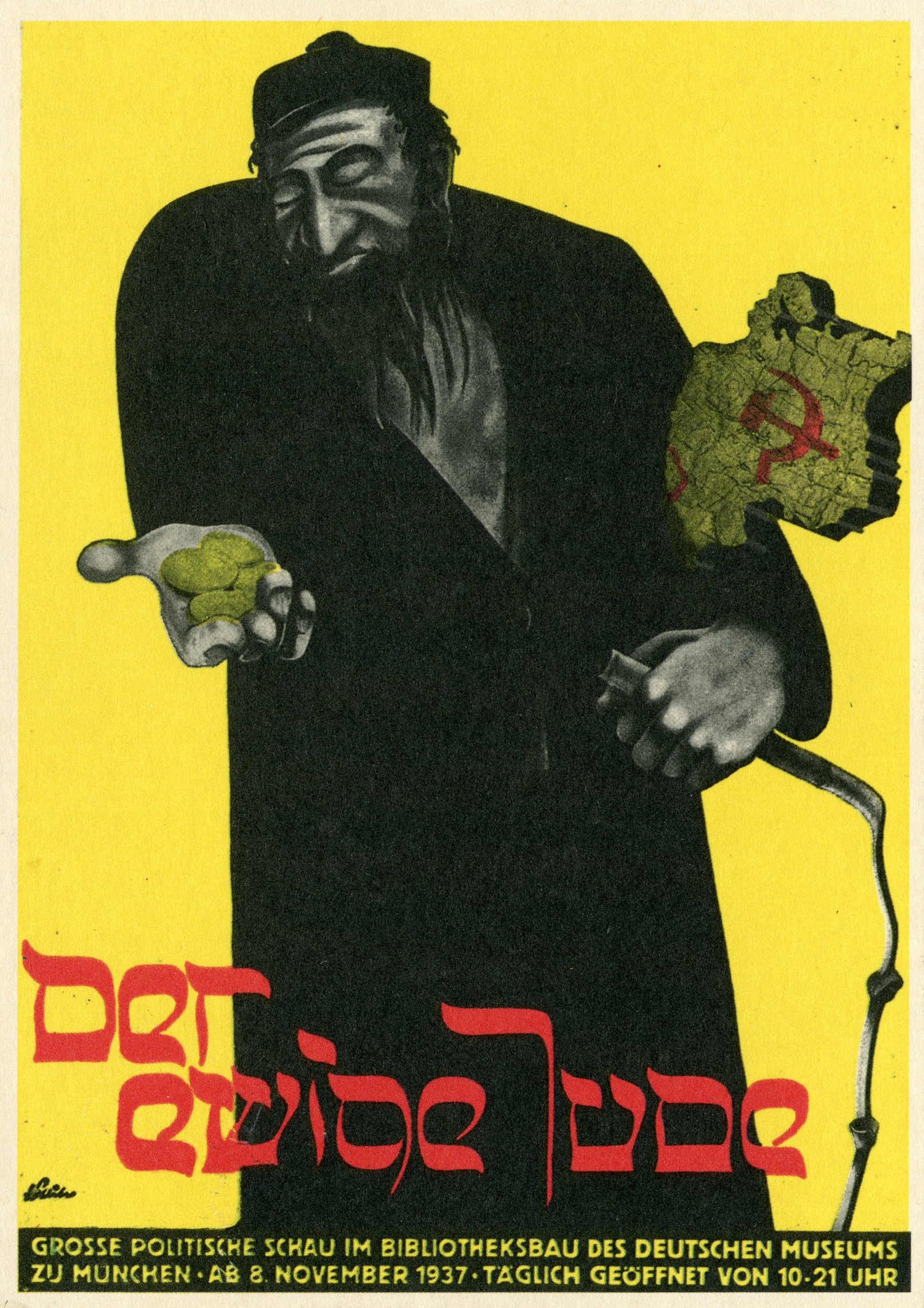
[Below: Ah, the notorious Eternal Jew postcard. It says:
'Der Ewige Jude
Grosse Politische Schau Im Bibliotheksbau des Deutschen Museums
Zu Munchen AB 8. November 1937 Täglich Geöffnet von 10-21 Uhr.'
(The Eternal Jew
Great Political Exhibition in the library building of the Deutsches Museum
In Munich, from November 8, 1937, Open daily from 10 a.m. to 9 p.m.)
Click to enlarge.]
[Below: Reverse. Special Eternal Jew postmark from December 19, 1937. This has a pre-paid airmail stamp as well. Click to enlarge.]
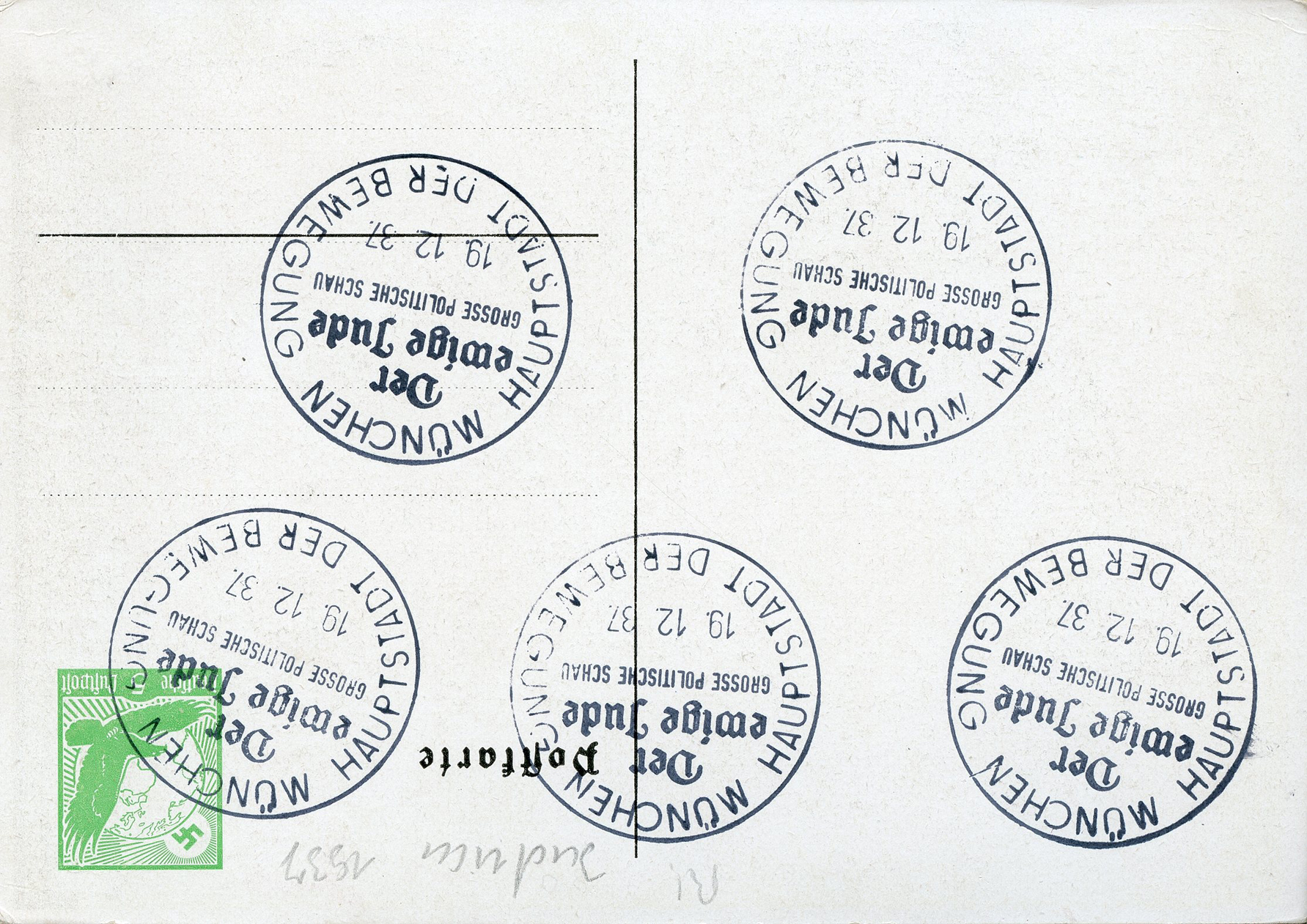
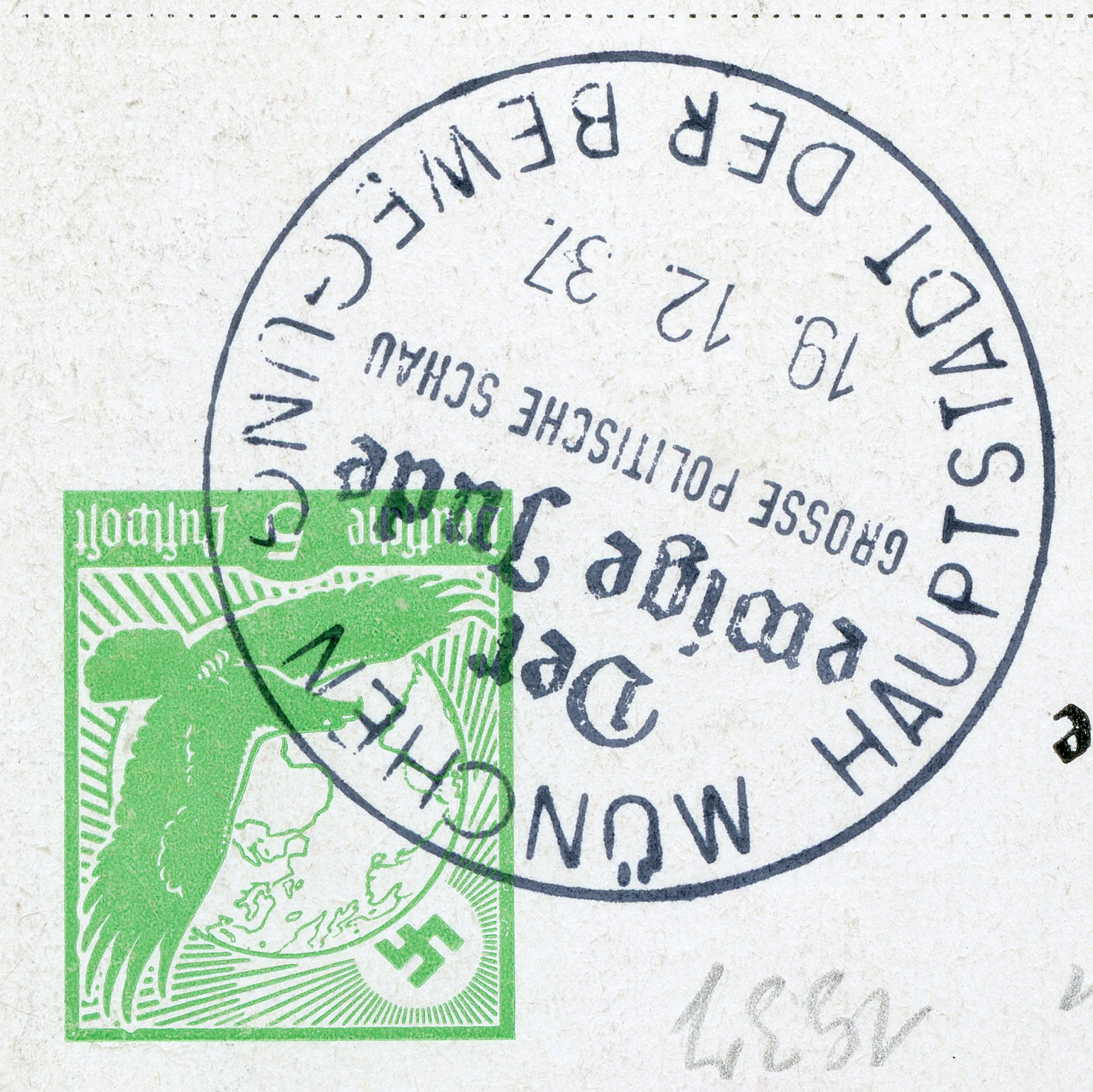
[Below: Close-up. Click to enlarge.]
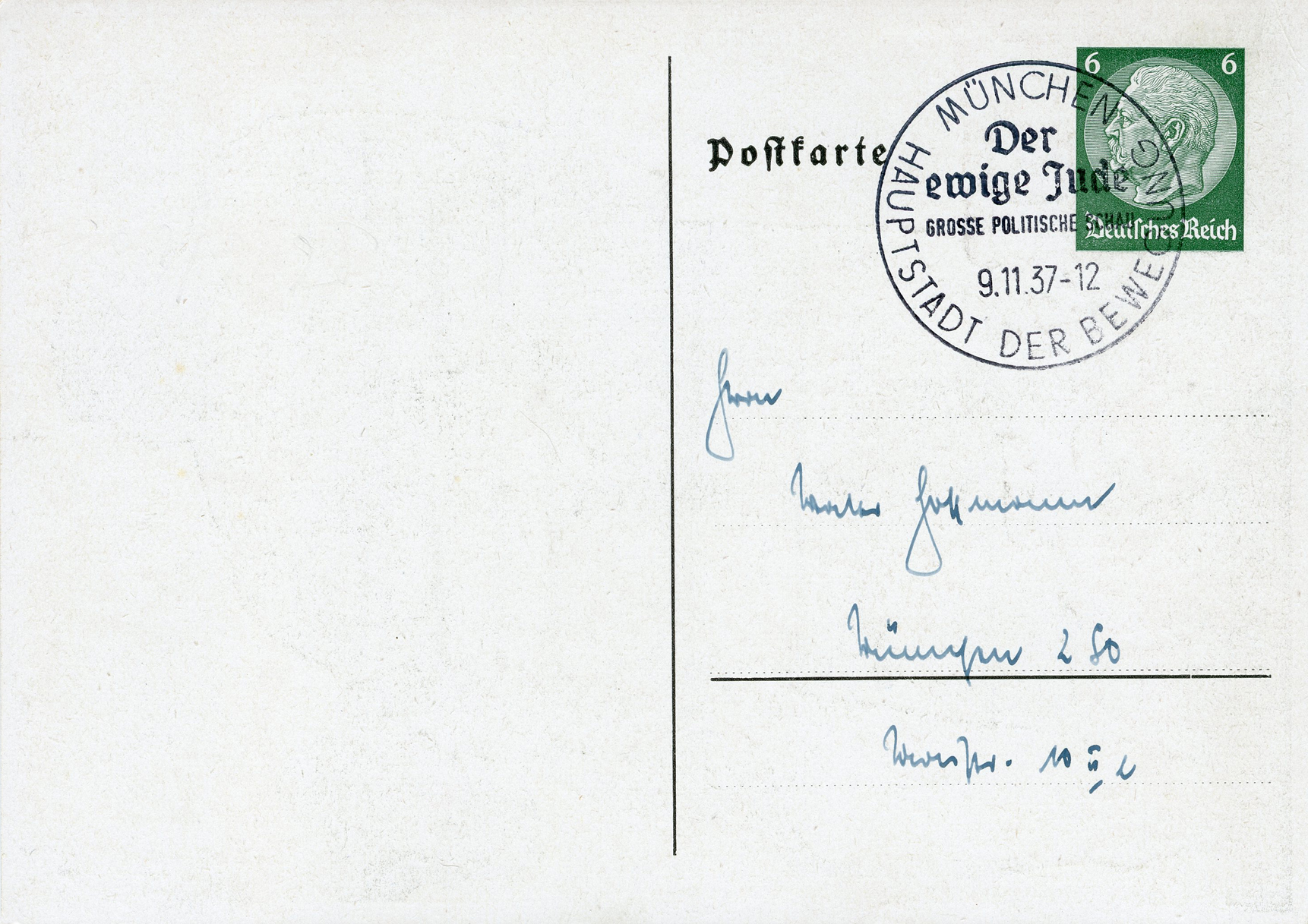
[Below: Here is the non-airmail version of the card above. Note the different pre-paid stamp. Click to enlarge.]
[Below: Reverse. Click to enlarge.]
[Below: Close-up. Click to enlarge.]
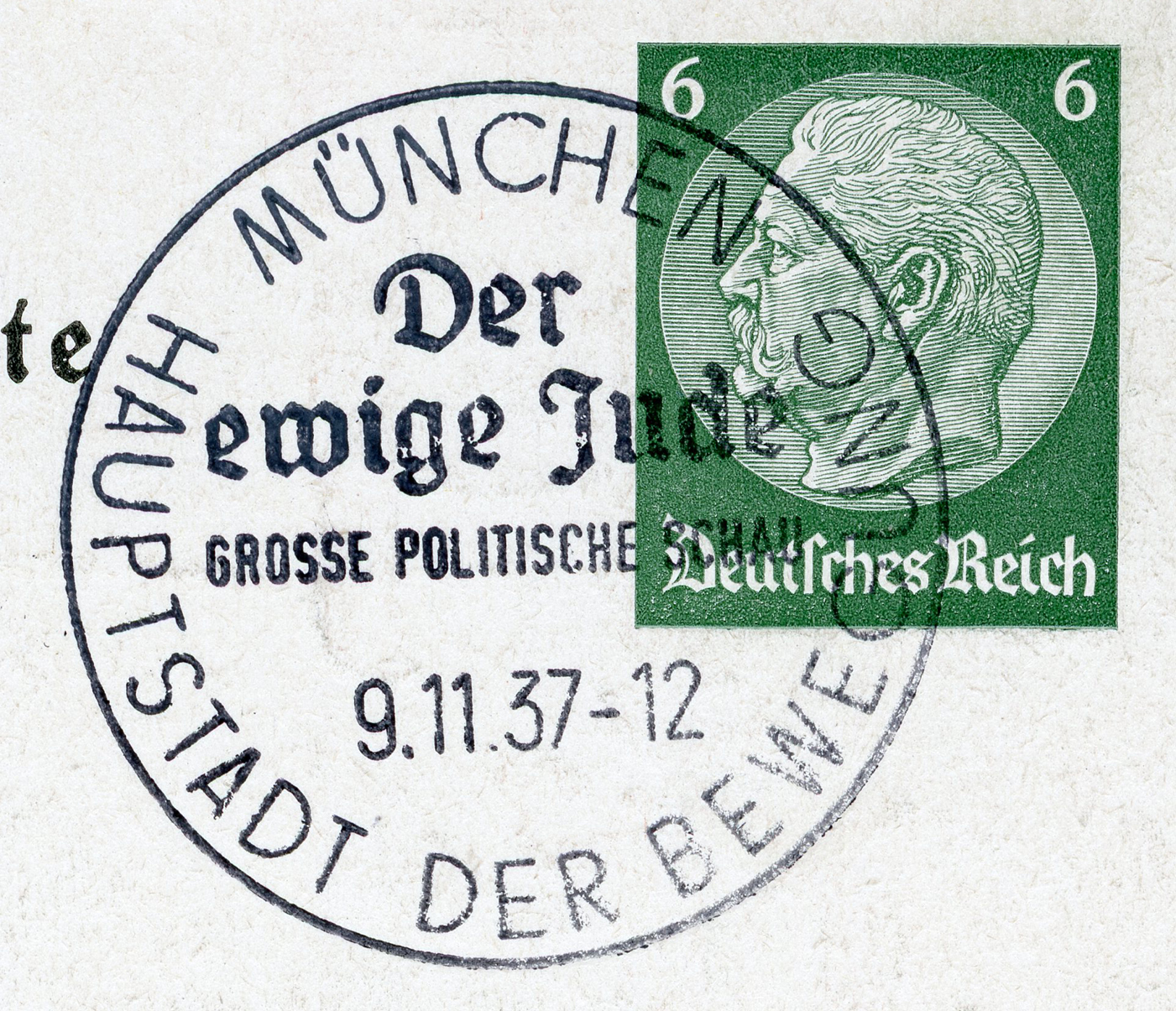
[Below: Here is a version of the card with no prepaid postage, it also has a different reverse. Click to enlarge.]
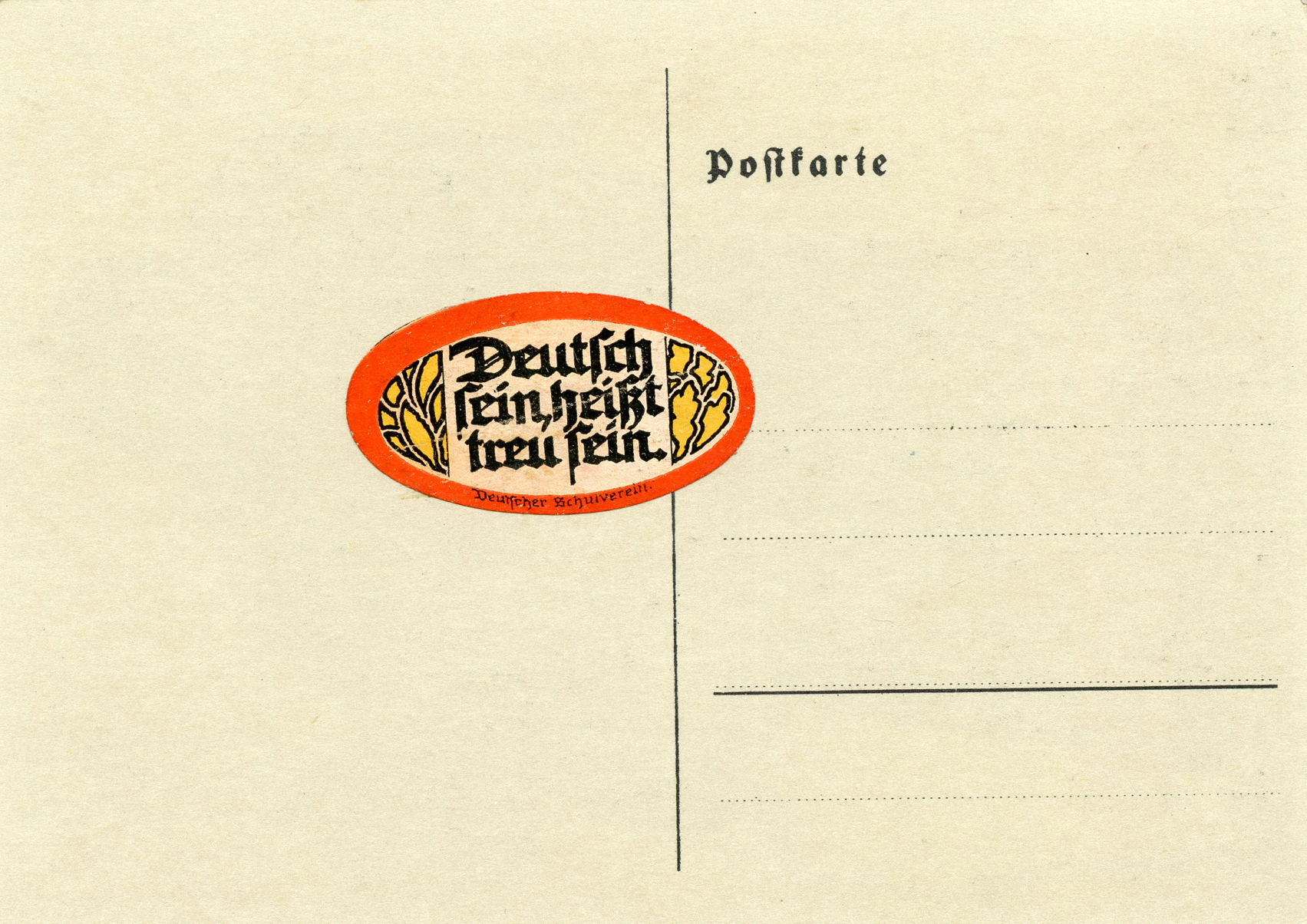
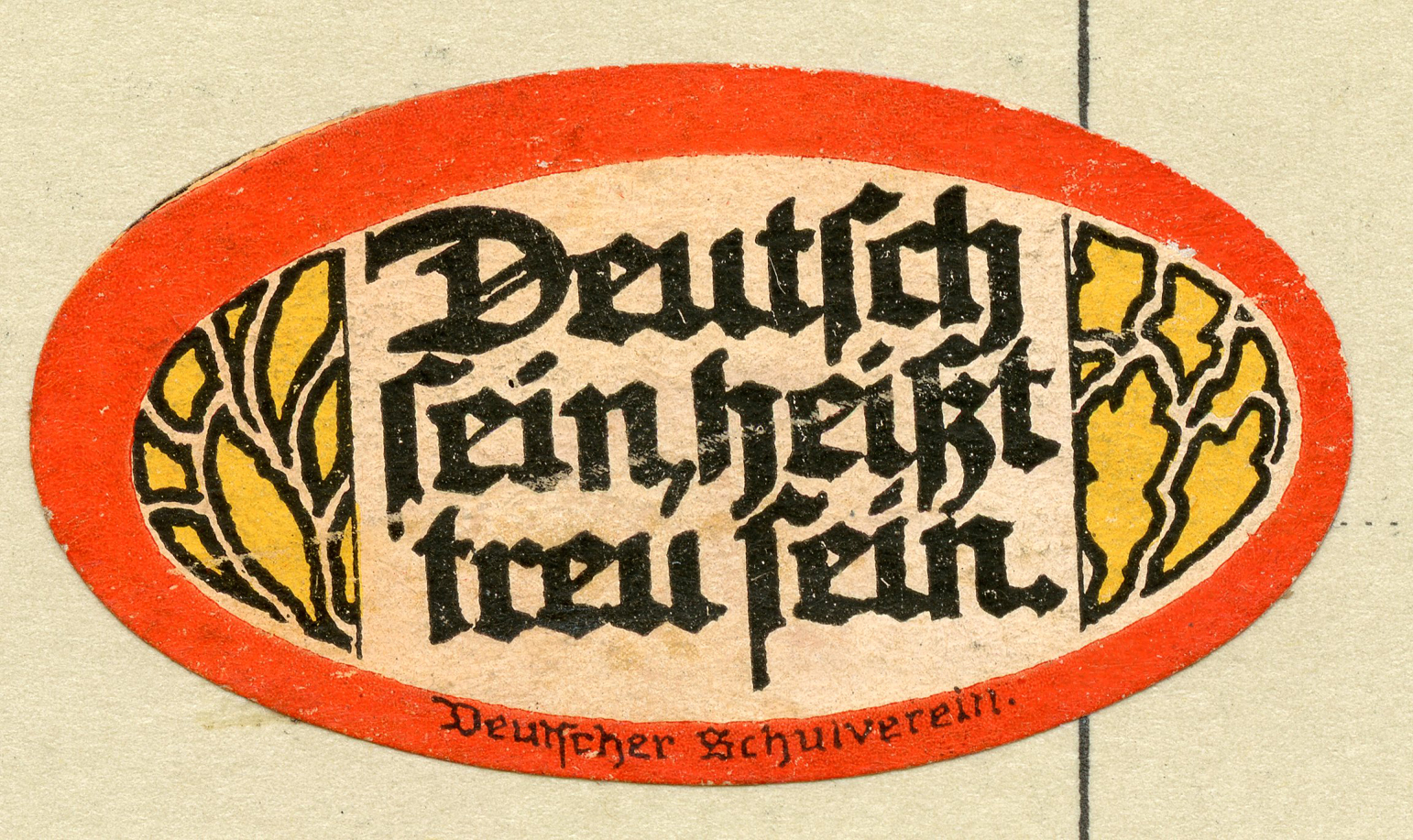
[Below: Reverse. Someone has stuck a vignette stamp on this for whatever reason. It says: 'Deutsch sein heißt treu sein' (To be German means to be loyal). Click to enlarge.]
[Below: Close-up. Click to enlarge.]
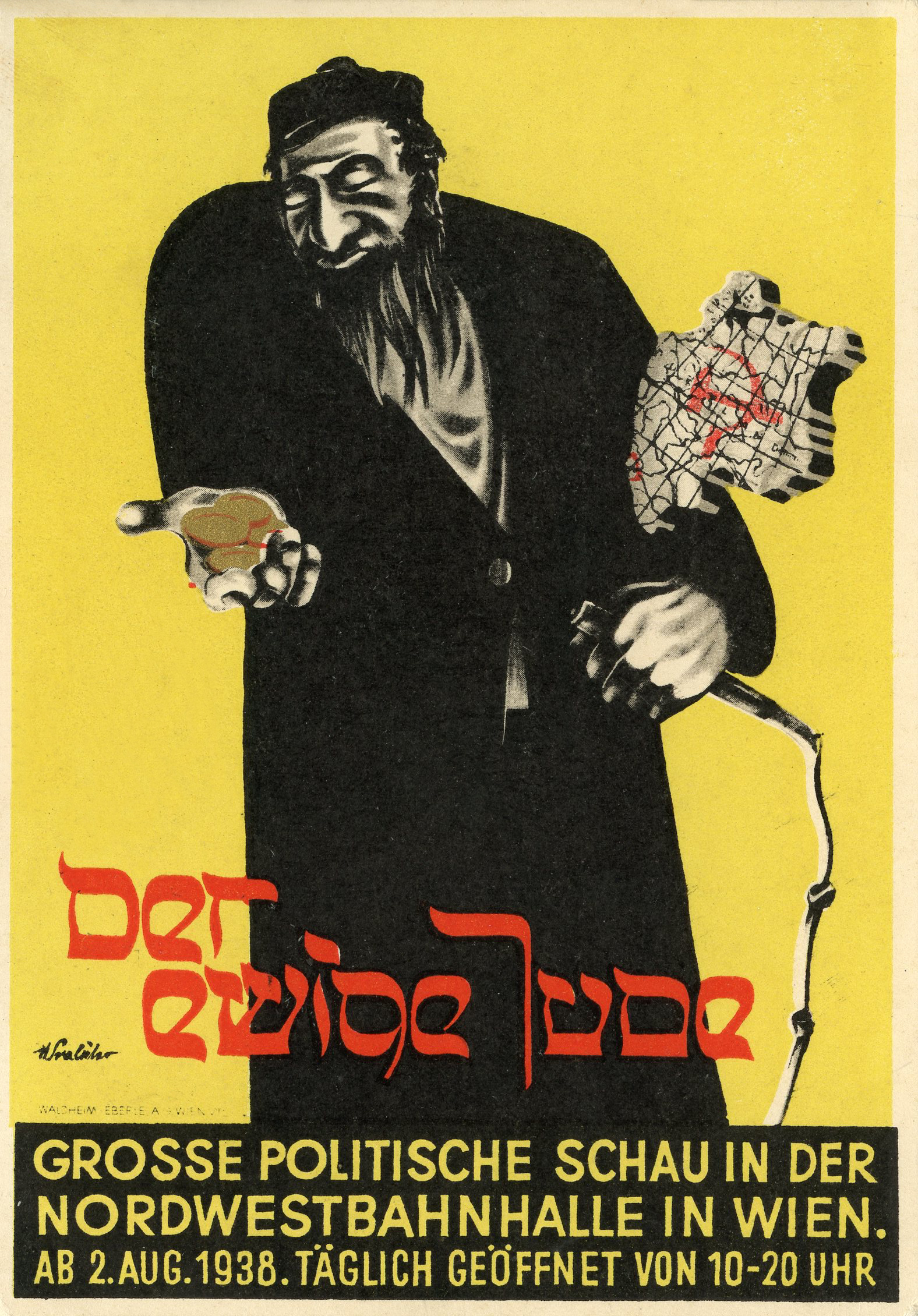
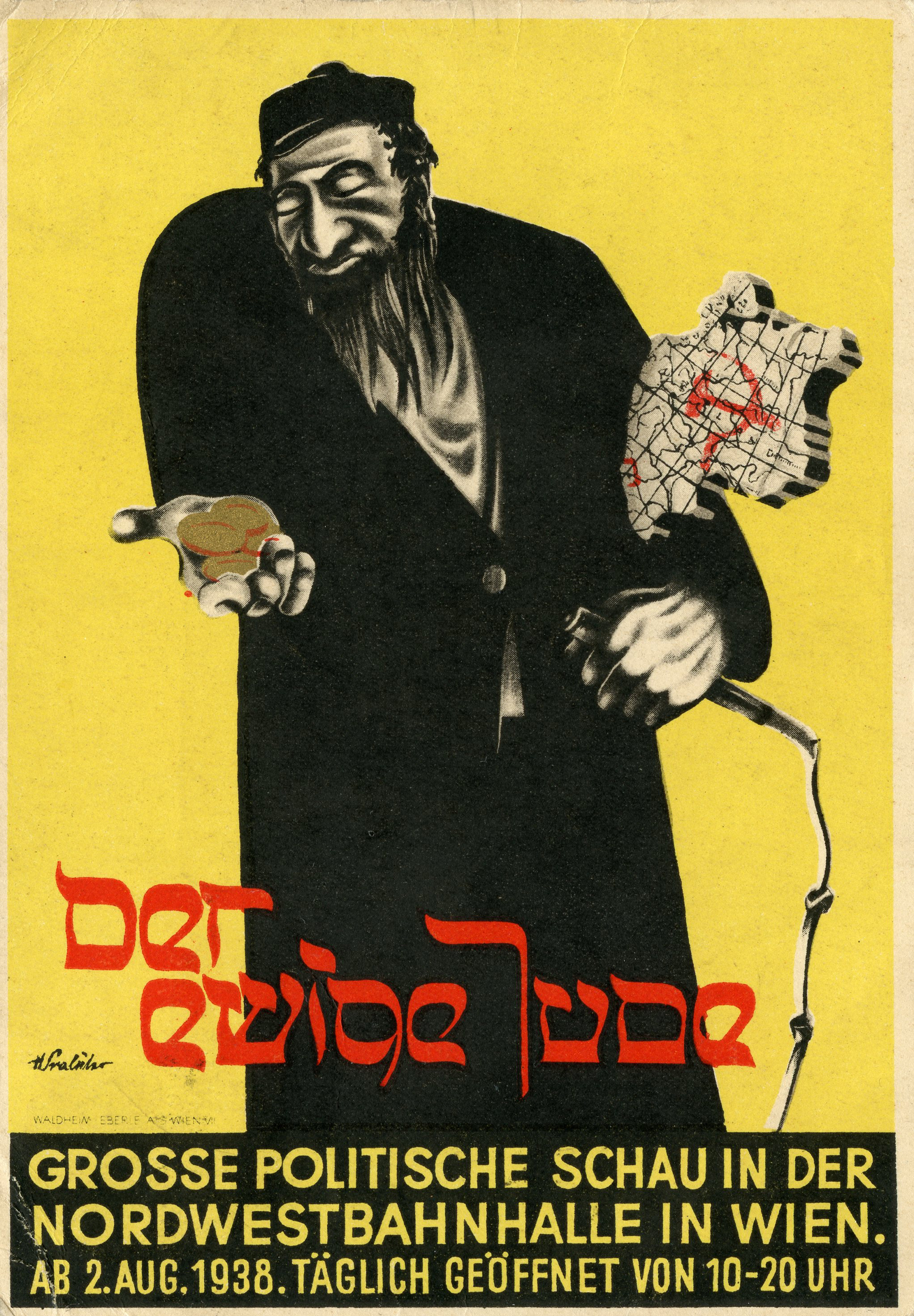
[Below: Another Eternal Jew postcard, but this time from 1938, with different text. It says:
'Der Ewige Jude
Grosse Politische Schau in der
Nordwestbahnhalle in Wien.
Im Bibliotheksbau des Deutschen Museums
AB 2.Aug.1938. Täglich Geöffnet von 10-20 Uhr.'
(The Eternal Jew
Major Political Exhibition in the
Nordwestbahnhalle in Vienna.
In the library building of the Deutsches Museum
From August 2, 1938. Open daily from 10 a.m. to 8 p.m.)
Click to enlarge.]
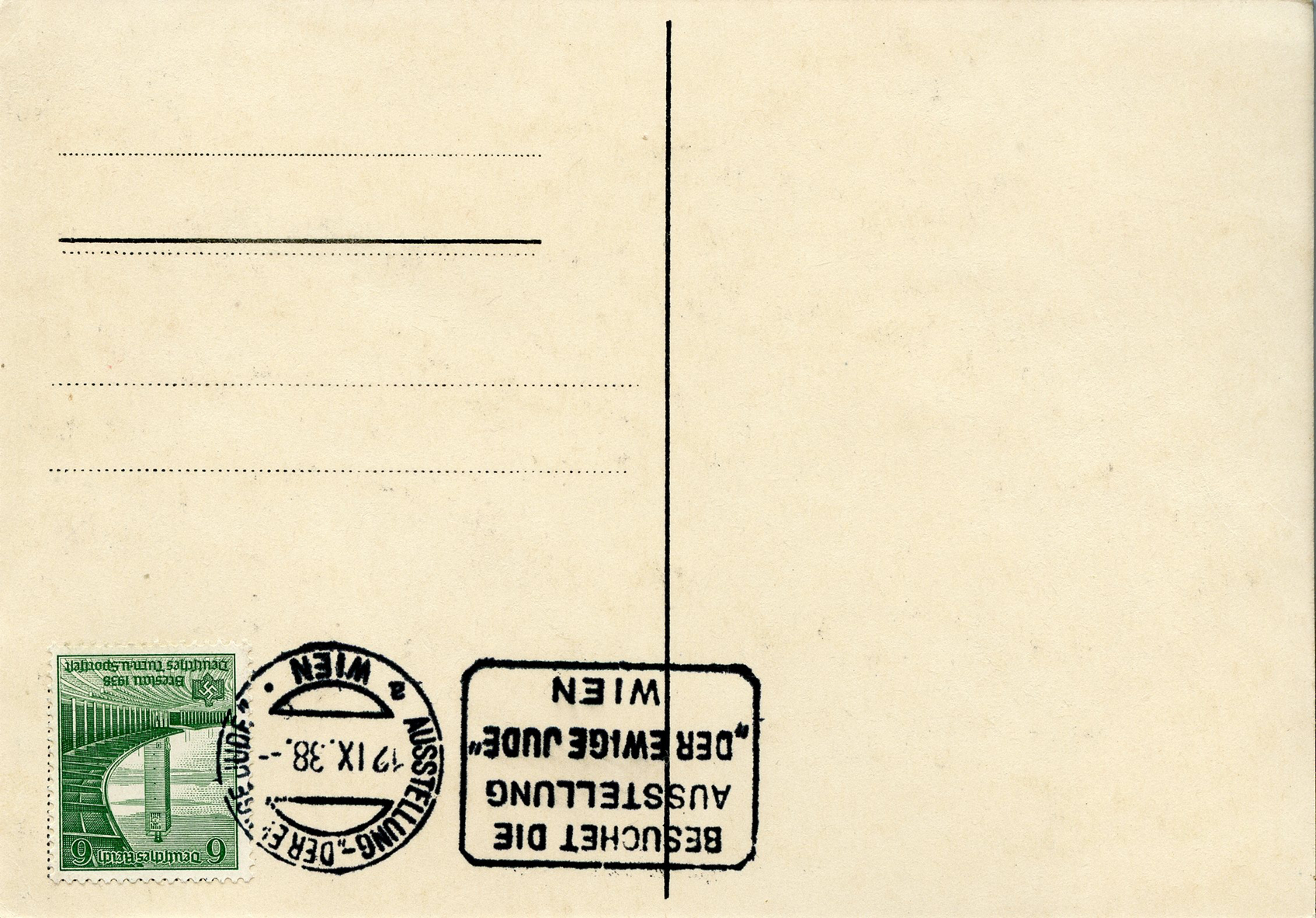
[Below: Reverse. Special Eternal Jew postmark from Vienna September 12, 1938. Click to enlarge.]
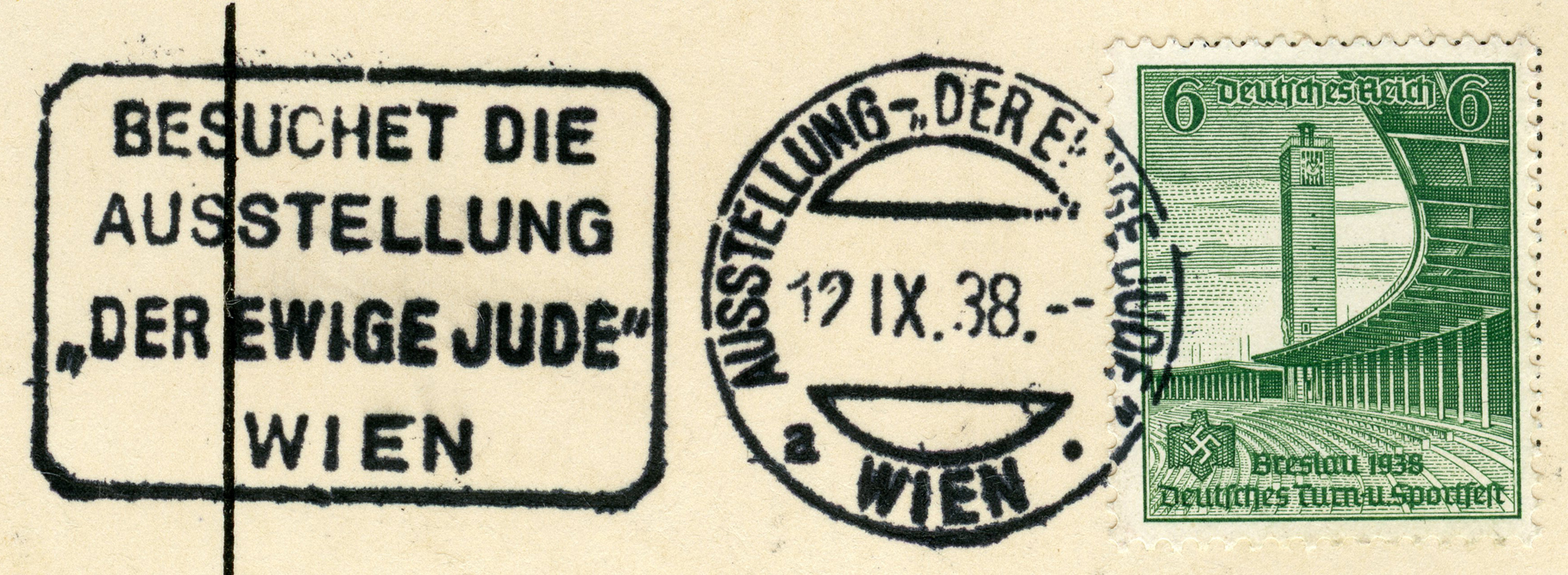
[Below: Close-up. Click to enlarge.]
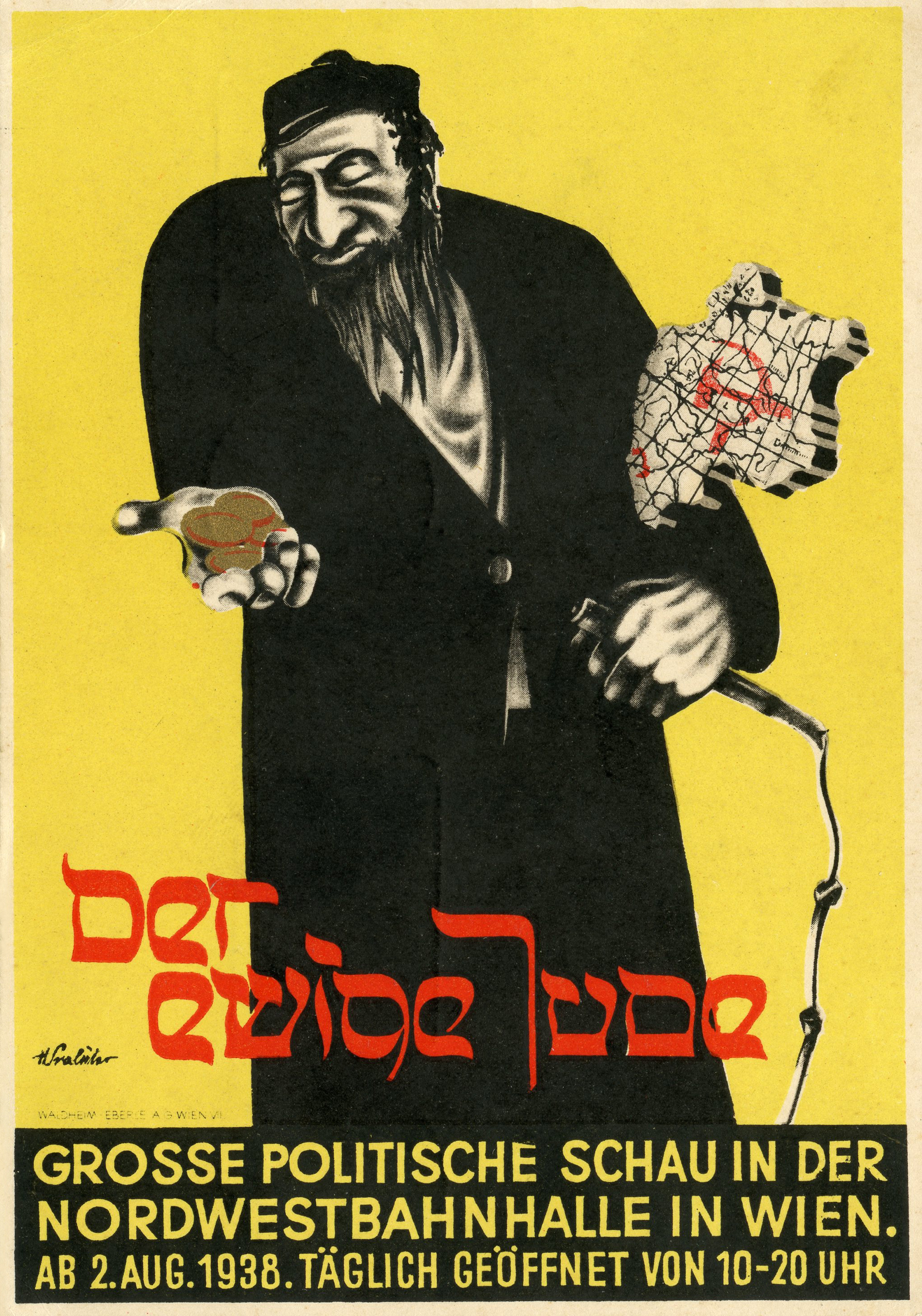
[Below: Another 1938 Eternal Jew postcard. Click to enlarge.]
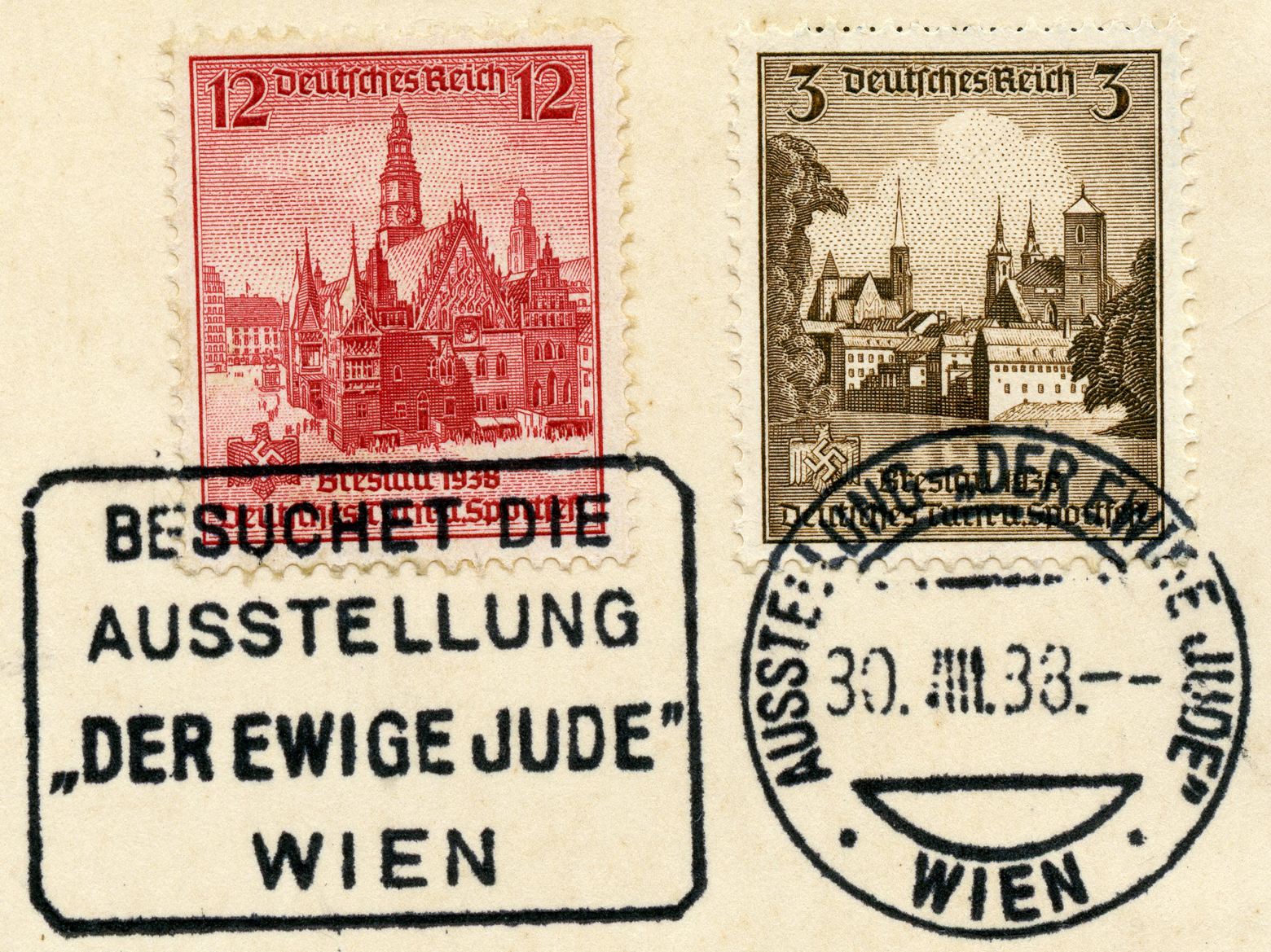
[Below: Reverse. Special Eternal Jew postmark from Vienna canceled August 30, 1938. Click to enlarge.]
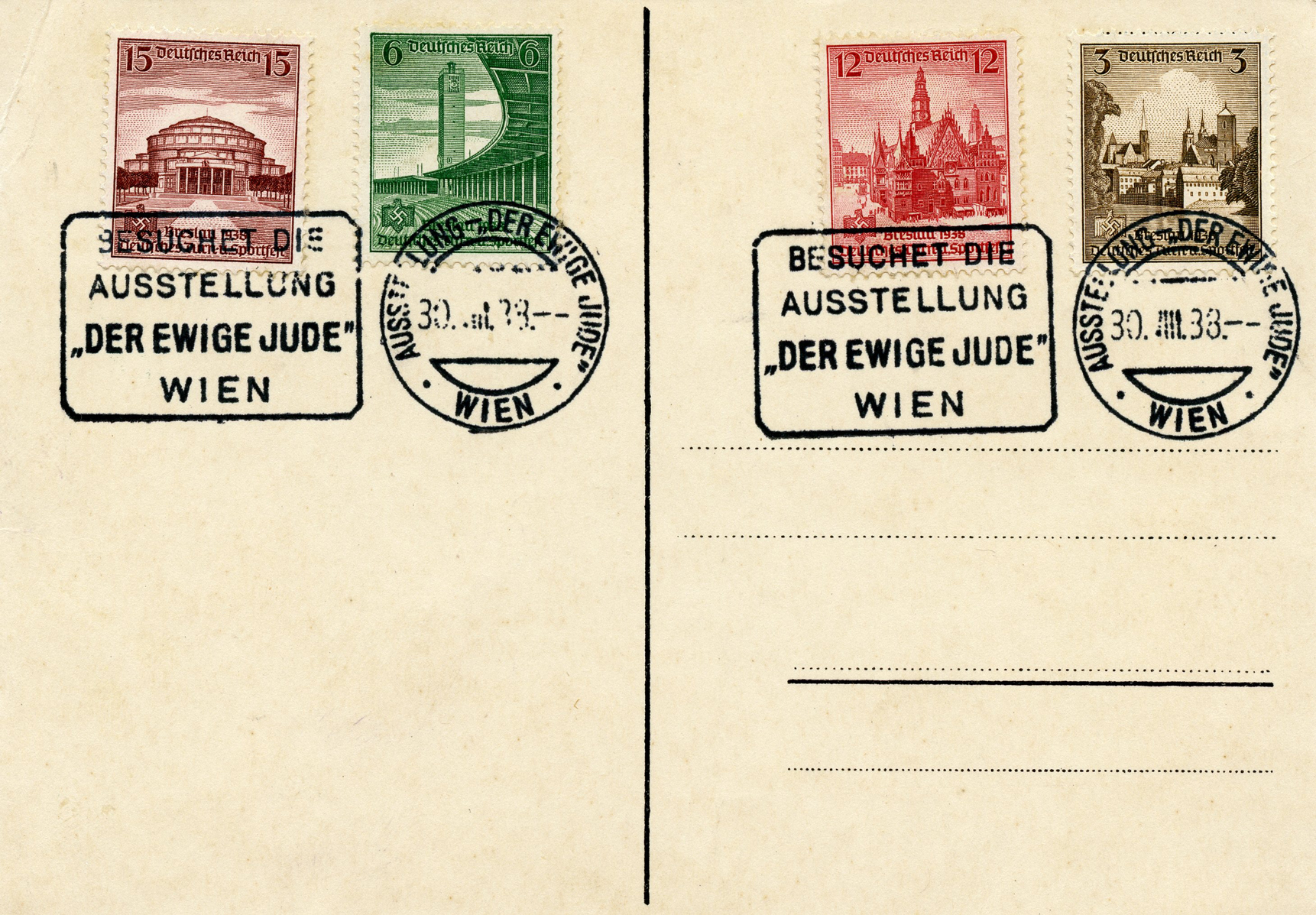
[Below: Close-up. Click to enlarge.]
[Below: Another 1938 Eternal Jew postcard. Click to enlarge.]
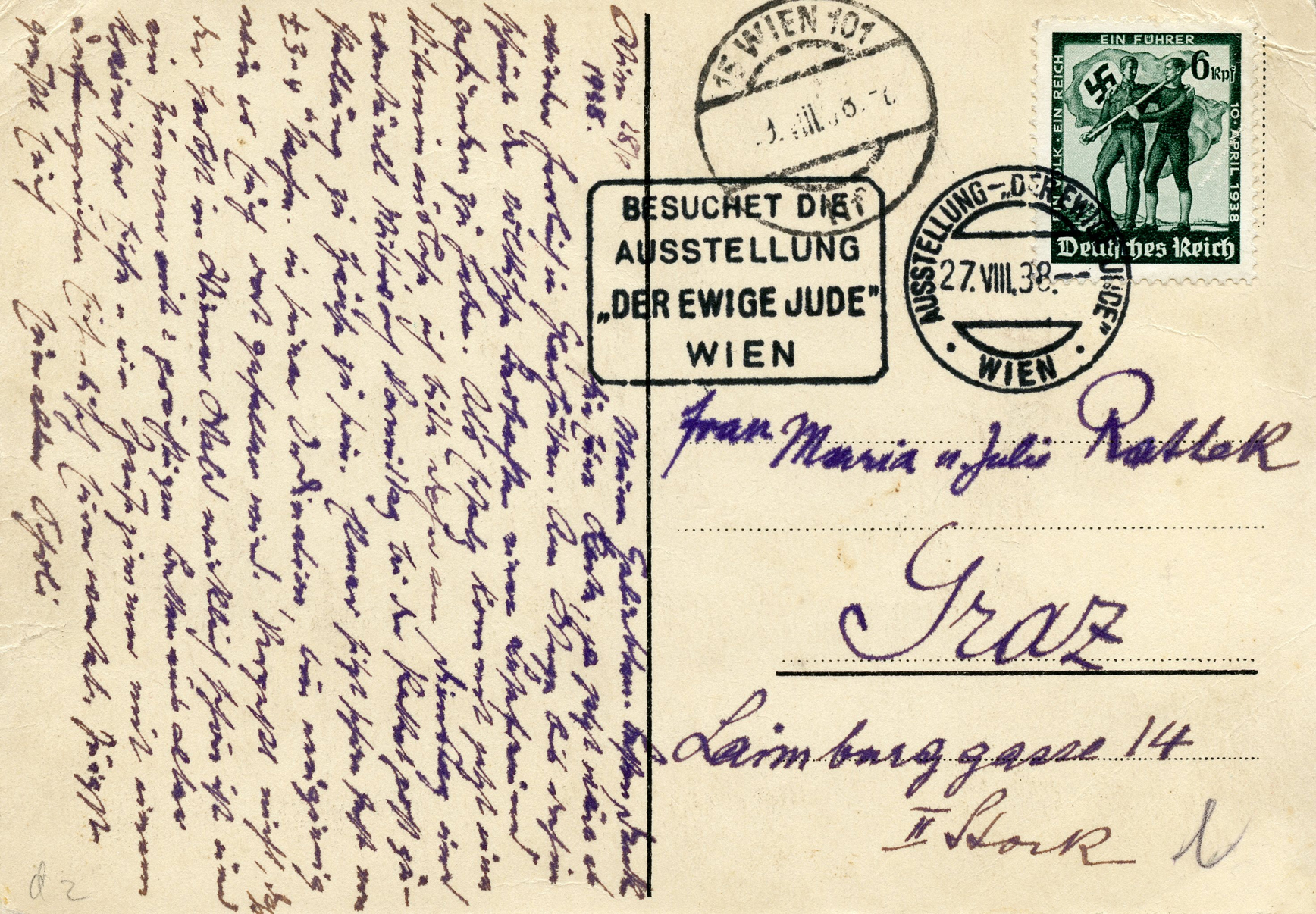
[Below: Reverse. Special Eternal Jew postmark from Vienna canceled August 27/29, 1938. Click to enlarge.]
[Below: ... Click to enlarge.]
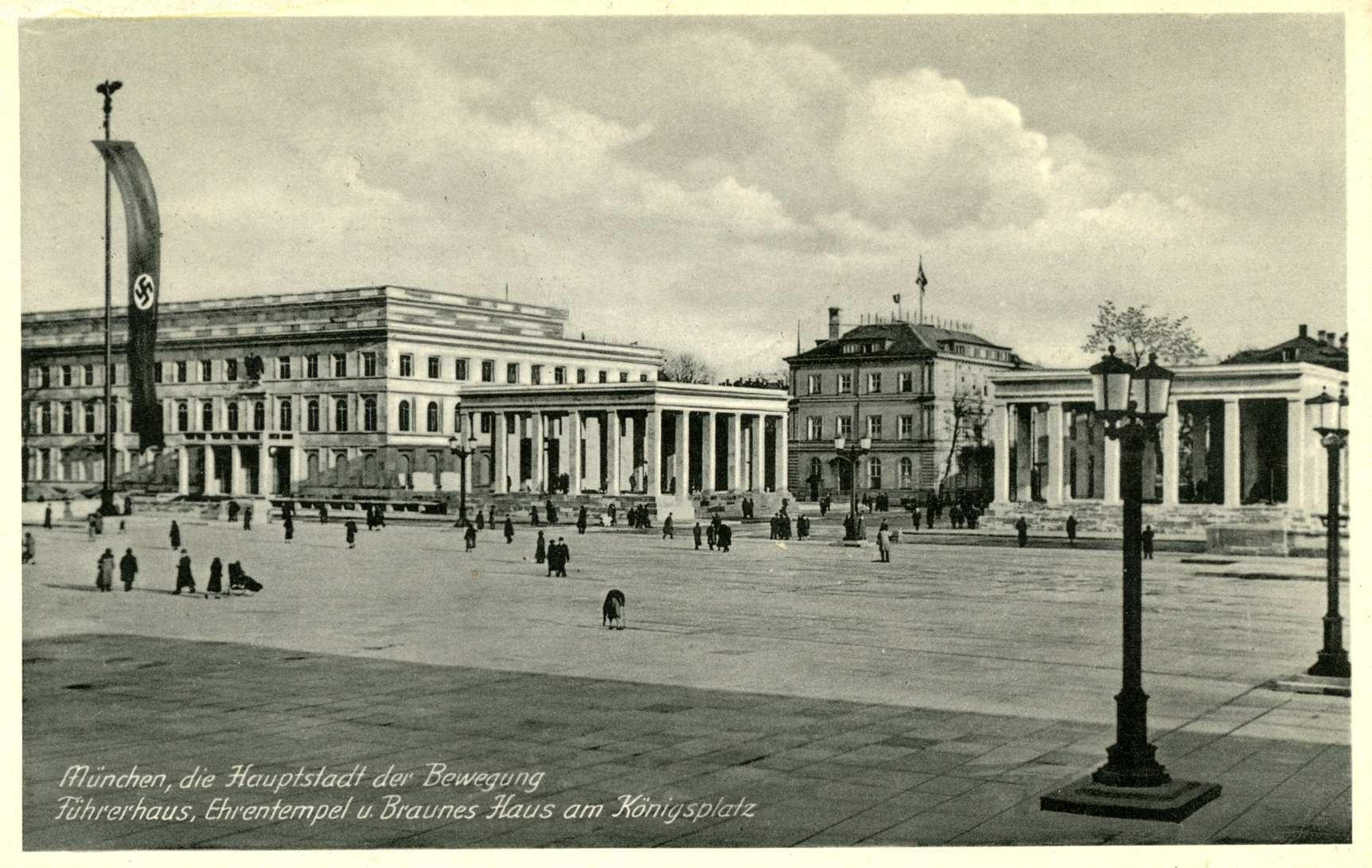
[Below: Reverse. Oddly this contains the special Eternal Jew postmark from Vienna canceled December 19, 1937, but also has a Munich January 30, 1938 cancel. Click to enlarge.]
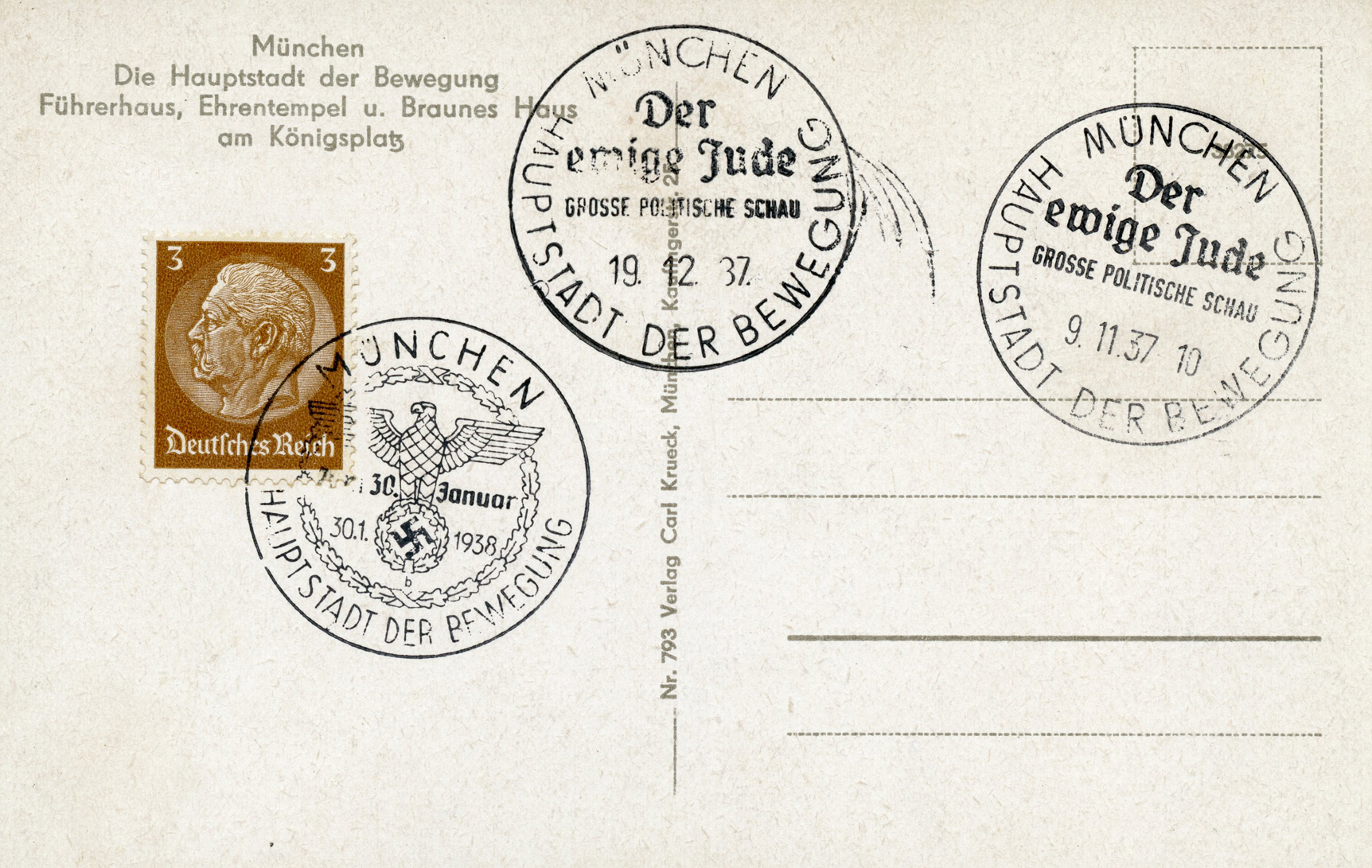
[Below: Close-up. Click to enlarge.]

[Below: Close-up. Click to enlarge.]
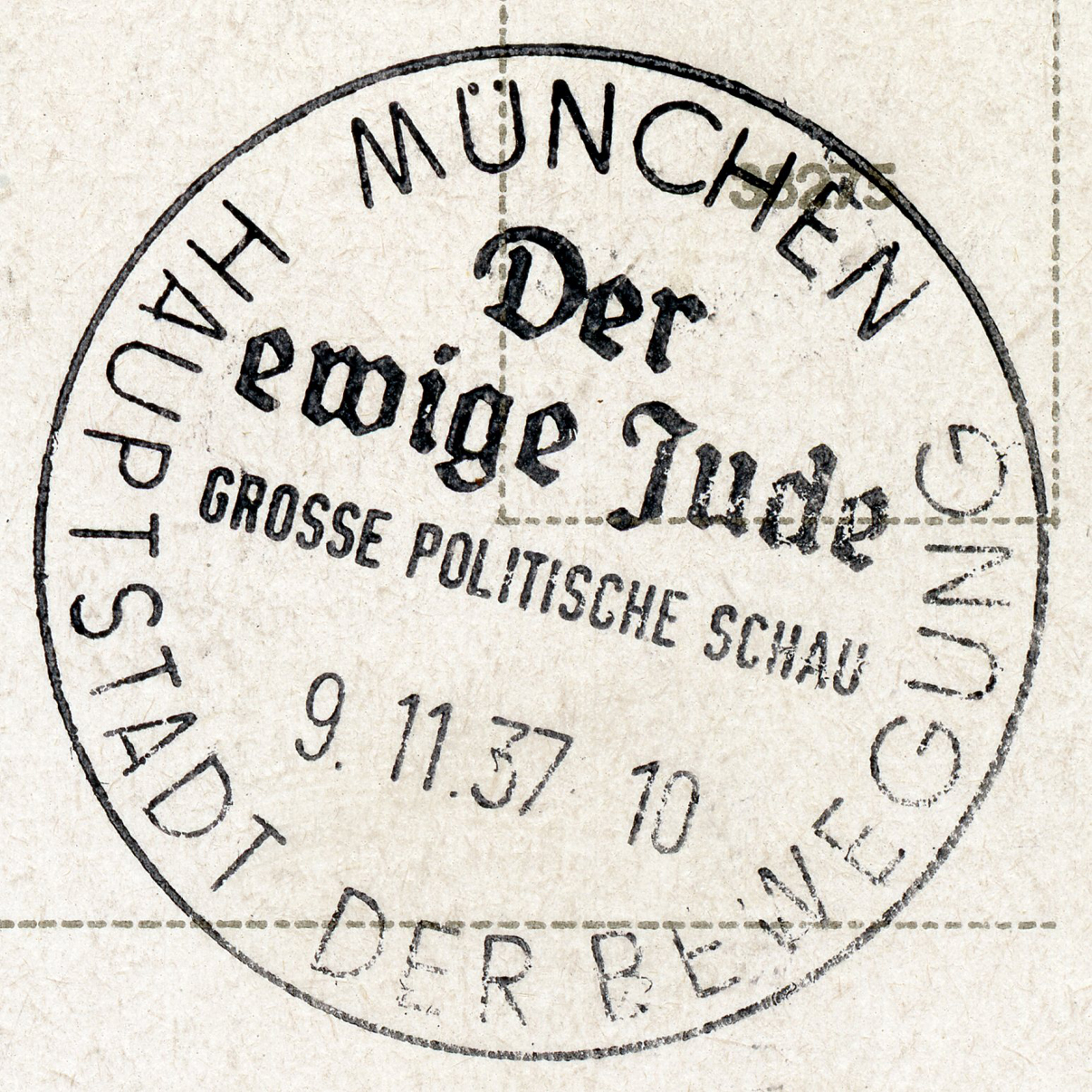
[Below: Here's an example showing a tête-bêche (a joined pair of stamps in which one is upside-down in relation to the other), with special Eternal Jew postmarks from November 9, 1937.]
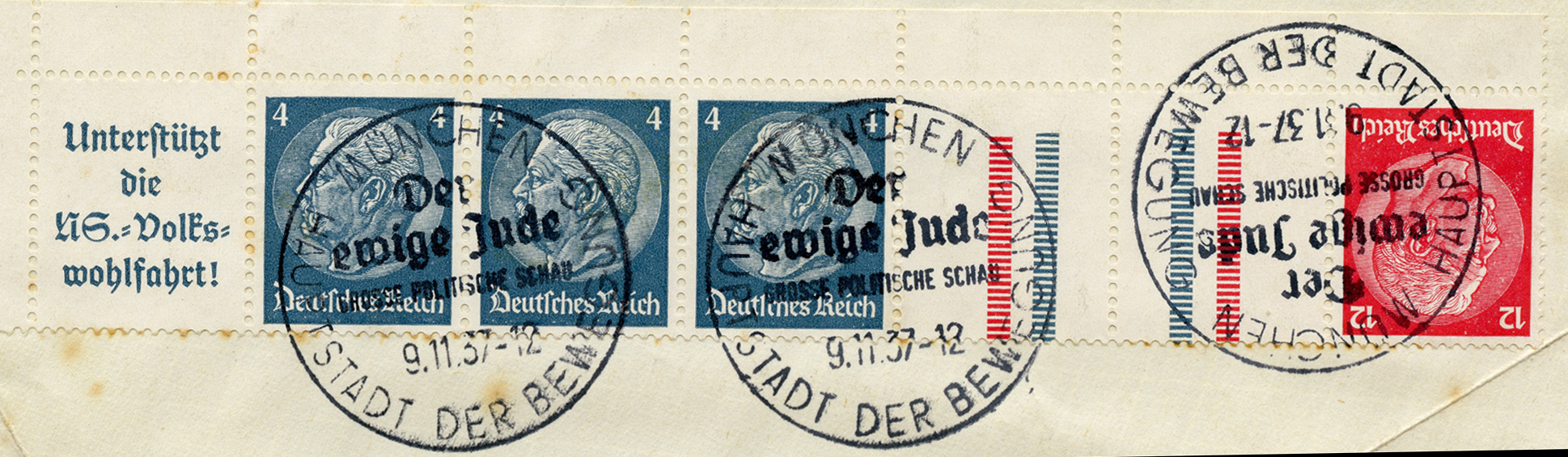
[Below: Here's an nice shot of the Eternal Jew postmark from the Berlin-Reichstag, from November 30, 1938.]

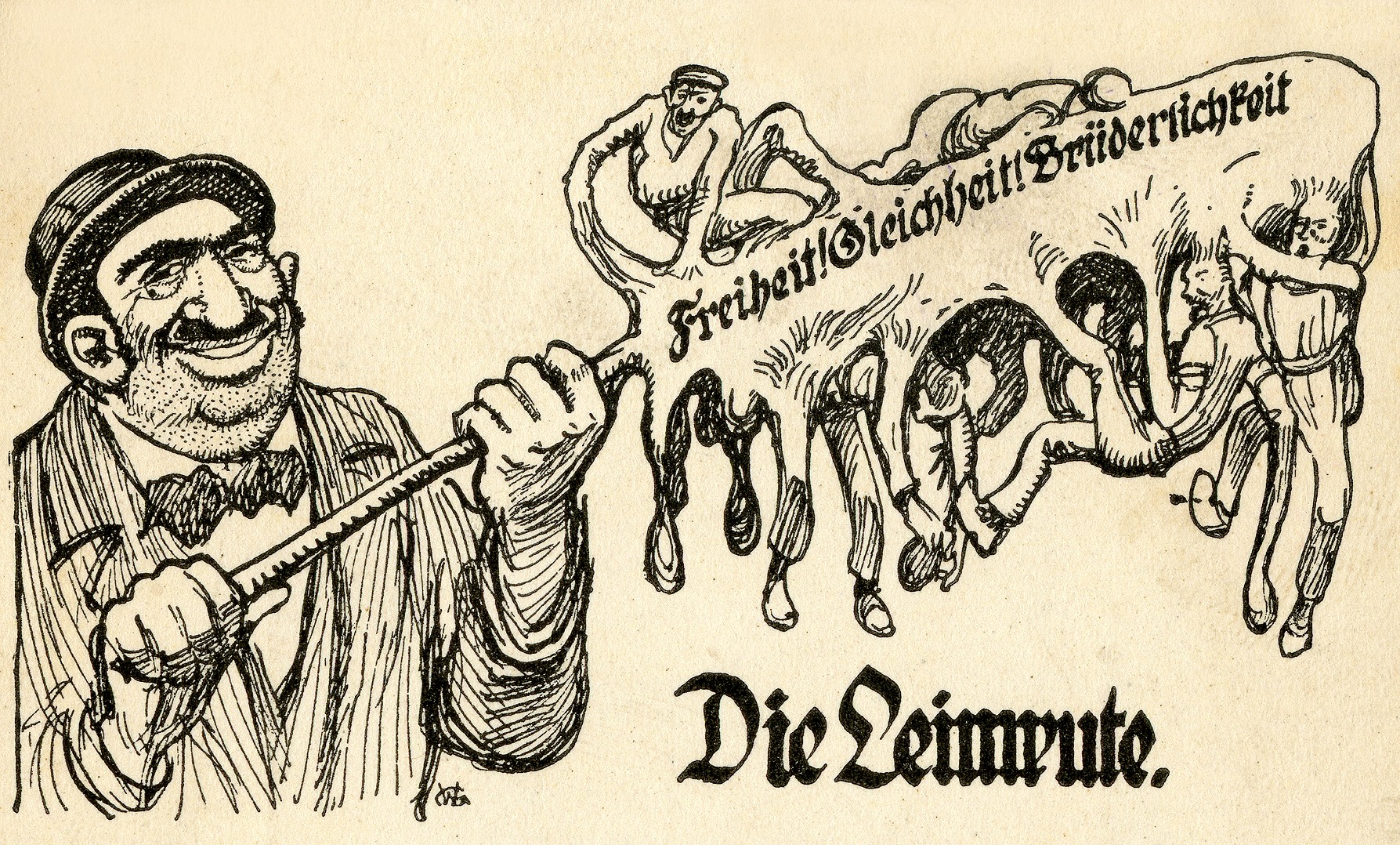
[Below: Here's an interesting postcard showing a caricature of a Jew. Here is the German and traslated English version.]
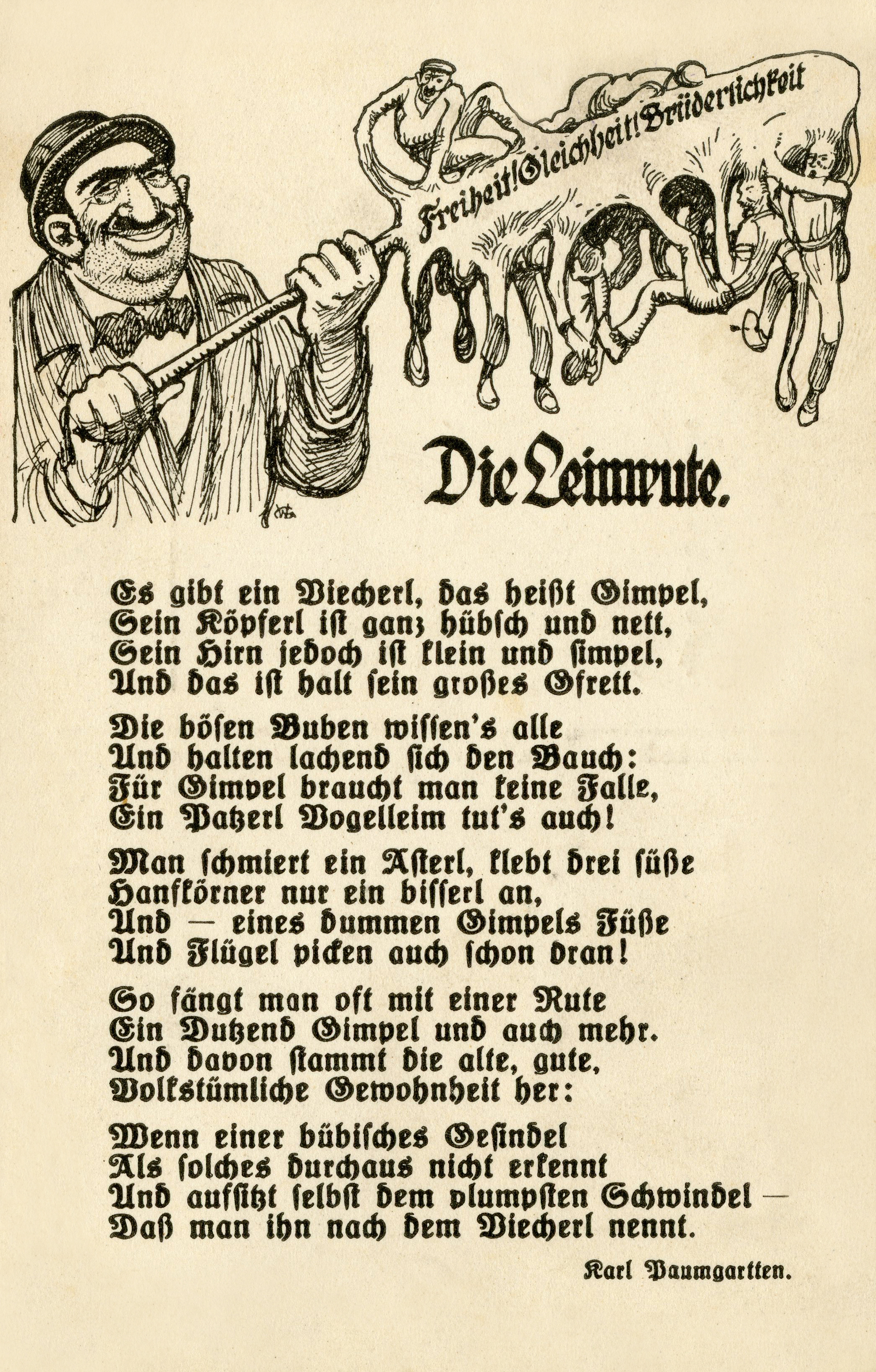

[Below: Close-up.]
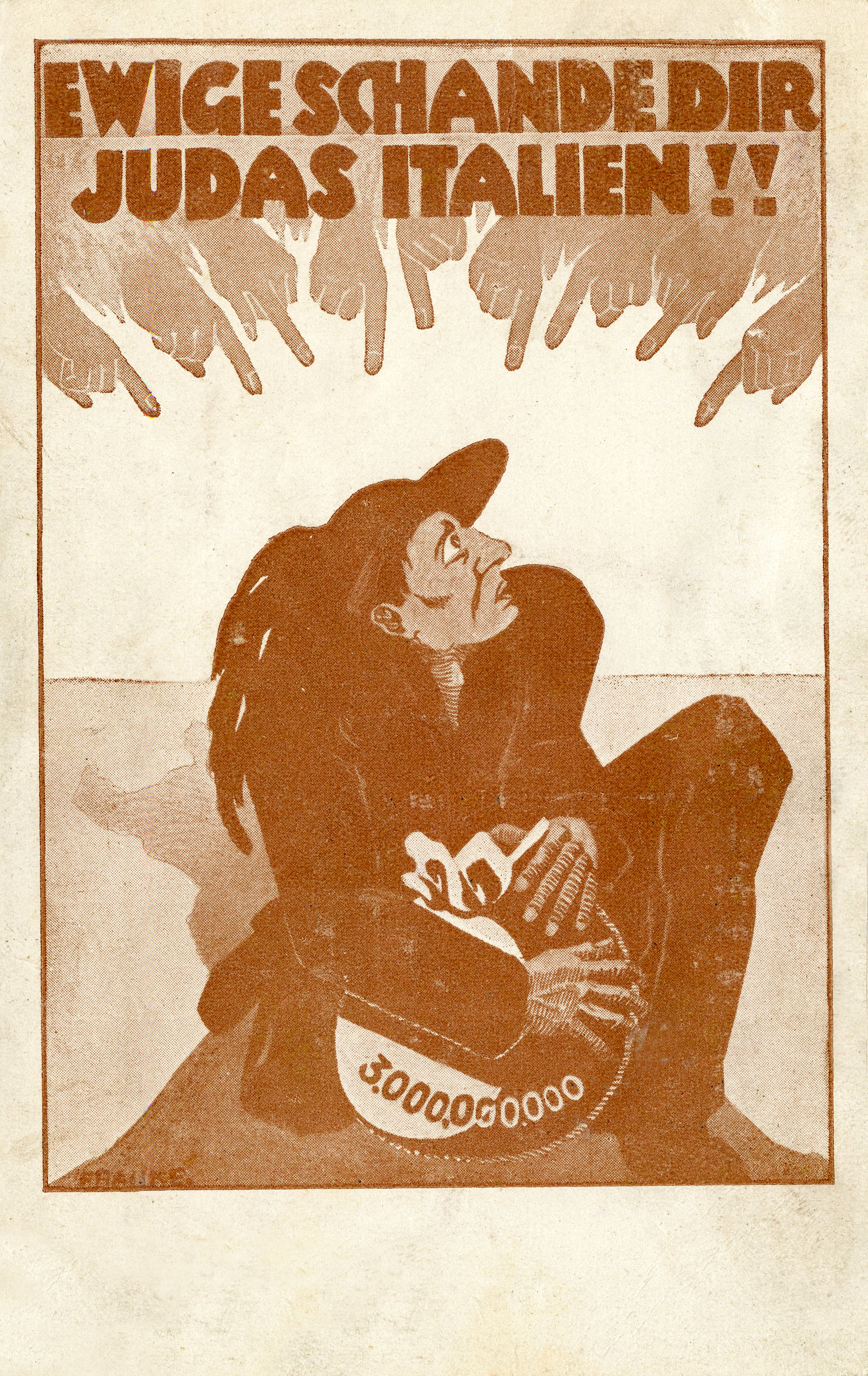
[Below: Here's a strange postcard (the reverse is blank), that says 'ETERNAL SHAME ON YOU JUDAS ITALY!!'. I'm sure what the meaning of this is...]
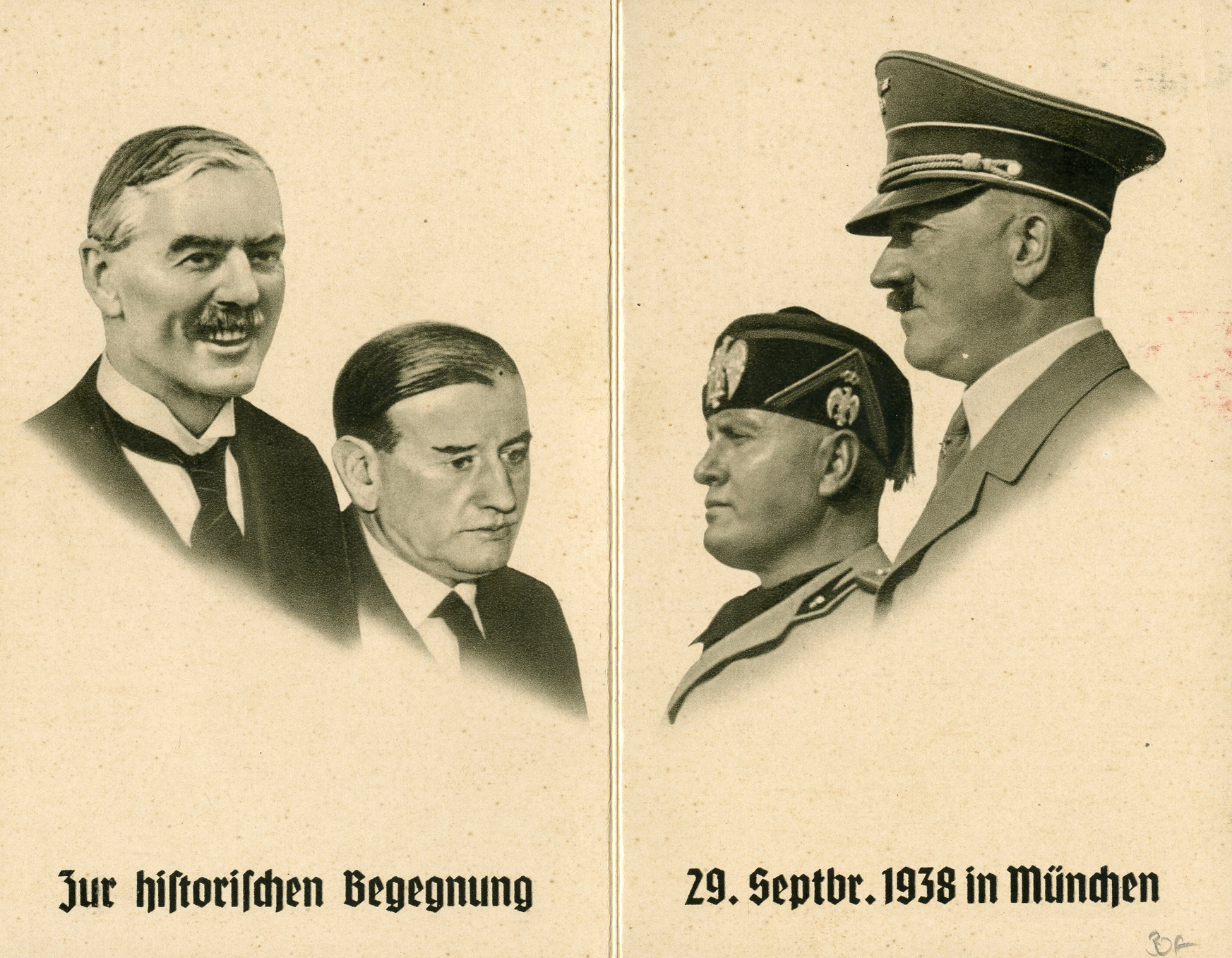
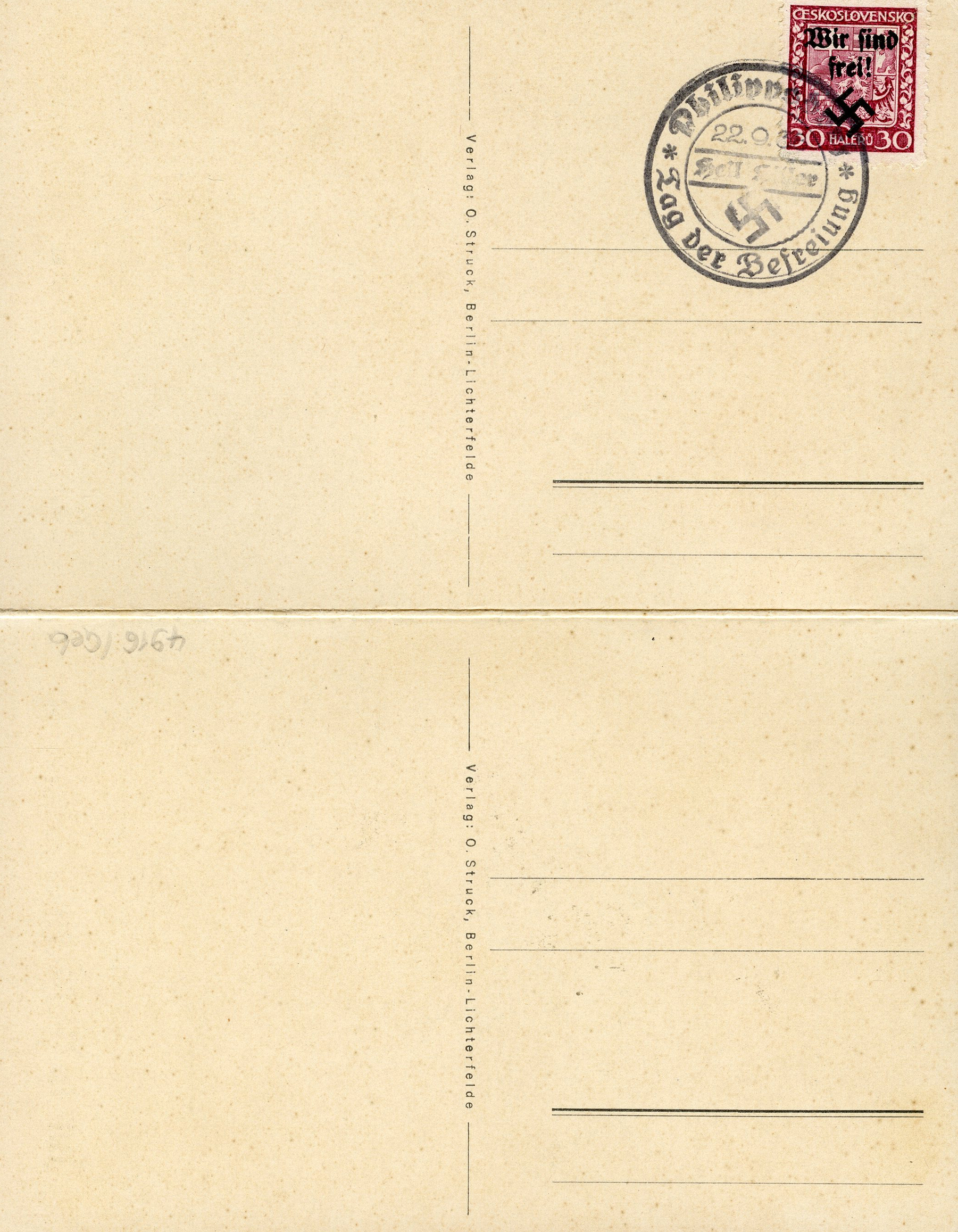
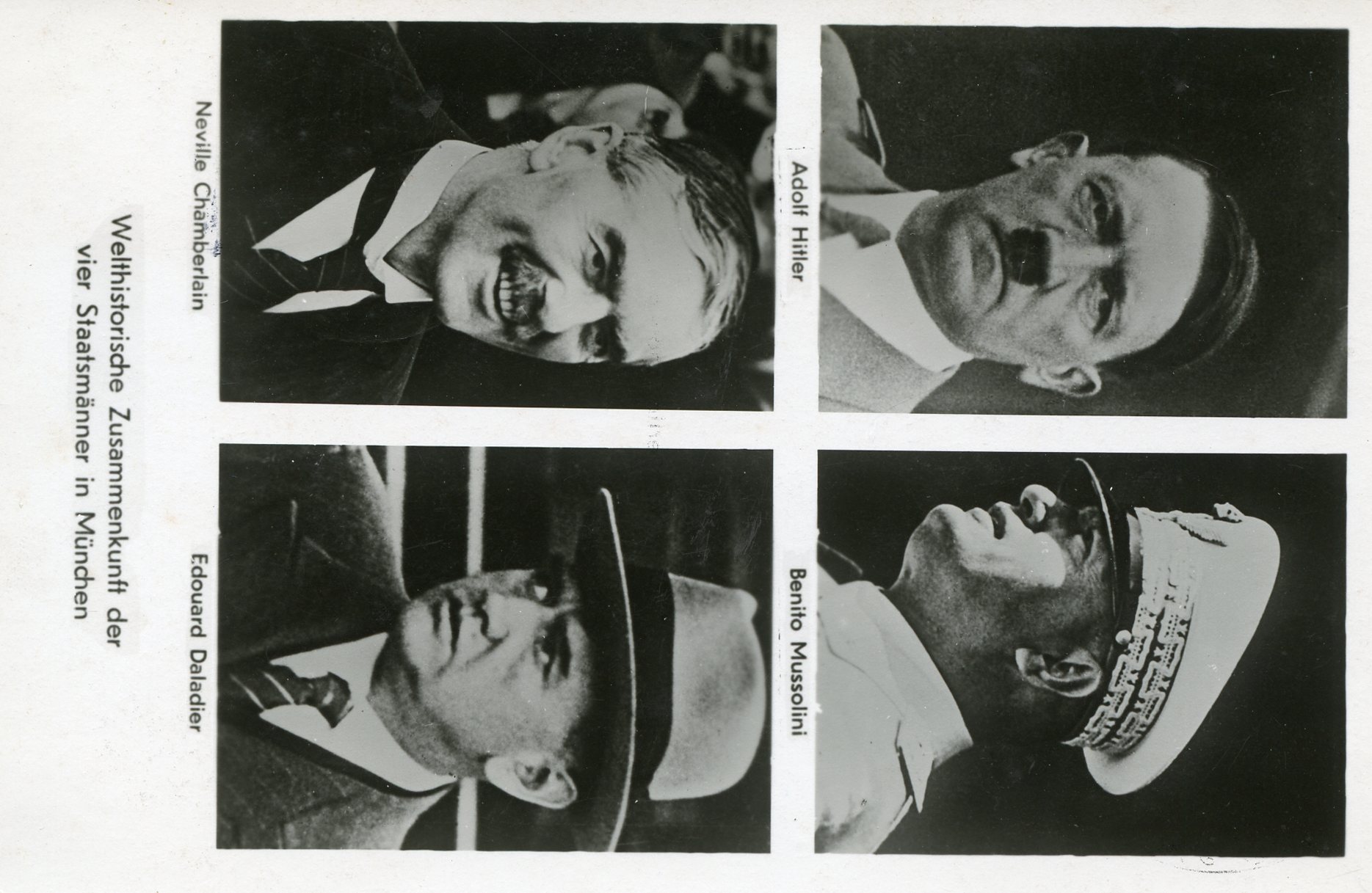
[Below: This is a pretty strange double postcard commemorating the September 1938 'Munich Agreement', a peace agreement between Germany, Great Britain, France, and Italy, which allowed Germany to annex the Sudetenland. The left side of the postcard shows the British Prime Minister Neville Chamberlain and the French Prime Minister Édouard Daladier. I don't think I need to tell you who the other two people are! Click to enlarge.]
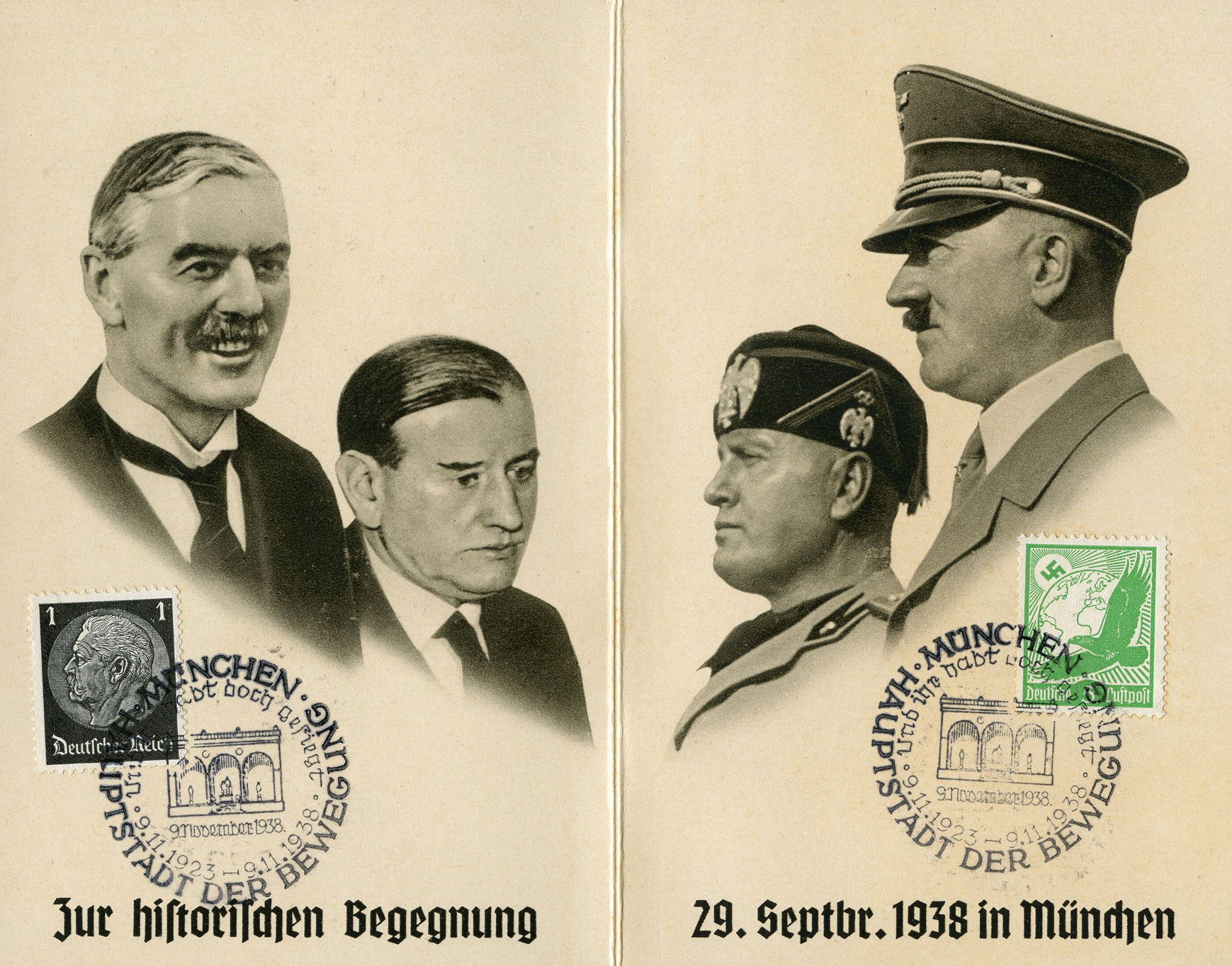
[Below: Close-up. Click to enlarge.]
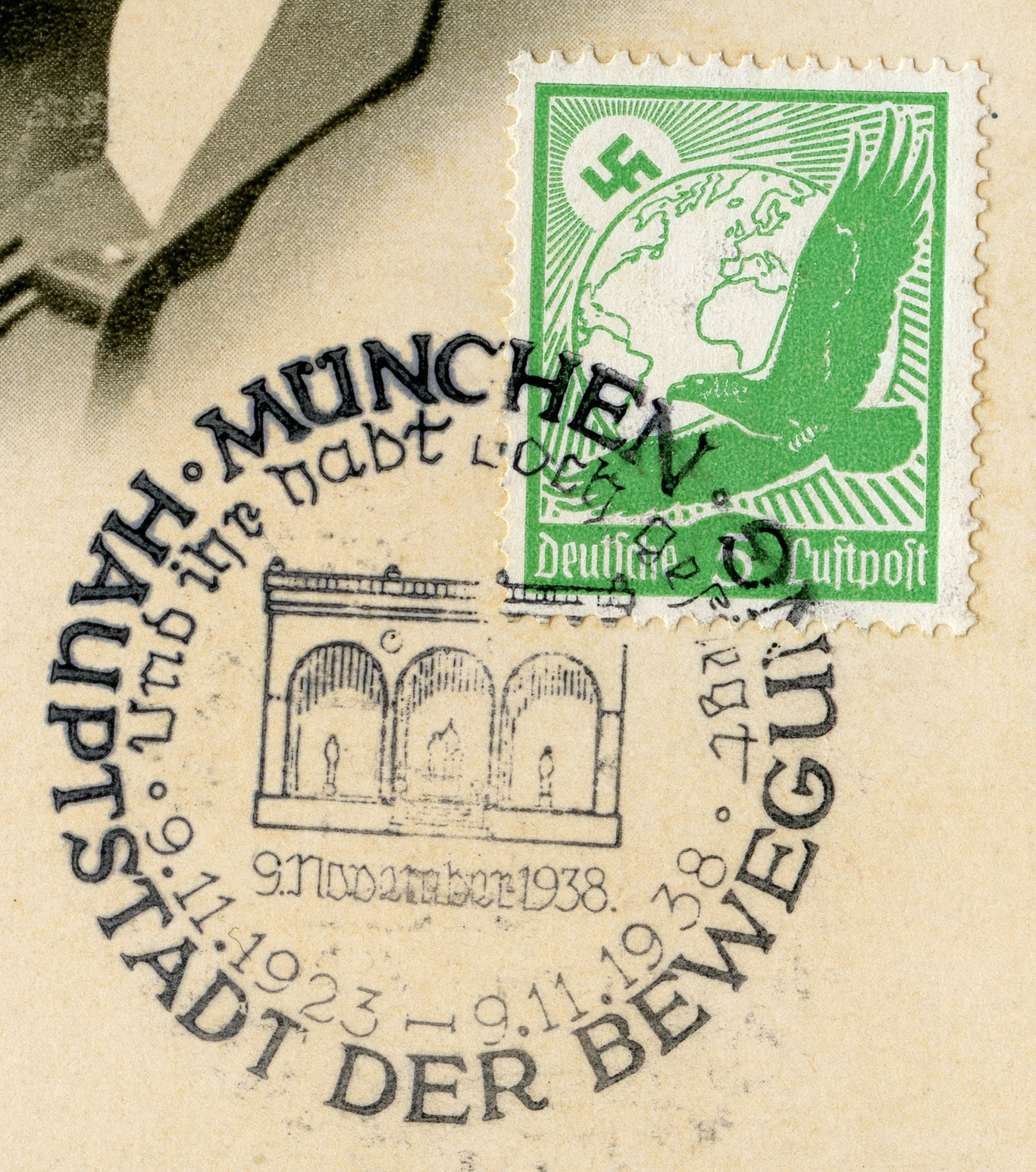
[Below: Reverse. Click to enlarge.]
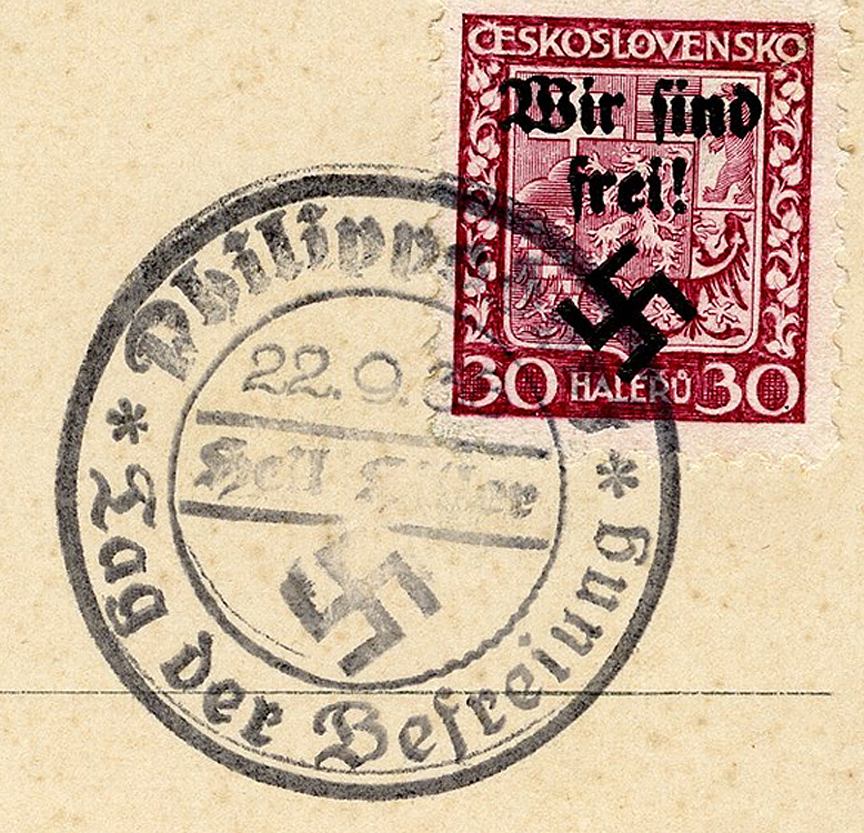
[Below: Same as above, but with overprinted Czech stamp for the Sudetenland. Click to enlarge.]
[Below: Close-up.]
[Below: Reverse. Click to enlarge.]
[Below: This says: 'Welthistorische Zusammenkunft der vier Staatsmänner in Münich' (World-historical meeting of the four statesmen in Munich). Click to enlarge.]
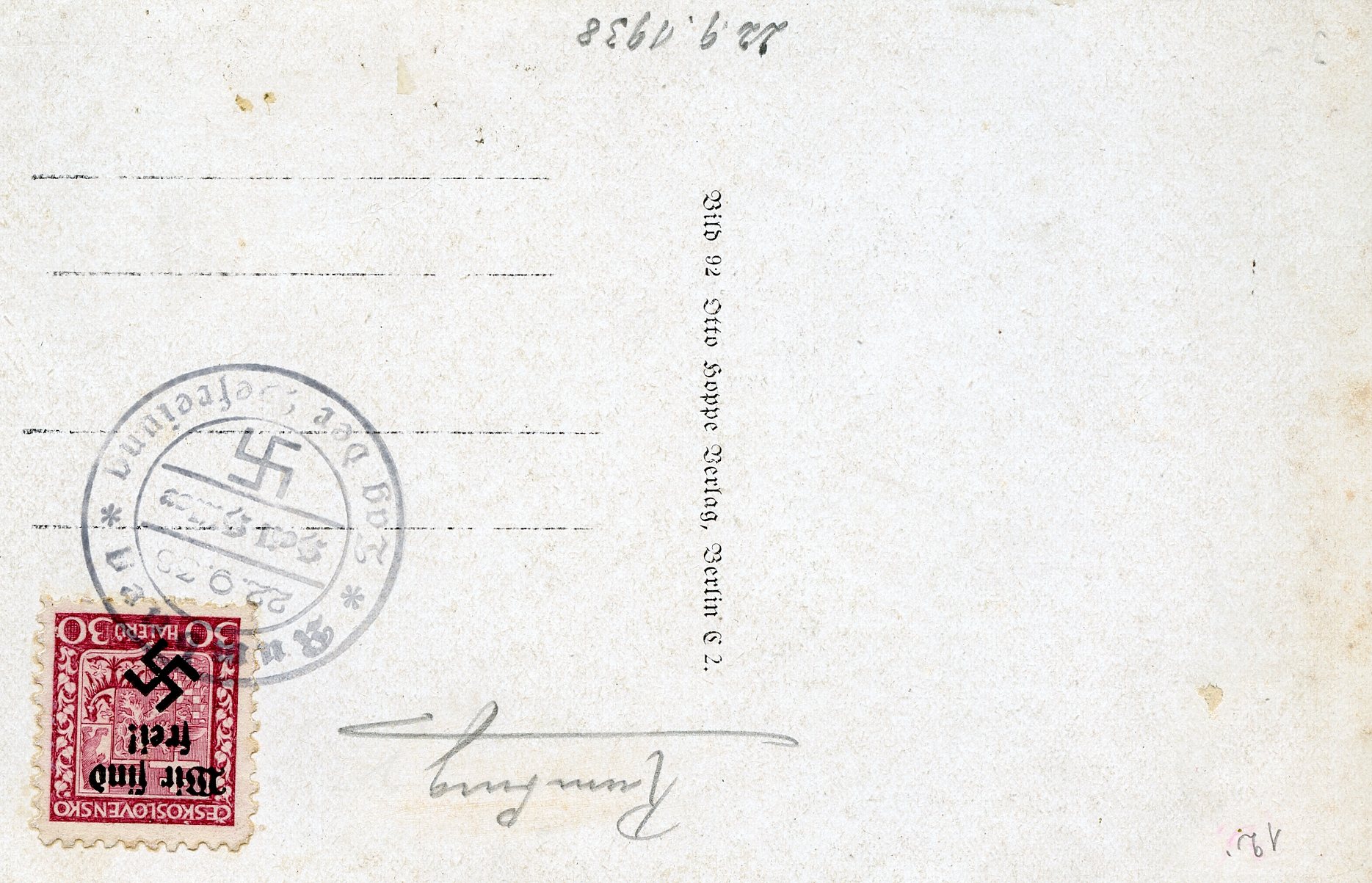
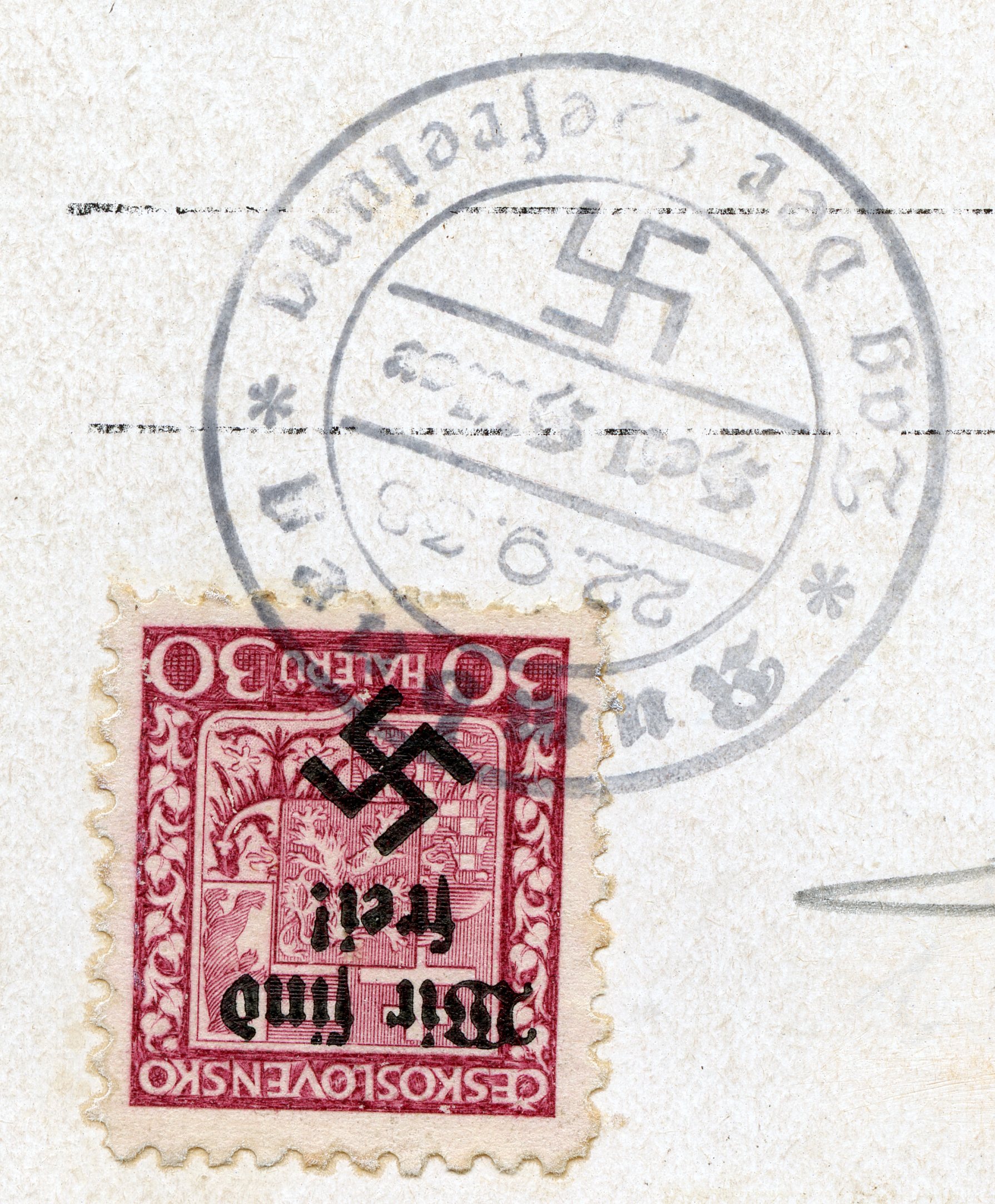
[Below: This is a Sudetenland overprint from September 22, 1938, when it rejoined Germany. This type of overprint is from Rumburg, Sudetenland. It is also canceled Rumburg. Click to enlarge.]
[Below: Close-up. Click to enlarge.]
[Below: This postcard, postmarked on September 22, 1938, says:
'On September 22, 1938 Adolf Hitler and Neville Chamberlain met for the historic negotiations in Godsberg to find, in a frank, man-to-man discussion, a way to preserve the threatened peace of Europe.'
The reverse is blank. Click to enlarge.]
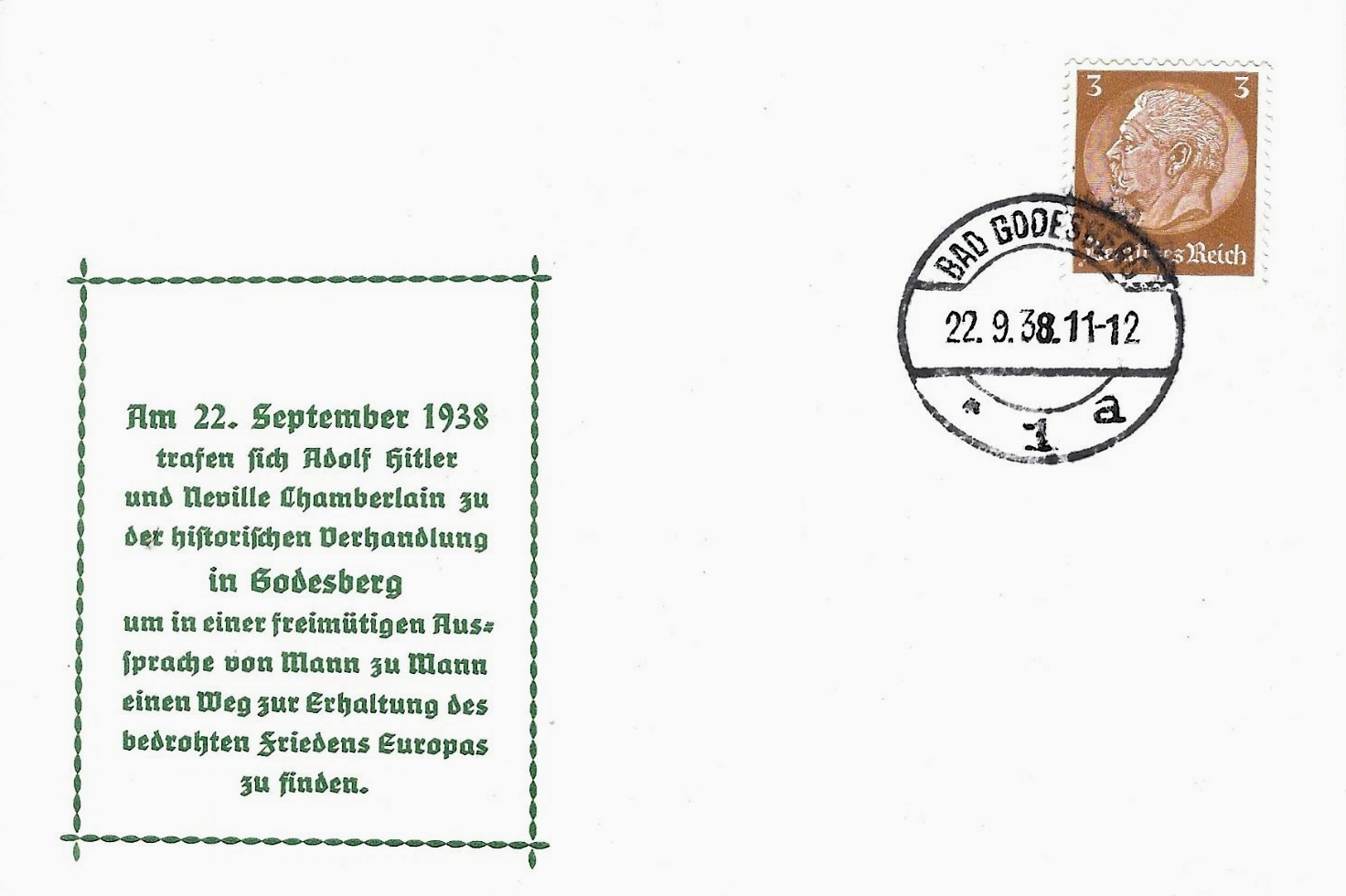
[Below: Miklós Horthy postcard. Click to enlarge.]
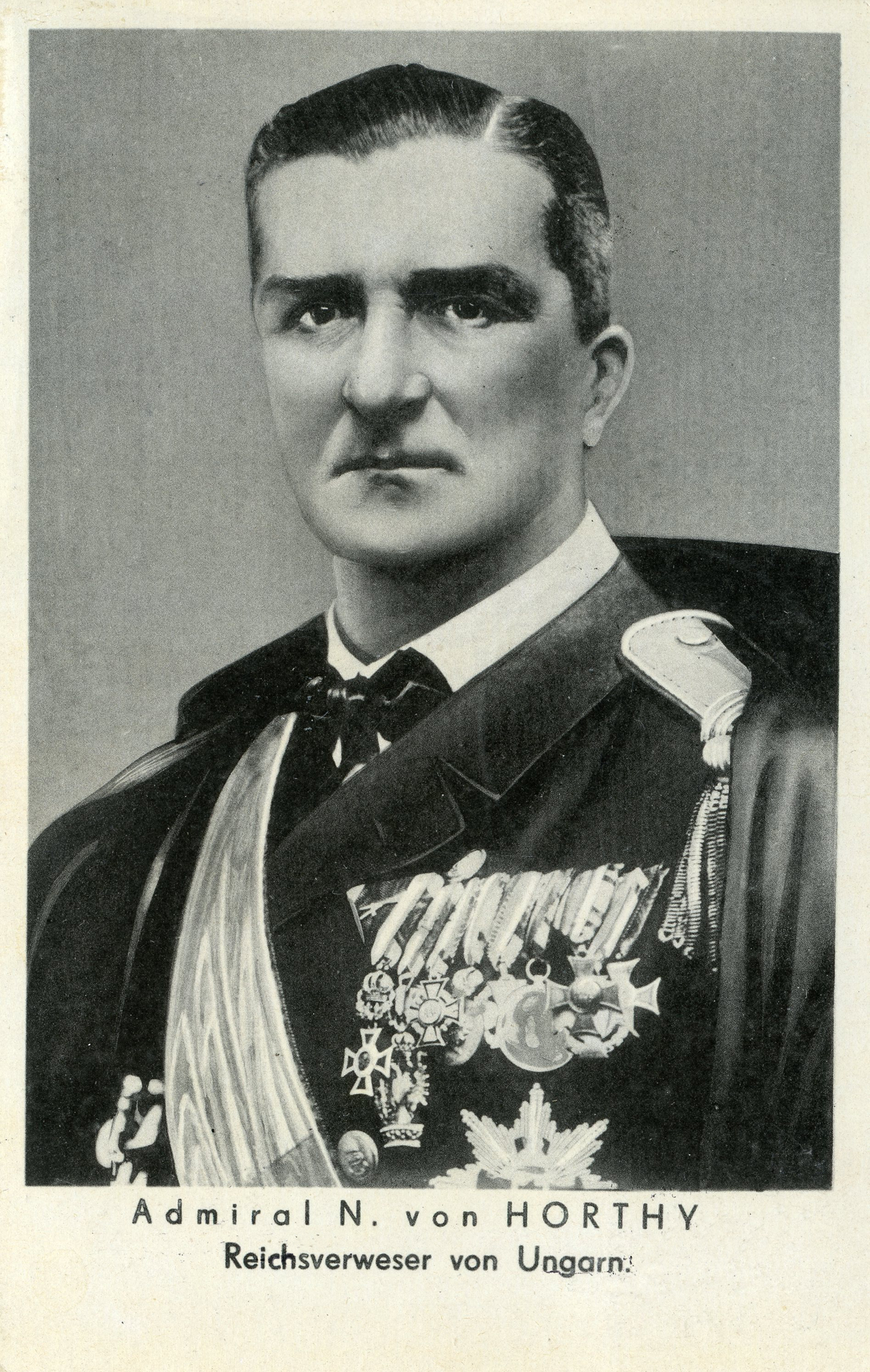
[Below: Reverse of postcard showing six different postmarks. Click to enlarge.]
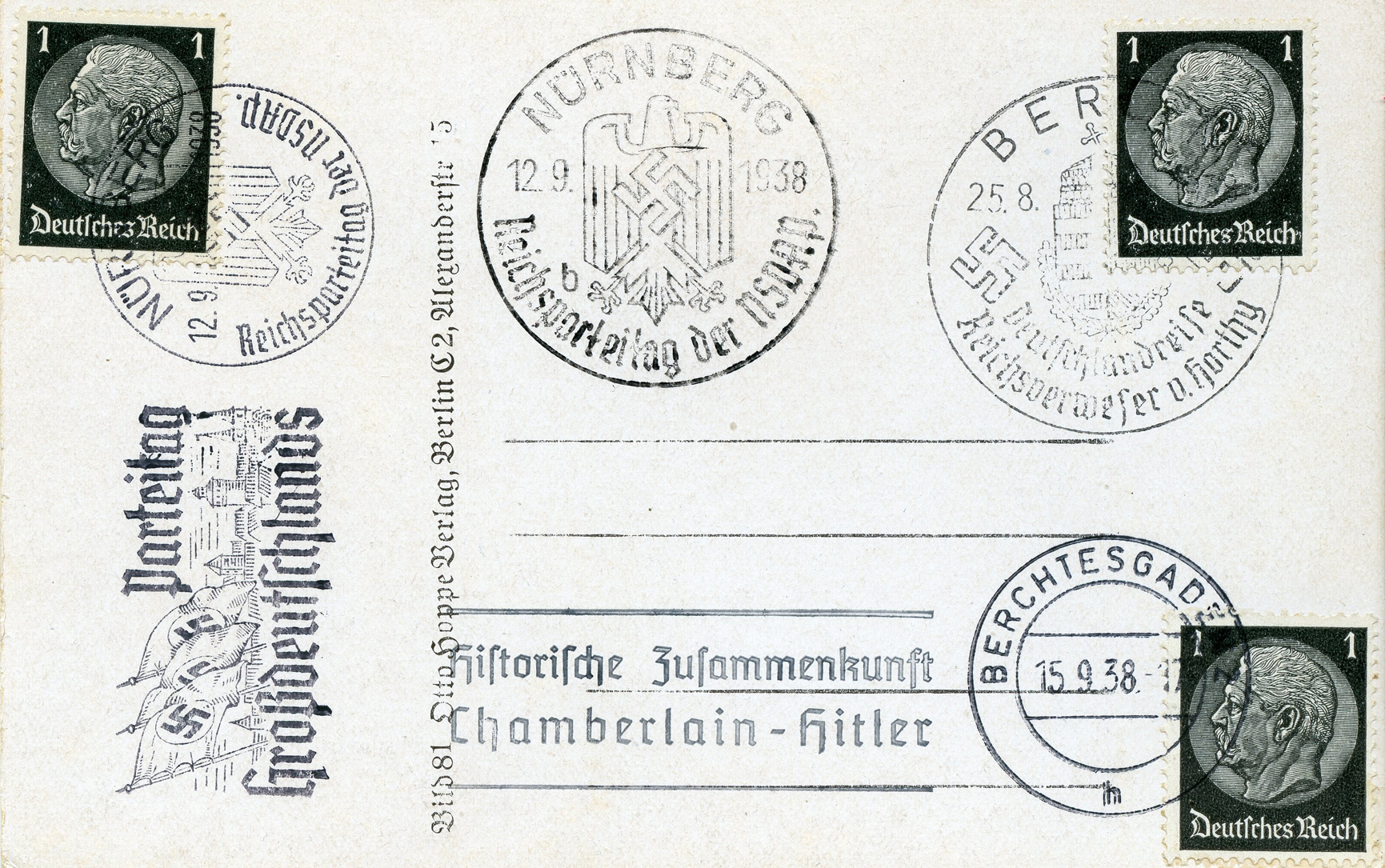
[Below: Close-up. Click to enlarge.]
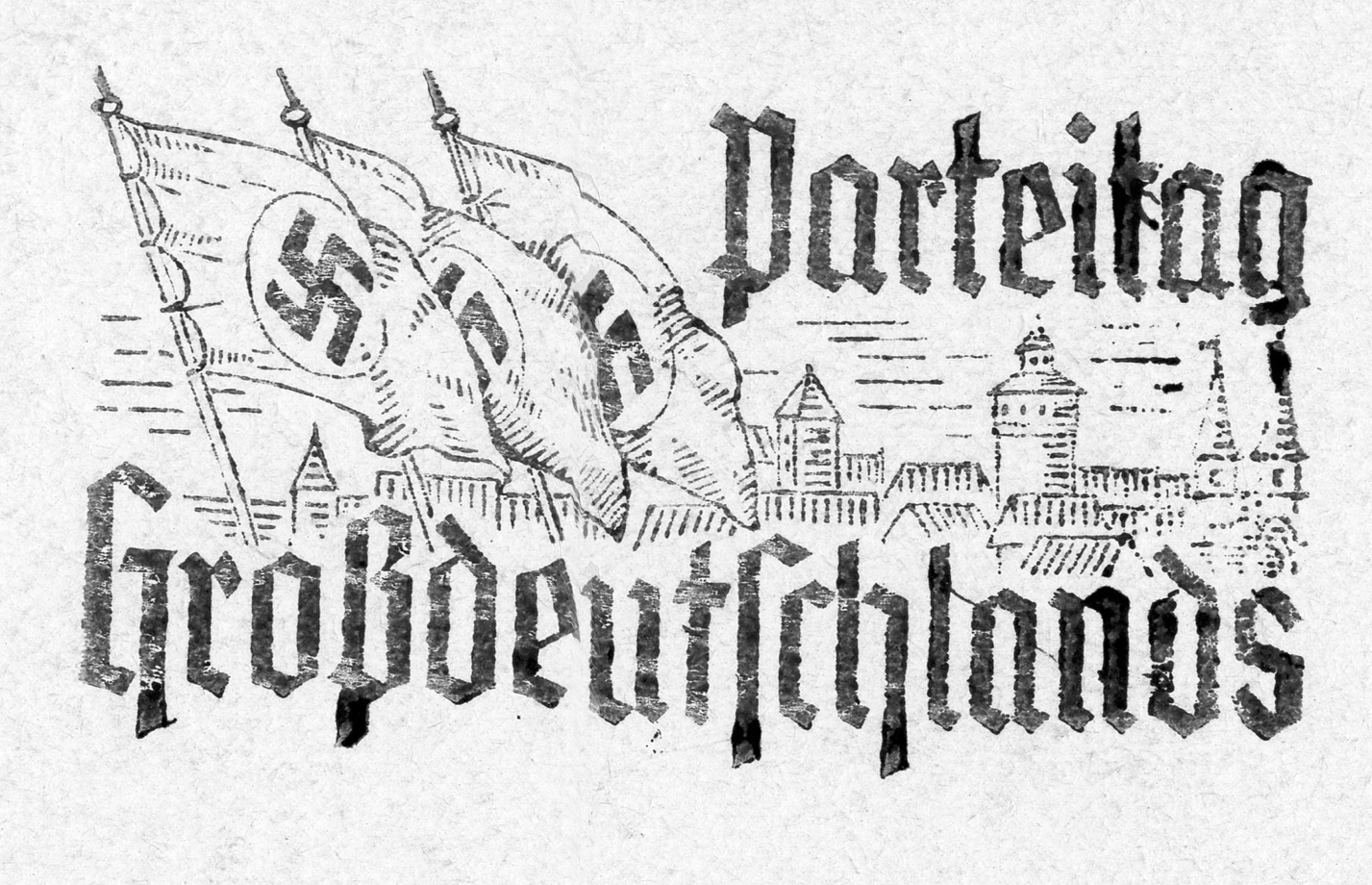
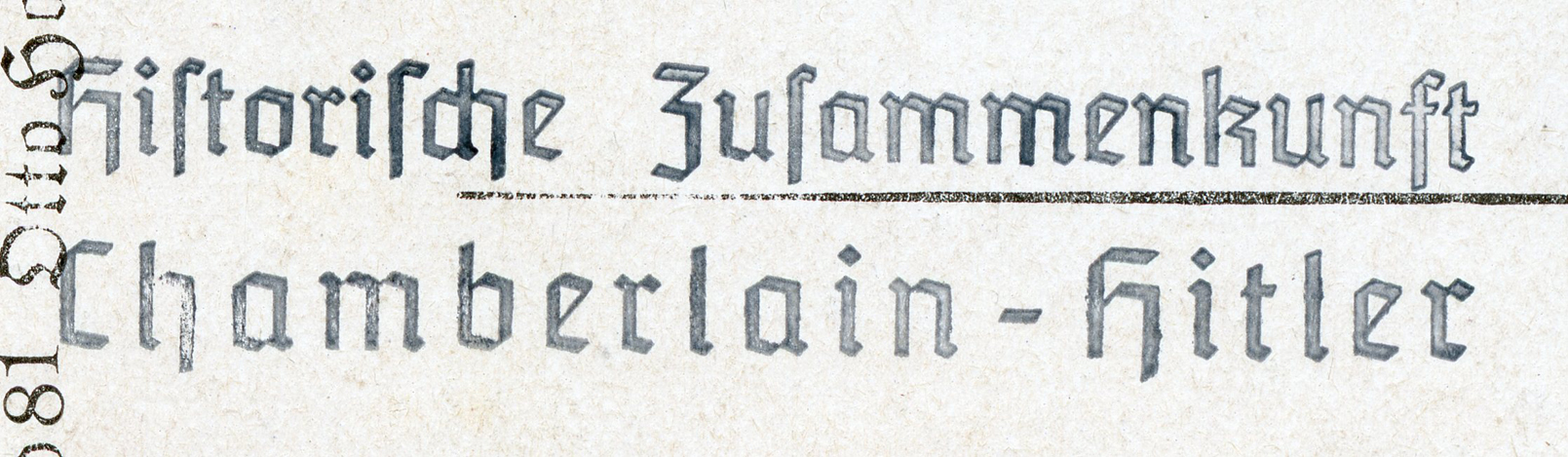
[Below: Close-up. This is a special postmark, it says: 'Historische Zusammenkunst Chamberlain - Hitler' (Historical collaboration Chamberlain - Hitler). Click to enlarge.]
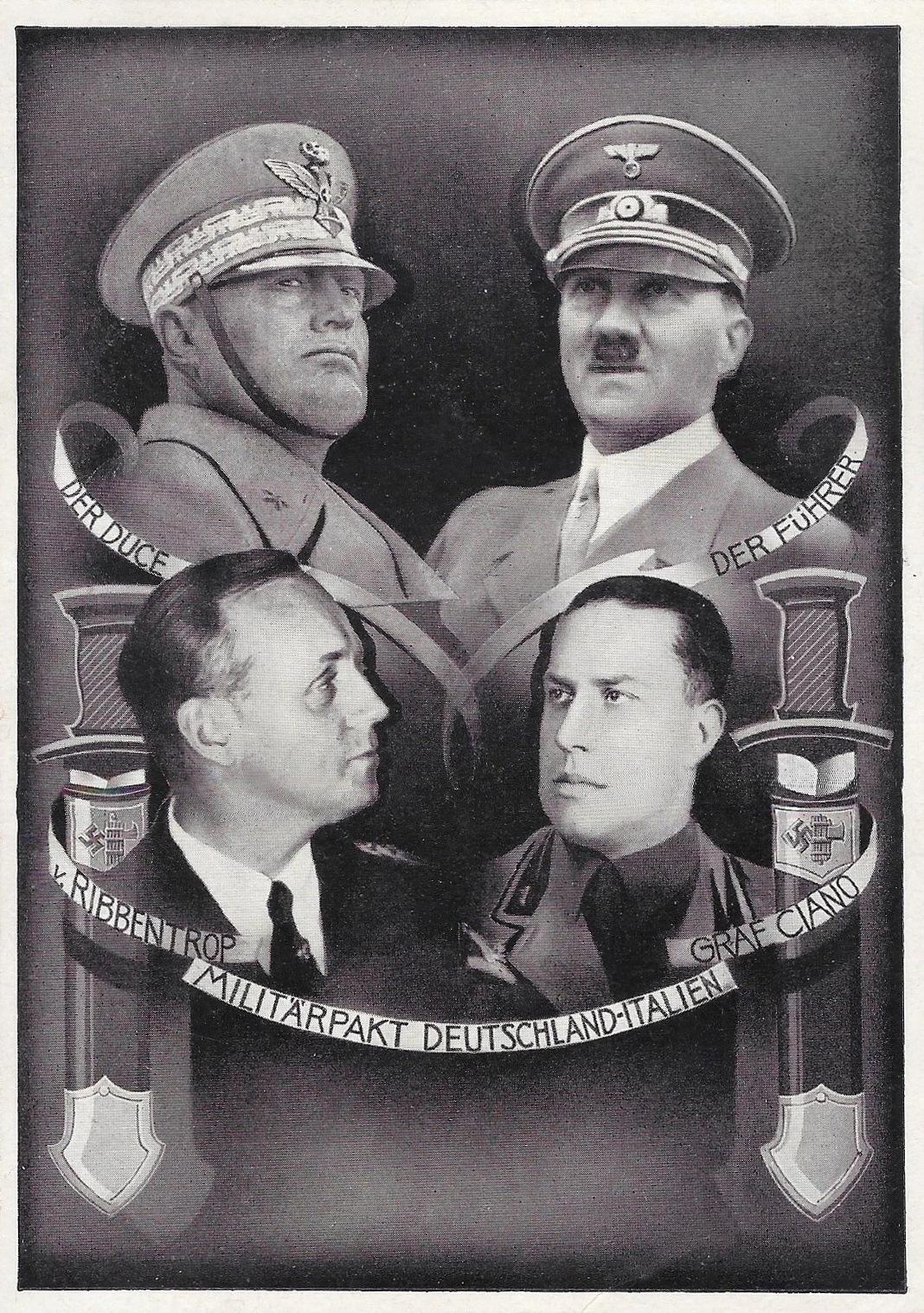
[Below: This postcard celebrates a military pact between Germany and Italy. The strange dagger shown here is a fantasy that never existed. Click to enlarge.]
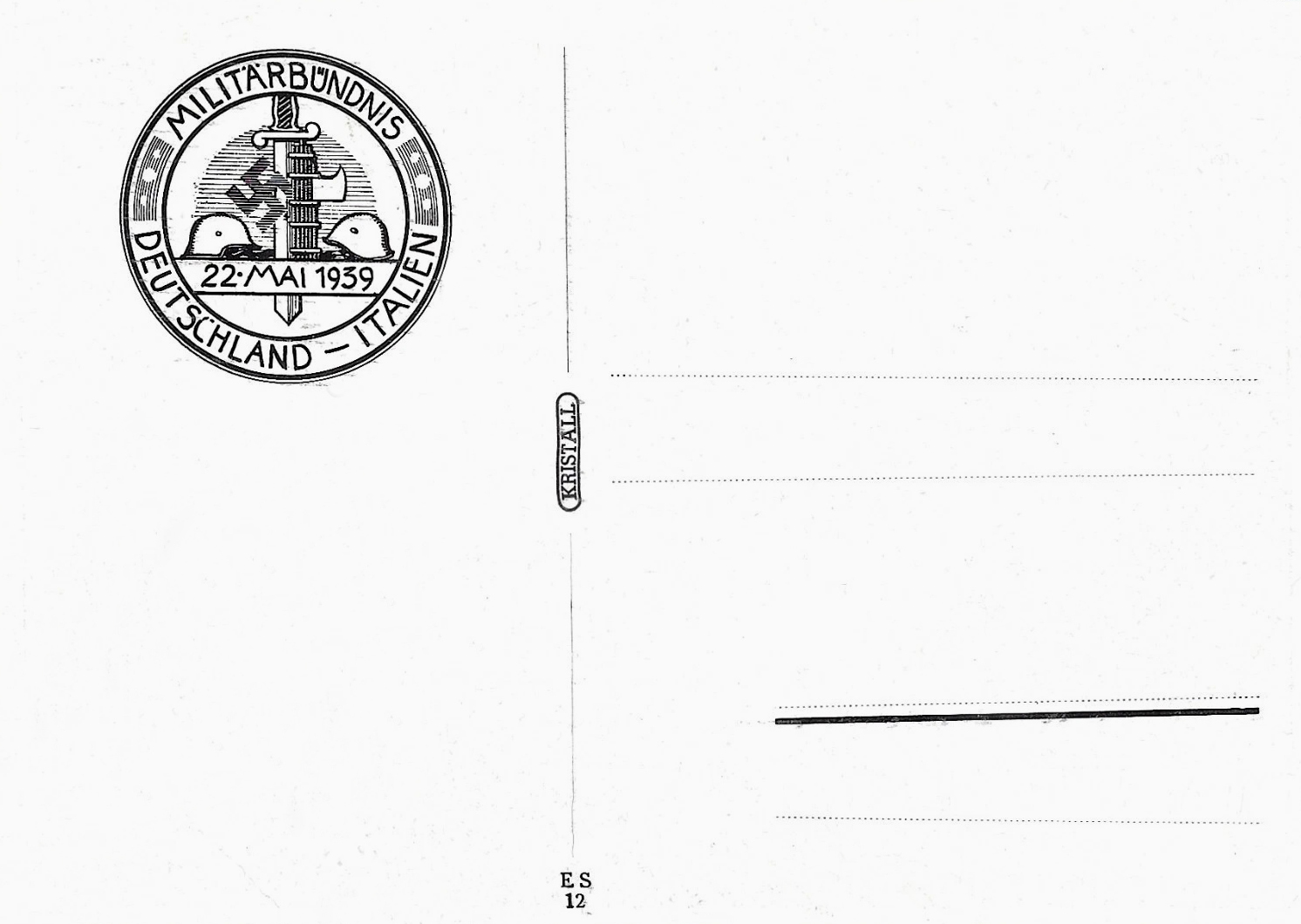
[Below: Reverse. Click to enlarge.]
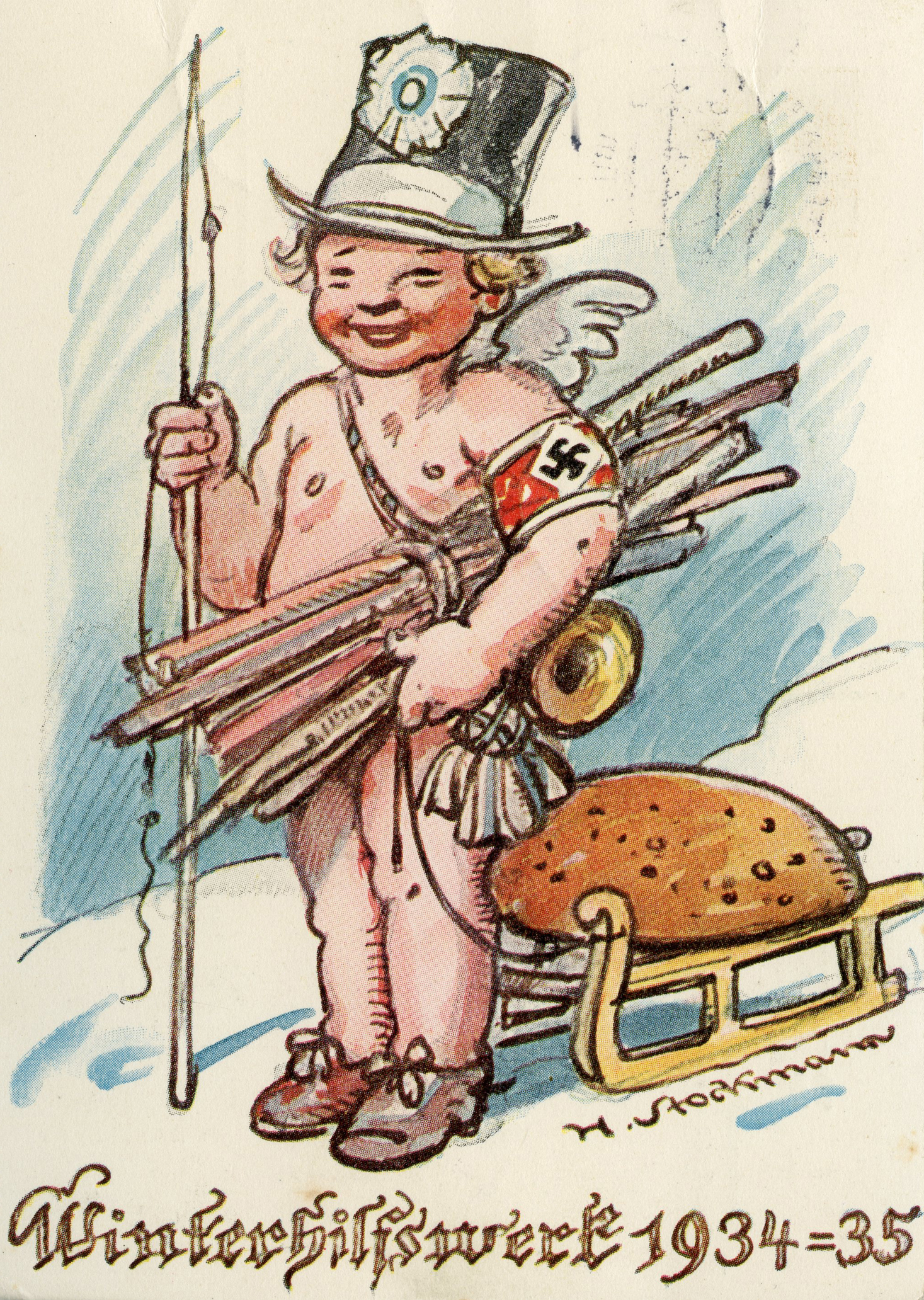
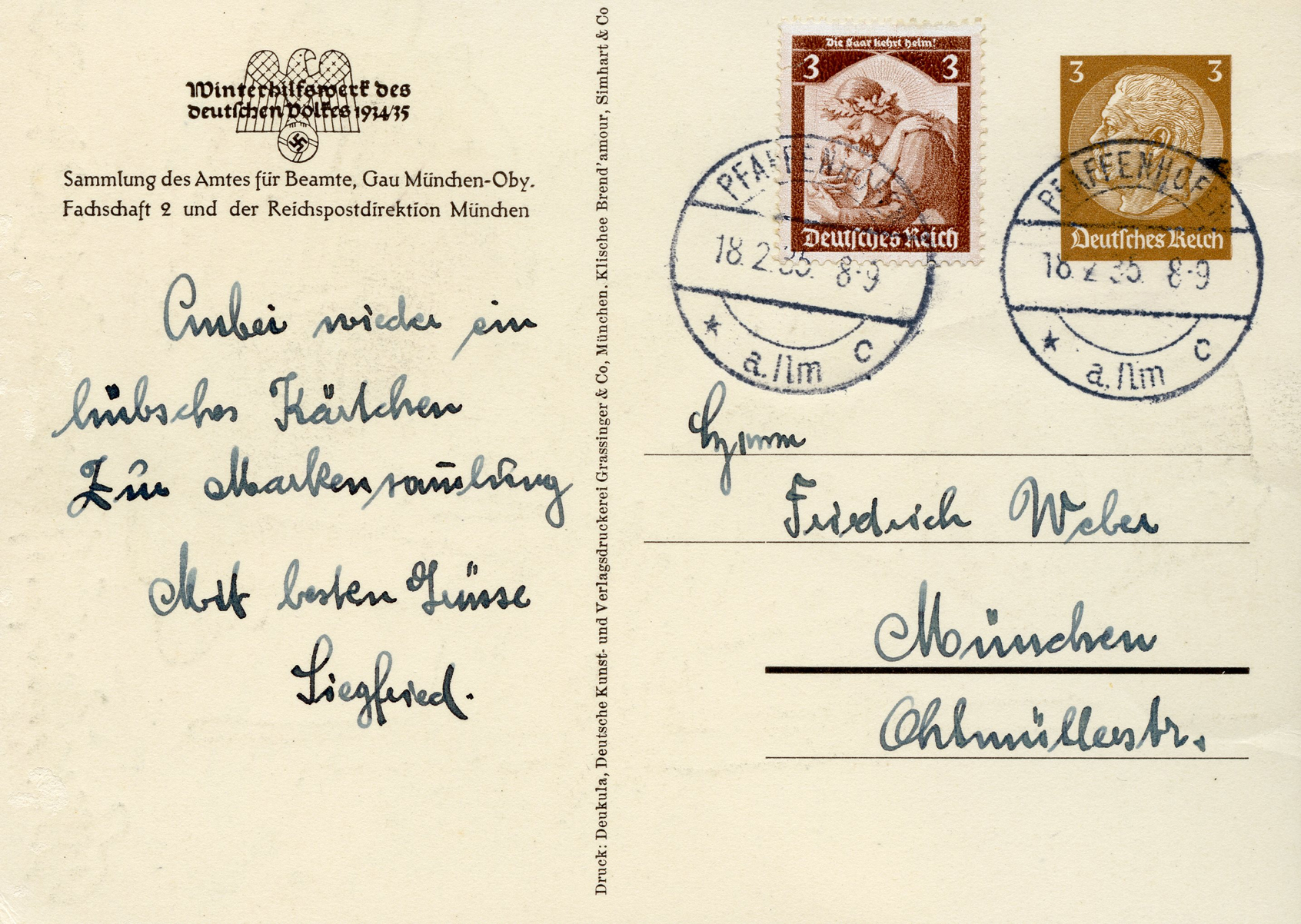
[Below: A 1934-35 donation postcard from the 'Winterhilfswerk des Deutschen Volkes' (Winter Relief of the German People) showing Baby New Year. Click to enlarge.]
[Below: This was canceled on February 18, 1935 in Pfaffenhofen (a municipality in Bavaria). Click to enlarge.]
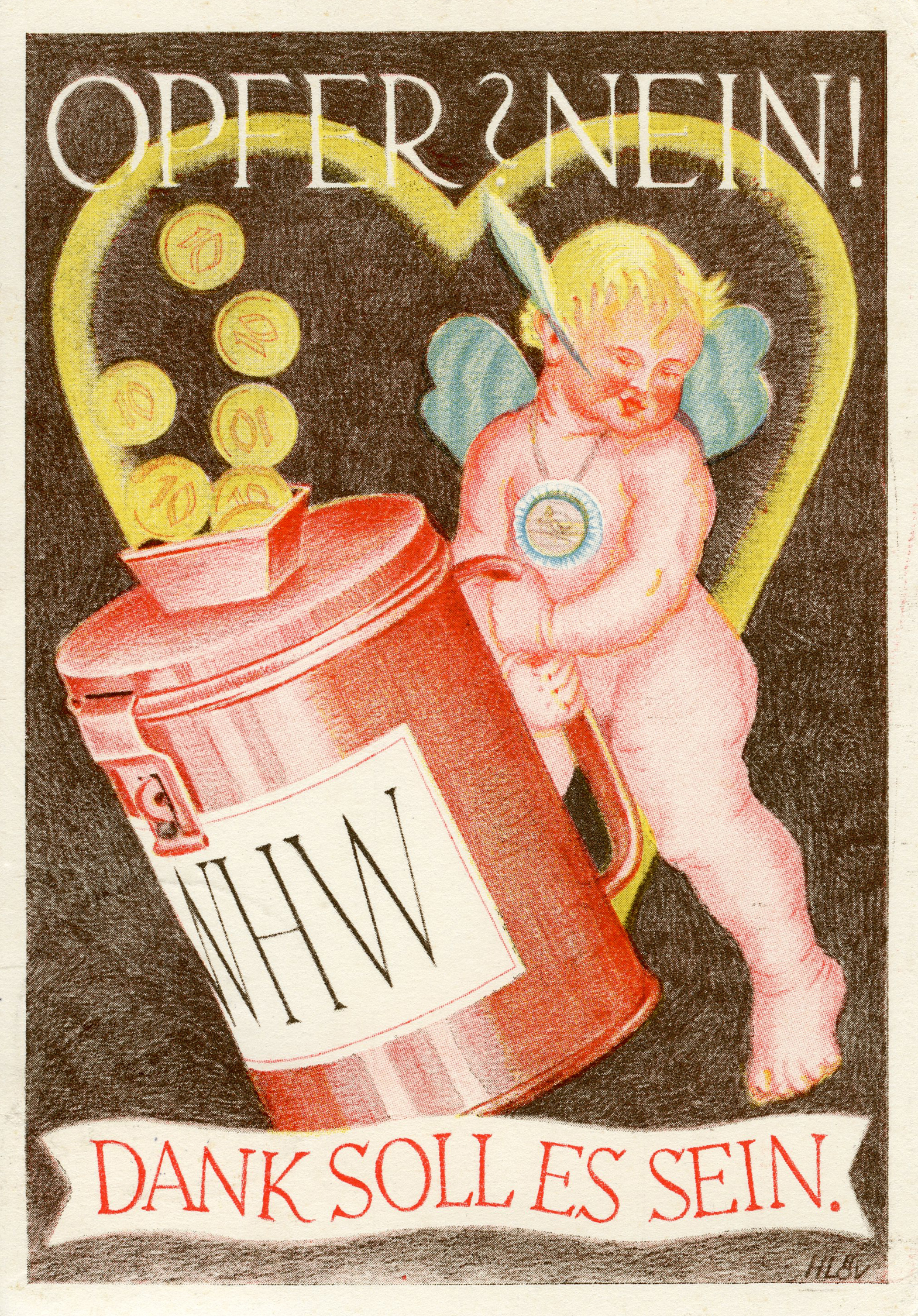
[Below: A 1938-39 donation postcard from the 'Winterhilfswerk des Deutschen Volkes' (Winter Relief of the German People). It says 'Opfer? Nein! Dank Soll Es Sein' (Sacrifice? No! It should be thanks). Click to enlarge.]
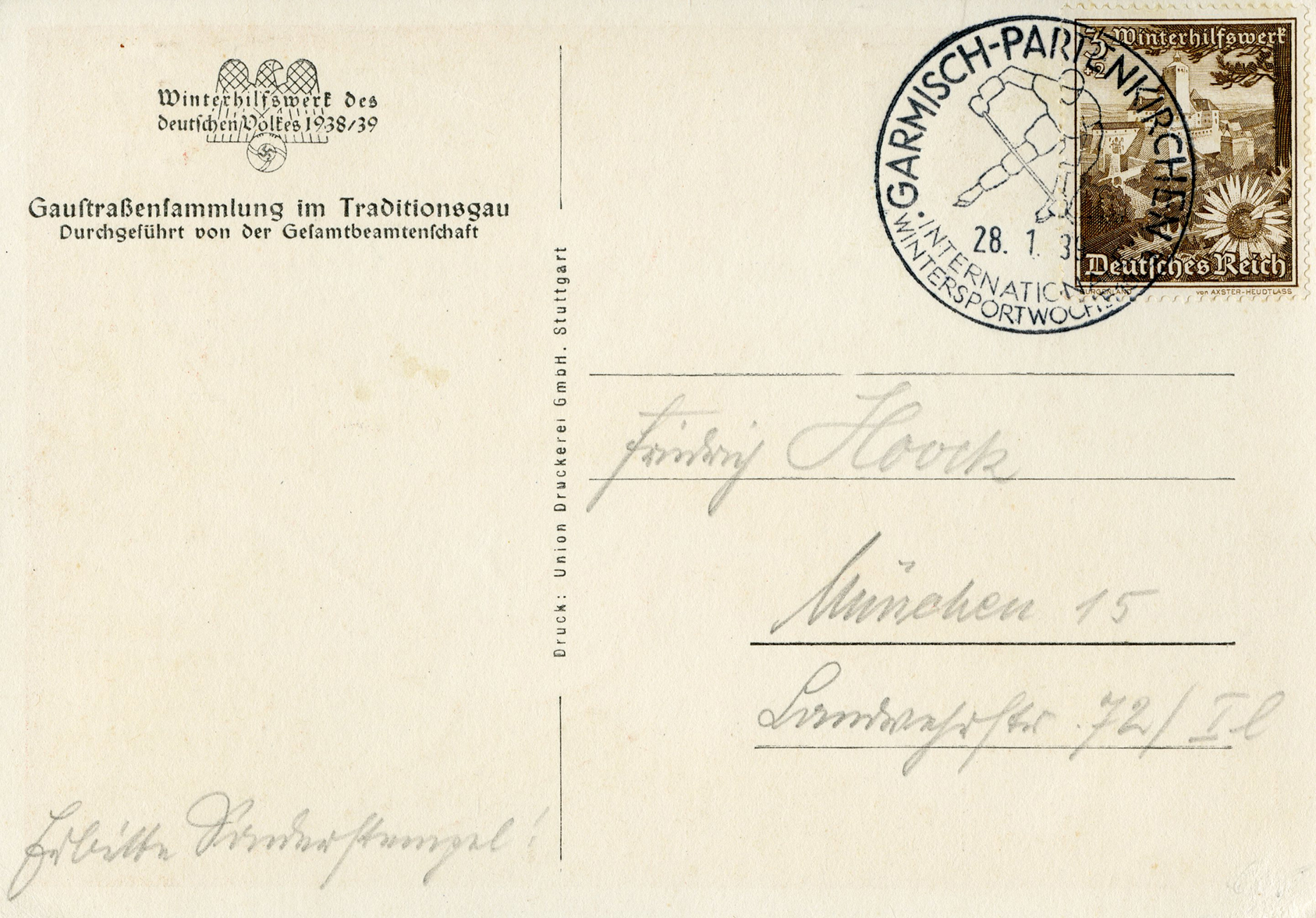
[Below: This was canceled on January 28, 1939 and says:
'Gaustraßenfammlung im Traditionsgau
Durchgeführt von der Gefamtbeamtenschaft.'
(Gau Street Collection in the Traditional Gau
Carried out by the Gau Officials)
Click to enlarge.]
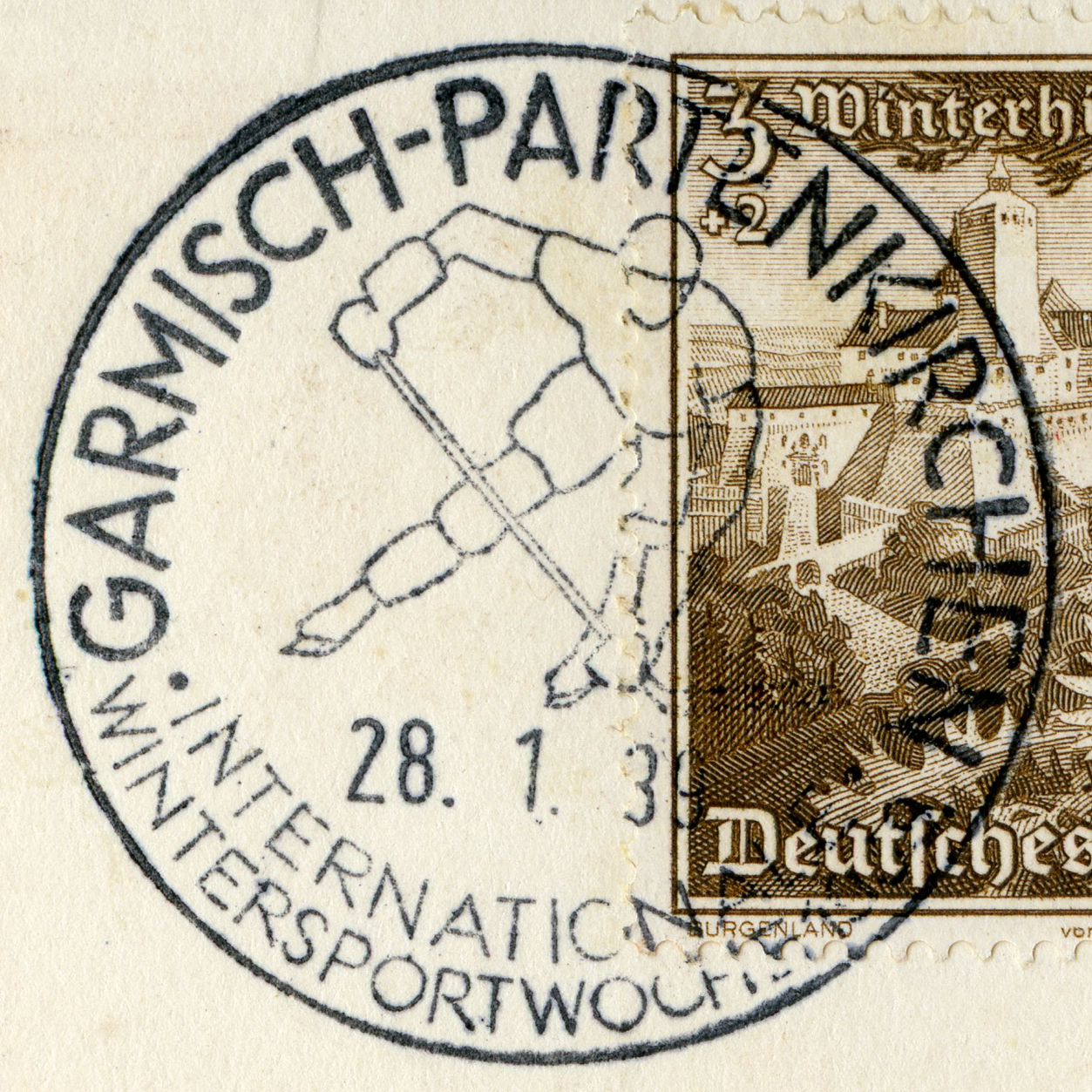
[Below: Close-up of interesting and uncommon hockey cancel. Click to enlarge.]
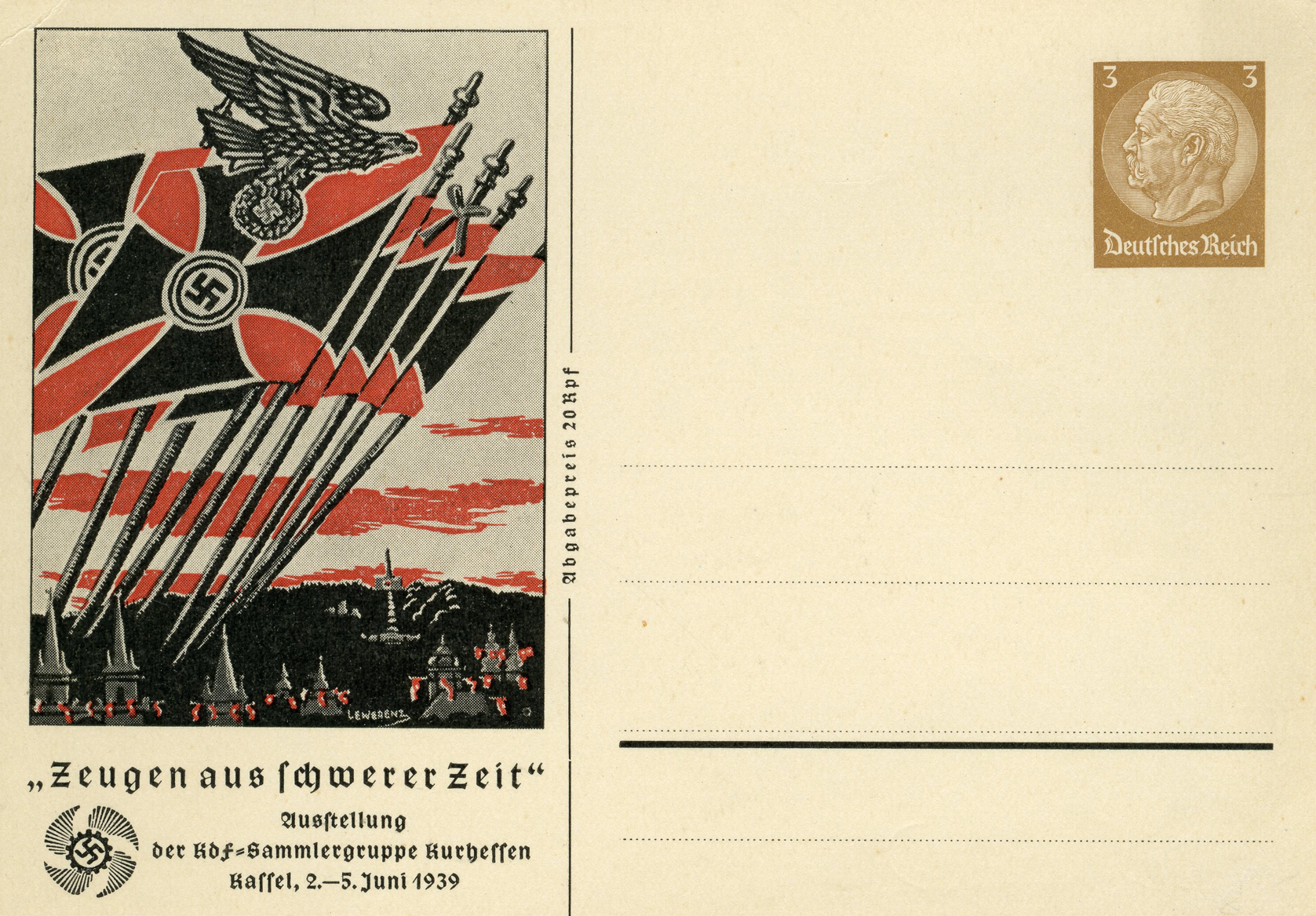
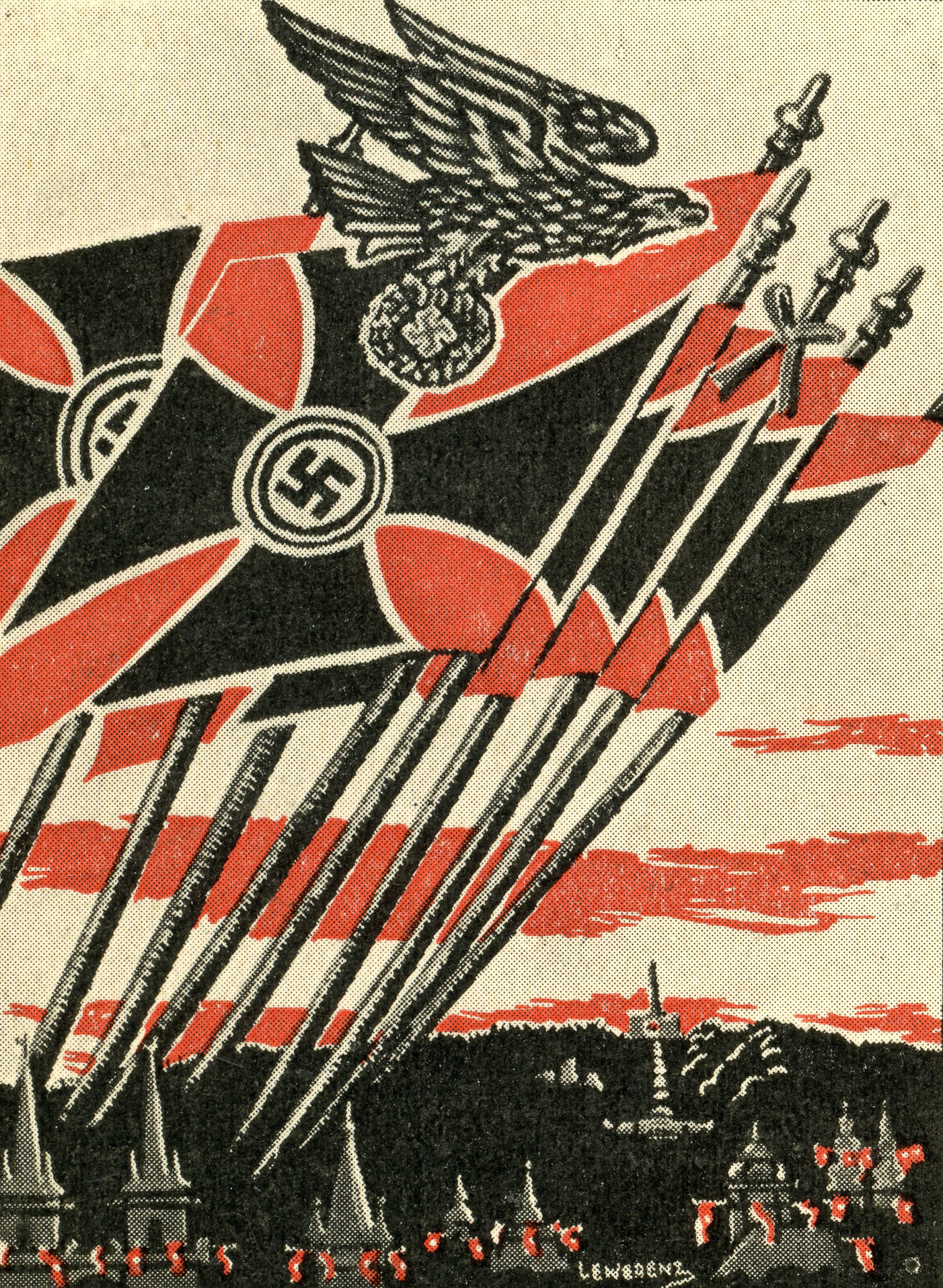
[Below: This is a neat-looking 'Kraft durch Freude' (Strength Through Joy) postcard. In case you don't know, anytime you see the swastika here with the cog wheel around it and the other swastika in the form of rays of light you know it is Strength Through Joy, or KdF for short. This says 'Zeugen aus Schwerer Zeit' (Witnesses from difficult times). Click to enlarge.]
[Below: Close-up. The reverse of this postcard is blank. Click to enlarge.]
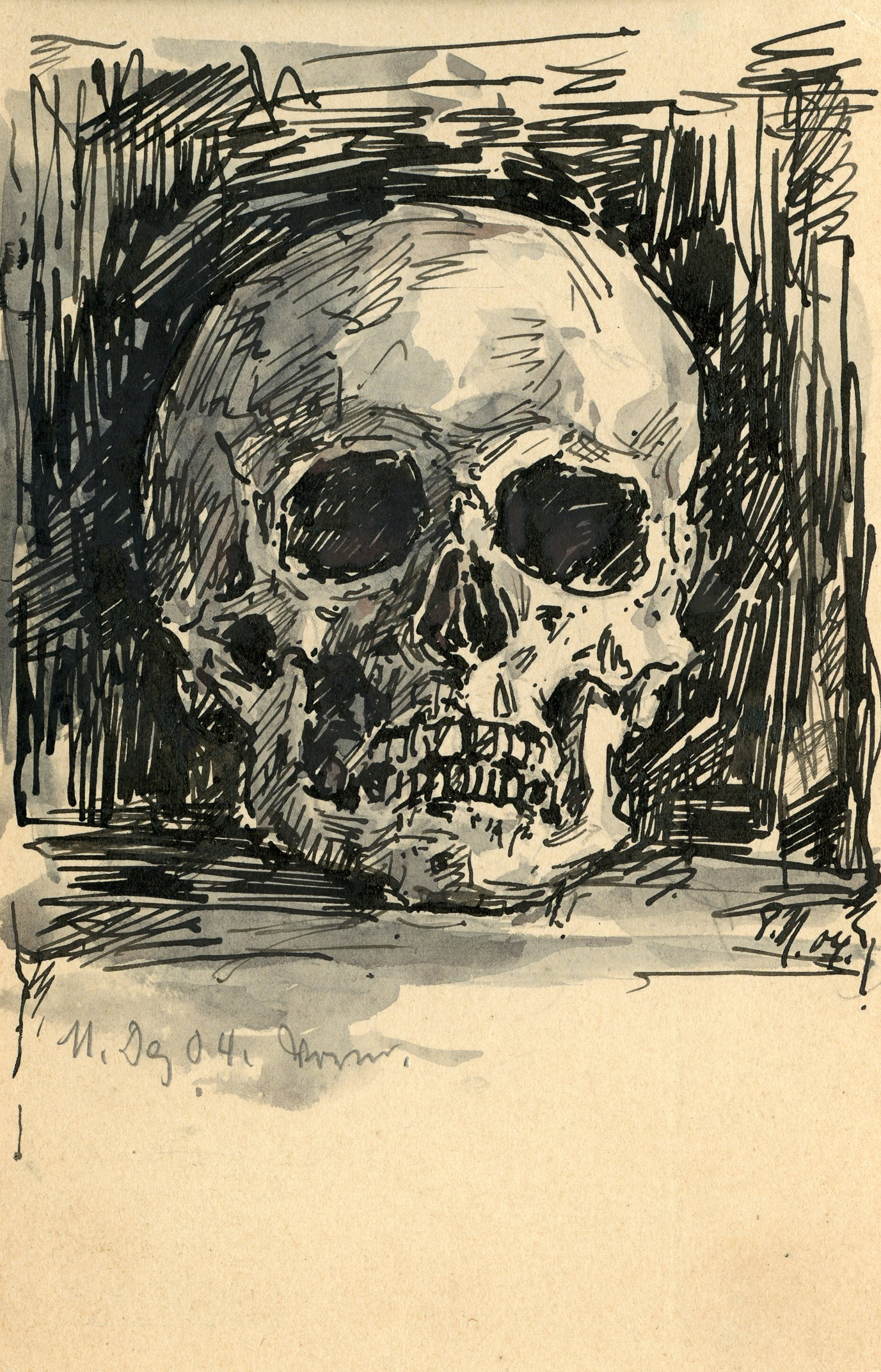
[Below: This is cool. It is hand-drawn and from the WWI era. Unfortunately the artist's name is unreadable. Click to enlarge.]
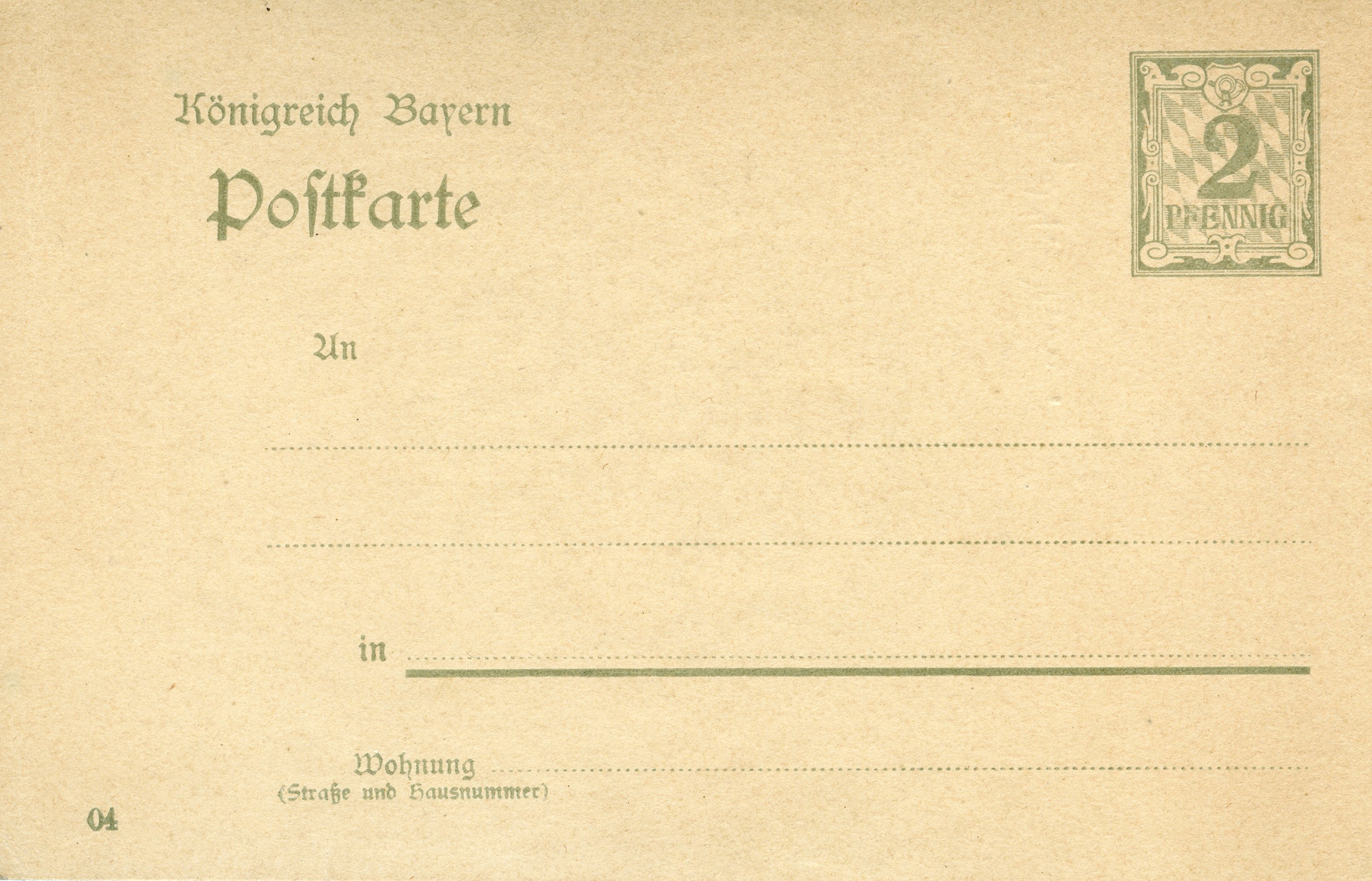
[Below: Reverse of postcard. This tells us that the postcard is from Bavaria (Bayern). Click to enlarge.]
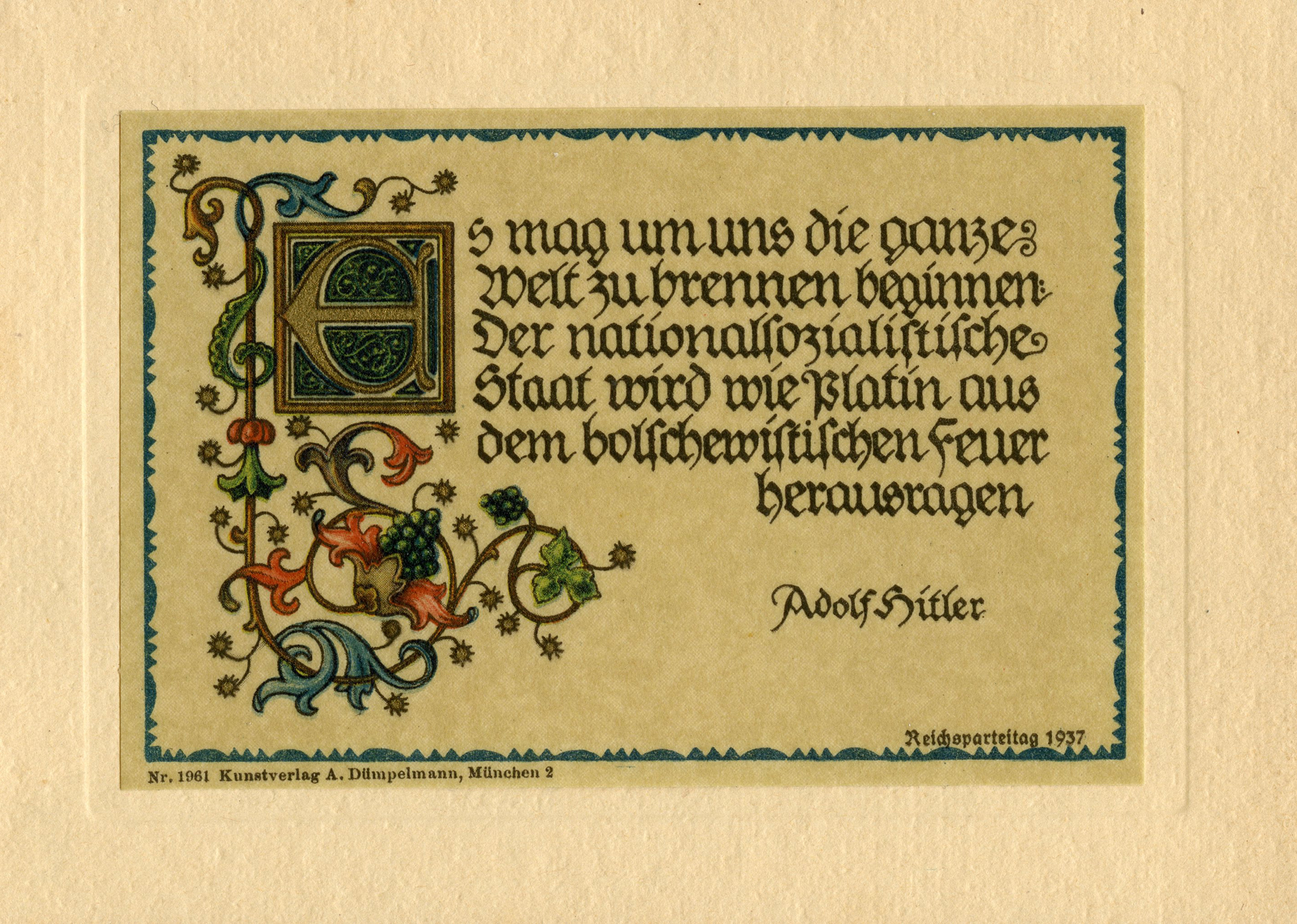
[Below: This type of postcard is rarely seen and is quite cool. The center of this is a silken fabric. It must have been expensive in its time (its expensive in our time too!). It says:
'Es um uns die ganze
Welt zu brennen beginnen:
Der nationalsozialistische
Staat wird wie platin aus
dem bolschewistischen feuer
herausragen'
Adolf Hitler
Reichsparteitag 1937'
(The whole
world will begin to burn:
The National Socialist
state will rise like platinum from
the Bolshevik fire
Adolf Hitler
Nuremberg Party Rally 1937).
How cool and relevant is that? Click to enlarge.]
[Below: Reverse of postcard. This tells us that the postcard is from Bavaria (Bayern). Click to enlarge.]
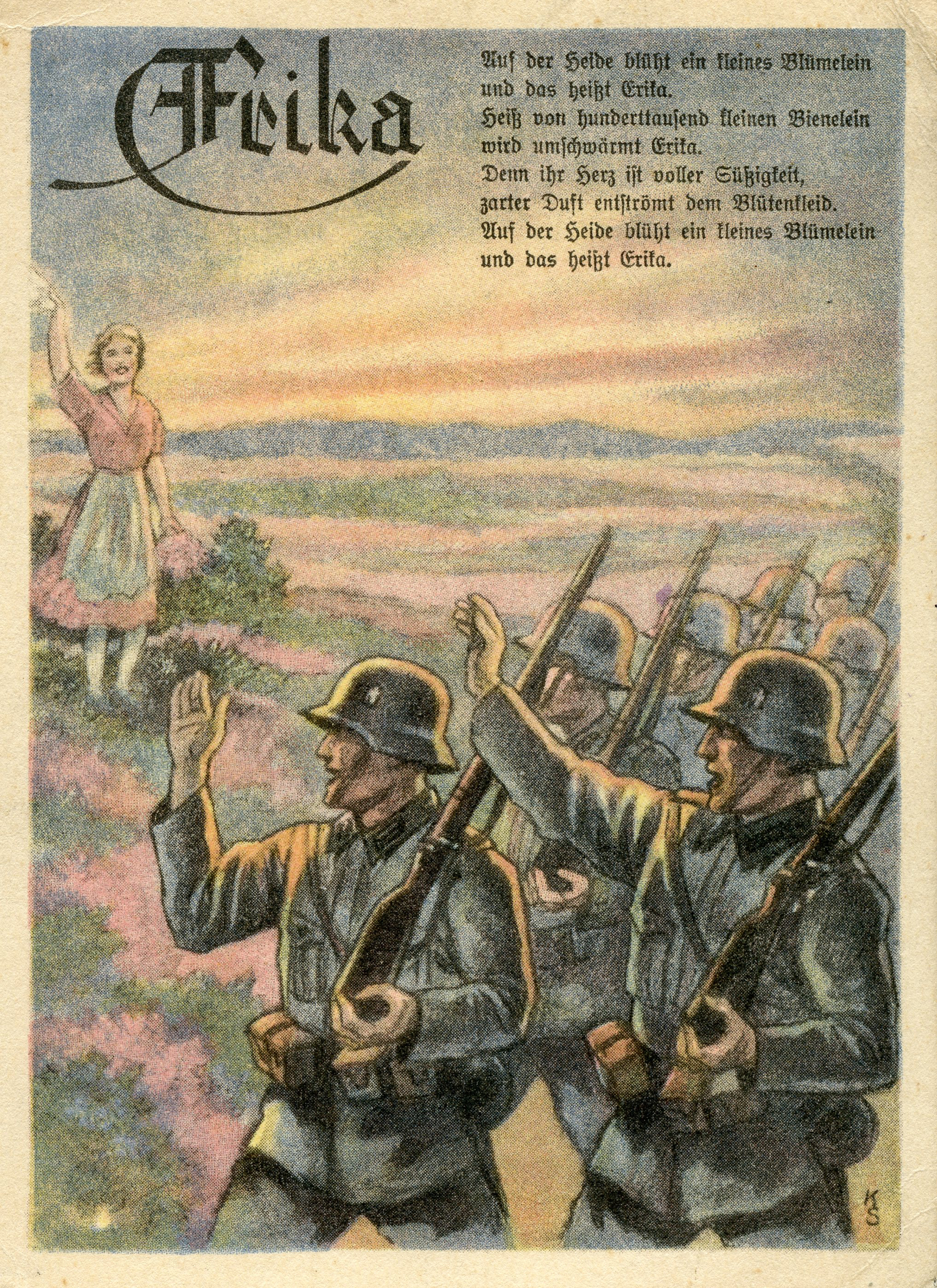
[Below: This postcard is fashioned after the famous German WWII song 'Erika' (a great song, by the way!). This shows part of the lyrics, below is the full lyrics:
'Auf der Heide blüht ein kleines Blümelein
Denn ihr Herz ist voller Süßigkeit,
In der Heimat wohnt ein kleines Mägdelein
Wenn das Heidekraut rot-lila blüht,
In mein'm Kämmerlein blüht auch ein Blümelein
Und dann ist es mir, als spräch' es laut:
English translation:
On the heath there blooms a little flower
For her heart is full of sweetness,
Back at home there lives a little maiden
When the heather blooms in a reddish purple,
In my room there also blooms a little flower
And then it seems to me, as if it's saying aloud:
Click to enlarge.]
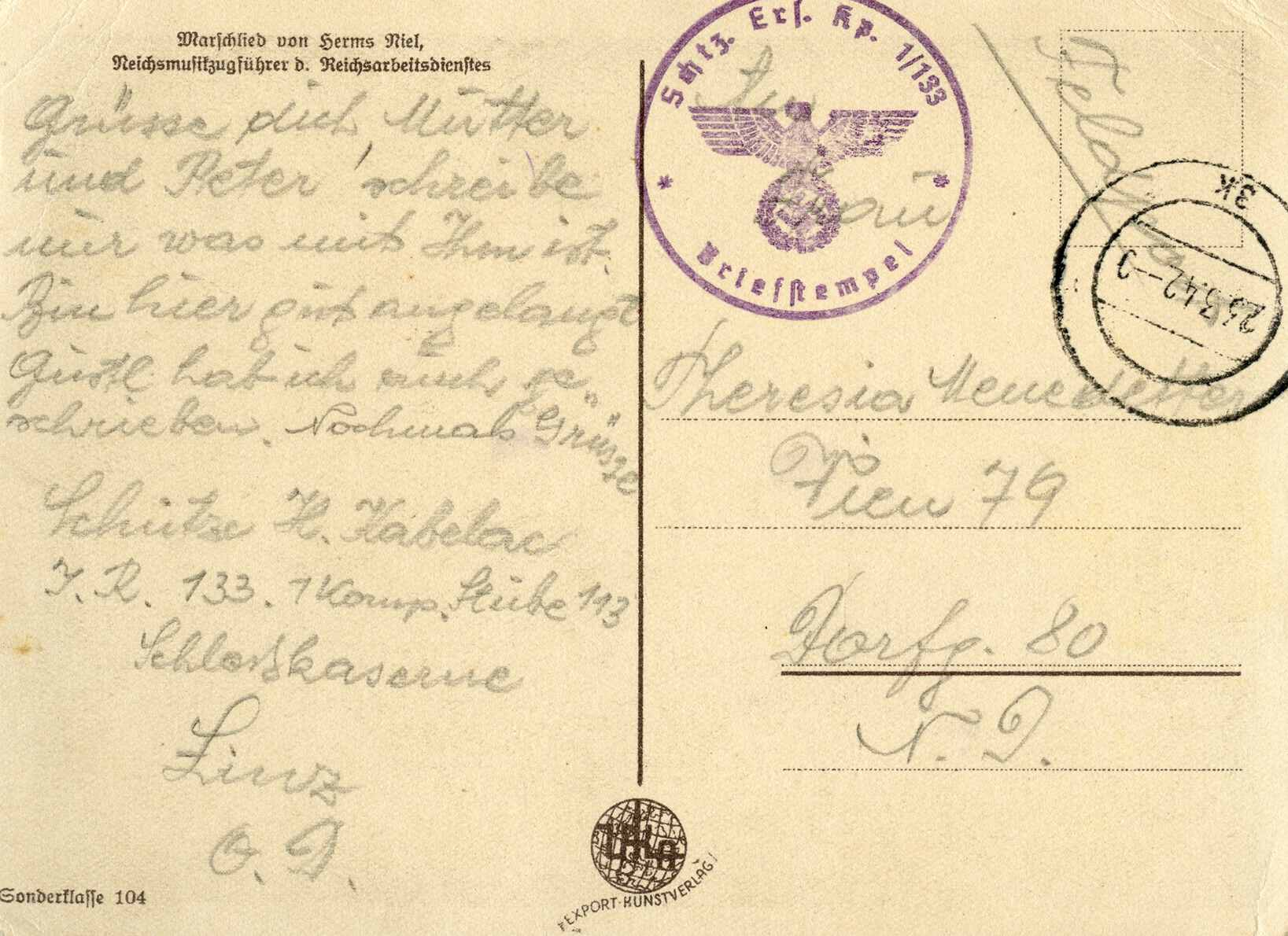
[Below: Reverse of postcard shows this was sent by a soldier through the Feldpost March 23, 1942. At the end of the soldier's message he writes 'Schlosskaserne' (Castle barracks). Click to enlarge.]
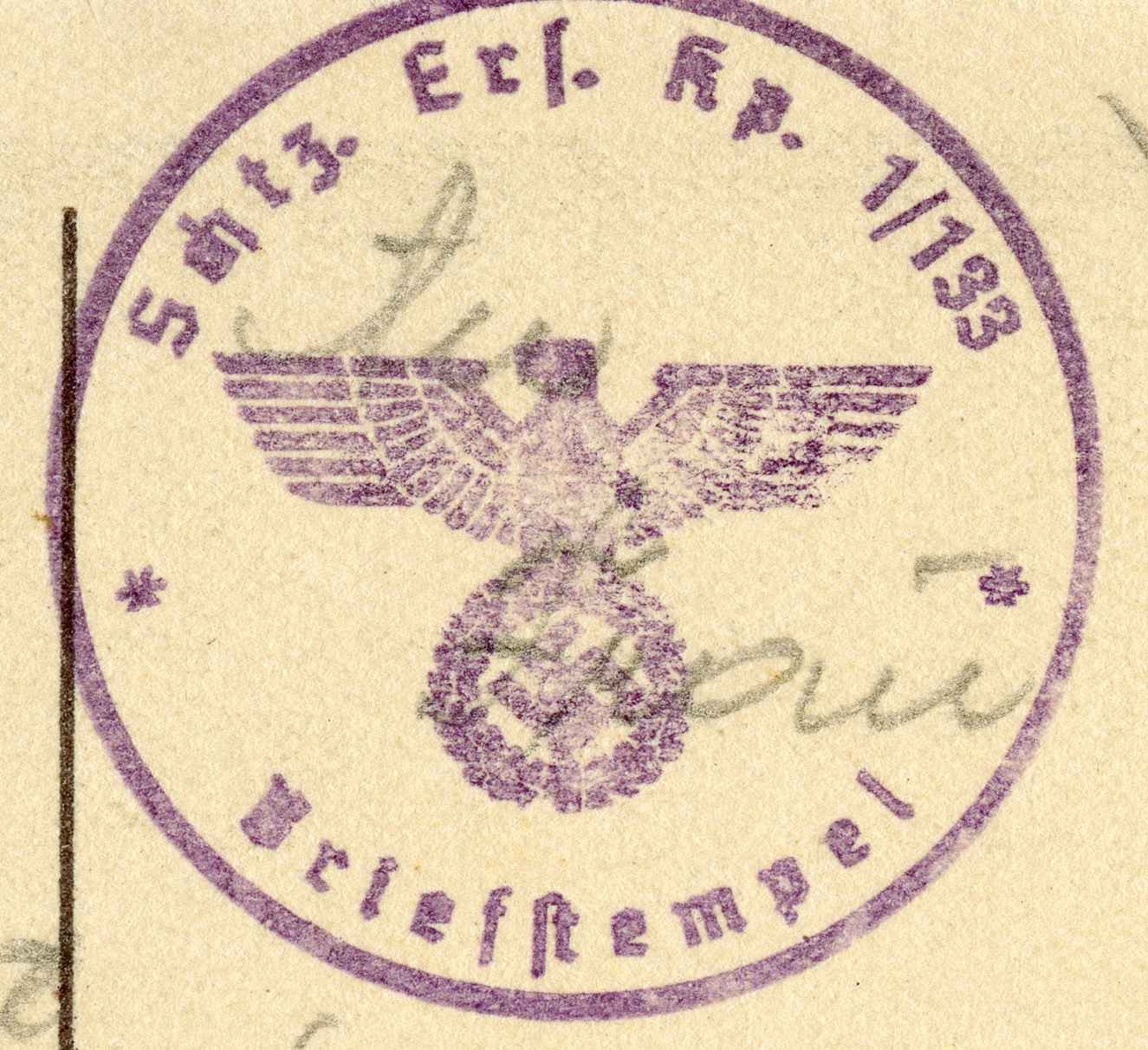
[Below: Close-up of ink stamp. Click to enlarge.]
und das heißt Erika!
Heiß von hunderttausend kleinen Bienelein
wird umschwärmt Erika!
zarter Duft entströmt dem Blütenkleid.
Auf der Heide blüht ein kleines Blümelein
und das heißt Erika!
und das heißt Erika!
Dieses Mädel ist mein treues Schätzelein
und mein Glück, Erika!
singe ich zum Gruß ihr dieses Lied.
Auf der Heide blüht ein kleines Blümelein
und das heißt: Erika!
und das heißt Erika!
Schon beim Morgengrau'n sowie beim Dämmerschein
schaut's mich an, Erika!
„Denkst du auch an deine kleine Braut?“
In der Heimat weint um dich ein Mägdelein
und das heißt Erika!'
and it's called Erika!
Eagerly a hundred thousand little bees
swarm around Erika!
a tender scent escapes her blossom-gown.
On the heath there blooms a little flower
and it's called Erika.
and she's called Erika!
That girl is my faithful little darling
and my joy, Erika!
I sing her this song in greeting.
On the heath there blooms a little flower
and she's called Erika!
and she's called Erika!
Already in the grey of dawn as it does at dusk
it looks at me, Erika!
"Are you thinking of your little bride?"
Back at home a maiden weeps for you
and she's called Erika!