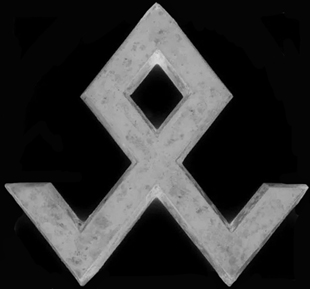
Interview with Johann Sepp K., member of 7th SS Mountain Division 'Prinz Eugen', Graz, Austria, 1989.
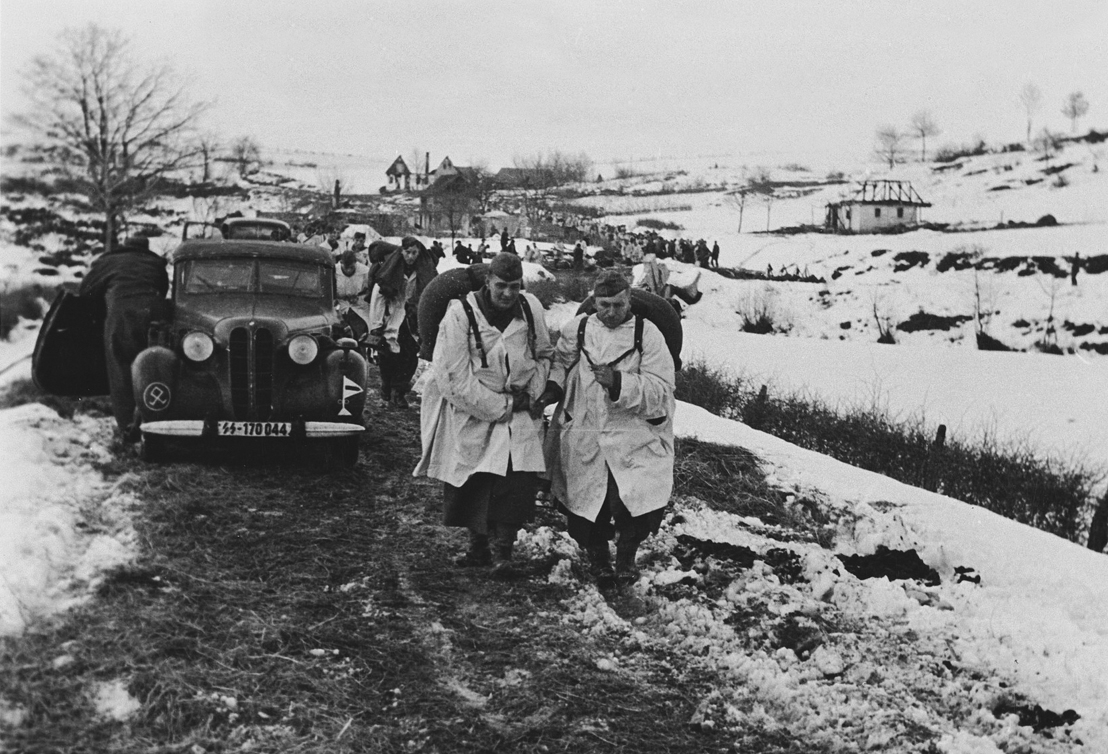
[Above: Soldiers of the 'Prinz Eugen' Division on a frozen road near the town of Grahowo, Croatia, March 1943. Note the Odal rune on the vehicle.]
I want to start by asking you what brought you to the Waffen-SS?
Sepp: That is a short explanation; I was drafted by the Germans to serve in this division. If I may, I would like to give you some history about the region and why I was drafted. This part of Europe has often been referred to as a powder keg. There are peoples who do not get along well with each other. The Serb does not like the Croat; the Bosnians dislike the Albanians, etc. Wars have separated the people.
When the Germans came into this region, it was due to Mussolini, and the threat of an English base as the Yugoslav government was friendly with the Russians and Allies. I was serving in the royal army at the time of the invasion, and there was a coup, which asked for German assistance. My garrison was put on alert, but surrendered as soon as the Germans entered our city.
We were held as prisoners for only a few days, then most all were sent home. Some native Serbs were held as they refused to agree to their paroles. I was from Ceminac, a German town in Croatia. I was considered Volksdeutsche and placed under German law. Part of that law was that I could be called up for Reich labor or military service.
Most of us wanted to be left alone, but as soon as the German army left the area and moved on to Greece problems started. This area was rife with hatred, and once one group lost power, another rose up. We started to hear of border clashes again, much like the 1920 war. Serbia was orthodox, and the other areas were a mix of Christian and Muslim which opposed the other.
The type of warfare the partisans launched was based on terror and assassinations of leaders, which prompted the Germans to create units to combat this rise of violence. Some areas exploded with attacks and reprisals that shocked us and some of the reprisals angered the Germans, who sent out orders for the militias to stop the executions they carried out.
This is what caused the creation of the Prinz Eugen Division. Named after a prince who stopped the Turks. When Germany went to war against Russia, it also triggered Serbs to launch attacks on German units. I received my notice to report for duty in late 1941; it was cold when training started. One reason I was drafted was that most all able-bodied men had already enlisted in German army or Croatian units to serve in the east. I was newly married since 1940, and did not want to leave my wife, who was expecting, but duty called.
What was your training like, and how did everyone get along?
Sepp: This new division was made up from men around the region; our general was Artur Phleps who was from Romania. We had men from every region and religion in our ranks, it was hard to decide what language to use, until the Germans insisted we all speak German since we were in the German SS. Training started right away with mountain climbing primarily, and we had to know the terrain in which we were going to fight.
Next was weapons training, which caused some consternation as we were given old, captured weapons. They handed out rifles, which were not practical for climbing. Our officers protested and in time, we received machine pistols, which were small and light weight. We even had a panzer regiment that had old out dated French tanks. While we were in training reports started to come through that partisans had killed the wife and child of a comrade who lived close to the Serbian border.
Our leaders met with us and explained the situation, that partisans had declared war, and would kill any family member of those helping the Germans. This made us angry, and I advised my wife to move to Zagreb with her family, it had a strong garrison for protection. Our training lasted a good part of 1942 but by the summer we were ready for action, other parts of our division had already had run ins with partisans earlier. With Czech machine guns, French tanks, and Russian and German machine pistols, we left for action.
What was your first action with Prinz Eugen?
Sepp: It was in October of '42, we were sent south to the border with Bulgaria as the Chetniks were causing trouble. They were a nationalist group who opposed German rule and were raiding towns and forcing men to join them. We worked with self-defense forces, the Bulgarian militia, and Croatian units to push them away. The hard part for us were the roads, which were nothing more than mountain paths many times. These early offensives showed what was lacking in our training and equipment.
They would take a village, fortify it, and wait for us to attack. Their weapons were old and worse than ours, some fought with swords and flintlocks. They were very good fighters, and after this offensive against them, many came to our side as the Germans promised them their own region free from interference, so they agreed to be our allies.
They helped us fight Greek communists who hid in the hills, and later on, Tito and his communist bands. After this offensive, we were kept in place to defend the area from any further attacks, and we kept being reinforced with new units and men. I want to tell you also that when we came into an area the relations with the civilians was generally very good. We would help the farmers harvest and plant when we could, our engineers would rebuild bridges and roads damaged by the partisans. We as a division received very few complaints, most were due to men trying to tempt the women or vice versa.
Did you have any interactions with General Phleps?
Sepp: Yes, he was always among us, and took an interest in our wellbeing. He was well-liked by all and had a very fatherly presence; his son was a doctor with the division. Like many SS officers he led from the front, he had a very bad habit of this, which got him captured by the Russians. They then murdered him.
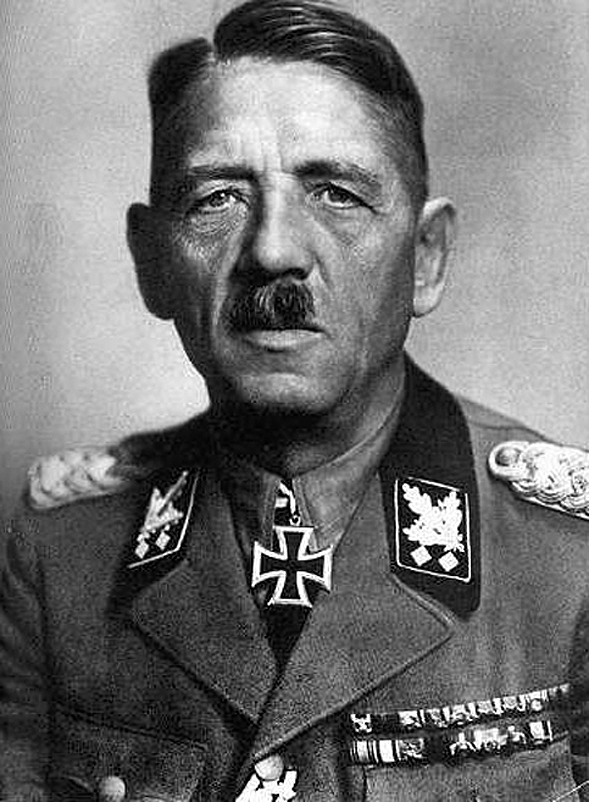
[Above: SS-Obergruppenführer und General der Waffen-SS Artur Gustav Martin Phleps (November 29, 1881 – September 21, 1944). A legend among his men, who called him 'Papa Phleps'. After being captured the communists murdered him on September 21, 1944.]
I would like to ask you a sensitive question, your division is accused of war crimes against the civilian population. You said to not believe any of these stories, why?
Sepp: It is simple, the victors of the war have gone to great lengths to formulate their stories, and put a lot of research and thought into what they accuse us of. Our defense is the civilians themselves. You can look at my photos and see the interactions we had with the civilians. Those who hated us fled to join the partisans; the vast majority left us alone and were not bothered. The amount of our soldiers who got into trouble sneaking off to woo the girls is testament of what went on. Some of those girls would later die at the hands of communists as punishment for collaboration.
I see in magazines and books more and more of these false stories of atrocities and terror supposedly visited on the Balkan peoples, I was there and saw nothing of the sort from German hands. There were times when communists were captured and executed for crimes, or sometimes their families would be captured and used as hostages to prevent the execution of an ally. Most of the time when we captured an enemy, even a partisan not in uniform, they were sent to a camp, whether man, woman or child. Often times we just exchanged prisoners to save our men from execution. Once I did see eight hostages shot in retaliation for the shooting of four of our men. These were partisans caught trying to blow up a bridge.
The fighting at times was very brutal, and the partisans would attack our weakest areas, and undefended men. I was part of a burial detail in Lav [Sarajevo, Bosnia and Herzegovina] cemetery where three of our men had been invited to a dinner, and went out of town to gather flowers for the women. They were attacked and killed in a supposed safe area, they were tortured before being killed, one had eyes missing, the other no tongue. The oldest was 22 and had a wife with a new baby like me.
As retaliation, an officer of Tito that was captured by the Chetniks, was publicly executed. This is the truth of how this war was fought in this area. Our enemy was cruel and fiendish, going out of their way to target family, friends, and supporters of anyone who was fighting against them. They used children in their ranks, training them as early as ten years old. Can you imagine having a child firing a very real weapon at you? Some men could not believe it and paid with their lives as they refused to fire on them.
I will add also that these bands were very well financed and supplied. They had heavy weapons from Russia, explosives from the western Allies, and aircraft to aid them. My division became better and better at fighting them, even though many times we were outgunned. We had more men, but at first, they had much better firepower. Please do not believe the lies the communists tell about us, they were the butchers, who turned our legal reprisals into crimes.
You were involved in the fight with [Josip] Tito in 1944, what was that like for you?
Sepp: Yes, Prinz Eugen was used as a support force for SS paratroopers that landed right in the town of Drvar [Bosnia and Herzegovina] where Tito had moved his camp into caves. I will give you the history of this, all of 1943 was spent fighting small, loose bands of partisans and destroying them. We had many allies now, and due to the brutal way the communists fought, many men who sat on the fence came to us. Our division had great success and the first Knight's Crosses were won.
We pushed the communists into small enclaves to keep them contained so they would not threaten our lines of supply. In May it was decided a final blow would be launched against the only group which still remained in the area, there were still more on the Italian and Greek borders, but in the Balkan area Tito was it. We started this offensive by using roads as lines of attack; we had the Luftwaffe, which was a rare sight to help scout and attack. We thought the going would be quick, but they mined the roads.
Tito had placed his units in blocking positions as he knew we were coming, the Führer unfortunately had traitors in his circle who fed the Russians information, who relayed it to Tito. The paratroopers landed right in the heart of the beast, and paid heavily. Our columns moved slowly but steady, the roadblocks and ambushes were brushed aside, as we anticipated these and moved around to cut off retreats. Our advance was slowed, and partisans would take pot shots at us and run away to hide, but allied militia tracked them and killed them. We had new sharpshooters who moved on our flanks, in the woods.
I saw close combat during these days, we would launch attacks on bunkers and trenches, jumping in and shooting anything that moved. A partisan jumped me from the back while clearing a trench, lucky for me the shovel hit my helmet and glanced off my leather straps. A comrade cut him down with a Russian PPSH [PPSh-41 submachine gun] he had captured. A few of the dead included women fighters, which was always hard to see.
This operation was overall a success as it drove Tito away and forced him to the coast where the Allies gave him help with aircraft attacks on us, and their navy took his men to Italy. We had broken his back in the Balkans, however this success was short lived as that fall the Red Army broke through and came up from Bulgaria. This caused our entire southern front to panic and retreat. For a few months after May '44, the people of the region had peace however.
Historians say this operation was a failure but we killed or captured a large amount of partisans and broke their power bases, even chasing their Allied handlers away. What makes it appear to be a failure is that by now the Allies had a hold in Italy and could launch air attacks on this area with no resistance. The partisans were largely gone, but the Allies could take over the battle. Then in the fall, the Red Army came. This was the beginning of a very dark period for the Balkans, which remains even today.
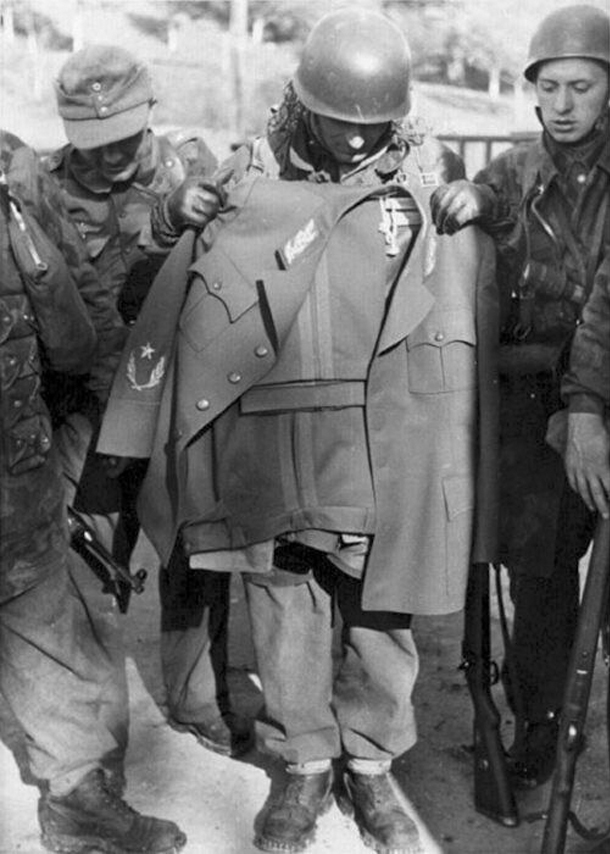
[Above: German paratroopers hold up Josip Tito's captured uniform during the Operation Rösselsprung, the mission to capture or kill him from May 25–27, 1944. The communist monster Tito was tipped off and ran like the coward he was before the German paratroopers arrived.]
What happened at the end of the war?
Sepp: After the attack on Tito, we settled into small camps to protect areas we recently freed. Our units would go on small search and destroy missions against very small, unorganized partisan units, as I mentioned their strength had been broken. This went on until September when the Russians were breaching the borders at many points. They forced former allies to join against us by now; it was either fight or die.
Our mission was to hold the Russians as best we could, hitting them with the same tactics the partisans used on us. Men from all over the region and all ages joined us to stop them, but we could not match their strength. They had tank armies, aircraft, and unlimited artillery. In December, a rocket salvo caught me in the open and put a splinter in my liver. I was sent to Austria to recover. For me the war was over. My wife fled to Austria also but witnessed the beginning of the attacks on civilians by partisans. She was walking with a group through Slovenia when communist partisans set upon the group.
She was clever in telling them her home was burned down by the Germans and she was only looking for food and shelter. She did not tell anyone her man was in the SS. Others spoke openly, and when people were asked if anyone was related to Germans, they pointed this out. Those people were pulled out, raped, shot, beaten, or all three. She could never forget the screams.
If you want to know what the real crimes were in this war, it was here. It was what the communists and their helpers did that have stained the land with the blood of innocents. This scene happened all over, Volksdeutsche were uprooted from established farms and towns, forced to flee with only the clothes on their backs. Many were raped and shot. Recently a mass grave was discovered, the TV reported it may be Jews or those killed by the Germans. When it was discovered it contained hundreds of Germans who were killed, it was dropped like a hot potato.
Anyone who was friendly with German soldiers was pulled out of their home and beaten by mobs of communists who flooded into the area. The southern front was evacuated, allowing several hundred thousand Wehrmacht units and civilians to flee north. I was still in a hospital bed when Americans came in and took control of the hospital. They saw I was in the Waffen-SS and interrogated me heavily, but with compassion. When I was well enough to walk again I was discharged and sent home.
It was interesting that the Americans found no evidence of war crimes but the communists went out of their way to lie and exaggerate to try to force former enemies to be sent to them. I was lucky as the Americans refused to do this after they saw what was happening. The Totenkopf Division was sent back, and both the Americans and Russians shot down some of the men. I believe this made some [American] soldiers see this was not right so they started to have sympathy.
We started to search out friends in 1946, and learned so many people we knew had perished. In one town the partisans came to, they lined up anyone who had a son in the German armed forces, shot them all, and drove vehicles over them to ensure they were dead.
This is why they fight tooth and nail to keep their version of the war going and blame the Germans for all the crimes. They do not want their crimes to be seen, as they cannot defend what they did, mainly to innocent civilians whose only crime was being of German decent, or believing in a better world led by German rule.
Back to Interviews