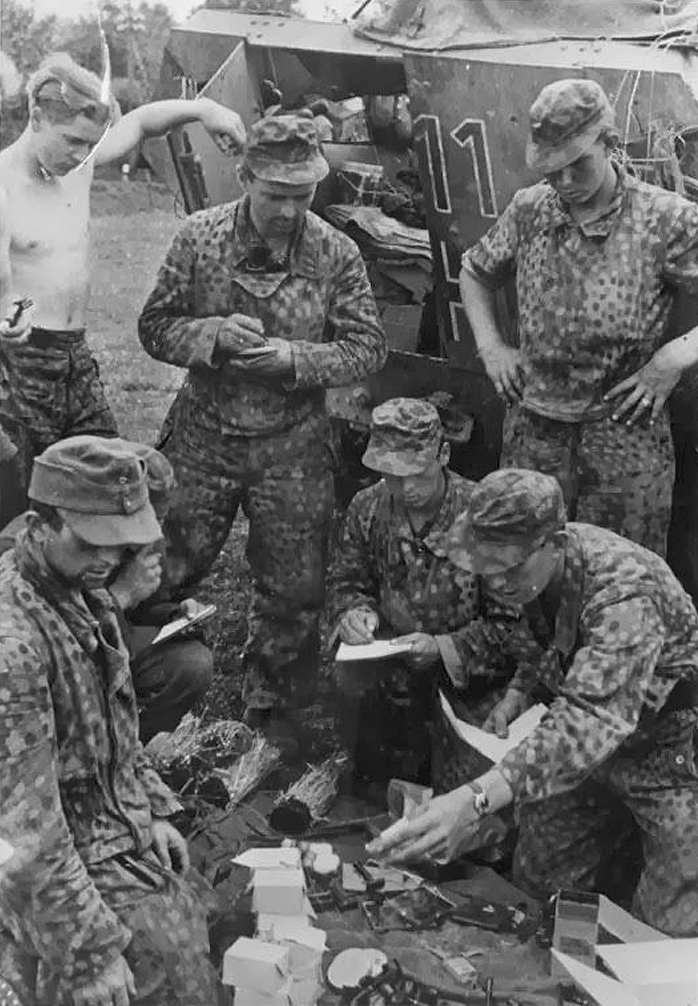
Interview with Karl, tank hunter with 'Hohenstaufen' Division, Columbus, Ohio, 1995.
[Above: Three selfless warriors from Hohenstaufen.]
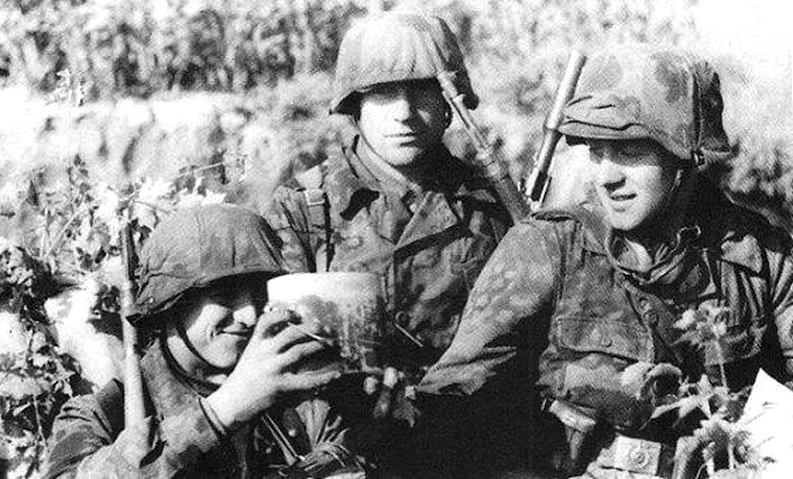

Interview with Karl, tank hunter with 'Hohenstaufen' Division, Columbus, Ohio, 1995.
[Above: Three selfless warriors from Hohenstaufen.]
Karl: Yes, I will tell you how I began. Like many young Germans of the time, I was drafted into the Luftwaffe in 1940, January to be exact. This was due to serving my time from '35 to '38. I was trained as a bomb loader on the He 111 bomber. I came to the field in August 1940, just in time for the battle of Britain. I was with bomber squadron 1 [Kampfgeschwader 1 (KG 1)] through the battle, and in 1941 we were sent to help in the Russian offensive. When war began in the east my squadron was tasked with supporting Army Group North. We had a hand in keeping pockets going during the Russian winter of 41/42. How I came to the Waffen-SS was in late 1943 our squadrons were depleted and for the ground crews there was not much to do. Rumors were we might be going into new ground units Göring was building. We also were visited by recruiters of the SS who told us they were very organized, and had many chances for promotion. I liked that idea so you could say I was allowed to volunteer, but I am sure they were there to gently tell us we had to choose one or the other. I chose to go into the tank hunters as it meant not marching, and offered some luxuries.
Since I had prior service I only went through a short SS training class and was then sent on to weapons school to learn tank hunting tactics. SS schools were odd in that we had to attend courses for everything from weapons, tactics, and even learning how engines work, so if we were stuck we could repair something.
After all this I was sent into the SS-Panzerjäger-Abteilung 9 [9th SS Panzer Tank Destroyer Battalion] and we were told by our commander, Wihelm Bittrich, we were deploying to Russia. So that is how I came to be in the Waffen-SS.
Can I ask about what it was like during the Battle of Britain?
Karl: Yes, we were stationed by Amiens which was a lovely town. I remember being very busy day and night with loading the bombers. We would work shifts, and the bomber crews had to rotate, but we still had to work. I remember that we had a pastime where we would draw on the bombs, it is called 'gallows humor'.
We had a good commander and we would be given weekend passes to go enjoy France or some who lived in the west of Germany could even go home. I remember we had several flak units around the area; the British would try to hit our field but often hit the towns. My time in France was very pleasant; my wife would come to visit and we celebrated our 5 year anniversary on the coast in a nice hotel. My comrades sent along very good champagne, wine, and cheese for us.
I can tell you something too, we had some ex-French prisoners who came to work in our workshops to repair the planes and keep them ready for action. You would think the base would be all German, but there were also many French girls who were brought in to help cook, clean, and be secretaries.
To some of the men's disdain it was forbidden to have any relationships with them. Our commander did not want it to seem like we were taking advantage of them. I had a comrade who got into trouble because he tried to court one who had a fiancé and he was reassigned for not following orders.
I remember the losses as well, we each had our planes and when they were lost it was hard on us, there would be replacements but you became close with the crew. I knew a gunner who had taken photos over London in one of the raids and he had a good Leica camera. The photos were sharp and it showed the city well.
He fell when his group was attacked by several fighters and shot down; the battle was very hard for us. It is not true the Brits were outnumbered, they outnumbered us. It was an uphill fight for Germany against Britain; the papers and movies make it seem otherwise.
Can I ask if you think Germany bombed British cities first or did the British start it?
Karl: Just like the war, the British started the bombing of cities. I remember in 1939 they were already hitting areas with civilians. Both the British and French hit the western part of Germany, killing civilians. Now maybe it was all accidents, as they claim they never meant to target cities, but it did set the tone for later on.
If I remember, it just kept escalating until finally in August of 1940, our bombers were sent against cities in England. I remember hearing many discussions by the crews that they had to be mindful of civilian areas, and they had to be precise with the bombs to avoid them.
It is simply not true that Germany sought to terrorize and harm civilians. I know we did this later on but only in response to the terror bombings against us. I suppose it does not make it right, but war is often a tit for tat. The side that won the war can shape the war's history.
Would you believe the Allies even bombed France and other countries in Europe? That is something they quietly like to hide, making it seem like we did all the bombings. As I said they bombed many places in France trying to hit us, but they in turn killed many French civilians.
I had a younger brother who went to the flak and was stationed outside Paris. He said during one heavy raid in 1943 the people came out after and cheered the downing of an Allied bomber. The one surviving crewman had to be protected as the people were throwing rocks at him.
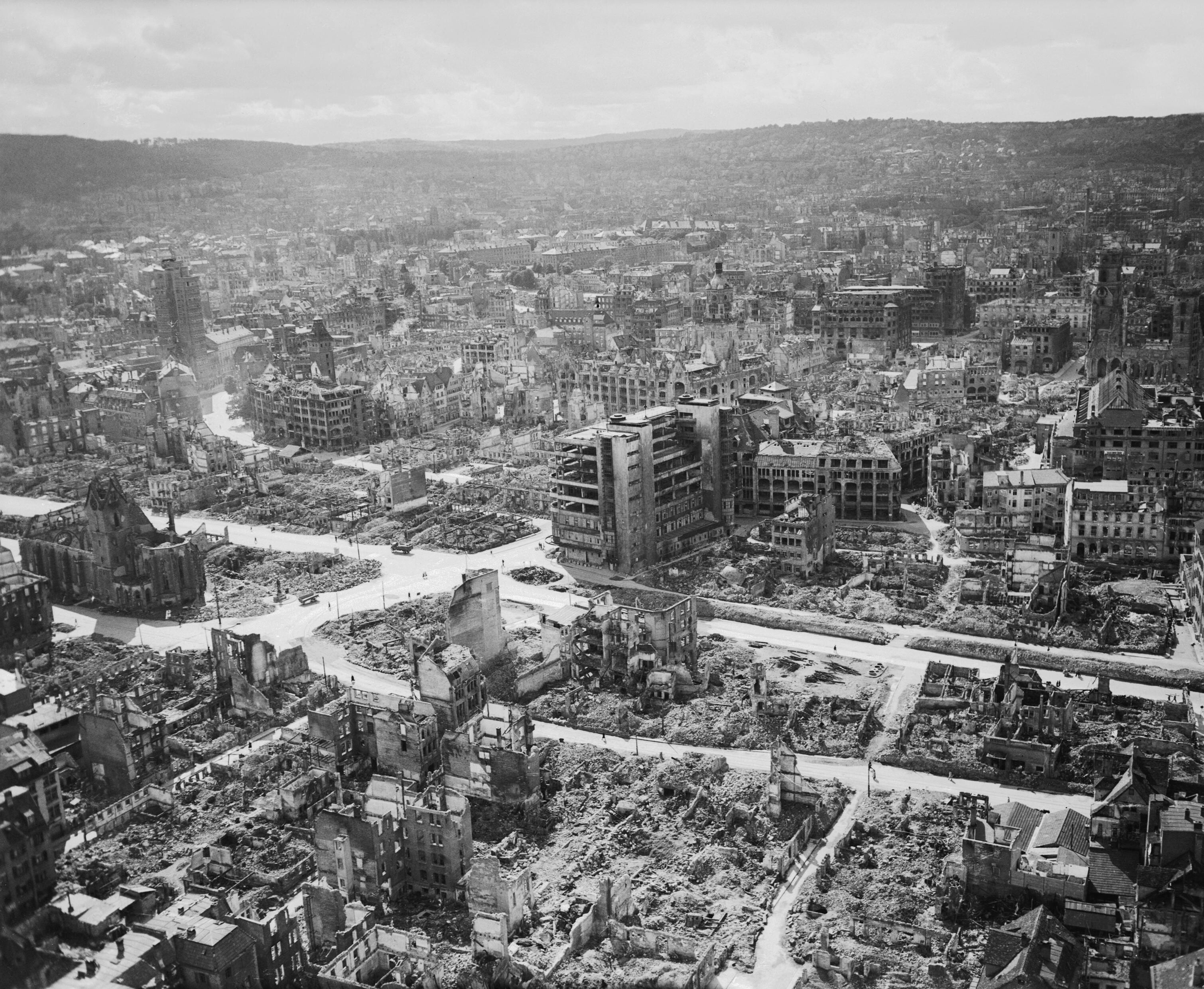
[Above: The Allies went out of their way to murder German civilians, going so far as to make it policy. Here is a picture of central Stuttgart, Germany, which could have been just about any German city based upon the utter devastation alone. Scenes such as these will forever showcase Allied iniquity and will stand testament to who the 'good guys' really were. Years after the war ended travelers to Germany shared a single question after seeing the Allied evil: 'Was this really necessary?']
What was your first action like when you went to Hohenstaufen?
Karl: The division was formed in 1943, and was all together by the late summer, if I remember. We received orders to go to the east to free trapped units; this was in February or March. I was assigned to a Pak gun towed by a halftrack and our commander was SS-Untersturmführer Balzer. I remember the weather in Russia was bad; it was damp and cold with lots of mud.
The lines were breached and Ivan sure put up a fight, he attacked our line with many tanks, and we had a field day in knocking them out. For many of us it was our first fighting and it was eventful. We went into action faster than what was anticipated, yet we did well. I can still see our shells brewing up Ivan tanks [the Term 'Brewing Up': Historically used by tank crews when a knocked-out tank's ammunition or fuel ignited, producing thick smoke and flames reminiscent of brewing tea]. We had plenty of ammunition at that time and I was pretty good at aiming.
I always tried to get the shell right under the turret ring, even if it did not penetrate; it usually froze the turret so we could safely fire again. We once hit a T-34 and the shell took out the tank with a huge explosion that killed a whole platoon hiding behind it.
Ivan would send masses of men but they were mowed down by the hundreds, I saw the carnage where they charged positions where a single MG 42 took out a whole battalion of Ivan it appeared. We were told to see if they had weapons, so I was able to grab a PPSh [PPSh-41 is a famous Soviet submachine gun], which was very popular. I remember being afraid I would not have enough bullets so I grabbed every magazine I could find.
My company was ordered to set up a Pak front for defense against counterattacks. Our corps was able to hold open a route to allow troops to retreat, this was from Tarnopol. Ivan tried his best to close the ring, and shot anything moving. I saw their fighters strafe a column of clearly marked medical vehicles.
We quickly learned that in the east Stalin did not want to follow the conventions that govern fair play in war. Veterans told us from the beginning Ivan fought dirty and there were many early atrocities that were found out. In contrast German forces were constantly being told we were at war with Bolshevism, not the people. The soldiers were only doing their duty just like us. We took prisoners and treated them well.
After this action we had to be pulled out of the front and sent back to Ukraine to rebuild. Ukraine seemed a far cry from France and Western Europe, it was mostly poor farm villages, but I can tell you the people hated Stalin. Many had come to help Germany either as workers or soldiers.
You were part of the battles in Normandy, what was your experience like?
Karl: Normandy was a hard fight, we were in Ukraine in June '44 doing more training and living a good existence. We were happy to have made it through our first action; we made friends with the locals and had a good routine. We could go out and enjoy sports, hiking, and swimming. Of course this was in free time, our duty was to train and be ready for the next battle.
When the Allies invaded we were given orders to form a corps and move to France. We said goodbye to the people we had been staying with and moved out. When we came into the west of Germany and then France we came under attack from the air. The Allies made it very hard to move towards the front; my SPW [Schützenpanzerwagen, a designated tracked or half-tracked troop carriers] was hit and got a flat tire on the way, so it took us awhile to get going. Our leaders were furious, I remember, at how the enemy dare attack us from so far away. One young officer pulled out his pistol and tried shooting at a plane, I laughed thinking how absurd.
We finally arrived in small pieces around Caen, and had to set up positions close to the young boys in the HJ Division [12th SS Panzer Division Hitlerjugend]. They had been in action almost since the beginning and really bloodied the enemy. No sooner did we get set up when the enemy started launching attacks with armor. We set up a Pak front as best we could and knocked out many of their heavy tanks.
Our 7.5 Pak was very good at long range and we could hit a Sherman or Churchill from far away. Of course if they saw our smoke they sent in barrages of artillery along with attack aircraft. It made life tough for us at times but the enemy did respect us, and kept their distance.
We had to endure many attacks on our front, but we held strong and defeated the enemy each time. They bombed us, shelled us, and used snipers often, but we held on. We had our artillery as well, and it was nice seeing the enemy get a dose of their own medicine when they launched an attack.
Our time in Normandy was marked by very brave defenses against superior forces, yet in the end we were forced back. I was wounded by artillery shrapnel in August and sent back to Germany. I was saved from the final battles and entrapment in the pocket, many of my comrades did not make it out. I was counted lucky.
You mentioned you fought at Arnhem, what was that like?
Karl: Well, I rejoined the regiment in early September I remember and we were sent to the area of Arnhem to refit and rebuild. When the landings happened there was not much we could do, we trained in hunting tanks and the British did not have any in Arnhem. We maintained a defensive position and waited.
Comrades were reporting wild stories of paratroopers everywhere. Our Panzer regiment and infantry went into the city to fight, and it was a hard fight. It was slightly different from Normandy in that we went on the offensive looking for the enemy. The Americans hid in woods, and the British were holed up in the town. I remember seeing all the aircraft overhead that were dropping supplies and spotting.
The planes were not like Normandy; here they seemed more careful at what they fired on. They had planes overhead it seemed all the time, bringing in supplies or attacking our positions. One incident I saw was a plane attack a column of prisoners by accident and surprisingly no one was hit.
I also saw a few of the planes being shot down; we had flak guns that had been brought in. One of the planes crashed by me and I could feel the heat from the explosion. We also enjoyed much of the supplies that were dropped on our lines; we ate very well for the time being.
I was a fan of the Spam that was dropped, I was able to amass quit a haul for my gun crew. We received a lot of medical supplies as well that was much needed. This battle was a big morale boost for us, as small battle groups defeated the enemy and took many prisoners.
I remember thinking then we still could win the war and defeat the Allies, as also we had new weapons coming. We could see the rockets going to England sometimes, and it filled us with a joy of getting back at them.
I know there are claims that the Waffen-SS committed many war crimes, did you see any examples?
Karl: I must say I did not personally see anything that made me question our morality. If anything I saw evidence of crimes on us where it appeared German soldiers had been shot after they had surrendered. I would be foolish if I did not say it is possible German soldiers did this too, but I believe it would have been more in retaliation for a first act. Germans are like the British, we have a sense of fair play, and compassion for a defeated foe.
I think the war in the west was fought with civility and charity; in the east I know there were Russian crimes. I saw the Russians shoot at Red Cross marked planes and vehicles. Something else I will tell you, do not believe what they say today about us rounding up Jews, we never did that. We were a fighting division and had nothing to do with the Jews or the camps. The Waffen-SS had nothing to do with this, yet our enemies always try to accuse us.
I can say after the surrender I did see harsh treatment by the Allies towards SS soldiers. They stole our belongings, punched and kicked us, and did not feed us. We fought as soldiers and were treated as animals. I remember hearing them accuse us of killing prisoners, and having a part in the camps.
We were forced to watch their films as part of our release later on. I saw them, but still to this day do not believe them. For the Americans the war seemed political and they were guided by war propaganda. We were not Nazis or criminals, we only answered the call of our nation to fight, and that was all. I had no hate towards the enemy, even in Russia I understood they were only fighting for their country.
The treatment we received was uncalled for and criminal. The army was not treated like the SS, they could all claim they were drafted, and easily walk away. Since most all SS men were volunteers we were held long after the war, with many in the east killed outright after surrender.
I have an old friend who went back to East Germany to take care of his parents, he told me that many of the missing were actually killed after the war and never registered. I firmly believe that someday the truth will be made known; we were not the bad guys and only fought as soldiers, fulfilling our oaths.
[Above: Men of the 'Hohenstaufen' Division.]